- Total Ban on Sit-Ins and Dharnas: RBI rules ban recovery sit-ins. Agents cannot camp outside doors or block hallways. Shaming borrowers before neighbors is strictly illegal.
- Immediate Police 112 Protocol: If agents refuse to leave, dial 112. The police will dispatch a PCR van to clear the area.
- Station Daily Diary (DD) Registration: Log a police DD entry under Section 270 BNS and Section 290 IPC. This creates official proof of public nuisance.
- Apartment Association &. RWA Eviction: Resident Welfare Associations hold legal power under society byelaws. Society guards can remove unruly agents from private lobbies.
- Harassment Transformed into 55% OTS: Escalating doorstep abuses to bank heads and the RBI Ombudsman stops home visits. Banks often agree to a 45% to 65% OTS waiver.
1. The Doorstep Standoff
The doorstep standoff is a stressful collection tactic. Third-party agents visit your home and refuse to leave. They stage sit-ins on porches or apartment hallways.
Agents often stay for hours. They speak loudly and knock repeatedly. They tell neighbors about your debts. This is not legal recovery. it is social shame. Agencies use shame to force payment.
Agents block hallways with their bodies. This creates a physical barrier. Family members feel trapped inside. This turns homes into unlawful confinement zones.
Agents talk loudly with neighbors and guards. They disclose loan details openly. This violates your privacy and banking secrecy laws.
This behavior is illegal. It violates Indian laws and RBI rules. Banks have no right to hold a dharna at your home.
2. Doorstep Harassment & Statutory Limits
The RBI sets clear debt collection rules. The RBI Master Direction on Fair Practices Code mandates strict conduct standards for lenders.
In ICICI Bank Ltd. v. Prakash Kaur (2007) and ICICI Bank v. Shanti Devi Sharma (2008), the Supreme Court banned musclemen. Debt recovery must follow legal process. Lenders cannot use force or threats. In Justice K.S. Puttaswamy (Retd.) v. Union of India (2017), the Court affirmed that domestic privacy is a fundamental right under Article 21.
RBI rules permit visits only between 8:00 AM and 7:00 PM. Arriving outside these hours is illegal and carries regulatory fines.
Agents must hold an IIBF DRA certificate. They must carry valid ID cards and official bank letters naming your loan.
Threats and abuse are strictly forbidden. Harassment invites heavy Ombudsman fines against the lender.
Banks are liable for their agencies. A single doorstep dharna creates major legal and financial risk for the bank.
Check Your Loan Settlement Options
Answer 2 quick questions to evaluate your settlement eligibility.
1. What type of loan do you want to settle?
3. Criminal Law Invocations
If agents refuse to leave your stairs, the case is criminal. Under the IPC and Bharatiya Nyaya Sanhita (BNS), 2023, key sections apply:
Public Nuisance (Section 270 BNS 2023 / Section 290 IPC)
Causing annoyance to neighbors via shouts or blocking passages is a public nuisance. This act is subject to police intervention.
Criminal Trespass & House-Trespass (Section 329 & 331 BNS 2023 / Section 441 & 448 IPC)
Entering property to intimidate is criminal trespass. Criminal house-trespass occurs when someone stays on private property after being told to leave.
Criminal Intimidation & Unlawful Assembly (Sections 351 & 189 BNS / Sections 503, 506 & 141 IPC)
Threats are criminal intimidation under Section 351 BNS. Two or more agents gathering to threaten you form an unlawful assembly under Section 189 BNS.
Knowing these terms helps you file accurate reports to the police. This moves the issue beyond a mere civil loan dispute.
4. Bank NPA Accounting Dynamics
Banks hire third-party agencies on commission. These agencies often earn 12% to 25% of recovered funds.
Loans overdue for 90 days are Non-Performing Assets (NPAs). Banks must reserve capital for these:
| Asset Classification. | default Timeline. | Capital Provision. | OTS Haircut. |
|---|---|---|---|
| SMA-1 / SMA-2. | 31–90 Days. | 5%. | Fee Waiver. |
| Substandard NPA. | 91–365 Days. | 25%. | 35%–45%. |
| Doubtful NPA 1. | 12–24 Months. | 100%. | 45%–55%. |
| Loss Asset. | 24+ Months. | 100%. | 55%–65%. |
As loans near write-off, agencies fear losing mandates. This leads them to stage illegal standoffs. Advocates use the Net Present Value (NPV) of Recovery formula to evaluate disputes:
Here, C_t is expected recovery cash flows. r is the discount rate. Deductions include legal fees, court delays of 3-5 years. And locked capital.
When you prove illegal visits with police logs, banks face high legal risks. A 35% to 55% OTS payment becomes their best option.
5. Doorstep Standoff Resolution Roadmap
The graphic shows how our lawyers stop doorstep standoffs. We guide clients through police removal, daily diary logging. And settlement deals.
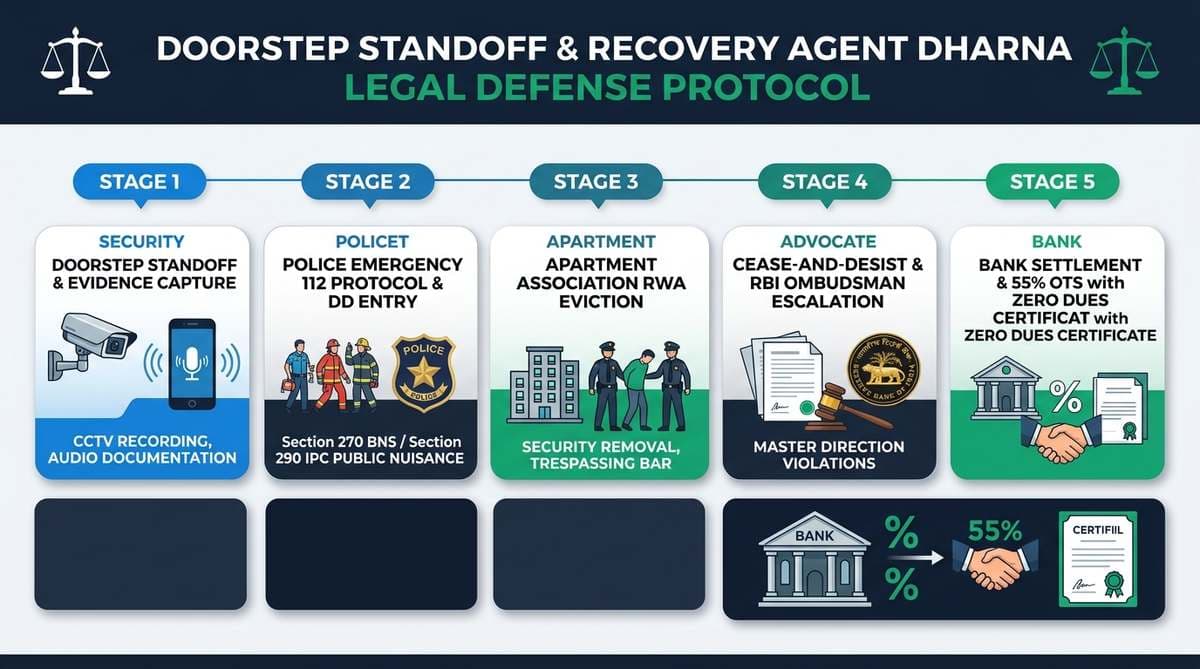
6. The Emergency 112/100 Police Protocol
If an agent refuses to leave, follow this plan. Do not open the door or argue.
Phase 1: Secure Entryway & Record Video
Keep your doors locked. Record video through your peephole or window. Capture the agent's face, shouting. And harassment. This recording provides vital legal proof.
Phase 2: Dial 112 (National Emergency Response System)
Call 112. Give your address. Tell the operator: "Men are blocking my door and scaring my family. Please send a PCR van." Report this as criminal trespass.
Phase 3: Interact with Police
Show the police your video. Cite Section 329 BNS for trespass and Section 270 BNS for public nuisance. Ask police to verify agent IDs.
Phase 4: Register a Daily Diary (DD) Entry
After dispersal, file a formal complaint for a Daily Diary (DD) Entry. Ensure the receipt notes the bank and agency name. Keep the DD tracking number.
This stamped DD entry proves harassment. It allows your advocate to halt visits and settle the debt.
7. RWA Byelaws & Gated Security Rules
For apartment residents, society rules offer fast protection. State laws define corridors as private common property.
The RWA has the power to control access. If agents loiter outside your flat, they commit trespass against the entire society.
Call your society manager. Report that illegal persons are loitering and disturbing the peace. Guards must verify visitors and escort trespassers off the property.
Request your RWA Secretary to blacklist the agency. Societies can block access via apps like MyGate.
When society enforces entry rules, agents cannot reach your door. This stops standoffs immediately.
8. Converting Harassment into an Affordable Settlement
A standoff shows collection desperation. By recording these events and filing a DD entry, you gain OTS leverage.
Our advocates notify bank leaders of trespass and RBI rule breaches. To avoid Ombudsman fines, banks stop visits and begin settlement talks.
- Registered Bank Letterhead: The letter must come on official letterhead with a reference number. Avoid agency PDFs.
- Identity &. Account Details: The letter must list your name, PAN. And loan account number.
- Debt closure: It must state the payment clears all principal and interest in full.
- Direct Remittance: Pay only into your loan account. Never pay agency accounts.
Per RBI circular, banks must issue a No Dues Certificate within 30 days of payment. They must also update CIBIL. If they delay, they owe you ₹5,000 per day.
Credit Score Rehabilitation
After settlement, bureaus show a "Settled" tag with a ₹0 balance. While your score may drop initially, paying bills on time will help rebuild your score above 750 within 2 years.
9. Standoff Legal Remedies Matrix
Comparing remedies helps you act effectively to safeguard your family and finances:
| Pathway. | Legal Basis. | Protection Scope. | Impact. |
|---|---|---|---|
| Police 112 / DD Entry. | Section 270/329 BNS. | Immediate dispersal. | Proves trespass. |
| RBI Ombudsman. | RBI Scheme 2021. | Regulatory inquiry. | Stops harassment. |
| Advocate OTS. | Settlement Agreement. | Permanent discharge. | Full debt closure. |
10. SettleLoans Legal Defense for Dharna Tactics
Handling standoffs requires expert banking advocates. We know how to enforce RBI rules, cite Supreme Court rulings. And file police complaints. SettleLoans provides complete defense. We notify bank heads, file Ombudsman complaints, coordinate police help. And negotiate 45%–65% OTS waivers with NDCs.

Settle Loan is India's trusted debt relief and loan settlement platform. We help borrowers overcome financial distress by negotiating with banks and NBFCs to legally settle personal loans and credit card debts. With our transparent, performance-based approach, you can achieve debt freedom and regain your financial peace of mind.
COMPUTER
11. FAQs: Recovery Agent Standoffs & Legal Defenses
Verified answers to questions about standoffs, police steps, DD entries. And debt settlement.
What should I do immediately if a recovery agent refuses to leave my doorstep or hallway?
Lock your front door at once. Stay inside your home. Record video using your phone or smart bell. Do not argue. Dial 112 for the police control room. Report that unknown persons are blocking your door. Ask for a PCR police van dispatch.
Is staging a sit-in or dharna outside a borrower's house legal under RBI rules?
No. RBI Fair Practices Code rules ban sit-ins outside homes. Agents cannot block doors or loiter in hallways. Shouting and public shaming are strictly forbidden. Visits are allowed only from 8:00 AM to 7:00 PM. Agents must carry an official ID, a bank letter. And a DRA card.
Under which criminal sections can I file a police complaint against recovery agents sitting outside my home?
You can report agents under Section 270 BNS (formerly Section 290 IPC) for Public Nuisance. You can invoke Section 329 BNS (Section 441 IPC) for Criminal Trespass. You can also cite Section 351 BNS (Section 506 IPC) for Criminal Intimidation. If two or more agents gather, cite Section 189 BNS for Unlawful Assembly.
What is a Daily Diary (DD) entry and how does it help against recovery agents?
A Daily Diary (DD) entry is an official police log of reported events. Filing a DD entry gives you a police tracking number. It proves that agents caused a public nuisance at your door. This official proof gives you strong leverage during RBI Ombudsman complaints and debt talks.
Can an Apartment Owners Association (RWA) evict or bar recovery agents from residential premises?
Yes. Gated societies have legal authority under society byelaws to control access. Society guards can stop unknown visitors. Guards can ask for bank letters. They can evict loud collection agents who disturb the peace.
Can a recovery agent demand immediate cash payment at my doorstep?
Never pay cash to collection agents at your door. Agents might steal cash without updating your loan file. Always pay directly to your bank loan account. Use NEFT, RTGS, IMPS, or bank web portals. Always save your payment receipt.
How does doorstep dharna harassment give leverage for a One-Time Settlement (OTS)?
A lawyer presents police DD logs and RBI rule breaches to top bank heads. Banks face heavy regulatory fines and bad press. To avoid Ombudsman fines, lenders halt all visits. Banks then agree to a 45% to 65% OTS waiver.
What documents must a recovery agent produce upon visiting a borrower's residence?
Under RBI rules, recovery agents must show three key documents. First, an official agency photo ID card. Second, a bank authorization letter with your loan number. Third, an IIBF DRA certificate proving regulatory training.
What is the mandatory timeline for banks to issue a No Dues Certificate after OTS payment?
Under RBI Circular RBI/2023-24/60, banks and NBFCs must send a zero-balance No Dues Certificate within 30 days of full settlement. They must also update credit bureaus within 30 days. If the bank delays past 30 days, it must pay you ₹5,000 per day in payout.
Can a recovery agent visit my home on a Sunday or public holiday?
Visits are permitted between 8:00 AM and 7:00 PM unless you set another time. But repeated visits on holidays or late nights violate RBI Fair Practices Code rules. You have a legal right to privacy and peace at home.