- The #1 Golden Rule of Debt Settlement: 100% of your settlement compromise money must be paid directly to your lending bank or NBFC into your specific loan account. Never transfer compromise funds to an agency or person UPI.
- Upfront Fee Trap: Fraudulent companies demand 20% to 50% upfront fees and vanish. Legitimate platforms operate on transparent retainers with performance-linked structures payable only after securing an authentic bank sanction.
- Forged OTS Sanction Letters: Scammers forge bank PDFs on WhatsApp using outdated logos and fake officer names. Authentic OTS letters originate from the bank's corporate domain or regional Stressed Asset Resolution Branch (SARB).
- Bar Council Empaneled Legal Defense: Real debt resolution is governed by advocates operating under the Indian Contract Act, 1872 and RBI Fair Practices Code, not unregulated telecallers making false promises.
- Zero-Dues Closure: True resolution concludes only when the lender issues a stamped ₹0 No Dues Certificate (NDC) and updates credit bureaus (CIBIL, Experian, CRIF) to "Settled" status.
1. The Dark Reality of Loan Settlement Scams in India
When you are trapped in severe debt, facing relentless collection calls, and struggling to make ends meet, the psychological pressure is suffocating. In this state of acute distress, borrowers become prime targets for predatory operators, fly-by-night telecallers, and organized cyber syndicates running sophisticated loan settlement scams across India.
Over the past three years, banking dispute records and cybercrime registries have witnessed an alarming surge in fraudulent "debt relief consultancies". These syndicates obtain leaked database leads of defaulting borrowers from rogue collection agents. They contact borrowers claiming to be "RBI-authorized settlement officers" or "Bank Dispute Ombudsmen". They promise to erase 80% to 90% of debt within 48 hours in exchange for an immediate upfront fee.
The Devastating Double-Loss Trap
When a borrower transfers money to a fraudulent settlement agency, they suffer catastrophic double-jeopardy: First, they lose hard-earned cash they painstakingly gathered to resolve their debt. Second, their bank never receives the funds, causing the loan default to age into legal recovery territory (triggering Section 138 cheque bounce summons, Section 25 PSSA warrants, and compounding penal interest).
Navigating out of debt requires professional legal intervention, but you must know how to distinguish legitimate legal advocates from fraudulent scammers. Let us dissect the seven unmistakable red flags of fake settlement operations.
2. 7 Red Flags of Fake Loan Settlement Companies
Scammers rely on urgency, legal intimidation, and unrealistic promises to bypass your critical judgment. If any debt settlement agency or caller shows even one of the following seven red flags, cease all notice immediately:
Demanding large Upfront Fees Before talksAdvance-Fee Fraud
Fraudulent agencies demand upfront charges ranging from ₹25,000 to ₹1,00,000 disguised as "file registration fees", "arbitration clearance deposits", or "bank officer facilitation bribes". Once the payment is made, the agency stops answering calls, blocks your WhatsApp, or closes their virtual office. Ethical firms operate with transparent, nominal onboarding fees with primary success retainers tied strictly to delivering a verified bank sanction letter.
Directing Compromise Payments to Personal UPIs or Private AccountsDirect Theft
The ultimate acid test: Where does your settlement money go? Never transfer funds to a private company current account, an "escrow trust", or a personal UPI ID. If an agency claims they will pay the bank on your behalf, it is a scam. In authentic banking settlements, 100% of compromise funds are deposited straight into your designated loan account number.
Guaranteed 80%–90% Haircuts Without Financial Hardship ReviewFalse Advertising
No ethical advocate or legitimate agency can guarantee a specific waiver percentage before reviewing your loan vintage, NPA provisioning stage, and financial hardship documents. Banks settle personal loans based on Reserve Bank of India (RBI) provisioning norms and internal risk committees—typically between 40% and 65% haircuts. Any claim of "guaranteed 90% off within 24 hours" is mathematically impossible and fraudulent.
Claiming to be "RBI-Approved Debt Settlement Companies"Misrepresentation
The Reserve Bank of India (RBI) regulates commercial banks, NBFCs, and ARCs, but RBI does not license, certify, or endorse debt settlement companies. Any platform displaying fake RBI seals or claiming to hold an "RBI Debt Relief License" is committing forgery under Bharatiya Nyaya Sanhita (BNS) Section 336(3). Legitimate firms operate strictly as legal advisories through Bar Council-enrolled advocates.
Refusal to Provide Advocate Bar Council Enrollment CredentialsUnlicensed Operators
Under the Advocates Act, 1961, only enrolled advocates have the statutory standing to represent clients in legal disputes, issue formal notices to lenders, and appear before Lok Adalats or mediation centers. Fraudulent agencies operate out of unregulated call centers with telecallers posing as lawyers. Always demand the advocate's full name, State Bar Council enrollment number, and verify their standing.
notice Solely via WhatsApp Numbers with No Physical OfficeGhost Operations
Scammers operate behind disposable virtual numbers, burner WhatsApp accounts, and free email domains (@gmail.com, @yahoo.com). They provide fake physical addresses or virtual coworking listings. Legitimate legal platforms have verifiable registered corporate offices, corporate domain emails (@settleloans.in), dedicated landlines, and transparent public profiles.
Promising to Instantly "Delete" Settled Records from CIBILCredit Bureau Fraud
Under the Credit Information Companies (Regulation) Act, 2005 (CICRA), credit bureaus (TransUnion CIBIL, Experian, CRIF) update records strictly based on electronic data feeds received directly from banks. No agency has a "backdoor" to magically erase a default or convert a "Settled" status to "Standard Clean" overnight. Anyone charging fees for "instant CIBIL score clearing" is running a scam.
Check Your Loan Settlement Options
Answer 2 quick questions to evaluate your settlement eligibility.
1. What type of loan do you want to settle?
3. Anatomy of a Forged OTS Sanction Letter
The most dangerous tool in the scammer's playbook is the forged One-Time Settlement (OTS) letter. Scammers download legitimate bank templates, edit borrower details using graphic editing tools, attach outdated bank logos, and insert arbitrary compromise figures to induce immediate payment.
Before transferring a single rupee to your bank loan account, perform this rigorous 8-point forensic audit on the settlement sanction document:
| Document Parameter | Authentic Bank OTS Sanction Letter | Forged / Fraudulent Settlement Letter | Risk Level |
|---|---|---|---|
| 1. Transmission Channel | Dispatched from the bank's verified corporate domain (e.g. @hdfcbank.com, @icicibank.com) or collected physically at the SARB branch. | Sent via personal WhatsApp from an unverified mobile number or a generic @gmail.com address. | CRITICAL |
| 2. Bank Letterhead & Watermark | High-resolution corporate stationery with crisp typography, accurate registered office address, CIN number, and valid branch IFSC code. | Pixelated, stretched, or outdated logos; missing corporate identification numbers (CIN); blurry borders from screenshot cropping. | HIGH |
| 3. Reference & Dispatch Number | Unique, sequential internal reference code (e.g. HDFC/SARB/DEL/OTS/2026/0892) verifiable in the bank's CBS core database. | Generic or missing reference number; numbers copied from online sample templates with no database match. | CRITICAL |
| 4. Payment Destination | Instructs deposit strictly into your designated Loan Account Number via internal bank transfer or branch cash counter. | Instructs payment into a third-party current account, agency escrow, or personal UPI handle. | DEFINITE FRAUD |
| 5. Breakdown of Liability | Explicitly details Principal Outstanding, Accrued Interest, Waived Penalties, and Final Agreed Settlement Figure. | Vague, single-line compromise sum with no breakdown of principal versus interest waivers. | MODERATE |
| 6. Authorized Signatory & Stamp | Signed by an authorized officer (Manager / Chief Manager SARB) with employee code and round branch seal. | Digital copy-pasted signature with no employee designation code or a generic "Authorized Signatory" text stamp. | HIGH |
| 7. NDC & CIBIL Reporting Clause | Contains explicit commitment to issue a ₹0 No Dues Certificate within 15–30 days and report "Settled" status to bureaus. | Promises "Clean/Standard CIBIL conversion" or makes no mention of formal NDC issuance timelines. | HIGH |
| 8. Branch Manager Confirmation | The Home Branch or SARB Branch Manager pulls up the exact OTS approval record on their terminal when presented in person. | Branch manager states the loan is still active in full default with zero settlement approvals in the system. | DEFINITE FRAUD |
4. Legitimate Settlement Agency vs Fraudulent Call Centers
To help you make an informed, confident decision when seeking debt relief, examine the structural and legal differences between an ethical legal platform like SettleLoans and unregulated scam operations:
| Operational Dimension | SettleLoans (Ethical Gold Standard) | Fraudulent / Fly-by-Night Scammers |
|---|---|---|
| Legal Representation | Empaneled advocates enrolled with the Bar Council of India representing you under statutory authority. | Unregulated telemarketers and call center agents with zero legal qualifications or professional accountability. |
| Fund Routing | Zero third-party handling: 100% of settlement funds are paid directly to your bank loan account. | Demands compromise funds routed through private company bank accounts or personal UPI wallets. |
| Fee Structure | Transparent nominal onboarding fee with primary success retainers payable only upon delivering verified OTS sanction. | Demands 20% to 50% upfront fees before any talks, with zero performance guarantees or refunds. |
| talks Channel | Direct written engagement with Bank Nodal Officers, Zonal SARB desks, and National Lok Adalat benches. | Colludes with rogue field recovery agents or generates forged documents without bank awareness. |
| Anti-Harassment Defense | Serves formal legal notices under the RBI Fair Practices Code to halt unlawful harassment within 48 to 72 hours. | Tells you to "just switch off your phone", leaving you vulnerable to home and workplace recovery visits. |
| Post-Settlement records | Ensures receipt of physical, stamped ₹0 No Dues Certificates and monitors credit bureau status reconciliation. | Vanishes immediately after payment; borrower receives no official NDC from the bank. |
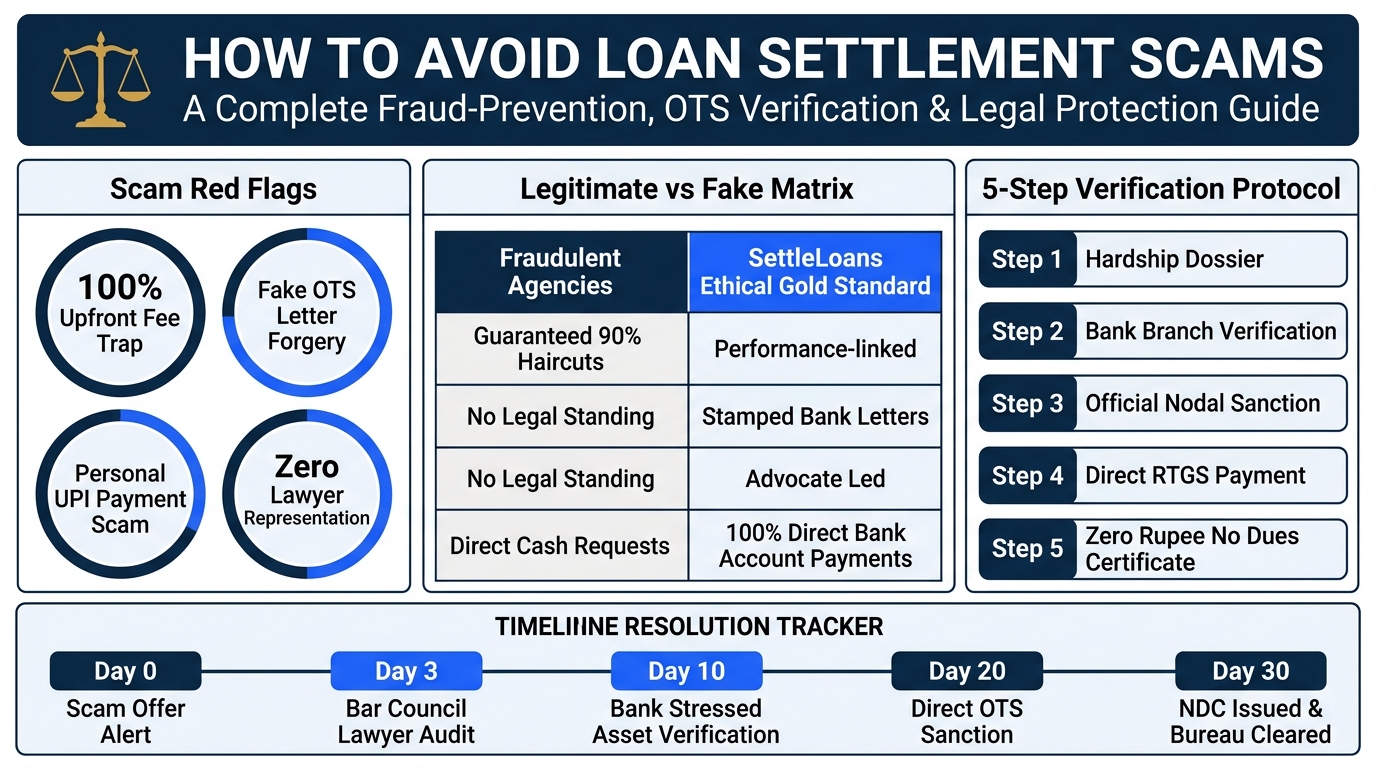
5. The 5-Step Scam-Proof Settlement Protocol
To guarantee that your debt settlement is 100% legally binding, mathematically sound, and protected against fraud, follow this systematic 5-step operational protocol:
1Compile a Formal Legal Hardship Dossier
Legitimate loan settlement is rooted in verifiable financial hardship, not informal talks. Empaneled advocates assemble an airtight documentary dossier—including employment termination letters, medical treatment records, business GST filing drops, or bank statements reflecting insolvency. This establishes genuine inability to pay and compels the bank's credit committee to approve large waivers.
2Bypass Collection Callers & Engage Stressed Asset Resolution Desks
Field recovery agents work on collection commissions and have zero sanctioning authority. Our advocates serve formal legal representations directly to the bank's Principal Nodal Officer and SARB Zonal Heads. This halts third-party harassment under the RBI Fair Practices Code and moves discussions to authorized decision-makers.
3Demand Official Bank OTS Sanction Letter on Registered Letterhead
Never accept verbal promises or WhatsApp message confirmations. The bank must issue a signed, stamped OTS Sanction Letter bearing an authentic dispatch reference code, specifying the exact compromise sum, payment due date, and loan account number. SettleLoans legal counsel performs a forensic audit to verify the sanction with the bank before you pay.
4Execute Payment Directly into Your Loan Account via RTGS/NEFT
Transfer the agreed compromise funds directly into your loan account number using official banking channels (RTGS, NEFT, or home branch counter). Obtain a stamped bank receipt with the transaction UTR number. This creates an indisputable audit trail under the Indian Evidence Act.
5Secure Stamped ₹0 No Dues Certificate & Reconcile CIBIL Records
Within 15 to 30 days of final payment, the bank is legally obligated to issue a formal No Dues Certificate confirming full discharge of liability. SettleLoans tracks the closure through to the credit bureaus, ensuring your outstanding balance is recorded as ₹0 and all legal actions are permanently withdrawn.
6. Legal Action & Police Recourse
If you have unfortunately fallen victim to an advance-fee settlement scam or transferred money to a fraudulent agency, time is of the essence. You must start immediate legal and cybercrime countermeasures to freeze the perpetrator's accounts and protect yourself from bank litigation:
| Recourse Mechanism | Governing Indian Law / Portal | Immediate Action Step | Expected Outcome |
|---|---|---|---|
| 1. Cybercrime Freeze | National Cyber Crime Reporting Portal (cybercrime.gov.in) / Helpline 1930 | Report within 2–4 hours of transaction with UPI transaction ID, bank account details, and suspect mobile number. | Golden Hour freeze on the scammer's bank account to reverse or hold fraudulent fund transfers. |
| 2. Criminal Police FIR | Bharatiya Nyaya Sanhita (BNS) 2023: Section 318(4) (Cheating) & Section 336(3) (Forgery) [formerly IPC 420 & 468] + IT Act Section 66D | Lodge formal complaint at your local police station or Cyber Cell with WhatsApp chats, forged PDFs, and payment receipts. | Registration of cognizable FIR, inquiry of ghost call centers, and formal police records. |
| 3. Bank Fraud Cell Intimation | RBI Master Directions on Frauds & Integrated Ombudsman Scheme | Submit a written affidavit to your lending bank explaining that you were defrauded by third-party imposters. | Prevents the bank from treating you as a wilful defaulter and opens legitimate settlement dialogue. |
| 4. Bar Council Misconduct Complaint | Advocates Act, 1961 (Section 35) | If an enrolled advocate was complicit in issuing fake letters or misappropriating funds, petition the State Bar Council. | Disciplinary cases, suspension or revocation of law license, and civil liability claims. |
7. Why SettleLoans is the Ethical Standard in Debt Relief
SettleLoans was founded with a single mission: to provide honest, transparent, and legally unassailable debt relief to distressed borrowers across India without exploiting their vulnerability. We have helped thousands of people break free from debt traps through our Zero-Fraud Trust Architecture:
100% Direct-to-Bank Payments
SettleLoans never touches or holds your settlement compromise money. Every rupee negotiated is paid directly by you into your own bank loan account against an official bank sanction letter.
Bar Council Empaneled Advocates
Your case is handled exclusively by verified, experienced legal advocates who represent you under the Indian Contract Act, 1872 and invoke RBI Fair Practices to shield you from harassment.
Forensic Letter Verification
Every OTS sanction letter is legally validated with the lender's central stressed asset desk and branch manager before you disburse funds, ensuring 0% forgery risk.
Guaranteed ₹0 NDC Delivery
We track your resolution to completion, ensuring the delivery of a physical No Dues Certificate and monitoring bureau records until your credit score rebuild journey begins.

Settle Loan is India's trusted debt relief and loan settlement platform. We help borrowers overcome financial distress by negotiating with banks and NBFCs to legally settle personal loans and credit card debts. With our transparent, performance-based approach, you can achieve debt freedom and regain your financial peace of mind.
COMPUTER
8. Frequently Asked Questions (FAQ)
Find clear, authoritative answers to the most critical legal, operational, and fraud-prevention questions regarding debt settlement companies in India:
Fake loan settlement companies show clear warning signs. First, they demand heavy upfront registration fees before performing any legal work. Second, they promise unrealistic 80% to 90% waivers within 24 to 48 hours. Third, they ask you to transfer funds to personal UPI IDs or third-party accounts instead of your official bank loan account. Fourth, they refuse to share advocate Bar Council enrollment numbers. Finally, they send unverified OTS letters on WhatsApp containing distorted logos and incorrect branch codes.
Legitimate, ethical, and legally compliant debt settlement firms operate with transparent, nominal retainers or performance-linked structures where primary professional fees are payable only upon the successful delivery of a verified, official bank OTS sanction letter. Any entity demanding 20% to 50% of your total loan balance upfront before even opening formal notice with your bank is running an advance-fee fraud scheme.
Follow these steps to verify an OTS sanction letter. First, ensure it is printed on official bank letterhead with a legitimate reference number, date, and officer stamp. Second, cross-verify the branch code with the bank's Stressed Asset Resolution Branch (SARB) or Nodal Officer. Third, confirm that the letter instructs you to deposit the compromise sum into your actual loan account. Finally, verify that the letter clearly promises a formal ₹0 No Dues Certificate (NDC) and credit bureau update upon payment.
Never transfer a single rupee of your loan settlement compromise funds to any private company, intermediary, lawyer's personal account, or third-party UPI ID. Under RBI directives and banking law, all settlement compromise payments must be deposited directly into your official bank loan account. You can pay via NEFT, RTGS, IMPS, or directly at the home branch cash counter against an official bank receipt. Never deposit funds into third-party accounts.
No company or advocate can legitimately guarantee a specific discount percentage before an person review by the lender's credit committee. In standard Indian banking practice, genuine personal loan settlement haircuts range between 40% and 65% (with borrowers paying 35% to 50% of the total claim depending on default vintage and documented hardship). Anyone guaranteeing 80% to 90% haircuts unconditionally is using deceptive marketing to lure vulnerable borrowers into paying upfront fees.
If you have fallen victim to a settlement scam, take immediate action. First, file a cybercrime complaint at cybercrime.gov.in or call the national helpline at 1930. Second, lodge a police FIR under BNS Section 318(4) (Cheating) and Section 336(3) (Forgery) [formerly IPC Sections 420 and 468], alongside Section 66D of the IT Act. Third, alert your lending bank's fraud prevention desk right away. Finally, file a misconduct complaint before the State Bar Council if an advocate was involved.
The Reserve Bank of India (RBI) regulates scheduled banks, NBFCs, and Asset Reconstruction Companies (ARCs), but it does not issue direct operational licenses to third-party debt settlement consultancies. Legitimate debt settlement help operates under clear legal and agent frameworks. Advocates enrolled with the Bar Council of India represent distressed borrowers under the Indian Contract Act, 1872 and the RBI Fair Practices Code.
SettleLoans eliminates fraud risks through a 4-pillar trust model. First, Zero third-party fund handling: 100% of your settlement funds are paid directly to your lending bank. Second, Advocate-led representation: Empaneled Bar Council advocates represent your case directly before bank SARB executives. Third, Forensic letter audit: Every OTS letter undergoes legal authentication before any payment is authorized. Fourth, Guaranteed NDC delivery: We follow through until you receive a verified ₹0 No Dues Certificate and credit bureau closure.
Do not make any payment based on WhatsApp text messages or unverified PDF attachments. Insist that the recovery agency arrange for the formal OTS letter to be emailed directly from the bank's corporate domain (such as @hdfcbank.com, @icicibank.com, or @axisbank.com). You can also collect a physical, stamped letter from the bank's regional stressed asset branch. Have an independent legal professional audit the letter before transferring funds.
Yes. If you pay money to a fraudulent agency based on a forged OTS letter, your actual bank loan remains unpaid, active, and delinquent. The bank will continue to levy compounding penal charges. It may also start Section 138 NI Act cheque bounce complaints, Section 25 PSSA cases, or civil recovery suits. This occurs because the bank never approved the compromise and never received your settlement funds.
Authoritative Legal & Regulatory Sources
- Reserve Bank of India (RBI) — Master Circular on Fair Practices Code for Lenders & Recovery Norms
- Ministry of Home Affairs (MHA) — National Cyber Crime Reporting Portal & Helpline 1930 Guidelines
- Bar Council of India — Statutory Professional Standards & Advocate Representation Rules (Advocates Act, 1961)
- Supreme Court of India — Landmark Rulings on Coercive Debt Recovery & Consumer Protection Jurisprudence
- RBI Complaint Management System (CMS) — Integrated Banking Ombudsman Scheme