- Zero Tolerance for Personal UPI/Cash: Genuine bank settlements NEVER accept cash payments or UPI transfers to third-party agency accounts. Funds must be credited exclusively into your designated 16-digit core loan account.
- Corporate Domain Email Mandate: Authentic One-Time Settlement (OTS) sanction letters are dispatched exclusively from the lending bank's corporate server domains (e.g., @hdfcbank.com, @icicibank.com, @sbi.co.in), never from generic webmail (@gmail.com, @yahoo.com).
- Credit Committee Delegation of Authority: Frontline collection agents have zero authority to sanction debt waivers. Legitimate sanction letters originate from the Branch Credit Committee, Stressed Assets Recovery Branch (SARB), or Zonal Settlement Committee.
- Comprehensive Debt Extinguishment Clauses: A genuine sanction letter explicitly states that the agreed compromised sum represents full and final settlement, extinguishing all remaining principal, penal interest, and legal cases.
- Mandatory ₹0 NDC Delivery within 30 Days: Under RBI Circular RBI/2023-24/60, lenders must deliver a formal No Dues Certificate and update credit bureau records within 30 calendar days under a mandatory ₹5,000 per day delay penalty.
1. Surge in Fake Settlement Scams & Collection Fraud
Over the past three years, the Indian retail lending landscape has witnessed an alarming spike in debt settlement fraud. Distressed borrowers struggling under the weight of unsecured personal loans, credit card revolving debt, or fintech micro-loans find themselves targeted by predatory third-party collection agencies and rogue tele-callers. Capitalizing on the borrower's severe psychological vulnerability and eagerness to resolve mounting default liabilities, unscrupulous recovery agents generate fabricated settlement documents that mimic authentic banking instruments with dangerous precision.
The operational anatomy of this fraud typically follows a calculated psychological trap. When an unsecured loan defaults past 90 days and enters Non-Performing Asset (NPA) classification, banks often assign recovery portfolios to outsourced tele-marketing and field collection agencies. Rogue recovery executives—driven by aggressive monthly recovery quotas and hefty cash incentives—bypass internal credit committees. They fabricate an official-looking PDF titled "One-Time Settlement Approval" or "Special OTS Concession Scheme" on their mobile phones using rudimentary graphic editing tools.
The agent contacts the distressed borrower over WhatsApp or Telegram, promising an irresistible 70% to 85% haircut on the outstanding ledger balance. To induce immediate compliance, they establish a false artificial deadline, asserting that the settlement offer will expire in 24 hours. The borrower is instructed to remit the compromised amount via personal UPI handles, generic collection agency current accounts, or even cash collections. Tragically, once the payment is executed, the funds are siphoned away into personal commissions or unauthorized agency accounts. The lending bank never receives the full settlement, the loan account remains completely active in default status, and penal interest continues compounding unabated on the bank's core banking ledger.
2. Statutory Protections: RBI Directives & IPC Rules
Borrowers must recognize that the creation or dissemination of fraudulent debt settlement instruments is not merely a breach of consumer ethics; it constitutes serious statutory non-compliance and actionable criminal misconduct under Indian penal jurisprudence. Both the Reserve Bank of India (RBI) and the Indian legal framework provide explicit safeguards to protect borrowers from fraudulent recovery practices.
Under the RBI Master Direction on Outsourcing of Financial Services, banks cannot delegate settlement authority. Regulated lenders are barred from allowing third-party recovery agencies to approve compromise write-offs.
Fabricating a bank settlement letter constitutes Forgery under Sections 463, 464, and 468 of the IPC. It also constitutes Cheating under Section 420 IPC, now codified under corresponding provisions of the Bharatiya Nyaya Sanhita (BNS).
Circulating a counterfeit sanction letter to induce payment violates Section 471 IPC (Section 340 BNS) and Section 420 IPC (Section 318 BNS for Cheating and Dishonestly Inducing Delivery of Property).
Lenders are legally obligated to maintain an authentic, verifiable digital audit trail of all compromise settlements, ensuring every borrower receives unambiguous written notice directly from official banking authorities.
The Supreme Court of India in multiple landmark decisions has affirmed that commercial banks cannot disown criminal misconduct perpetrated by their authorized recovery vendors. If an empanelled agency issues a fraudulent settlement letter, the bank is vicariously liable to rectify the account ledger and can be penalized by the RBI Integrated Ombudsman for systemic governance breakdown.
Check Your Loan Settlement Options
Answer 2 quick questions to evaluate your settlement eligibility.
1. What type of loan do you want to settle?
3. Fatal Consequences of Paying on a Forged Letter
Falling victim to a counterfeit settlement letter leads to catastrophic multi-layered financial and legal repercussions. Borrowers mistakenly assume that producing a PDF receipt or WhatsApp chat with a recovery agent will legally bind the bank into closing the loan. In reality, the legal ramifications are severe and immediate:
- Total Loss of Hard-Earned Capital: Any amount transferred to a recovery agency's personal account, third-party wallet, or personal UPI handle is effectively stolen. The bank will not credit these funds toward your principal liability.
- Continuing Default & Compounding Penalties: Because the bank's Core Banking System (CBS) never recognized the settlement, the loan continues to accumulate overdue interest, bounce fees, and penal interest at compounding rates of 24% to 36% per annum.
- Ongoing Legal & Criminal cases: Legal actions started by the bank—such as Section 138 Negotiable Instruments Act (cheque bounce), Section 25 Payment and Settlement Systems Act (NACH dishonour), or fast-track arbitration under Section 21 of the Arbitration Act—will continue unabated in local courts.
- Severe CIBIL Score Destruction: Instead of updating the account status to "Settled" with a ₹0 balance, credit bureaus (CIBIL, Experian, Equifax, CRIF High Mark) will report the account as "Written-Off" or "Substandard NPA" with massive overdue balances, destroying your credit profile for years.
Under the Indian Evidence Act and Section 17 of the Indian Contract Act, oral assurances, phone recordings, and informal WhatsApp chats with third-party recovery executives hold zero evidentiary value against the bank. Only a written instrument issued under authorized corporate authority constitutes an enforceable compromise agreement.
4. Why Authentic OTS Requires Credit Committee Approval
To understand why collection agents cannot sanction waivers, consider how banks account for stressed assets. Under the RBI Master Direction on Compromise Settlements (June 8, 2023), every loan haircut requires authorization from a designated internal bank committee:
As a loan ages across delinquency buckets, the bank must set aside regulatory capital reserves out of its operating profits:
| Delinquency Bucket | Overdue Days (DPD) | RBI Mandatory Capital Provision | Competent Sanctioning Authority |
|---|---|---|---|
| SMA-0 / SMA-1 / SMA-2 | 1 – 90 Days | 0.40% – 5.0% General Provision | Branch Manager (Penal Waivers Only) |
| Substandard NPA | 91 – 365 Days | 25% Unsecured Provision | Regional Settlement Committee (RSC) |
| Doubtful 1 (D1) | 12 – 24 Months Default | 100% Full Provisioning | Zonal Settlement Committee / SARB |
| Doubtful 2 / Loss Asset | 24+ Months Default | 100% Balance Sheet Write-off | Head Office Credit Committee (HOCC) |
When a genuine One-Time Settlement proposal is evaluated, the bank's Credit Committee compares the immediate lump-sum settlement offer against the Net Present Value (NPV) of Estimated Recovery through formal litigation:
Here, C_t represents estimated recoverable cash flows over time, while r is the bank's discount rate. Deductions account for advocate retainers, court fees, multi-year execution delays, and capital locked in mandatory provisioning.
Because an authentic OTS involves writing off bank capital, only designated Credit Committees have the legal and statutory authority to approve the compromise and issue an official sanction letter. Frontline recovery agents who claim they have "personally approved" your discount are committing blatant fraud.
5. Roadmap: Verifying Authentic Bank Settlement Letters
The visual roadmap below details the complete 5-step forensic verification methodology required before remitting any settlement amount to a lending institution, ensuring absolute legal safety, direct loan ledger credit, and complete debt discharge.
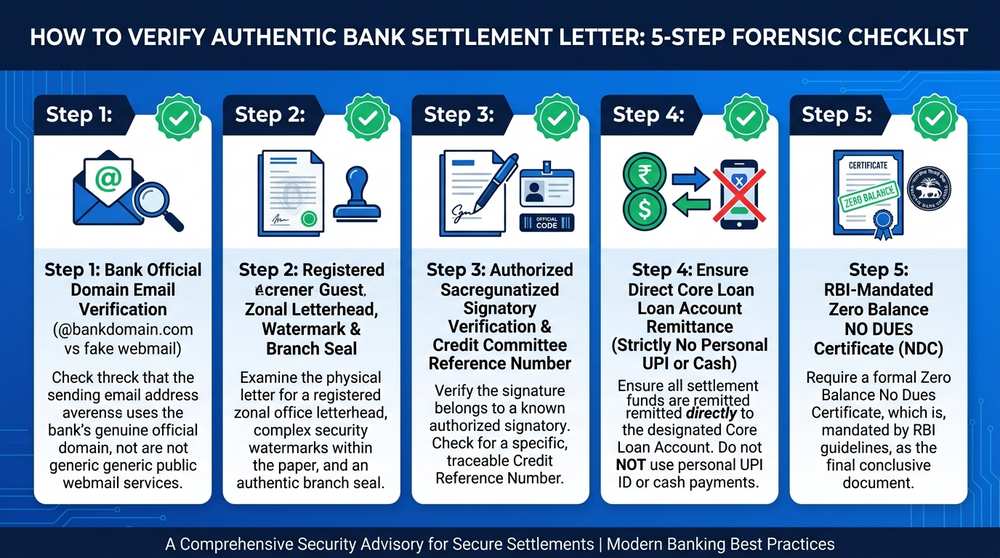
6. 7-Point Checklist: Verifying Settlement Letters
Before you deposit a single rupee toward an agreed compromise settlement, execute this rigorous 7-point forensic checklist developed by our senior debt defense advocates:
Check 1: Official Corporate Domain Email Dispatch
Ensure the settlement letter is emailed directly from the bank's registered corporate email domain (e.g., nodal.officer@hdfcbank.com, retail.settlements@icicibank.com, or sarb.zonal@sbi.co.in). Any letter received exclusively via WhatsApp, Telegram, or from public webmail servers (@gmail.com, @yahoo.co.in) is completely invalid.
Check 2: Registered Zonal Letterhead & Corporate Details
Authentic letters are printed on high-grade corporate letterheads displaying the bank's full legal corporate entity name, Corporate Identification Number (CIN), registered head office address, and zonal branch coordinates. Counterfeit letters often display pixelated, low-resolution logos downloaded from web searches.
Check 3: Traceable Committee Approval Reference Number
A genuine OTS sanction letter always features a unique, structured internal reference number (e.g., HDFC/SARB/NZ/OTS/2026/08/9421). This reference code corresponds directly to an entry in the bank's Centralized Core Banking System and Credit Committee minutes.
Check 4: Authorized Officer Name, Designation & Employee Code
The sanction letter must clearly disclose the authorized signing officer's full name, formal corporate designation (such as Chief Manager, Assistant General Manager, or Stressed Asset Recovery Officer), employee ID code, and official branch stamp.
Check 5: Unambiguous Debt Discharge & Litigation Withdrawal Clause
Verify that the letter explicitly declares that the settlement payment constitutes full and final satisfaction of dues. It must also confirm that the bank will withdraw pending Section 138 NI Act or Section 25 PSSA complaints and issue a formal ₹0 No Dues Certificate.
Check 6: In-Person Branch Manager Verification
Before making any financial transfer, visit the home branch or regional Stressed Assets Recovery Branch in person. Present the letter to the Branch Manager or Operations Head and request an explicit confirmation in their core banking system that the OTS proposal is formally sanctioned.
Check 7: Exclusive Remittance to Core Loan Account
The settlement terms must instruct you to deposit funds directly into your specific 16-digit loan account number. The letter must NEVER mandate payments to any third-party agency name, person bank account, or QR code.
7. Forged Settlement Letters: Red Flags & Metadata Forensics
Forged settlement letters created by rogue recovery agents almost always exhibit identifiable forensic anomalies. Understanding these red flags allows borrowers and legal practitioners to instantly detect fraudulent instruments:
Counterfeit documents often use outdated bank logos, distorted aspect ratios, pixelated headers, or incorrect parent company branding copied carelessly from Google Images.
Authentic bank legal teams use standardized legal drafts vetted by corporate counsel. Forged letters frequently contain glaring spelling mistakes, informal conversational phrasing, and inconsistent font sizes.
Forged drafts often state that the payment is a "part-payment towards settlement" rather than a full and final discharge, allowing the bank or agency to then demand the entire remaining balance.
Inspecting PDF document properties (under File > Properties) frequently reveals creation software such as "CamScanner", "Canva", or mobile PDF editors rather than official banking enterprise document generation systems.
When receiving digital settlement correspondence, inspect the full email headers (DKIM, SPF, and DMARC verification). Authentic emails originating from institutional banking servers will show dmarc=pass and spf=pass from the bank's authenticated domain.
8. Safe Remittance, RBI ₹0 NDC Mandate & CIBIL Update
Once the One-Time Settlement sanction letter has passed all 7 forensic verification checks, executing the settlement payment requires absolute procedural discipline. Adhere strictly to the following three safe remittance channels:
Under RBI Circular RBI/2023-24/60, all commercial banks and NBFCs must issue an official No Dues Certificate within 30 calendar days. They are also legally obligated to update credit bureau records within this same 30-day timeline.
Understanding CIBIL Bureau Reporting & Credit Score Rebuilding
Following settlement execution, the bank reports your loan account to all four authorized credit bureaus: CIBIL, Experian, Equifax, and CRIF High Mark. The status is marked as 'Settled', reflecting an outstanding balance of ₹0.
9. Matrix: Authentic Bank OTS vs Rogue Fake Letter
To provide total clarity, the comparative matrix below contrasts the critical forensic parameters of a genuine, legally binding bank OTS sanction letter against a fraudulent instrument fabricated by rogue collection agents:
| Forensic Parameter | Authentic Bank OTS Sanction Letter | Rogue Agent Fake WhatsApp Letter |
|---|---|---|
| Issuing Authority | Credit Committee / SARB / Zonal Authority | Unauthorized Third-Party Tele-Caller / Agent |
| Dispatch Channel | Corporate Bank Domain Email (@bank.com) / Branch Counter | Personal WhatsApp / Telegram / Gmail / Yahoo |
| Payment Destination | Directly into 16-Digit Core Loan Account Number | Personal UPI ID, Agency Account, or Cash Handover |
| System Verification | Verifiable in Core Banking System by any Branch Manager | Zero record in Core Banking; shows continuous default |
| Debt Discharge Status | Explicit full waiver of residual balance stated | Ambiguous wording; treated as partial installment |
| Legal Enforceability | Binding contract; enforceable under Indian Contract Act | Void ab initio; constitutes criminal forgery under IPC/BNS |
| No Dues Certificate (NDC) | Guaranteed within 30 days under RBI ₹5,000/day penalty | Never issued; bank continues legal recovery actions |
10. SettleLoans Letter Verification & Legal Audit Services
Resolving stressed debt requires experienced banking litigation advocates. Our legal team understands credit committee procedures, forensic letter verification, and statutory borrower rights under RBI directives.

Settle Loan is India's trusted debt relief and loan settlement platform. We help borrowers overcome financial distress by negotiating with banks and NBFCs to legally settle personal loans and credit card debts. With our transparent, performance-based approach, you can achieve debt freedom and regain your financial peace of mind.
COMPUTER
11. Frequently Asked Questions: Bank Settlement Letter Verification
Clear, legally verified answers to essential questions regarding bank settlement letter authenticity, fraud detection, and safe debt resolution in India.
What is an authentic bank loan settlement letter?
An authentic bank loan settlement letter (also called an OTS Sanction Letter) is a formal, legally binding instrument issued directly by an authorized credit authority or Stressed Assets Resolution Branch of a regulated bank or NBFC. It explicitly states the borrower's exact loan account number, total outstanding balance, negotiated compromised settlement amount, installment schedule, and a legally enforceable commitment to waive the residual debt and issue a zero-balance No Dues Certificate upon timely payment.
How do rogue recovery agents forge bank settlement letters on WhatsApp?
Rogue recovery agents and unauthorized third-party agencies use digital editing software to paste bank logos and fake signatures onto generic letter templates. They issue these fabricated PDFs over WhatsApp, promise massive 70% to 80% discounts, and coerce borrowers into transferring money to personal UPI handles, recovery agency current accounts, or third-party wallets, while leaving the borrower's core bank loan active and accumulating default interest.
How can I verify the email domain sending the settlement letter?
Legitimate settlement letters must originate from the bank's official corporate email domain (such as @hdfcbank.com, @icicibank.com, @axisbank.com, @sbi.co.in, or @kotak.com). Any settlement letter sent from public webmail domains like @gmail.com, @yahoo.com, @outlook.com, or obscure third-party agency domains (@collectionagency.in) is fraudulent and carries zero legal validity with the lending institution.
What happens if I make a settlement payment to a personal UPI ID or third-party account?
Paying any settlement amount to a personal UPI ID, cash collector, or collection agency bank account is fatal to your settlement. The lending bank will not recognize this payment toward loan closure. The bank's core banking system will continue to classify your account as delinquent, penal interest will compound, and you will lose both your money and your legal standing to claim a debt waiver.
How do I safely remit funds once a settlement letter is verified?
All settlement payments must be deposited strictly into your designated core loan account number through verified banking channels: (1) RTGS/NEFT mentioning your specific loan account number as the beneficiary, (2) Direct net banking loan repayment portal on the official bank website, or (3) Account Payee Cheque or Demand Draft drawn strictly in favor of '[Bank Name] A/C [Your 16-Digit Loan Account Number]' submitted across the branch counter against an official stamped receipt.
What statutory authority level approves a genuine One-Time Settlement?
Under RBI Master Directions, person recovery agents and frontline collection executives have zero legal authority to sanction debt waivers. OTS approvals must follow the bank's board-approved Delegation of Financial Powers (DoFP) matrix, requiring sanction from the Branch Credit Committee, Regional Head, Zonal Settlement Committee, or Stressed Assets Recovery Branch (SARB) depending on the principal exposure.
What criminal and civil legal actions can be taken against agents forging settlement letters?
Forging bank settlement documents constitutes serious criminal offenses under the Indian Penal Code (IPC) and Bharatiya Nyaya Sanhita (BNS): Forgery (Section 463/468 IPC; Section 336 BNS), Using Forged Documents as Genuine (Section 471 IPC; Section 340 BNS), Cheating (Section 420 IPC; Section 318 BNS), and Criminal Breach of Trust (Section 406 IPC; Section 316 BNS). Borrowers can file police FIRs and lodge complaints before the RBI Integrated Ombudsman for severe institutional penalties.
What essential clauses must be present in an authentic OTS sanction letter?
An authentic letter must include: (1) Unique reference number and date, (2) Exact loan account number and customer CIF/PAN, (3) Total ledger balance broken down into principal and charges, (4) Specific agreed settlement figure and payment due dates, (5) Unambiguous debt discharge clause stating residual dues are fully waived, (6) Express commitment to withdraw pending civil/criminal/arbitration litigations, and (7) Mandate to deliver a zero-balance No Dues Certificate within 30 days.
How long does a bank have to issue the No Dues Certificate after settlement payment?
Under RBI Circular RBI/2023-24/60, all commercial banks and NBFCs must release original loan security documents and deliver the official No Dues Certificate (NDC) within 30 calendar days of receiving the full settlement amount. For every day of delay beyond 30 days attributable to the bank, the lender is legally required to pay relief of ₹5,000 per day to the borrower.
How will an authentic settlement reflect on my CIBIL credit report?
Upon full remittance of an authentic settlement, the bank updates credit bureaus (CIBIL, Experian, Equifax, CRIF) with the status 'Settled' or 'Post-Write-off Settled' with an outstanding balance of ₹0. This immediately ends overdue default status, stops collection harassment, and allows you to systematically rebuild your credit score above 750 over 18 to 24 months.