
Introduction to Personal Loan Debt Relief
Falling into a debt trap is an overwhelming experience for any individual. With rising living costs and unforeseen emergencies like medical crises or job loss, keeping up with personal loan EMIs can quickly become impossible. In India, unsecured personal loans form a massive chunk of consumer credit. When defaults happen, borrowers often face aggressive recovery tactics, mounting penal interest, and immense psychological stress.
Fortunately, there are legal frameworks and recognized financial strategies to help you break free. The two most prominent strategies discussed by financial planners are Debt Settlement and Debt Consolidation. Understanding the nuances, legal implications, and long-term consequences of these paths is the first step toward reclaiming your financial stability.
At SettleLoans, we specialize in helping individuals navigate these turbulent waters. We provide a buffer against harassment from recovery agents and negotiate with banks to find a middle ground that adheres to the Reserve Bank of India (RBI) guidelines.
Check Your Loan Settlement Options
Answer 2 quick questions to evaluate your settlement eligibility.
1. What type of loan do you want to settle?
Debt Settlement vs. Consolidation
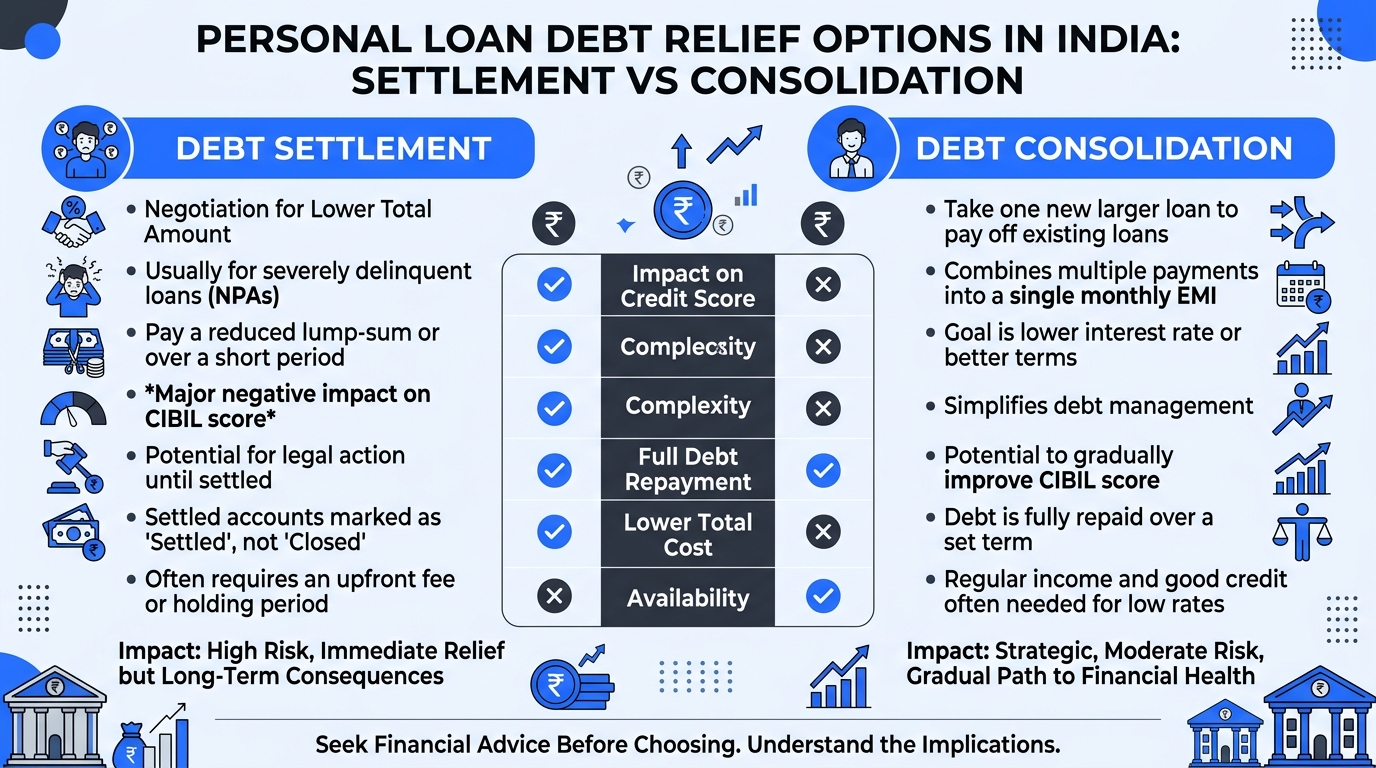
Many borrowers confuse settlement with consolidation, but they are fundamentally different approaches designed for entirely different financial situations. Knowing which one applies to you can save you time, money, and further damage to your credit profile.
Key Differences at a Glance
- Mechanism: Consolidation combines multiple loans into one. Settlement negotiates to pay only a fraction of the outstanding amount.
- Credit Score Impact: Consolidation protects or even improves your CIBIL score if paid on time. Settlement severely damages your CIBIL score, dropping it by 50-100 points, as the account is marked "Settled."
- Eligibility: Consolidation requires a decent credit score to secure a new loan. Settlement is typically for those who have already defaulted and have a poor credit score.
- Financial Obligation: In consolidation, you repay 100% of the principal plus interest. In settlement, a portion of your debt is legally forgiven by the lender.
If you have missed several EMIs and the bank is sending legal notices, consolidation is likely no longer an option because no new lender will approve a loan. At this stage, a well-negotiated debt settlement becomes the optimal strategy.
Cost-Benefit Analysis
To provide a clear picture of how these two strategies compare, we have outlined a comparative analysis below. This is highly useful when deciding the trajectory of your financial recovery.
| Criteria | Debt Settlement | Debt Consolidation |
|---|---|---|
| Total Amount Paid | Significantly less (often 40-60% of outstanding) | 100% of Principal + New Interest |
| Impact on CIBIL | Negative (Drops drastically, marked "Settled") | Positive/Neutral (Maintains payment history) |
| Time to Debt-Free | Faster (Lump sum payment ends it immediately) | Longer (Requires paying off new tenure, 1-5 years) |
| Lender Harassment | High (Until settlement is formalized) | Low/None (Accounts remain in good standing) |
| Ideal Candidate | Already defaulted, experiencing severe hardship | Good credit, struggling with multiple EMI dates |
Legal Implications in India (RBI Guidelines)
In India, debt settlement is entirely legal. It is governed by the Indian Contract Act, 1872, where both parties agree to alter the terms of the original contract. Furthermore, the Reserve Bank of India (RBI) provides strict guidelines for banks regarding compromise settlements and the treatment of non-performing assets (NPAs).
It is crucial to note that while the SARFAESI Act, 2002 allows banks to seize assets without court intervention, this applies only to secured loans (like home or auto loans). Personal loans are unsecured. If you default on a personal loan, the bank cannot seize your property directly. They must file a civil suit for recovery, which is a lengthy legal process. This leverage often encourages banks to agree to a one-time settlement (OTS).
Additionally, RBI guidelines strictly prohibit the use of muscle power or harassment by recovery agents. Borrowers have the right to report abusive agents to the Banking Ombudsman or local police.
Step-by-Step Settlement Process
Approaching your lender for a settlement requires preparation and a clear strategy. Here is the recommended step-by-step approach to achieving a successful personal loan settlement:
Assess Your Financial Hardship
Compile documentation proving your inability to pay. This includes medical bills, termination letters, or bank statements showing depleted savings.
Stop Paying the EMI
This is a harsh reality: banks will not negotiate a settlement if you are still managing to pay the EMI. The account must typically be 90+ days overdue (NPA status).
Initiate Communication
Send a formal letter or email to the bank manager or the recovery department explaining your situation and offering a realistic lump-sum amount.
Negotiate Vigorously
The bank will initially refuse or offer a tiny discount. Stand firm. Professional services like SettleLoans can handle this negotiation to secure the best possible waiver.
Get Everything in Writing
Never make a payment based on a verbal promise from a recovery agent. Always demand a formal settlement letter on the bank's letterhead detailing the exact terms.
Pay and Obtain NOC
Make the payment via demand draft or online transfer. Immediately request the No Objection Certificate (NOC) and ensure your loan account shows a zero balance.
Impact on Your CIBIL Score
The most significant drawback of a debt settlement is its effect on your creditworthiness. When a bank writes off a portion of your debt, they report the account status to credit bureaus (like CIBIL, Experian, Equifax) as "Settled" rather than "Closed."
A "Settled" remark is a massive red flag to future lenders. It indicates that you have historically failed to honor a financial commitment in full. Your score will drop significantly, and this remark stays on your report for up to 7 years. During the initial 2-3 years, obtaining a new loan, credit card, or even a mortgage will be extremely difficult.
However, if the alternative is unending harassment, legal notices, and an ever-growing debt pile due to penal interest, taking the hit on your CIBIL score is a necessary sacrifice to regain your peace of mind and financial equilibrium. Once settled, you can slowly begin rebuilding your credit through secured credit cards or small gold loans.