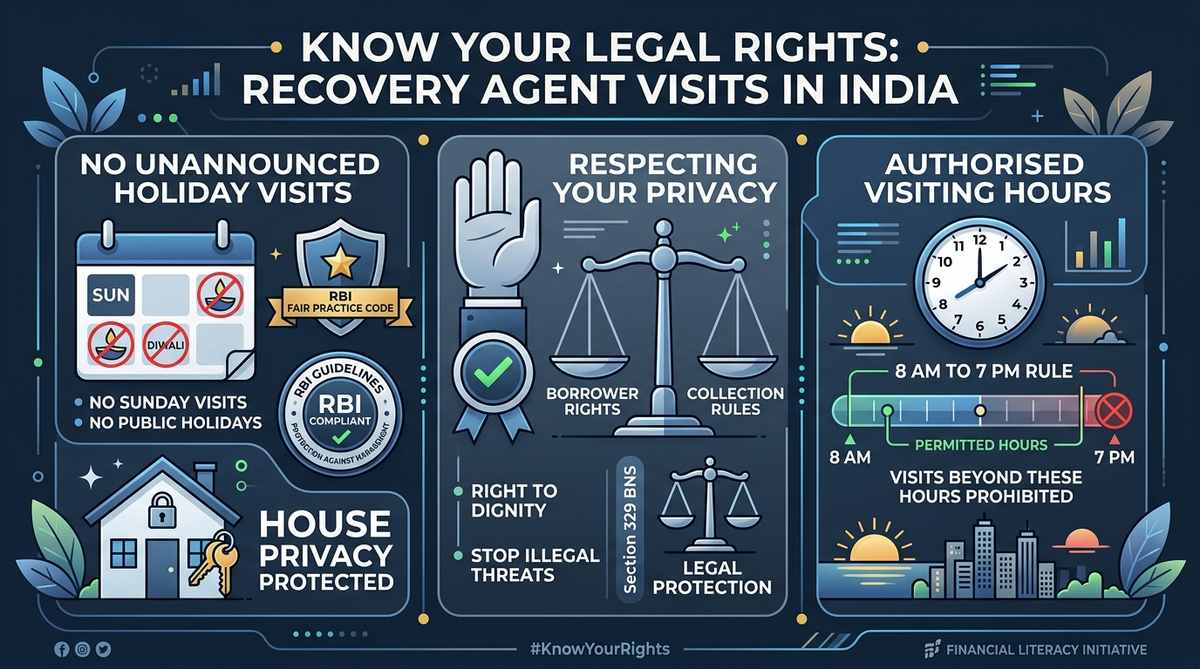
- Zero Unannounced Entry Rights: Agents cannot enter your home on Sundays or holidays without prior written consent.
- Strict Permissible Hours (8 AM to 7 PM): Even with consent, visits must stay within 8:00 AM to 7:00 PM. Visits outside these hours violate rules.
- Festival & Bereavement Safeguards: RBI directives ban agent visits during religious festivals, family illness, or mourning.
- Absolute Doorstep Sovereignty: Under Article 21, you have the full right to shut your door and refuse verbal talks.
- Cease-and-Desist Immunity: Appointing an advocate makes the bank route all talks through legal channels for an OTS settlement.
1. The Weekend & Holiday Doorstep Ambush
Defaulting on a personal loan or credit card causes deep stress. Sundays and public holidays are meant for rest with family. Yet, many recovery agencies use weekends to put pressure on borrowers.
Agencies pick Sundays because borrowers are at home. They know spouses, parents, and neighbors are around. Agents try to create scenes at your door. They hope fear of public shame will force you to pay. They shout in building corridors to cause embarrassment.
Recovery agents are private workers. They hold no police powers. They have no court search warrants. Your home is a private space under the law. No bank can take away your peace on Sundays or holidays.
Under the Indian Contract Act, 1872, loan default is a civil matter. It is not a crime. Banks can only send legal notices or file civil suits. They cannot use holiday harassment or threats to collect money.
2. RBI Directives on Holiday Visits
The Reserve Bank of India sets rules for banks and NBFCs. Under Section 21 and Section 35A of the Banking Regulation Act, 1949, RBI orders are binding law.
Recovery rules are in the RBI Master Direction on Outsourcing. They are also in the Fair Practices Code. These rules fix strict visit limits:
Mandatory RBI Standards Governing Doorstep Visits
1. Strict Time Window Restriction (8:00 AM to 7:00 PM)
Agents can only call or visit between 8:00 AM and 7:00 PM. Any contact outside these daily hours breaks RBI rules.
2. Mandatory Prior Notice and Appointment Protocols
Recovery visits cannot be surprise ambushes. Banks must notify you about the recovery agency. Visits must be pre-arranged.
3. Express Prohibition on Festival & Mourning Intrusions
Agents must not disturb you during family illness, mourning, or festivals like Diwali, Eid, and Christmas.
4. Vicarious Liability of Lending Institutions
Banks stay fully liable for agent actions. Lenders cannot escape blame for harassment.
When agents visit on holidays without written notice, they break RBI rules. You can quote these rules, refuse entry, and tell them to send written letters.
Check Your Loan Settlement Options
Answer 2 quick questions to evaluate your settlement eligibility.
1. What type of loan do you want to settle?
3. Privacy Rights & Sec 329 BNS Trespass
Borrower rights are backed by the top court. In Justice K.S. Puttaswamy (Retd.) v. Union of India (2017) 10 SCC 1, the Supreme Court ruled privacy is a fundamental right under Article 21.
The court ruled that every home is a private space. Every citizen has the right to be left alone. Banks and collection agents have no power to breach your privacy.
The Bharatiya Nyaya Sanhita, 2023 (BNS) replaced the Indian Penal Code (IPC). Bad agent conduct triggers key criminal sections:
Penal Consequences for Unlawful Holiday Recovery Conduct
Section 329 BNS: Criminal House-Trespass
Entering without consent or refusing to leave on a holiday is criminal trespass. It can lead to jail.
Section 351 BNS: Criminal Intimidation
Threats of arrest, loss of items, or public shame violate Section 351 BNS (Section 506 IPC).
Section 308 BNS: Extortion Demands
Forcing cash payments by creating scenes outside your home is extortion under Section 308 BNS (Section 383 IPC).
Section 189 BNS: Unlawful Assembly
Sending groups of agents to block doors or shout violates Section 189 BNS (Section 141 IPC).
In ICICI Bank Ltd. v. Prakash Kaur & Ors. (2007) 2 SCC 711, the Supreme Court banned musclemen for debt collection. The court ordered banks to follow lawful civil steps.
4. Bank NPA Accounting in Weekend Recovery
Banks push on weekends because bad loans tie up bank funds. Under RBI rules, unpaid loans turn into Non-Performing Assets (NPAs) after 90 days.
When a loan turns into an NPA, the bank must set aside capital provisions from profits:
- Substandard NPA (Delinquency up to 12 Months): 15% provisioning on unsecured loans.
- Doubtful NPA Category 1 (12 to 24 Months): 100% provisioning on unsecured loans.
- Loss Assets: 100% full balance sheet write-off against bank reserves.
Civil suits for ₹3 Lakhs to ₹25 Lakhs cost heavy fees and take 3 to 5 years. Unsecured loans have no collateral to seize. Household items are safe under Section 60 of the Code of Civil Procedure, 1908 (CPC). Banks judge recovery via Net Present Value (NPV):
Here, C_t is expected cash inflow over time t. The letter r is the bank discount rate. Deductions cover legal fees and locked capital.
Civil court cases yield low returns. Thus, banks prefer a fast One-Time Settlement (OTS). A 40% to 65% waiver gives the bank quick cash. It frees locked capital. Sunday visits are cheap scare tactics before settlement talks.
6. Tactical Steps to Turn Away Agents
When agents visit on a Sunday or holiday, stay calm. Follow a clear legal step-by-step process. You do not need to panic or argue. Follow this 5-step plan:
Step 1: Keep the Main Door Securely Latched
Never open the door fully to uninvited callers. Speak through a safety grill or peephole.
Step 2: Demand Official Credentials and Bank Authorization
Ask the agent for bank ID cards and authority letters. Take clear photos of these papers through the grill.
Step 3: State Clear Refusal of Holiday Discussions & Record
Turn on your phone camera. State clearly: "Today is a holiday. I do not talk about loans on holidays. Please leave now. Send notices by post."
Step 4: Strictly Refuse Cash or Informal UPI Payments
Never give cash, blank cheques, or UPI transfers. Informal payments are often lost or applied to penal fees.
Step 5: Close the Door Firmly and Engage Legal Counsel
Lock your door. If the agent shouts or refuses to leave, call 112 for police help. Send the video proof to your lawyer.
Closing the door on holiday visitors is fully lawful. It is a valid exercise of your property and privacy rights.
7. Escalation to Ombudsman & Police
If a lender sends agents on holidays, build a clear paper trail. Save visits, audio clips, and CCTV clips for formal complaints.
First, write to the bank Principal Nodal Officer (PNO). List the date, time, agent names, and RBI rule breaches. The bank gets 30 days to resolve your issue.
If the bank fails to reply, file a case on cms.rbi.org.in. The RBI Ombudsman can fine the bank. They can award up to ₹20 Lakhs in damages. If agents make physical threats, file a police complaint under Section 329 and Section 351 BNS.
8. OTS Settlement Protocol for Weekend Defaults
Stopping Sunday visits brings peace of mind. But settling your debt brings permanent relief. Token cash payments only extend debt troubles. An institutional One-Time Settlement (OTS) is the best path.
A formal OTS follows three clear legal pillars:
1. Statutory Cease-and-Desist
Your lawyer sends a formal notice to bank leaders. This stops holiday visits and directs all talks to legal counsel.
2. Verified Sanction Letter
Get an OTS letter on bank letterhead. It must state the agreed sum, waiver, and payment terms.
3. Bank-Stamped NDC & CIBIL
Pay directly into the bank loan account. Get an official No Dues Certificate under RBI rules. Update all credit bureaus.
After OTS payment, the bank updates CIBIL, Experian, CRIF, and Equifax to show 'Settled'. This clears debt claims. It ends home visits for good.
9. Weekend Recovery & Defense Matrix
The table below outlines legal boundaries, visiting hours, and borrower protections across recovery channels in India:
| Recovery Channel | Legal Authority | Sunday / Holiday Rules | Permissible Hours | Borrower Safeguards |
|---|---|---|---|---|
| Third-Party Recovery Agents | Private Vendor Contract (Zero Judicial Authority) | Unannounced visits prohibited. Prior consent is mandatory. | Strictly 8:00 AM to 7:00 PM only. | Section 329 BNS complaint. RBI Ombudsman. Cease-and-Desist notice. |
| Civil Court Bailiff / Nazarat | Court Warrant under Order XXI CPC | Courts closed on holidays. Execution is during court hours only. | Standard daytime judicial working hours. | Section 60 CPC exemptions. Stay Petition. Order XXI Rule 58 objections. |
| SARFAESI Authorized Officer | Securitisation Act, 2002 (Secured Debt Only) | No holiday possession. Mandatory 60-day notice and DM order. | Official daytime business hours only. | Section 17 Securitisation Application before DRT. |
| National Lok Adalat | Legal Services Authorities Act, 1987 | No field visits. Voluntary compromise hearings on Lok Adalat Saturdays. | Designated court session hours. | Consensual OTS compromise. Full judicial finality. Non-appealable award. |
| Section 138 NI Act (Cheque Bounce) | Judicial Magistrate First Class (JMFC) Court | No private recovery visits. Summons served by police or post. | Judicial working days. | Bail application. Legal compounding under Section 147 NI Act via OTS. |
10. SettleLoans Weekend Harassment Defense
No family should face aggressive debt agents during weekend rest or festivals. At SettleLoans, our legal team defends borrowers across India. We enforce privacy rights under the RBI Fair Practices Code and Section 329 BNS.
We send formal notices to bank leaders. This stops uninvited visits. We then negotiate 40% to 65% OTS waivers with official No Dues Certificates.

Settle Loan is India's trusted debt relief and loan settlement platform. We help borrowers overcome financial distress by negotiating with banks and NBFCs to legally settle personal loans and credit card debts. With our transparent, performance-based approach, you can achieve debt freedom and regain your financial peace of mind.
COMPUTER
11. FAQs: Recovery Agent Sunday & Holiday Rules
Clear answers regarding recovery agent restrictions on weekends, holiday visit rules, criminal trespass, and debt settlement in India.
Are recovery agents legally allowed to visit my home on Sundays or public holidays?
No unannounced visits are allowed. Under RBI Fair Practices and Outsourcing Guidelines, agents must respect privacy. Field visits are restricted to 8:00 AM to 7:00 PM. Sunday or holiday visits without prior consent count as harassment. You have the full legal right to turn agents away. You can insist on written notices or weekday meetings.
Can recovery agents visit my residence during religious festivals like Diwali, Eid, or Christmas?
No. The Reserve Bank of India strictly bans visits during festivals. Agents cannot disturb borrowers during family illness, mourning, or religious events. Visits or threats during festivals violate the RBI Integrated Ombudsman Scheme. Such acts count as severe misconduct.
Can I refuse to open the door if a recovery agent knocks on a Sunday morning?
Yes. You have a full legal right under Article 21 to keep your door closed. Agents are private contractors. They have no police powers. They hold no court search warrants. You can speak through a closed door. Tell them you do not allow holiday visits.
What should I do if a recovery agent creates a scene or shouts outside my home on a holiday?
Do not open the door. Record audio and video proof on your phone. Tell the agent their actions violate the law. Shouting outside your home is criminal intimidation under Section 351 BNS (Section 506 IPC). If they refuse to leave, call 112 for police help right away.
Are recovery agents required to give prior notice before visiting my home?
Yes. RBI rules require banks to give notice before sending agents. The lender must tell you the agency name in advance. Field visits must be pre-arranged. Agents cannot use surprise weekend ambushes to shame your family.
What are the permissible hours for recovery agents to visit or call borrowers?
The Reserve Bank of India sets clear visit hours. Agents can only call or visit between 8:00 AM and 7:00 PM. Any calls or visits before 8:00 AM or after 7:00 PM break the RBI Master Direction on Outsourcing of Financial Services.
Can recovery agents bring local police with them on a Sunday to force a settlement?
No. Unsecured personal loans and credit cards are civil matters under the Indian Contract Act, 1872. Police cannot act as debt collectors. If agents pretend to be police, it is a crime under Section 204 BNS for impersonating public servants.
How can appointing a debt settlement advocate stop Sunday and holiday home visits?
Your advocate sends a formal Cease-and-Desist notice with a Vakalatnama to the bank. Under RBI rules, the bank must stop home visits once you hire a lawyer. All debt talks must then go through your legal counsel.