- Total Ban on Employer Contact: The Reserve Bank of India strictly prohibits commercial banks, NBFCs, and recovery agencies from contacting employers, emailing HR, or communicating with colleagues regarding a borrower's personal debt.
- Privity of Contract Safeguard: An employer is a complete legal stranger to your personal loan agreement. A bank has zero statutory authority to serve demand notices on corporate management or request salary attachments without a civil court decree.
- Constitutional Right to Privacy: The Supreme Court of India in the landmark Puttaswamy ruling recognized financial privacy as an inalienable fundamental right under Article 21. Disclosing debt status at the workplace constitutes an actionable constitutional and tortious breach.
- Criminal Defamation & Intimidation Remedies: Unlawful workplace recovery actions expose bank officials and recovery agents to criminal prosecution under Sections 499, 500, 503, and 506 IPC (Sections 356 and 351 BNS), along with heavy IT Act penalties.
- Transforming Harassment into 55% OTS: Serving a statutory advocate legal notice on the bank's Principal Nodal Officer forces lenders to halt workplace interference immediately and open negotiations for a formal 45%–65% One-Time Settlement.
1. The Crisis of Workplace Debt Collection: Illegal HR
Few events are more distressing for a salaried professional than discovering that an overdue personal loan or credit card balance has spilled into their workplace. In recent years, aggressive collection agencies representing major private banks and digital lending NBFCs have increasingly resorted to coercive workplace tactics: sending intimidating emails to Human Resources desks, repeatedly dialling corporate reception boards, confronting employees at office reception lobbies, or serving purported "Legal Notices for Salary Attachment" directly on corporate management.
These tactics are deliberately engineered to inflict intense psychological terror, generate professional embarrassment, and weaponize the borrower's fear of job loss. When a collection agent contacts an HR director or copies company management on a loan default notice, their singular objective is to humiliate the borrower into borrowing from friends, liquidating retirement savings, or taking expensive high-interest emergency loans to settle the arrears.
Under the Indian Contract Act, 1872, a contract creates rights and obligations strictly between the contracting parties—namely, the lender and the individual borrower. An employer is a total stranger to this transaction. A bank has zero legal foundation to demand that an employer intervene, investigate, or satisfy a private civil monetary dispute.
Collection agencies frequently draft misleading documents styled as "Court Notices" or "Garnishee Mandates" demanding that HR deduct loan EMIs from payroll. Under Indian civil law, no private bank or advocate has administrative power to attach salary without a formal decree and execution warrant issued by a competent Civil Judge under Order 21 CPC.
When a bank or its outsourced recovery agency breaches these boundaries by contacting your workplace, they cross the line from standard debt recovery into blatant statutory non-compliance, tortious misconduct, and criminal defamation. Salaried borrowers must understand that the law provides robust, immediate protections to shut down workplace harassment permanently.
2. Statutory Protections: Supreme Court Privacy Rulings & RBI Fair Practices Code Bans
Indian jurisprudence and banking regulations explicitly forbid commercial lenders from using third-party disclosures or public humiliation as recovery mechanisms. A multi-layered statutory architecture protects borrowers against unlawful workplace intrusions:
In Justice K.S. Puttaswamy (Retd.) v. Union of India (2017), a nine-judge Constitution Bench of the Supreme Court held that the Right to Privacy is a fundamental right guaranteed under Article 21 of the Constitution, encompassing informational privacy and the protection of personal financial data. Furthermore, in ICICI Bank v. Shanti Devi Sharma (2008), the Supreme Court severely condemned the use of musclemen and coercive recovery tactics, ruling that banks cannot recover loans by violating the dignity, privacy, and fundamental rights of citizens.
The RBI Master Direction on Fair Practices Code mandates that lenders shall not resort to intimidation, harassment, or verbal abuse. Agents are strictly prohibited from publicly disclosing debt details or harassing family members and employers.
Under RBI regulations on Outsourcing of Financial Services, recovery agents are strictly barred from contacting borrowers before 8:00 AM or after 7:00 PM. Contacting third parties at workplaces without explicit written consent is a direct regulatory violation.
Under Section 43A and 72A of the Information Technology Act and the Digital Personal Data Protection Act, transmitting personal financial records to unauthorized corporate HR desks constitutes unlawful processing and illegal data disclosure.
When a recovery agent contacts your employer, they violate these codified RBI directives and constitutional mandates. Because commercial banks remain vicariously liable for the actions of their recovery agents, legal advocates can leverage these regulatory breaches to hold senior bank management directly accountable.
Check Your Loan Settlement Options
Answer 2 quick questions to evaluate your settlement eligibility.
1. What type of loan do you want to settle?
3. Criminal Defamation, IPC/BNS Provisions & Tort Liabilities Against Predatory Lenders
Workplace debt collection is not merely an ethical infraction or a banking service deficiency; it constitutes an actionable civil wrong and a criminal offense under Indian law. By broadcasting confidential financial distress to corporate executives, co-workers, or human resource managers, recovery agencies actively defame the borrower and jeopardize their professional standing.
Salaried borrowers hold substantive statutory remedies under both the Indian Penal Code (IPC) and the modern Bharatiya Nyaya Sanhita (BNS), 2023:
Criminal Defamation (Section 499 & 500 IPC / Section 356 BNS 2023)
Whoever, by words spoken or written, makes or publishes any imputation concerning another person intending to harm their reputation commits criminal defamation. Sending defamatory notices, emails, or debt claims to an employer with intent to lower the borrower's professional standing carries a penalty of up to two years of simple imprisonment, a fine, or both.
Criminal Intimidation & Extortion (Section 503, 506 & 384 IPC / Sections 351 & 308 BNS)
Threatening a borrower with termination of employment, public exposure at their workplace, or visiting their corporate office to cause humiliation constitutes criminal intimidation. Using coercive workplace threats to extract money constitutes attempted extortion under criminal law.
Civil Tort of Defamation & Exemplary Damages
Under Indian tort law, a borrower whose professional reputation, appraisal, or career progression is damaged by unauthorized bank communications can initiate a civil suit for substantial monetary damages against the lending institution and the collection agency.
When legal counsel serves a formal advocate legal notice detailing these criminal and civil provisions, bank management quickly realizes that the legal cost and reputational fallout of defending a workplace harassment lawsuit far exceed the value of the underlying loan arrears.
4. Bank Accounting Dynamics: Why Recovery Agencies Target Workplaces & The NPV Recovery Equation
To counter workplace recovery harassment effectively, one must understand the internal operational machinery driving it. Commercial banks in India do not typically dispatch their own full-time branch officers to visit workplaces. Instead, when an unsecured personal loan crosses 60 to 90 days of delinquency, the file is outsourced to third-party Direct Recovery Agencies (DRAs) operating on aggressive contingency commission models.
Under Reserve Bank of India prudential provisioning guidelines, when a loan crosses 90 days overdue, it is classified as a Non-Performing Asset (NPA), triggering mandatory capital provisioning deductions from the bank's quarterly profits:
| Delinquency Classification | Overdue Aging Timeline | Mandatory RBI Capital Provision | Settlement / Haircut Scope |
|---|---|---|---|
| SMA-1 / SMA-2 | 31 – 90 Days Overdue | 5% General Capital Provision | Penal Interest & Late Fee Waivers |
| Substandard NPA | 91 – 365 Days Overdue | 25% Unsecured Provisioning | 35% – 45% Principal Haircut |
| Doubtful NPA 1 (D1) | 12 – 24 Months Default | 100% Unsecured Capital Provision | 45% – 55% Principal Haircut |
| Doubtful NPA 2 / Loss Asset | 24+ Months / Written-Off | 100% Full Balance Sheet Write-Off | 55% – 65% Principal Haircut |
Because third-party recovery agents earn high commissions (often 10% to 25% of recovered amounts) only if they extract payments before the loan moves into write-off buckets, rogue tele-callers resort to illegal workplace harassment. When an advocate confronts the bank with regulatory violations, bank credit committees step in and evaluate the dispute using the Net Present Value (NPV) of Recovery formula:
Where C_t represents estimated recoverable cash flows, r is the discount rate, and deductions account for 3–5 years of civil court delays, advocate retainers, regulatory risk from Ombudsman complaints, and capital locked in NPA provisions.
When faced with formal advocate notices citing criminal defamation and RBI violations, lenders recognize that continuing illegal workplace pressure exposes them to severe Ombudsman penalties. An upfront compromise recovery of 35% to 55% via a negotiated One-Time Settlement becomes the bank's most rational financial outcome.
5. Visual Strategic Roadmap: Workplace Harassment Defense & Debt Resolution
The visual roadmap below details the structured 5-stage institutional workflow deployed by seasoned banking litigation advocates to halt illegal employer communications, invoke Supreme Court privacy protections, serve criminal defamation notices, and conclude an official debt settlement.
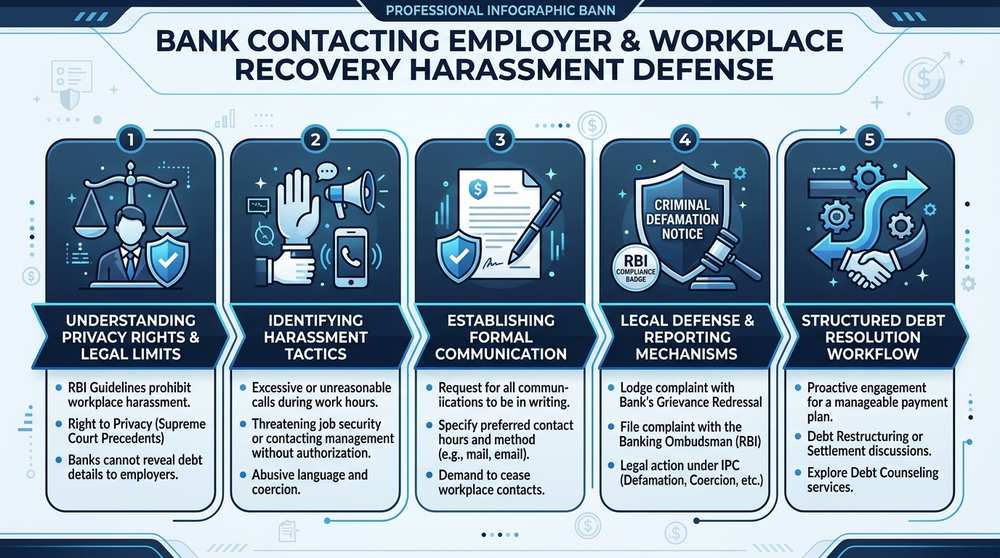
6. The Emergency 4-Stage Advocate Protocol to Stop Workplace Harassment Immediately
When a recovery agent contacts your employer or threatens office visits, emotional panic or arguing over the phone will not stop them. Rogue collection agencies view verbal protests as vulnerability. Instead, debt defense advocates execute an aggressive, legally calibrated 4-stage protocol designed to enforce an immediate ceasefire:
Stage 1: Evidence Preservation & Internal HR Clarification Memo
Collect every piece of evidence: email headers sent to corporate addresses, call recordings from office switchboards, WhatsApp messages, and physical copies of notices served at reception. Concurrently, provide your HR department with a formal written advisory stating that an external agency is engaged in unlawful third-party privacy harassment in violation of RBI regulations, and that your legal counsel is taking formal action.
Stage 2: Serving Advocate Legal Notice for Criminal Defamation & Tort
Your advocate drafts and serves an emergency legal notice on the bank's Managing Director, Principal Nodal Officer, and the collection agency directors. The notice cites Section 499/500 IPC (Defamation), Section 503/506 IPC (Criminal Intimidation), the Supreme Court Puttaswamy ruling, and the RBI Fair Practices Code, giving them 48 hours to retract defamatory communications and cease all workplace contact.
Stage 3: Escalation to RBI Integrated Ombudsman & Police Cyber Desk
If the bank fails to provide an immediate written apology and confirmation of agency disengagement, an expedited grievance is logged on the RBI CMS portal (cms.rbi.org.in) under "Violation of Fair Practices Code / Harassment by Recovery Agents". Where physical trespass or threats occurred at the office, a formal Police Complaint is filed for criminal trespass and intimidation.
Stage 4: Strategic Transition to Structured Debt Settlement
With the bank's collection agency disarmed and the lender facing substantial regulatory liability before the Banking Ombudsman, advocates shift the engagement to the bank's Stressed Asset Resolution Desk to negotiate an amicable, heavily discounted One-Time Settlement.
This decisive legal counter-offensive neutralizes the lender's leverage, restores your professional security, and paves the way for total financial liberation.
7. Converting Workplace Harassment into an Affordable 45%–65% One-Time Settlement (OTS)
Workplace harassment indicates that the bank is anxious about its mounting NPA provisions and is using coercive pressure because it lacks viable legal avenues to attach your assets. By exposing these illegal actions through advocate representation, you transform a distressing workplace incident into your greatest negotiating asset to secure a formal One-Time Settlement (OTS).
Rather than succumbing to demands for full payment with inflated penal charges, our legal advocates negotiate structured settlement terms:
Submit verified documentation of genuine financial distress—such as medical expenses, job disruption, salary cuts, or family emergencies—establishing that default was involuntary and bona fide.
Demand total elimination of late fees, penal interest, and legal costs, combined with a 45% to 65% reduction on the principal ledger balance based on the loan's NPA classification bucket.
Include an explicit covenant in the settlement agreement requiring the bank to immediately recall all outsourced recovery files and permanently cease all contact with your employer.
Structure the negotiated settlement sum across 2 to 4 manageable monthly installments, allowing you to settle the debt without liquidating essential living funds.
8. Sanction Letter Forensics, Direct Remittance, RBI ₹0 NDC Mandate & CIBIL Recovery
Borrowers dealing with rogue collection agencies must exercise extreme vigilance during settlement execution. Unscrupulous tele-callers frequently fabricate fake settlement letters on WhatsApp or promise verbal closures to collect partial token amounts. A borrower must never transfer funds until the settlement letter is forensically verified by legal counsel.
- Official Bank Letterhead: Must be issued on registered institutional letterhead with an official reference number, corporate email domain, and the digital or physical signature of an authorized Scale-IV/Zonal Manager.
- Exact Account & Identity Details: Must clearly list your full legal name, PAN, and exact 16-digit loan account number.
- Absolute Debt Extinguishment Recital: Must state unambiguously that upon receipt of the agreed compromised sum, all remaining balances, interest, and legal claims stand fully extinguished.
- Direct Bank Account Remittance: Payment must only be made directly into the borrower's own loan account number via NEFT/RTGS or official bank portal—never to an agency or individual account.
Under RBI Circular RBI/2023-24/60, all commercial banks and NBFCs are legally mandated to deliver a formal No Dues Certificate (NDC) / Loan Closure Certificate and update all credit information companies (CIBIL, Experian, Equifax, CRIF High Mark) to zero balance within 30 calendar days of receiving final settlement payment. Any unjustified delay beyond 30 days incurs a mandatory statutory penalty of ₹5,000 per day payable directly to the borrower.
CIBIL Bureau Reporting Trajectory & Credit Score Rehabilitation
Following settlement, the bank updates credit bureau records with the status remark "Settled" or "Post-Write-off Settled" with a current outstanding balance of ₹0. While this causes a temporary credit score dip of 70 to 120 points, it halts compounding default accumulation and eliminates collection harassment permanently. By maintaining a secured fixed-deposit credit card, keeping credit utilization below 30%, and ensuring timely utility payments, settled borrowers systematically rebuild their credit score back above 750 within 18 to 24 months.
9. Comparative Legal Matrix: Workplace Harassment vs. Legal Due Process vs. Ombudsman vs. OTS
Evaluating the legal remedies available to salaried borrowers allows you to choose the most effective strategy to protect your career, stop recovery harassment, and resolve your outstanding debt:
| Resolution Channel | Legal Basis & Limitations | Workplace Protection Scope | Typical Resolution Time | Final Legal Effect |
|---|---|---|---|---|
| Workplace Collection Actions | Unlawful extra-judicial pressure (Violates Privity of Contract) | Zero Protection (High risk of professional embarrassment) | Indefinite / Recurring | Exposes lender to criminal defamation and Ombudsman sanctions |
| Civil Court Execution (Order 21 CPC) | Section 60(1)(i) CPC Mandatory Salary Exemption | 1st ₹1,000 + 2/3rd of salary completely exempt | 2 – 4 Years | Judicial decree with strict statutory wage ceilings |
| RBI Banking Ombudsman | RBI Integrated Ombudsman Scheme 2021 (Deficiency in Service) | Directs immediate cessation of third-party contact | 30 – 45 Days | Regulatory order forcing bank compliance & statutory damages |
| Advocate-Led 55% OTS | Consensual Compromise Settlement Agreement | 100% Workplace Ceasefire & Permanent Debt Relief | 15 – 30 Days | Absolute debt extinguishment with official ₹0 NDC |
10. SettleLoans Legal Defense & Workplace Harassment Advisory
Confronting illegal workplace debt recovery requires seasoned banking litigation advocates who understand how to enforce RBI Master Directions, invoke Supreme Court privacy protections, and draft hard-hitting criminal defamation notices. SettleLoans provides end-to-end legal defense for salaried professionals across India: issuing emergency cease-and-desist notices to bank management, filing formal complaints with the RBI Banking Ombudsman, shielding your corporate reputation, and negotiating directly with bank zonal authorities to secure 45% to 65% principal haircuts backed by official, bank-stamped No Dues Certificates.

Settle Loan is India's trusted debt relief and loan settlement platform. We help borrowers overcome financial distress by negotiating with banks and NBFCs to legally settle personal loans and credit card debts. With our transparent, performance-based approach, you can achieve debt freedom and regain your financial peace of mind.
COMPUTER
11. Frequently Asked Questions: Bank Notices to Employer & Legal Remedies
Direct, legally verified answers to critical questions regarding workplace debt collection, unauthorized HR communications, and debt settlement protocols in India.
Can a bank legally send a loan recovery legal notice to my employer?
No. Under Indian contract and privacy laws, an employer is a complete third-party stranger to an unsecured loan agreement. Sending legal notices, debt demands, or default intimations to an employer violates the doctrine of Privity of Contract, the RBI Master Direction on Fair Practices Code, and the Supreme Court Right to Privacy judgment in the Puttaswamy case.
What should I do if a recovery agent emails my HR or calls my colleagues?
Immediately preserve all email headers, call recordings, and written communications. Issue an internal written memo to your HR department clarifying that the communication represents an unlawful third-party privacy breach by an external agency. Concurrently, retain legal counsel to serve a criminal defamation notice under Section 499/500 IPC (or Section 356 BNS) and file an expedited complaint with the RBI Banking Ombudsman.
Can a bank order my employer to deduct loan EMIs directly from my salary without a court order?
No. A commercial bank or NBFC has zero legal authority to order an employer to attach or deduct salary unless authorized by a formal judicial attachment warrant issued by a competent Civil Court under Order 21 CPC or an order from the Debt Recovery Tribunal (DRT). Even in court attachments, Section 60(1)(i) CPC strictly exempts the first ₹1,000 plus two-thirds of the remainder of the salary.
What RBI regulations prohibit recovery agents from contacting employers?
The RBI Master Direction on Fair Practices Code for Lenders and the Circular on Outsourcing of Financial Services strictly prohibit lenders and their recovery agents from contacting third parties, friends, relatives, or employers without explicit borrower consent. Agents are barred from disclosing debt details, calling outside 8:00 AM to 7:00 PM, and engaging in any conduct intended to humiliate the borrower.
Can I file a police complaint or criminal case against a recovery agent for office visits?
Yes. If recovery agents enter your workplace without permission, create a disturbance, or intimidate staff, you can lodge a Police Complaint (or FIR) under Section 441/447 IPC (Criminal Trespass), Section 503/506 IPC (Criminal Intimidation), and Section 499/500 IPC (Defamation), corresponding to Sections 329, 351, and 356 of the Bharatiya Nyaya Sanhita (BNS), 2023.
Does sending notices to an employer constitute criminal defamation under Indian law?
Yes. Publishing false, exaggerated, or confidential debt information to third parties like HR directors, managing partners, or co-workers with the intent to harm professional reputation constitutes criminal defamation under Section 499 of the Indian Penal Code (Section 356 BNS) as well as a civil tort of defamation entitling the borrower to claim substantial damages.
How does workplace harassment provide leverage to negotiate a One-Time Settlement (OTS)?
When an advocate formally documents egregious violations of RBI directives, privacy jurisprudence, and criminal defamation, the lending institution faces acute regulatory scrutiny, potential Ombudsman fines, and reputational risk. To avert litigation and regulatory sanctions, bank management frequently agrees to an immediate ceasefire and sanctions a 45% to 65% principal waiver via an official OTS.
Can my employer terminate my employment due to a bank notice or recovery agent email?
No reputable employer can terminate an employee solely due to a personal civil loan default, as civil debt disputes do not constitute professional misconduct or criminal breach of employment contracts. However, because unauthorized communications cause unnecessary stress and reputational risk, serving an advocate notice on the lender swiftly halts further workplace interference.
What details are required in an authentic One-Time Settlement sanction letter?
An authentic OTS letter must be issued on official bank letterhead, feature a unique sanction reference number, state the exact borrower name, PAN, and loan account number, specify the exact compromised settlement amount and payment tranches, and contain an unambiguous clause confirming that all claims are extinguished and credit records will be updated upon receipt.
What is the mandatory RBI timeline for issuing a No Dues Certificate after settlement?
Under RBI Circular RBI/2023-24/60, all regulated lenders must issue an official No Dues Certificate (NDC) and update credit bureau records to reflect zero outstanding balance within 30 calendar days of receiving final settlement payment. Any delay beyond 30 days incurs a mandatory statutory penalty of ₹5,000 per day payable directly to the borrower.