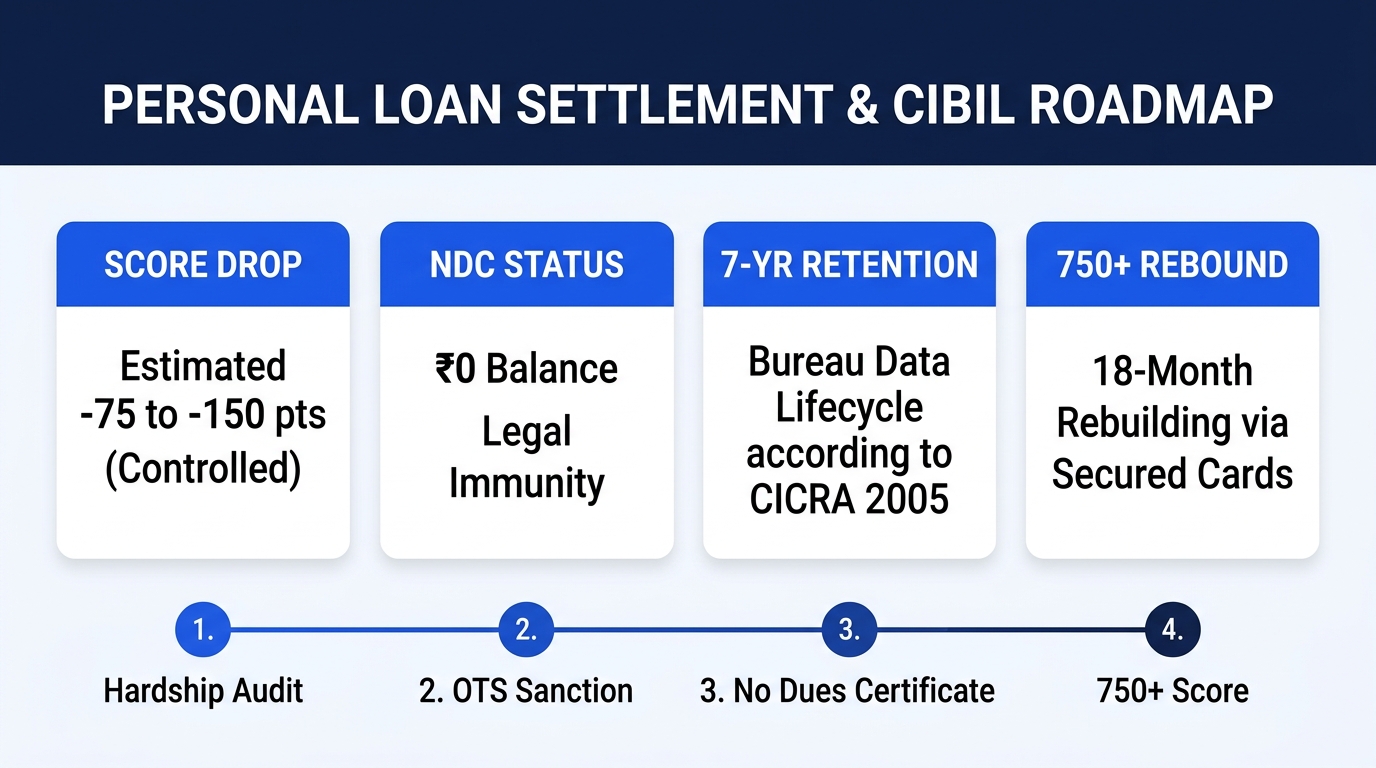
- Score Impact: Settling a personal loan triggers a one-time drop of 75 to 150+ points in your CIBIL score due to the write-off waiver reported by the lending bank.
- Status Distinction: The account status changes from default to "Settled", proving you satisfied your negotiated legal liability and bringing balance to ₹0.
- 7-Year Retention: Under the CICRA Act 2005, the record stays for 7 years, but its negative underwriting impact wanes after 18 to 24 months with active credit rebuilding.
- Legal Immunity: Settlement eliminates compounding penal interest (up to 36% p.a.), halts continuous 180+ DPD degradation, and cancels pending litigation under Section 138 of the NI Act.
- Conversion Path: If your cash flow recovers in future years, you can pay the waived balance to convert your CIBIL status permanently from "Settled" to "Closed".
1. What Happens to Your CIBIL Score After Loan Settlement?
When faced with overwhelming unsecured debt, borrowers frequently ask: "does personal loan settlement affect CIBIL permanently, and is it worse than falling behind on EMIs?" To understand the algorithmic reality, one must analyze how Credit Information Companies (CIBIL, Experian, CRIF High Mark, and Equifax) process loan settlement data submitted by member banks.
"In Indian banking jurisprudence, a One-Time Settlement (OTS) is a legally binding compromise wherein the lender accepts a lump-sum payment lower than the contractual outstanding ledger and foregoes recovery of the residual balance, reporting the account as 'Settled' to Credit Information Bureaus."
— Banking Regulation Act, 1949 & RBI Compromise Settlement Guidelines (2023)
When a borrower undergoes a structured One-Time Settlement (OTS), the immediate algorithmic consequence is a credit score drop ranging between 75 and 150 points. For instance, a borrower with a 720 score may see their score dip to approximately 570–610 once the settlement is recorded.
However, this must be evaluated against the alternative: Continuous Default. When you miss EMIs without a settlement:
- Your Days Past Due (DPD) counter advances from 030 to 060, 090 (NPA classification), and escalates past 180+.
- The bank levies monthly penal interest rates (often compounding at 24% to 36% per annum), causing your total liability to double or triple.
- Your CIBIL score continues a relentless, uncontrolled free-fall into the sub-500 territory.
- The bank initiates aggressive litigation: Section 138 cheque bounce complaints, Section 25 NACH dishonour proceedings, or civil money recovery suits.
By entering into a formal OTS, you trade an uncontrolled, perpetual credit degradation for a controlled, one-time score adjustment. The moment the settlement is completed, the DPD counter stops, the active balance is set to zero, and the foundation for credit rehabilitation is solidified.
Comparison: Personal Loan Settlement vs. Alternative Outcomes
| Resolution Pathway | CIBIL Score Impact | CIBIL Status Code | Legal & Penal Status | Time to 750+ Rebuild |
|---|---|---|---|---|
| Standard Loan Closure | +20 to +50 pts (Positive) | "Closed" | 100% Repaid; Zero Legal Risk | Immediate Prime Status |
| One-Time Settlement (OTS) | -75 to -150 pts (Controlled) | "Settled" / Balance: ₹0 | Legal Immunity; Interest Capped | 18 to 24 Months |
| Loan Restructuring | -30 to -60 pts | "Restructured" | Extended Tenure; Interest Accrues | 12 to 18 Months |
| Continuous Default / NPA | -200 to -350 pts (Ongoing) | "Written Off" / "Suit Filed" | Active Section 138/Court Notices | Indefinite (Unrepaired) |
2. CIBIL Statuses: Closed vs Settled vs Written Off
Credit reports in India utilize precise terminology governed by the Credit Information Companies (CIC) Regulations. When reviewing your TransUnion CIBIL CIR (Credit Information Report), understanding these exact account markers is vital to assessing your standing.
1. "Closed" (Pristine Health)
The borrower repaid 100% of the loan principal, contractual interest, and associated fees over the agreed tenure. No concession was sought or given. Lenders view this as the highest benchmark of creditworthiness.
2. "Settled" (Compromise Resolution)
The borrower encountered genuine financial hardship (e.g., job loss, medical emergency, business loss), and the bank sanctioned an OTS. A discounted payment was accepted, the remaining balance was waived, and the account balance is recorded as ₹0 with no further recovery rights.
3. "Written Off" (Unresolved Loss)
The lender deemed the unpaid loan uncollectible after 180+ days of default and moved the entire outstanding balance to their internal bad-debt accounting ledger (write-off). The borrower has not settled, and recovery agencies or asset reconstruction companies (ARCs) may still pursue recovery.
4. "Suit Filed" / "Willful Defaulter" (Legal Action Active)
The highest tier of credit delinquency. The bank has initiated formal judicial recovery proceedings in the Debt Recovery Tribunal (DRT), Civil Courts, or filed criminal complaints under Section 138 of the Negotiable Instruments Act. A "Willful Defaulter" tag bars the individual from holding directorships or accessing any regulated credit in India.
Check Your Loan Settlement Options
Answer 2 quick questions to evaluate your settlement eligibility.
1. What type of loan do you want to settle?
CIBIL Account Status Codes & Underwriting Risk Assessment
| Status Terminology | Outstanding Balance | Legal Liability | Tier-1 Bank Eligibility | Secured Loan Eligibility |
|---|---|---|---|---|
| Closed | ₹0 (Fully Paid) | None (Discharged) | Immediate / Instant | 100% Eligible |
| Settled | ₹0 (Waived via OTS) | None (Full & Final NDC) | Restricted (18-24 Mo) | Immediate with Collateral |
| Written Off | Full Amount + Penalties | Active Debt Liability | Strict Rejection | Subject to High Scrutiny |
| Suit Filed / Wilful Default | Full Amount + Legal Fees | Pending Litigation / Warrants | Absolute Blacklist | Strict Rejection |
3. The 7-Year Rule: How Long 'Settled' Stays on CIBIL
A primary source of anxiety for borrowers considering debt settlement is the lifespan of the adverse remark. Under Section 20 of the Credit Information Companies (Regulation) Act, 2005, CICs are legally authorized to maintain historical credit records for a period of up to seven (7) years from the date of closure or settlement.
However, there is a critical distinction between historical data retention and active credit scoring algorithm weight:
How Underwriting Models Decay the Negative Weight of Settlement Over Time:
Months 0 – 12
High Scrutiny Period: Prime banks automatically reject unsecured applications. Focus strictly on disciplined secured credit usage.
Months 13 – 24
Rehabilitation Window: Negative weight declines. Fintechs and Tier-2 NBFCs approve credit cards and small consumer loans.
Months 25 – 36+
Prime Recovery: CIBIL score can cross 750+. Home loans, auto loans, and standard personal loans become fully accessible.
Credit evaluation algorithms place over 70% of their scoring weight on the most recent 24 to 36 months of repayment history. If your recent track record reflects 100% on-time payments, the historical 5-year-old "Settled" remark loses its prohibitive power during manual credit underwriting.
4. Can You Ever Get a Personal Loan, Credit Card, or Home Loan Again?
The short answer is yes, you can qualify for loans and credit cards again after settling a personal loan, but your approach must be strategic and phased.
Here is how different categories of credit instruments treat a post-settlement profile:
Secured Credit Cards (FD-Backed): Available Day 1
Because these cards are secured against a 100% cash fixed deposit (e.g., ₹25,000–₹1,00,000), banks do not perform underwriting checks on your past CIBIL status. The card reports monthly to TransUnion CIBIL as an active, standard credit line, generating positive repayment marks.
Home Loans & Mortgage Loans: Accessible After 24–36 Months
Housing finance companies (HFCs) and public sector banks evaluate the Loan-to-Value (LTV) ratio of the property and your current debt-to-income ratio. If your post-settlement score has rebounded above 720 and you provide your No Dues Certificate, home loans are routinely sanctioned.
Unsecured Personal Loans: Accessible After 24 Months
While the original lending bank that absorbed the haircut will internally blacklist you for future unsecured products, other non-consortium banks and NBFCs will evaluate your renewed 750+ score and approve personal loans based on stable income and low credit utilization.
5. RBI Guidelines & Borrower Rights in Compromise OTS
Many distressed borrowers are unaware that loan settlement is not an act of charity by the bank—it is a formalized, statutory mechanism governed by Reserve Bank of India (RBI) circulars and protected under Indian consumer and banking law.
RBI Master Direction on Compromise Settlements (June 2023)
The RBI explicitly directed all commercial banks, NBFCs, and All-India Financial Institutions to put in place board-approved compromise settlement policies. It formalized that regulated entities can enter into compromise settlements without prejudice to commercial prudential norms.
RBI Fair Practices Code & Recovery Agent Guidelines
Under the Master Circular on Recovery Agents, lenders are strictly prohibited from: calling borrowers before 8:00 AM or after 7:00 PM, contacting friends/family or employers, using abusive language, or visiting homes without prior formal notice. Any violation makes the lender liable to severe penalties under the Integrated Ombudsman Scheme.
Supreme Court Ruling on Debtor Dignity (ICICI Bank vs. Prakash Kaur)
The Hon'ble Supreme Court established that banks cannot utilize musclemen or coercive recovery tactics to recover dues. Recovery must strictly adhere to the rule of law and statutory dispute resolution mechanisms.
6. NDC Forensic Audit & 45-Day CIBIL Reporting Mandate
A critical pitfall that traps thousands of Indian borrowers is paying a settlement amount based on verbal promises or informal WhatsApp messages from third-party recovery agents, only to find months later that the bank still shows an active default.
THE 3 MANDATORY RULES OF AUTHENTIC LOAN SETTLEMENT:
- Rule 1: Never pay a single rupee without an official OTS Sanction Letter issued on the bank's registered letterhead, containing your loan account number, sanctioned settlement figure, payment schedule, and authorized signatory signature.
- Rule 2: All payments must be deposited directly into your designated loan account number via NEFT/RTGS/NetBanking. Never make payments to individual collection agency accounts or in cash.
- Rule 3: Demand your formal No Dues Certificate (NDC) / Closure Certificate within 15 to 30 days of the final payment.
As mandated by RBI guidelines, once the NDC is issued, the bank must transmit the updated status to all four Credit Information Companies (CIBIL, Experian, CRIF, Equifax) in their next monthly reporting cycle (within 30 to 45 days).
If the bank fails to report the settlement or erroneously reports an overdue balance, you have the statutory right to raise a dispute on the TransUnion CIBIL portal, followed by an immediate escalation to the Banking Ombudsman under Clause 11 of the Integrated Ombudsman Scheme, 2021.
7. From 550 to 750+: The Step-by-Step Credit Rebuilding Blueprint
A personal loan settlement is not a financial death sentence—it is a financial reset button. With a disciplined 5-pillar rebuilding strategy, you can reliably restore your CIBIL score to prime status (750+) within 18 to 24 months.
36-Month CIBIL Score Recovery Blueprint
| Timeline Milestone | Strategic Action Plan | Target Credit Instruments | Projected CIBIL Score |
|---|---|---|---|
| Month 0 – 3 | Obtain NDC, verify ₹0 balance across all 4 bureaus, file disputes for errors | ₹25,000 Secured FD Card (IDFC WOW / Kotak 811) | 560 – 600 |
| Month 4 – 12 | Maintain Credit Utilization Ratio (CUR) strictly below 25%; zero late marks | Secured Card + Utility Bill Autopayments | 640 – 690 |
| Month 13 – 24 | Introduce a low-ticket installment loan to diversify credit mix | Fintech Consumer Durable Loan / 2-Wheeler Loan | 710 – 745 |
| Month 25 – 36+ | Full prime eligibility achieved; apply for standard unsecured loans | Unsecured Credit Cards, Auto Loan, Prime Home Loan | 750 – 790+ (Prime) |
Pillar 1: Keep Credit Utilization Ratio (CUR) Below 30%
If your secured credit card has a limit of ₹50,000, never spend more than ₹15,000 in any billing cycle. High credit utilization signals credit hunger and penalizes your score.
Pillar 2: Zero Hard Inquiries for 12 Months
Do not apply for multiple loans or cards across various bank portals. Each hard inquiry deducts 5–10 points from your score and flags you as a desperate borrower.
Pillar 3: Diversify Your Credit Mix Over Time
A healthy credit portfolio consists of both revolving credit (credit cards) and installment credit (secured auto or consumer durable loans). Adding an installment loan in year 2 enhances your credit score stability.
8. Settled to Closed: Paying Balance Later to Clean CIBIL
A unique legal provision in Indian credit reporting allows borrowers whose financial situation improves to convert a past "Settled" account into a 100% clean "Closed" account.
Here is the step-by-step conversion protocol:
- Request Ledger of Write-Off: Contact the Stressed Asset Resolution Branch (SARB) or Nodal Officer of the original lending bank and request the exact written-off balance amount.
- Submit Formal Repayment Letter: Submit a formal letter stating your intent to pay the residual principal/interest waiver to achieve a status modification from "Settled" to "Closed".
- Pay Balance & Obtain Revised NDC: Deposit the residual funds and obtain a Comprehensive Final No Dues Certificate that explicitly mentions full closure.
- Bank Updates CIC Bureaus: The bank submits an account status change to TransUnion CIBIL, Equifax, Experian, and CRIF High Mark in their monthly data upload.
- CIBIL Updates Status to "Closed": Within 30 to 45 days, the "Settled" flag is removed, and your CIBIL record displays "Closed", completely restoring your institutional credit eligibility.

Settle Loan is India's trusted debt relief and loan settlement platform. We help borrowers overcome financial distress by negotiating with banks and NBFCs to legally settle personal loans and credit card debts. With our transparent, performance-based approach, you can achieve debt freedom and regain your financial peace of mind.
COMPUTER
9. Frequently Asked Questions (FAQ)
Get immediate answers to the most critical legal, financial, and credit score questions regarding personal loan settlement in India.
Yes, personal loan settlement directly impacts your CIBIL score. When an account is settled via a One-Time Settlement (OTS), the lender waives a portion of the principal, accumulated interest, and penal charges. Consequently, the bank reports the account status as "Settled" rather than "Closed". This leads to an immediate drop of 75 to 150+ points in your credit score. However, settling stops compounding default penalties, removes active litigation threats under Section 138/SARFAESI, and creates a defined baseline to rebuild back to 750+ within 18 to 24 months.
A "Closed" status signifies that the borrower fulfilled 100% of their contractual repayment obligations, including all principal and accrued interest, without any financial loss to the lending institution. This builds a pristine credit score. In contrast, a "Settled" status indicates that due to demonstrated financial distress, the bank agreed to accept a discounted compromise payment and wrote off the balance as a commercial loss. While both statuses legally conclude the debt and halt recovery actions, automated underwriting algorithms at prime banks treat "Settled" as an indicator of past default risk.
Under the provisions of the Credit Information Companies (Regulation) Act, 2005 (CICRA), all four licensed credit bureaus in India—TransUnion CIBIL, Experian, CRIF High Mark, and Equifax—are permitted to retain historical credit data for up to 7 years. However, credit scoring algorithms weigh recent payment behavior far more heavily than historical records. By maintaining 100% on-time payments on secured credit instruments, the negative weight of the "Settled" tag drops dramatically after 18 to 24 months.
Immediately following a settlement, prime public and private sector banks will reject unsecured personal loan or premium credit card applications due to automated credit filters. However, you can immediately obtain a Fixed Deposit (FD)-backed secured credit card or a secured gold loan. After demonstrating 12 to 18 months of disciplined repayment on secured lines, progressive NBFCs and fintech lenders will begin approving small unsecured credit lines, and home loan eligibility re-opens after 24 to 36 months.
Yes, you can convert a "Settled" status to "Closed". If your financial liquidity improves, you can approach the original lender with a formal request to pay the balance amount that was waived during the OTS negotiation. Upon receiving the residual payment, the bank will cancel the write-off ledger, issue a Comprehensive Final No Dues Certificate, and transmit an updated status of "Closed" to TransUnion CIBIL and other credit bureaus within 30 to 45 days.
Settlement is overwhelmingly superior to perpetual default. A continuous default generates compounding 24%–36% penal interest, mounts consecutive 90+, 120+, 180+ Days Past Due (DPD) entries, invites aggressive recovery agent harassment, and triggers legal notices under Section 138 of the Negotiable Instruments Act or Section 25 of the PSS Act. Settlement caps your liability legally, halts interest permanently, protects you under the RBI Fair Practices Code, and stops the downward spiral of your credit score.
Under RBI Master Directives, commercial banks and NBFCs must report monthly credit updates to Credit Information Companies within 30 to 45 days. Once your final settlement tranche is paid and the bank issues the official No Dues Certificate (NDC), the account ledger should reflect "Settled" with a current balance of ₹0 in the subsequent bureau cycle.
If a lender mistakenly reports an active outstanding balance or delinquent DPD after issuing an OTS letter, this constitutes an actionable reporting violation. You should immediately file an online CIBIL Dispute providing your OTS Sanction Letter, payment transaction UTR receipts, and No Dues Certificate. If the bank fails to rectify the error within 30 days, you can lodge a formal grievance with the RBI Banking Ombudsman under the Reserve Bank - Integrated Ombudsman Scheme, 2021 for financial deficiency and mental harassment.
The most effective strategy consists of five steps: 1) Secure a ₹25,000–₹50,000 FD-backed credit card (e.g., IDFC FIRST WOW, Kotak 811 Dream Different, or OneCard); 2) Utilize less than 30% of the credit limit monthly; 3) Automate full bill payments 5 days before the due date; 4) Avoid hard loan inquiries for at least 12 months; 5) Add a low-ticket consumer durable or 2-wheeler loan after month 12 to build a healthy credit mix.
Official Regulatory Sources & Legal Authorities
- Reserve Bank of India (RBI) — Master Directives on Compromise Settlements & Fair Practices Code
- TransUnion CIBIL — Credit Information Companies (Regulation) Act, 2005 Dispute Guidelines
- Supreme Court of India — Landmark Jurisprudence on Debtor Protection & Recovery Norms
- Insolvency and Bankruptcy Board of India (IBBI) — Individual Debt Resolution Framework
- eCourts Services — National Judicial Data Grid for Debt Recovery & Lok Adalat Awards