- Civil vs Criminal Boundary: Inability to repay bank installments represents a civil breach of contract; deploying criminal intimidation to recover funds is strictly unlawful.
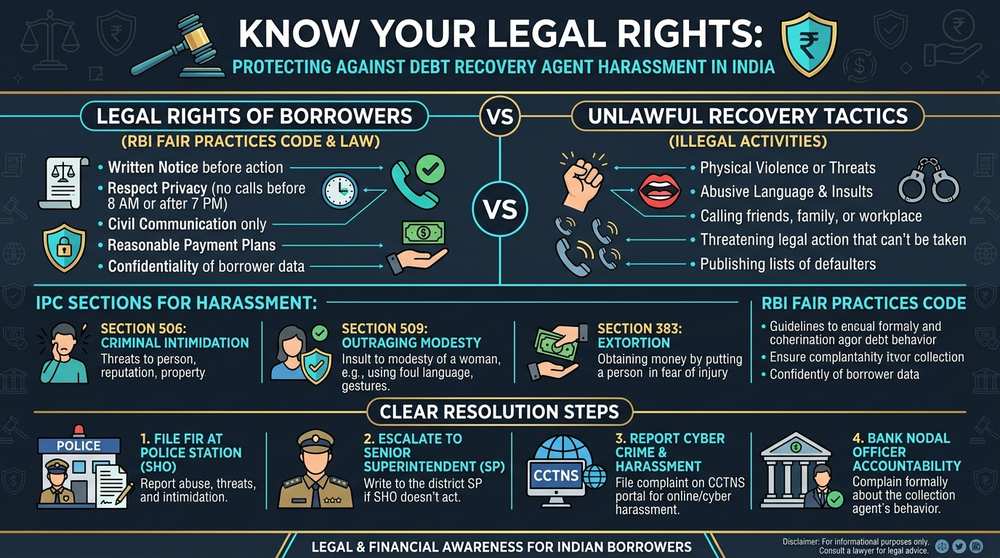
- Penal Code Applicability: Recovery agents uttering verbal threats, insulting female modesty, or trespassing face prosecution under IPC Sections 506, 509, 383, and 441.
- Mandatory Complaint Architecture: A legally effective police complaint must document specific dates, phone numbers, verbatim threats, and digital evidence logs.
- Vicarious Institutional Liability: Lenders cannot hide behind third-party collection agencies; Supreme Court rulings hold bank directors vicariously accountable.
- Strategic OTS Transition: Formal police and regulatory complaints neutralize aggressive coercion, forcing institutional lenders into structured debt compromise talks.
1. Recovery Agent Harassment & Criminality Threshold
Across the Indian retail credit landscape, unexpected financial setbacks—such as involuntary job separation, severe enterprise cash flow disruption, or debilitating health emergencies—often leave honest borrowers unable to meet scheduled Equated Monthly Installments (EMIs). When an unsecured personal loan or credit card facility remains overdue beyond ninety days, banking institutions classify the ledger exposure as a Non-Performing Asset (NPA). In an effort to bypass the procedural duration and cost of formal civil litigation, financial institutions frequently assign these delinquent accounts to third-party collection and recovery agencies.
A critical legal boundary separates legitimate recovery from actionable criminal conduct. A loan agreement under the Indian Contract Act, 1872, is purely a civil commercial contract. The lender’s lawful remedies are confined to civil suits under Order 37 CPC, commercial arbitration, or DRT cases. When recovery agents resort to physical stalking, abusive calls, threats of violence, or social humiliation, their actions become penal offenses under the Indian criminal justice system.
The Constitution of India under Article 21 guarantees every citizen the fundamental right to life, dignity, and personal liberty. Financial default does not strip an person of these constitutional safeguards. Coercive recovery tactics deployed by banks or third-party collection agencies violate fundamental privacy and personal safety rights established by the Supreme Court of India.
2. Penal Framework: IPC Sections & Bharatiya Nyaya Sanhita
When drafting a formal criminal complaint to be lodged with local law enforcement, precision in statutory citations is paramount. The Indian Penal Code (IPC), along with corresponding provisions under the Bharatiya Nyaya Sanhita (BNS), provides robust penal remedies against abusive recovery practices. Each specific coercive act committed by collection agents triggers distinct statutory provisions:
Section 506 IPC / Section 351 BNS
Criminal Intimidation: Punishes anyone who threatens another with injury to their person, reputation, or property. If the threat involves death, grievous hurt, or destruction of property, the offense carries imprisonment for up to seven years.
Section 509 IPC / Section 79 BNS
Insulting Modesty of Women: Applies directly when recovery agents use indecent language, obscene gestures, or verbal intimidation against female borrowers, spouses, mothers, or daughters, carrying rigorous imprisonment.
Section 383 & 384 IPC / Section 308 BNS
Extortion: Intentionally putting any person in fear of injury or public disgrace to dishonestly induce the delivery of valuable property or money constitutes criminal extortion punishable with up to three years imprisonment.
Section 441 & 447 IPC / Section 329 BNS
Criminal Trespass: Entering private residential property or commercial offices unlawfully with the intent to intimidate, insult, or annoy the occupant constitutes an actionable criminal trespass offense.
In addition to these core provisions, complaints cite Section 504 IPC (Intentional insult) and Section 354D IPC (Stalking). These sections apply when recovery agents make continuous abusive calls or track the physical movements of borrowers and their family members.
3. Structuring an Actionable Police Complaint
A police complaint submitted to the Station House Officer (SHO) of your local territorial police jurisdiction must be drafted with analytical precision. Vague allegations of general distress are often dismissed as civil disputes. To ensure law enforcement registers a General Diary (GD) entry or First Information Report (FIR), the complaint narrative must be structured methodically around concrete factual and legal elements.
Essential Structural Sections of the Legal Complaint
1. Formal Jurisdiction & Addressee Block
Addressed formally to "The Station House Officer, [Name of Local Police Station, City/District]" with full complainant identification, residential address, Aadhaar number, and active contact credentials.
2. Clear & Specific Subject Line
"Complaint against illegal criminal intimidation, verbal abuse, unlawful trespassing, and extortion by recovery agents of [Lending Bank/NBFC Name]. Filed under Sections 506, 509, 383, 441, and 504 of the Indian Penal Code and the RBI Fair Practices Code."
3. Commercial Relationship Context
Briefly outline the underlying credit facility: Loan Account Number, principal disbursed, regular EMIs serviced before default, and the genuine situations causing temporary financial distress (e.g., job loss, medical emergency).
4. Chronological Fact Matrix & Incident Log
Document each incident in chronological sequence: exact dates, specific timestamps, originating telephone numbers, names of visiting agents, verbatim abusive language or physical threats uttered, and names of family members or colleagues targeted.
5. Regulatory Violation Breakdown
Explicitly detail how the conduct violates RBI Master Direction DOR.ORG.REC.65/21.04.158/2022-23 prohibiting calls before 8:00 AM or after 7:00 PM, workplace harassment, and disclosure of financial defaults to third parties.
6. Evidentiary Annexures Index
Enclose and cross-reference certified Annexures: Call Detail Records (CDRs), pen-drive containing high-definition audio recordings, transcriptions of WhatsApp messages, screenshots of fake legal summons, and CCTV security footage.
7. Explicit Relief & Prayer Clause
Specifically pray for: (a) Immediate registration of an FIR against the recovery agents and lending institution. (b) Initiation of formal inquiry under Section 156 CrPC. And (c) Immediate issuance of restraining directions to ensure life and liberty protection.
Presenting law enforcement with a statutory complaint and structured evidentiary annexures is vital. It eliminates the standard police claim that the matter is merely civil. This compels investigating authorities to start a formal inquiry.
4. Evidentiary Audit: CDRs, Audio Logs & CCTV Forensics
In modern criminal jurisprudence, contemporaneous electronic evidence forms the bedrock of an unassailable prosecution. Collection agencies often operate through outsourced tele-callers using VoIP applications, spoofed virtual numbers, or rotating SIM cards. To legally bind both the person perpetrator and the principal lending bank, the complainant must construct an airtight digital audit trail.
Under Section 65B of the Indian Evidence Act, 1872 (now Section 63 BSA), electronic records are admissible when accompanied by a statutory certificate. Borrowers must record incoming recovery calls and preserve raw audio files. In addition, capture screenshots displaying caller IDs with timestamps, and secure CCTV recordings showing unauthorized entry.
Where C_t represents estimated recoveries across time periods t, r is the institutional cost of capital discount rate, and deductions account for 3–5 years of court friction, advocate fees, and locked regulatory provisioning capital.
When a borrower exposes this institutional calculus through formal legal pushback, banks recognize that continuing unlawful recovery tactics generates catastrophic liability. Under RBI provisioning mandates, a classified NPA forces 15% to 100% capital lock-in. Facing potential criminal exposure and high litigation friction, the bank's risk committee is commercially incentivized to settle the account at a steep discount.
6. Police Escalation Ladder: CrPC & BNSS Procedures
Local police stations sometimes hesitate to register an FIR against recovery agencies, directing borrowers to settle with the bank. The Code of Criminal Procedure establishes a strict escalation mechanism to overcome administrative inaction:
Tier 1: Formal Submission to Local SHO (Section 154(1) CrPC / Section 173 BNSS)
Submit two physical copies of the complaint to the Station House Officer. Obtain a stamped receiving acknowledgment with date and General Diary (GD) reference number on the duplicate copy.
Tier 2: Escalation to Superintendent of Police (Section 154(3) CrPC / Section 173(4) BNSS)
If the SHO fails to act within 72 hours, send the complete complaint docket via Registered Post with Acknowledgment Due (RPAD) directly to the District Superintendent of Police (SP) or Deputy Commissioner of Police (DCP).
Tier 3: Judicial Magistrate Application (Section 156(3) CrPC / Section 175(3) BNSS)
If police authorities remain passive, your legal counsel files an application before the Chief Judicial Magistrate (CJM). Counsel presents postal receipts and requests a judicial directive ordering the police to register an FIR and submit a compliance report.
Tier 4: Simultaneous Cyber Crime & Nodal Escalation
Lodge a digital complaint on the National Cyber Crime Reporting Portal (cybercrime.gov.in) for telephonic harassment, while serving formal legal notices to the bank's Principal Nodal Officer and the RBI Integrated Ombudsman.
7. Holding Bank Directors & Nodal Officers Accountable
A frequent defense raised by commercial banks and NBFCs is that collection agencies are independent third-party contractors, attempting to insulate corporate management from criminal liability. Indian judicial precedent has decisively rejected this corporate shielding doctrine.
In the landmark ruling ICICI Bank Ltd. v. Prakash Kaur (2007) 2 SCC 711, the Supreme Court of India severely reprimanded the banking industry for deploying musclemen and recovery goons to terrorize defaulters. The apex court affirmed that banks are vicariously liable for every tortious and criminal act committed by their authorized recovery agents. This principle was further reinforced in Manager, ICICI Bank Ltd. v. Prakash Kaur and subsequent RBI circulars, establishing that the Principal Nodal Officer, Head of Retail Lending, and Managing Director can be joined as co-accused in complaints alleging institutional extortion and harassment.
When a formal police complaint explicitly names the bank's senior executives and references the RBI Master Direction on Outsourcing of Financial Services, the institution’s legal compliance division immediately intervenes. The collection file is abruptly recalled from aggressive third-party agencies to insulate senior management from regulatory sanctions and judicial summons.
8. Transitioning Criminal Defense into Structured OTS
Filing a statutory police complaint is not merely a defensive maneuver to stop unlawful harassment—it serves as the foundational catalyst for achieving an advantageous, conclusive debt settlement. Once the aggressive third-party agency is neutralized by criminal pushback, the lending bank is forced to transition the account from extra-judicial intimidation to lawful commercial talks.
At this juncture, specialized debt defense advocates step in to execute a structured settlement protocol:
1. Hardship Dossier Presentation
Submitting certified income loss records, medical dossiers, or business termination proofs directly to the bank’s internal Zonal Compromise Committee.
2. Principal Waiver talks
Leveraging the lender’s regulatory vulnerability to secure a 45% to 65% waiver on outstanding ledger balances, completely eliminating accumulated penal interest.
3. Official Sanction Letter Verification
Ensuring the One-Time Settlement (OTS) letter is issued directly on official bank letterhead with unique verification numbers, explicit waiver terms, and structured installment dates.
4. Stamped NDC & CIBIL Reconciliation
Remitting settlement amounts directly to the bank loan account and securing a stamped No Dues Certificate within 30 days under RBI Circular RBI/2023-24/60.
By pairing criminal defense protections with experienced commercial talks, borrowers achieve permanent debt freedom without succumbing to intimidation or compromising their dignity.
9. Harassment Redressal & Enforcement Comparative Matrix
The following comparative matrix outlines the legal forums, governing statutes, enforcement timelines, and typical outcomes available to borrowers facing recovery agent harassment across India:
| Enforcement Forum | Governing Statutory Law | Primary Jurisdiction | Enforcement Timeline | Typical Redressal Outcome |
|---|---|---|---|---|
| Local Police Station (SHO) | IPC 506, 509, 383 / CrPC 154 | Local Territorial Police | 24 to 72 Hours | GD Entry, FIR registration, physical harassment halted |
| District Superintendent (SP) | Section 154(3) CrPC / BNSS | District Police Headquarters | 7 to 15 Days | Direct supervisory probe ordered on rogue agency |
| Judicial Magistrate Court | Section 156(3) / 200 CrPC | Metropolitan / Judicial Magistrate | 30 to 60 Days | Court-mandated FIR and formal police inquiry |
| RBI Integrated Ombudsman | RBI Ombudsman Scheme 2021 | Reserve Bank of India Portal | 30 to 45 Days | Institutional penalty, borrower relief up to ₹20L |
| Bank Zonal OTS Committee | RBI Compromise Framework | Lender Legal & Recovery Division | 15 to 30 Days | Official OTS sanction letter with 45%–65% waiver & NDC |
10. SettleLoans Legal Ecosystem: Restoring Dignity
Navigating collection tactics, false police threats, and banking regulations requires seasoned legal advocates. SettleLoans stands as India’s foremost debt defense platform. We safeguard borrowers from harassment while negotiating binding One-Time Settlements. Our team serves cease-and-desist notices, prepares police complaints under IPC Sections 506 and 509, files escalations with the RBI Ombudsman, and secures large principal waivers backed by official No Dues Certificates.

Settle Loan is India's trusted debt relief and loan settlement platform. We help borrowers overcome financial distress by negotiating with banks and NBFCs to legally settle personal loans and credit card debts. With our transparent, performance-based approach, you can achieve debt freedom and regain your financial peace of mind.
COMPUTER
11. FAQs: Police Complaints Against Recovery Harassment
Clear, legally verified answers regarding recovery agent harassment, police complaint formats, IPC sections, and borrower rights under Indian law.
Can I legally file a police complaint against a bank loan recovery agent in India?
Yes. While loan default itself is a civil contractual matter, any act of criminal intimidation, verbal abuse, stalking, physical assault, extortion, unauthorized trespassing into private premises, or contacting third parties constitutes a cognizable penal offense under the Indian Penal Code (Sections 506, 509, 383, 441) and corresponding provisions of the Bharatiya Nyaya Sanhita (BNS). You have the constitutional right to lodge a formal complaint at your local police station.
Which IPC sections apply to debt recovery agent harassment and abuse?
Key penal provisions include Section 506 (Criminal Intimidation), Section 509 (Word, gesture or act intended to insult the modesty of a woman), Section 383/384 (Extortion through coercion), Section 441/447 (Criminal Trespass into residential premises), Section 504 (Intentional insult with intent to provoke breach of peace), and Section 354D (Stalking and continuous digital surveillance).
What essential details must be included in a police complaint against recovery agents?
A legally robust complaint must include: your full identity and address; loan account details with the principal lender; chronological timeline of harassment incidents; exact dates, times, and phone numbers used; specific verbal threats or physical actions; names of agents if disclosed; digital evidence (call recordings, WhatsApp screenshots, CCTV footage); citations of violated IPC sections and RBI Fair Practices Code; and a specific prayer requesting an FIR or GD entry.
What should I do if the local Police Station (SHO) refuses to accept my complaint?
If the Station House Officer (SHO) refuses to register your complaint, you should immediately send the written complaint via Registered Post with Acknowledgement Due (RPAD) to the Superintendent of Police (SP) or Deputy Commissioner of Police (DCP) under Section 154(3) CrPC (Section 173(4) BNSS). If inaction persists, your advocate can file an application before the Judicial Magistrate under Section 156(3) CrPC (Section 175(3) BNSS) to direct police inquiry.
Are recovery agents permitted to visit my office or contact my employer?
No. The Reserve Bank of India Master Directions explicitly prohibit recovery agents from visiting a borrower's workplace unless specifically authorized in writing, or disclosing loan default details to colleagues, supervisors, or human resource managers. Such conduct violates borrower privacy rights protected under the Puttaswamy Supreme Court judgment and constitutes actionable defamation.
What are the permissible hours for debt recovery agents to call or visit?
Under RBI Master Circulars and Directions on Fair Practices Code, recovery personnel and outsourced collection agencies can only contact or visit borrowers between 8:00 AM and 7:00 PM. Any phone calls, visits, or electronic messages outside these permitted hours constitute statutory harassment and regulatory violations.
Is the lending bank vicariously liable for the criminal acts of outsourced recovery agents?
Yes. In landmark rulings such as ICICI Bank Ltd. v. Prakash Kaur (2007), the Supreme Court of India established that banks and financial institutions are vicariously and legally responsible for the coercive actions, harassment, and strong-arm tactics deployed by their outsourced recovery agents. Complaints must name both the recovery agency and senior bank officials.
How does filing a police complaint assist in achieving a favorable debt settlement?
When a borrower formally documents collection malpractice through police complaints, RBI Ombudsman grievances, and advocate notices, the lending institution faces significant regulatory, reputational, and penal risks. To mitigate legal liabilities, bank legal departments typically withdraw aggressive collection agencies, transfer the file to internal settlement committees, and offer large principal waivers (often 45% to 65%) under an official One-Time Settlement (OTS).
Can recovery agents carry out asset seizure or confiscate personal belongings without a court order?
No. For unsecured personal loans and credit cards, lenders and their agents have zero legal authority to seize vehicles, household items, or property without a formal execution decree from a competent civil court. Any attempt to forcibly take possession of belongings constitutes criminal trespass, theft under Section 379 IPC, and extortion under Section 384 IPC.