- Independent Corporate Structure: SBI Cards &. Payment Services Limited is a separate listed NBFC. Local SBI bank branches cannot settle card balances.
- Banker's Lien Inapplicability: Under Section 171 of the Indian Contract Act, 1872, SBI Bank cannot freeze or debit savings accounts for credit card debts.
- Waiver of Compounding Finance Fees: High finance charges of 42% to 45% plus 18% GST and late fees are 100% cancelled in an OTS.
- Deep 60% to 70% Lok Adalat Haircuts: SBI Card settles delinquent accounts in National Lok Adalats with binding Civil Court Decrees.
- Mandatory 30-Day ₹0 NDC Delivery: Under RBI Circular RBI/2023-24/60, SBI Card must deliver a stamped No Dues Certificate within 30 days.
SBI Cards & Payment Services Limited
SBI Card is not a division of State Bank of India. SBI Cards &. Payment Services Limited is an independent, listed NBFC (CIN: L65999HR1998PLC034160). It has its own board and risk team at DLF Cyber City, Gurugram, Haryana.
Visiting a local SBI branch will not help. Branch staff have no power to alter card balances or approve settlements. All OTS requests must go to the central Stressed Assets Desk in Gurugram.
Under Section 171 of the Indian Contract Act, 1872, Banker General Lien applies only to the same entity. SBI Bank cannot freeze or debit your savings account for card dues.
The Mechanics of SBI Card Financial Escalation
SBI Card charges 3.50% to 3.75% per month. This equals 42% to 45% APR. On top of that, 18% GST applies to all finance charges and late fees. This creates a fast debt spiral.
Paying only the Minimum Amount Due (MAD) is a trap. About 80% of each payment goes toward interest and GST. Only a tiny fraction reduces your principal.
When payments stop, late fees of up to ₹1,300 per month get added. An audit separates actual purchase principal from inflated charges to set a baseline for OTS.
Check Your Loan Settlement Options
Answer 2 quick questions to evaluate your settlement eligibility.
1. What type of loan do you want to settle?
SBI Card Delinquency Lifecycle
SBI Card follows RBI rules to track default across DPD stages:
Stage 1: Days Past Due 1 to 30 (SMA-0)
Auto-calls and SMS reminders start. Card gets blocked. No principal waiver.
Stage 2: Days Past Due 31 to 60 (SMA-1)
Collection calls increase. Late fees pile up. Issuer demands full dues.
Stage 3: Days Past Due 61 to 90 (SMA-2)
Field visits begin. Pre-litigation notices are sent from Gurugram desks.
Stage 4: Days Past Due 91 to 180 (NPA)
Account becomes an NPA under RBI rules. File moves to Gurugram Stressed Assets Desk. Opens door to 45%–55% OTS waivers.
Stage 5: Days Past Due 181 to 365+ (Doubtful / Loss Asset)
Full loss provisioned. Lok Adalat referrals begin. Maximum 55% to 70% debt waivers unlocked.
Net Present Value (NPV) Recovery Modeling
SBI Card settles debts using Net Present Value (NPV). Under RBI rules, the lender compares immediate cash recovery against 3 to 6 years of slow court litigation.
Here C_t is the cash recovered over time. The letter r is the discount rate. Deductions cover court costs and bad loan reserves.
Realistic SBI Card Settlement Haircut Matrix by Card Product & Aging
| SBI Card Category. | default Aging. | Interest &. Fee Waiver. | Principal Haircut Range. | Target OTS Settlement. |
|---|---|---|---|---|
| SimplySAVE / SimplyCLICK. | 90 – 180 Days (NPA). | 100% All Penal APR &. Fees. | 40% – 50% Principal Waiver. | Pay 45%–55% of Principal. |
| SimplySAVE / SimplyCLICK. | 181 – 365+ Days (Doubtful/Loss). | 100% All Penal APR &. Fees. | 55% – 70% Principal Waiver. | Pay 30%–45% of Principal. |
| SBI Card PRIME / Elite. | 90 – 180 Days (NPA). | 100% All Finance Charges. | 35% – 50% Principal Waiver. | Pay 50%–60% of Principal. |
| SBI Card PRIME / Elite. | 180+ Days (Written Off). | 100% All Finance Charges. | 50% – 65% Principal Waiver. | Pay 35%–50% of Principal. |
| AURUM / Corporate Cards. | 180+ Days (Stressed Assets). | 100% Penal Fees &. Interest. | 45% – 60% Principal Waiver. | Pay 40%–55% of Ledger Dues. |
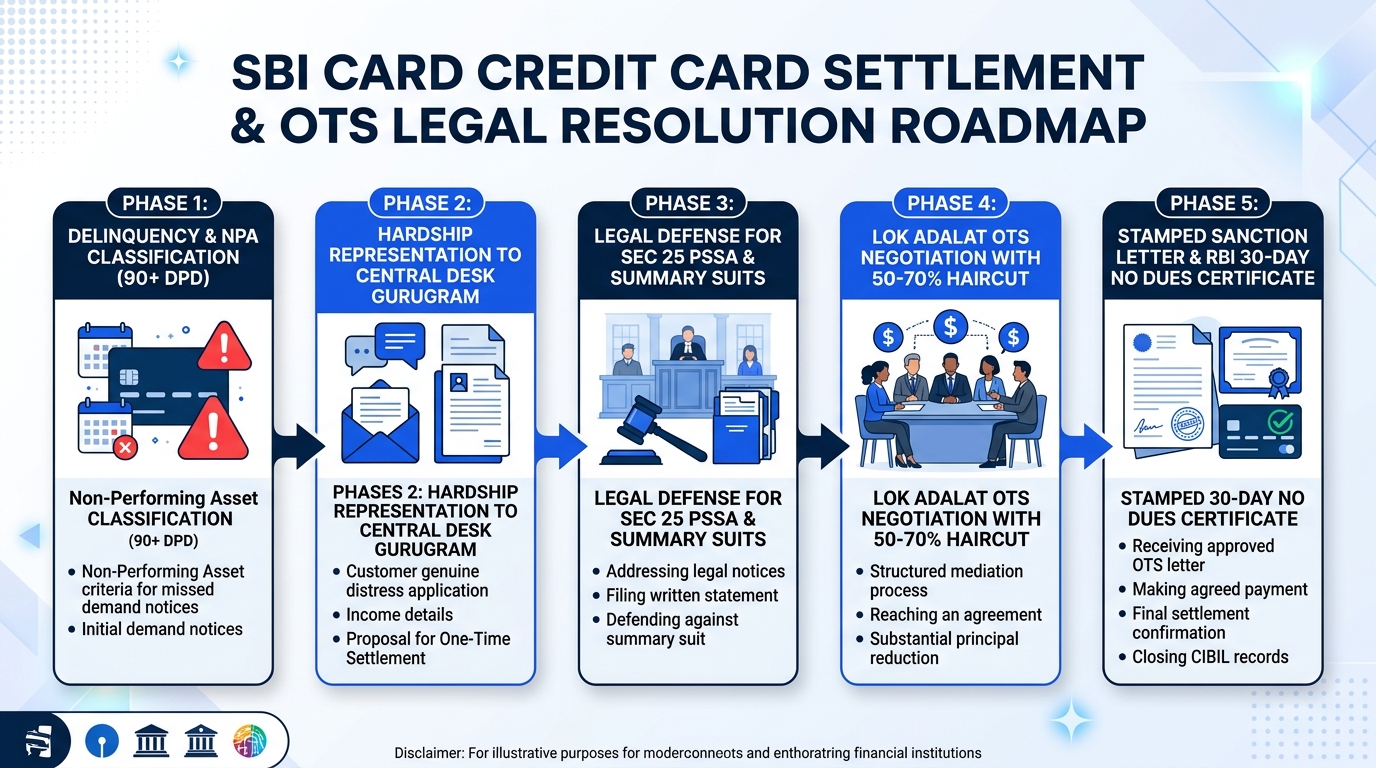
SBI Card Credit Card Settlement & Legal Resolution Roadmap
Demystifying SBI Card Gurugram Legal Notices
SBI Cards &. Payment Services Limited runs a centralized legal recovery team in Gurugram. When an account stays unpaid for over 90 days, borrowers get formal demand notices. These notices cite strict laws to demand quick payment.
Knowing how these legal steps work helps you reply calmly:
1. Section 25 Payment and Settlement Systems Act (PSSA), 2007: If an automated NACH debit fails, SBI Card sends a 15-day legal notice. This is a bailable matter handled by a local magistrate. It is not an arrest warrant. A timely legal reply explaining your financial hardship prevents court summons and helps secure a compromise settlement.
2. Summary Recovery Suits under Order 37 Code of Civil Procedure (CPC), 1908: SBI Card lawyers may file summary suits in civil court. You must enter an appearance within 10 days. You then file an Application for Leave to Defend. A lawyer can highlight heavy interest charges and procedural gaps. This prompts the court to grant leave to defend and push for mediation.
3. Section 138 Negotiable Instruments Act, 1881: If a physical cheque bounces, Section 138 actions may begin. These matters can be closed easily once both parties sign an official OTS pact.
Leveraging National Lok Adalats
SBI Cards &. Payment Services Limited joins National Lok Adalats set up by NALSA and state bodies. For borrowers seeking deep debt relief, Lok Adalat benches offer a safe and neutral platform.
SBI Card officers at Lok Adalats hold special approval to settle bad debts. A sitting or retired judge oversees every session. This ensures fair discussions without collection pressure. Bank managers routinely waive 100% of late fees, finance charges, and GST. They also offer 50% to 70% write-offs on the principal balance for genuine hardship cases.
Settlements made in Lok Adalat carry strong legal power. Under Section 21 of the Legal Services Authorities Act, 1987, a Lok Adalat order works as a final civil court decree. You pay no court fees, neither party can appeal. And the debt is closed for good.
Step-by-Step Strategic Roadmap
Follow these clear steps to secure a binding One-Time Settlement with SBI Card:
Download your card statements for the last 12 to 24 months. Separate your original purchase spends from finance charges, late fees, and GST. This reveals your true baseline debt.
Send a formal notice to the Principal Nodal Officer of SBI Card in Gurugram. Direct them to stop recovery calls to your workplace, relatives. And friends under RBI Fair Practices Codes.
Submit a formal hardship petition to the SBI Card central team or Lok Adalat. Attach clear proof like medical bills, pay cut letters, or bank statements.
Review counter-offers from SBI Card managers. Do not accept minor 10% discounts. Negotiate firmly for a 50% to 70% waiver based on account aging and your repayment capacity.
Check the official stamped OTS letter on SBI Card letterhead. Pay the agreed sum directly into your 16-digit card account via NEFT or RTGS.
SBI Card OTS Sanction Letter Forensics
Never pay settlement money based on phone calls or informal letters from recovery agents. illegal agents might keep your money or mark it as a part-payment. This leaves your debt open with ongoing interest.
Before paying any money, check these four vital items in your settlement letter:
- Official Corporate Letterhead: The letter must feature the official SBI Cards &. Payment Services Limited letterhead with CIN L65999HR1998PLC034160 and Gurugram office details.
- Complete Card Account Particulars: The letter must list your 16-digit card number, full name, total outstanding, agreed settlement amount. And payment due dates.
- Full &. Final Settlement Discharge Clause: The text must clearly state that paying this amount closes the account fully and withdraws all legal actions.
- Authorized Signatory Credentials: The letter must show the name, employee code, signature. And stamp of an authorized SBI Card manager.
Under Reserve Bank of India Circular RBI/2023-24/60, SBI Card must issue a formal No Dues Certificate (NDC) within 30 days of full payment. If the bank delays your NDC beyond 30 days without cause, it must pay you ₹5,000 for each day of delay.
SBI Card CIBIL Recovery & Credit Rebuilding
Knowing how settlement affects your credit score is vital. When SBI Card closes an account under OTS, it reports the status as 'Settled&apos. or 'Post-Write-off Settled&apos. to CIBIL and Experian with a ₹0 balance.
Your CIBIL score may drop by 75 to 140 points at first. However, settlement stops ongoing default tags and ends legal risk. You can rebuild your score back above 750 in 18 to 24 months:
| recovery Phase. | Target Timeline. | Primary Action Item. | Expected CIBIL Trajectory. |
|---|---|---|---|
| Phase 1: Zero Balance Audit. | Month 1 – 2. | Ensure CIBIL, Experian, and Equifax show a ₹0 balance. | Score stabilizes around 580–620. |
| Phase 2: Secured Credit Inception. | Month 3 – 6. | Get a small fixed-deposit (FD) backed card. | Score climbs to 650–680. |
| Phase 3: Utilization Discipline. | Month 7 – 12. | Keep total credit usage below 25% of your card limit. | Score crosses 700–720. |
| Phase 4: Prime Credit Restoration. | Month 13 – 24. | Pay all monthly bills and EMIs on time with zero delay. | Score reaches prime 750–780+. |

Settle Loan is India's trusted debt relief and loan settlement platform. We help borrowers overcome financial distress by negotiating with banks and NBFCs to legally settle personal loans and credit card debts. With our transparent, performance-based approach, you can achieve debt freedom and regain your financial peace of mind.
COMPUTER
SBI Card Credit Card Settlement: Frequently Asked Questions
What is the SBI Card credit card settlement process in India?
Can I settle my SBI credit card at a local State Bank of India (SBI) branch?
Can SBI Bank freeze my savings account if I default on an SBI Credit Card?
What percentage of waiver or haircut can I expect in an SBI Card settlement?
How do I handle a Section 25 PSSA legal notice from SBI Card legal counsel in Gurugram?
Can SBI Card initiate criminal proceedings or send police to my home for card default?
How can I resolve my SBI Credit Card dues through National Lok Adalat?
How do I stop recovery agent harassment and workplace visits from SBI Card agencies?
How does an SBI Card settlement affect my CIBIL score and how can I restore it?
How long does SBI Card take to issue a No Dues Certificate (NDC) after settlement?
Official Statutory & Regulatory References
- Reserve Bank of India (RBI): Master Direction – Credit Card and Debit Card – Issuance and Conduct Directions, 2022 (Updated 2026)
- RBI Master Circular: Prudential Framework for Resolution of Stressed Assets and Compromise Settlements
- SBI Cards &. Payment Services Ltd.: Grievance Redressal Policy, Most Important Terms &. Conditions (MITC) &. Nodal Officer Matrix
- Reserve Bank - Integrated Ombudsman Scheme, 2021: Online Complaint Portal for Card Harassment, Excessive Charges &. NDC Non-Compliance
- National Legal Services Authority (NALSA): Legal Services Authorities Act, 1987. National Lok Adalat Conciliation Framework