- Zero Right of Entry: Recovery agents have no court warrant or legal right to step into your home without your explicit consent.
- Criminal Trespass Offense: Forcing a door open or refusing to leave is criminal house-trespass under Section 329 BNS and Section 441/442 IPC.
- Constitutional Privacy Shield: The Supreme Court in Puttaswamy ruled that your home is a private zone protected under Article 21.
- Absolute Right to Shut the Door: You can refuse in-person talks, close your door, record any threats. And ask for legal notice in writing.
- Advocate Representation Stops Visits: A formal Cease-and-Desist notice stops doorstep visits under RBI rules and starts structured One-Time Settlement (OTS) talks.
1. The Doorstep Intrusion Reality
Defaulting on a personal loan or credit card is stressful. In many Indian cities, borrowers face unannounced home visits by recovery agents. Heavy knocking or doorbell ringing creates deep anxiety. Families worry that agents will barge inside, shout in front of neighbors, or harass elderly parents. This fear is common.
This fear comes from a lack of legal awareness. Collection agencies pretend to have official power. Agents wear uniforms, hold clipboards. And act tough. They falsely claim they have the right to enter your home or check your belongings. They hope you do not know the law.
Recovery agents are private contractors hired by banks. They have zero police or court powers. Under Indian law, your home is a private space. No agent can cross your doorway without your permission.
An unsecured loan default is a civil dispute under the Indian Contract Act, 1872. It is not a crime. It gives lenders no right over your house. A lender can only file a civil suit in court. When agents try to force entry, they commit a punishable crime.
2. Statutory Protections & Criminal Trespass
Indian law gives strong protection to private homes. The Bharatiya Nyaya Sanhita, 2023 (BNS) replaced the Indian Penal Code, 1860 (IPC). It sets strict jail terms for unlawful entry and trespass.
Under Section 329 BNS (Section 441 and Section 442 IPC), criminal trespass means entering private property to commit an offense or intimidate the owner. Staying on property unlawfully after being asked to leave is also a crime. When done in a home, it is house-trespass and brings jail time.
Statutory Penal Provisions Governing Unlawful Recovery Intrusions
Section 329 BNS / Section 441 &. 442 IPC: Criminal House-Trespass
An agent who steps into your home without consent commits house-trespass. Putting a foot in the door is also illegal. Every minute spent after you say 'leave&apos. adds to the crime.
Section 351 BNS / Section 503 &. 506 IPC: Criminal Intimidation
Threatening a borrower with physical harm or public shaming is criminal intimidation. It carries up to two years in prison.
Section 308 BNS / Section 383 &. 384 IPC: Extortion
Using fear or public shaming to force an instant payment is extortion under law.
Section 189 BNS / Section 141 IPC: Unlawful Assembly
If two or more agents gather outside your home to create a scene or block your door, it is unlawful assembly. Call the police at once.
The law is clear. No loan agreement clause can override criminal law. Even if a loan form mentions inspection visits, it gives no right to trespass. Forcing entry into your home is an actionable crime.
Check Your Loan Settlement Options
Answer 2 quick questions to evaluate your settlement eligibility.
1. What type of loan do you want to settle?
3. Right to Privacy & Supreme Court Precedents
Indian borrowers have strong constitutional rights. In Justice K.S. Puttaswamy (Retd.) v. Union of India (2017) 10 SCC 1, a 9-judge bench of the Supreme Court gave a historic ruling. It held that the Right to Privacy is a fundamental right under Article 21.
The court protected spatial privacy. Your home is a private sanctuary. You have the right to be left alone from uninvited visits and harassment. Private debt collectors have no right to break into this personal zone.
This ruling builds on earlier court verdicts. In ICICI Bank Ltd. v. Prakash Kaur &. Ors. (2007) 2 SCC 711, the Supreme Court ruled that banks cannot use musclemen to collect debts. Lenders must follow the rule of law and due process.
In Sardar Associates v. Punjab &. Sind Bank (2009) 8 SCC 257, the Supreme Court ruled that RBI guidelines have statutory binding force under Section 21 and Section 35A of the Banking Regulation Act, 1949. If agents violate RBI rules, the lender is directly liable for fines and damages.
4. RBI Fair Practice Code on Doorstep Recovery
The Reserve Bank of India sets strict rules for banks, NBFCs. And recovery agents. These rules come under the RBI Master Direction on Outsourcing and the Fair Practices Code.
The RBI bans aggressive, rude, or uninvited doorstep behavior. Under these master directions:
Mandatory RBI Recovery Code of Conduct Standards
Permissible Contact Hours (8 AM to 7 PM)
Agents can only call or visit between 8:00 AM and 7:00 PM. Early morning or late night visits violate RBI rules.
Mandatory Authorization &. Identity Verification
Every agent must show an ID card and a bank letter authorizing them for your specific loan account.
Absolute Prohibition on Force &. Public Shaming
Agents cannot use abusive words or shout in corridors. They cannot talk to neighbors or security guards about your debt.
Respect for Privacy &. Advocate Routing
If you ask to route talks through your legal counsel in writing, the lender and agents must comply.
Lenders are fully responsible for the actions of their recovery agents. A bank cannot blame an outside agency for bad conduct. Under the RBI Ombudsman scheme, banks face heavy fines and must pay payout up to ₹20 Lakhs for borrower harassment.
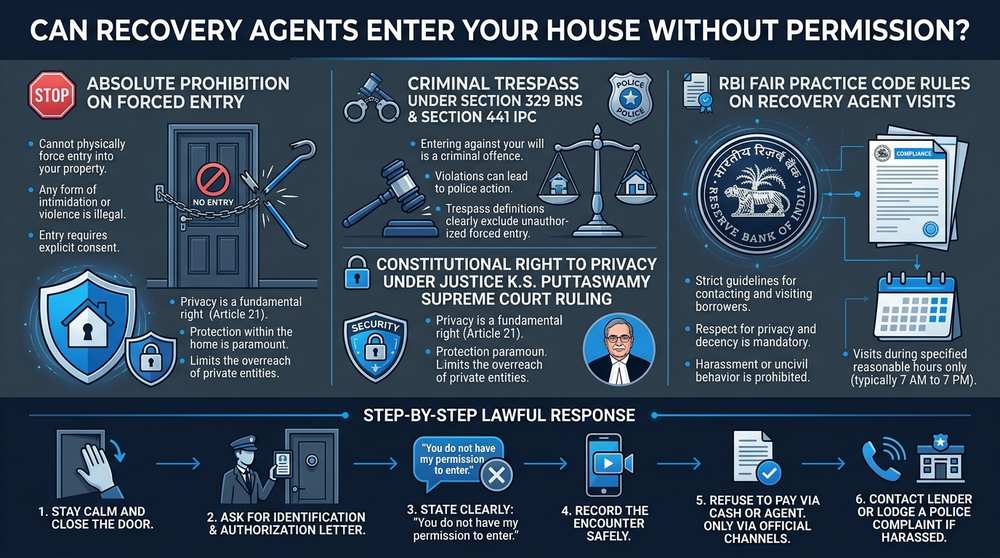
6. How to Lawfully Shut the Door
When agents show up at your door, stay calm. You do not need to shout or argue. Follow this simple 5-step legal protocol to protect your rights:
Step 1: Keep the Main Door Closed or Latched
Never open the door fully. Speak through a safety grill or latch. Do not invite them inside.
Step 2: Demand Official Identification &. Authorization
Ask the agent to show their agency ID and bank authorization letter. Take clear photos with your phone.
Step 3: State Explicit Refusal of Physical Entry &. Record
Record video on your phone. Say calmly: "You do not have permission to enter. Loan default is a civil matter. Please leave now."
Step 4: Refuse Cash or Informal Transactions
Never hand over cash, blank cheques, or make personal UPI transfers. All settlement payments go directly to the bank.
Step 5: Firmly Close the Door and Notify Legal Counsel
Close and lock your door. If they make noise, call 112 for police help. Send the video proof to your lawyer.
Closing your door on an agent is legal. It is not contempt of court. It gives the lender no right to file criminal cases. You are simply using your basic property rights.
7. Bank NPA Accounting & Doorstep Economics
Why do agencies use aggressive doorstep visits instead of going to court? The answer lies in bad debt economics. Under RBI Prudential Norms on Income Recognition, Asset Classification and Provisioning (IRACP), an unpaid loan becomes a Non-Performing Asset (NPA) after 90 days.
Once an account becomes an NPA, banks must set aside capital provisions from their profits:
- Substandard NPA (Up to 12 Months Overdue): Mandatory 15% provision on unsecured debt.
- Doubtful NPA - Category 1 (12 to 24 Months Overdue): Mandatory 100% provision on unsecured balance.
- Loss Assets / Written-Off Portfolio: Full 100% write-off against bank profits.
Filing a civil suit for an unsecured personal loan of ₹5 Lakhs to ₹20 Lakhs costs money. The bank must pay court fees of 1% to 3%, hire lawyers. And wait 3 to 5 years. Household items cannot be seized due to Section 60 CPC exemptions. Thus, court recovery yields a low return. Banks evaluate settlements using Net Present Value (NPV):
Where C_t is estimated recovery over years t, r is the bank discount rate. And deductions cover court fees and locked capital.
Because long court cases lower NPV, banks prefer a negotiated One-Time Settlement (OTS). By granting a 40% to 65% waiver, the bank gets fast cash and releases locked provisions back into profits. Doorstep visits are just cheap pressure tactics before files move to the settlement team.
8. Direct OTS Settlement Protocol for Borrowers
A common mistake is paying token cash or UPI to agents on verbal promises. These informal payments go toward late fees and fines. They do not clear the loan. And visits resume soon.
To stop home visits for good, follow these three formal legal steps:
1. Statutory Cease-and-Desist
A formal lawyer notice sent to bank nodal officers. It stops doorstep visits and routes all talks through legal counsel.
2. Official Sanction Letter
A signed OTS letter on official bank letterhead. It states the agreed settlement amount, waiver percentage. And payment dates.
3. Bank-Stamped NDC &. CIBIL
Direct payment to the loan account, followed by a stamped No Dues Certificate under RBI Circular RBI/2023-24/60 and bureau closure.
After payment, the bank marks your credit files at CIBIL, Experian, CRIF, and Equifax as "Settled". or "Post-Write-Off Settled". This ends all legal risk, keeps your home safe. And lets you rebuild your credit score.
9. Doorstep Recovery & Defense Matrix
The comparative matrix below details the statutory boundaries, entry authority. And borrower legal protections across various debt recovery mechanisms operating in India:
| Recovery Channel. | Legal Authority. | Right to Enter Residence. | Doorstep Conduct Restrictions. | Applicable Legal Remedies. |
|---|---|---|---|---|
| Third-Party Recovery Agents. | Private Agency Contract (Zero Judicial Authority). | Absolute Zero (Uninvited entry is Criminal Trespass). | Strictly 8 AM to 7 PM. No shouting, force, or harassment. | Police complaint (Sec 329 BNS / 441 IPC), RBI Ombudsman, Cease-and-Desist Notice. |
| Civil Court Execution Bailiff. | Court Warrant under Order XXI CPC. | Only with Official Court Warrant and proper ID. | Must follow Section 60 CPC property exemptions. | Leave to Defend, Objection Petition under Order XXI Rule 58 CPC. |
| SARFAESI Authorized Officer. | Securitisation Act, 2002 (Secured Debt Only). | Zero for unsecured loans. Only secured mortgaged property with DM/CMM order. | Mandatory 60-day Section 13(2) notice and formal possession protocols. | Section 17 Securitisation Application before DRT. |
| Lok Adalat Conciliator. | Legal Services Authorities Act, 1987. | None (Consensual compromise forum). | Zero field visits. Consensual settlement hearings. | Mutually negotiated settlement award with full finality. |
| Section 138 NI Act (Cheque Bounce). | Judicial Magistrate First Class Court. | Zero (Court summons served via registered post or police). | No private collection visits during court trial. | Bail application, compounding under Section 147 NI Act via OTS settlement. |
10. SettleLoans Doorstep Harassment Defense
No family should live in fear of collection agents banging on doors or shouting in hallways. At SettleLoans, our banking lawyers protect your privacy and dignity under Section 329 BNS and RBI rules. We send Cease-and-Desist notices to stop doorstep visits. We then negotiate directly with senior bank managers to get a 40% to 65% One-Time Settlement with a stamped No Dues Certificate.

Settle Loan is India's trusted debt relief and loan settlement platform. We help borrowers overcome financial distress by negotiating with banks and NBFCs to legally settle personal loans and credit card debts. With our transparent, performance-based approach, you can achieve debt freedom and regain your financial peace of mind.
COMPUTER
11. FAQs: Recovery Agent Doorstep Rules & Legal Rights
Clear, verified legal answers regarding recovery agent limitations, criminal trespass laws, privacy rights. And debt settlement in India.
Can a bank recovery agent enter my house or living room without my explicit permission?
No. Recovery agents have no legal power to enter your home without your clear consent. They cannot step across your doorway. They cannot refuse to leave when asked. Any uninvited entry is criminal house-trespass under Section 329 BNS and Section 441/442 IPC.
Can I legally shut the door on a loan recovery agent who arrives at my home?
Yes. You have a full legal right to close your door. You can refuse doorstep talks. You do not have to let agents inside. You do not have to speak to them in person. Tell them to send all notices in writing or speak to your lawyer.
What criminal section applies if a recovery agent pushes the door open or forces their way inside?
Forcing entry or pushing a door open is criminal house-trespass under Section 329 BNS and Section 442 IPC. It carries jail time. If agents make threats or shout, it is Criminal Intimidation under Section 351 BNS / Section 506 IPC. Demanding money through fear is Extortion under Section 308 BNS / Section 383 IPC.
What did the Supreme Court rule regarding recovery agents entering borrower residences?
In ICICI Bank Ltd. v. Prakash Kaur (2007), the Supreme Court banned musclemen and threats. Banks must follow due civil process. In Justice K.S. Puttaswamy v. Union of India (2017), the court upheld the Right to Privacy under Article 21. Your home is a private zone free from forced intrusions.
What are the permissible visit timings and rules for recovery agents under RBI guidelines?
Under RBI Fair Practice rules, agents can visit only between 8:00 AM and 7:00 PM. Agents must carry a bank authorization letter and valid ID card. They must speak with respect. They must leave if you request talks through your legal counsel.
Can recovery agents bring local police with them to enter my residence for a personal loan default?
No. Personal loan and credit card default is a civil matter. Police officers cannot act as debt collectors. They cannot enter your house for an unsecured loan without a court warrant.
What immediate steps should I take if a recovery agent refuses to leave my doorstep or premises?
Stay calm and keep the door locked. Start recording video on your phone. Tell the agent through the door: 'You do not have permission to be here. Please leave now.' If they refuse to leave or shout, dial 112 for police help. Then call your debt lawyer.
How does a debt settlement advocate stop recovery agents from visiting my residence entirely?
A lawyer files a Vakalatnama and sends a Cease-and-Desist notice to the bank. Under RBI rules, lenders must then talk only to your lawyer. This stops doorstep visits and starts formal One-Time Settlement (OTS) talks.