- Strict RBI Ban on Workplace Visits: Under RBI Master Directions on Outsourcing of Financial Services (2022/2023), recovery agents cannot visit your office unless residential notice is completely exhausted and you have given explicit consent.
- Zero Third-Party Disclosure: Contacting your HR manager, supervisor, or colleagues is an actionable violation of privacy under Article 21 and the RBI Fair Practices Code, carrying civil and criminal defamation liability.
- Criminal Trespass & Intimidation: Entering private corporate property without company authorization is Criminal Trespass under Section 441/447 IPC (Section 329 BNS) and Criminal Intimidation under Section 503/506 IPC (Section 351 BNS).
- Your Job Is Legally Protected: Unsecured personal loan default is a purely civil contractual matter. Employers cannot lawfully end you for a personal bank dispute.
- Immediate Advocate Intervention: A formal legal notice issued to the bank's Principal Nodal Officer forces the bank to recall third-party collection agencies within 48 hours to avoid massive RBI Ombudsman penalties.
1. Can Recovery Agents Legally Visit Your Workplace?
Few situations cause greater distress than a recovery agent arriving at your workplace. Agents often try to create scenes at reception or threaten to report defaults to your Human Resources (HR) department. For salaried professionals in India, this triggers an acute existential panic regarding job security, professional reputation, and career progression.
"Regulated Entities and recovery agents shall not resort to intimidation or harassment in debt collection efforts. This includes acts intended to humiliate publicly or intrude upon family privacy. Threatening calls or persistently contacting borrowers at odd hours or workplaces are strictly prohibited."
- Reserve Bank of India (RBI) Master Direction on Outsourcing of Financial Services & Fair Practices Code (August 12, 2022 & June 2023 Updates)
Under Indian banking regulations established by the RBI and affirmed by the Supreme Court, loan recovery agents have NO legal right to enter your workplace. Office premises are private commercial property governed by corporate access policies.
The regulatory framework mandates a strict hierarchy of notice:
- Primary Contact Channel: All notice must be conducted via registered written notices, official email, or telephone contact at the borrower's residential contact coordinates between 8:00 AM and 7:00 PM.
- Condition Precedent for Workplace Visits: A recovery agent can ONLY attempt contact at a workplace if the borrower has completely vacated their residential address, has become demonstrably unreachable over registered phone channels, OR has provided explicit written consent requesting meetings at their office.
- Strict Prohibition of Third-Party notice: Even if a recovery agent enters the office building, they are strictly prohibited under banking secrecy laws from revealing the nature of their visit, the name of the lending institution, the overdue amount, or the loan account details to security guards, receptionists, office colleagues, or HR personnel.
Outsourced recovery agencies often threaten to visit your office or contact your HR director. These threats constitute illegal psychological coercion designed to exploit your fear of workplace embarrassment. Such threats violate RBI Master Directions and expose the lending bank to severe regulatory sanctions.
2. Legal Dos and Don'ts: What Recovery Agents Can and Cannot Do
The Reserve Bank of India and the Indian Institute of Banking & Finance (IIBF) have laid down comprehensive operational codes for Debt Recovery Agents (DRAs). Understanding the precise legal boundaries between lawful debt notice and illegal harassment enables you to identify violations immediately.
Comparative Guide: Lawful Recovery vs. Illegal Workplace Harassment
| Parameter | Lawful Recovery Conduct (RBI Permitted) | Illegal Workplace Conduct (Strictly Banned) | Legal Violation / Code |
|---|---|---|---|
| Visiting Location | Registered residential address during daylight hours. | Unannounced arrival at corporate office or business desk. | RBI Master Direction Sec 7.3 |
| Calling Window | Strictly between 08:00 hrs and 19:00 hrs on weekdays. | Repeated spam calls during work meetings or late nights. | Fair Practices Code 2022 |
| Third-Party Interaction | Speaking strictly and exclusively to the primary borrower. | Informing HR, reception, manager, or colleagues of debt. | Article 21 & BCSBI Norms |
| Credentials & ID | Must present Bank ID, Agency ID & IIBF DRA Certificate. | Refusing identification; claiming to be "Police" or "Court Bailiff". | Section 419 IPC (Impersonation) |
| Behavior & Language | Polite, civil, and professional notice of balance. | Shouting, abusive slurs, blocking doorway, or creating scene. | Sec 503/506 IPC (Intimidation) |
| Payment Collection | Official bank payment links, DD, or account transfers only. | Demanding personal cash payment or spot UPI transfers. | Sec 383 IPC (Extortion) |
Check Your Loan Settlement Options
Answer 2 quick questions to evaluate your settlement eligibility.
1. What type of loan do you want to settle?
3. Criminal Penal Codes & Constitutional Privacy Protections
When a recovery agent enters private commercial premises or harasses employees, their actions cross the line into cognizable criminal offenses under the IPC and Bharatiya Nyaya Sanhita (BNS). Legitimate debt recovery does not permit criminal trespass.
Criminal Trespass (Sec 441/447 IPC / Sec 329 BNS)
Corporate office premises, IT parks, and business establishments are private property. Entering without lawful visitor permission or refusing to leave when asked by corporate security constitutes criminal trespass, punishable by imprisonment and fines.
Criminal Intimidation (Sec 503/506 IPC / Sec 351 BNS)
Threatening to get a borrower fired, creating scenes to destroy their livelihood, or using threatening language to induce fear of injury to reputation is a punishable criminal offense under Indian law.
Criminal & Civil Defamation (Sec 499/500 IPC / Sec 356 BNS)
Making unverified, disparaging statements to colleagues, receptionists, or HR directors regarding a person's credit status with intent to cause reputational damage entitles the borrower to file criminal defamation and seek massive civil tort damages.
Right to Privacy (Article 21 of Constitution)
As affirmed by the 9-Judge Constitution Bench of the Supreme Court in Justice K.S. Puttaswamy (Retd.) v. Union of India (2017), personal financial standing is an intrinsic element of informational privacy and person human dignity.
Landmark Precedent: Supreme Court in ICICI Bank Ltd. v. Shanti Devi Sharma (2008)
The Supreme Court of India sternly ruled that banks and financial institutions cannot deploy musclemen, goons, or abusive recovery agents to recover loans through intimidation or humiliation. The Court held that "banks are vicariously liable for the unlawful acts of their recovery agents and must adhere strictly to the rule of law and human dignity."
4. Protecting Your Job: HR notice Protocol & Email Script
The single biggest fear of any employee facing debt default is: "Will HR fire me if a recovery agent calls the office switchboard or sends an email?"
The Legal Reality: In corporate India, personal loan and credit card defaults are purely private civil matters. They do not constitute professional misconduct, fraud against the company, or grounds for immediate termination under standard employment contracts.
However, remaining passive allows unscrupulous recovery agents to control the narrative. By submitting a preemptive, highly professional disclosure to your HR department, you transform yourself from a passive target into a proactive professional dealing with an external commercial dispute through legal counsel.
Subject: Confidential Notice: Unauthorized Third-Party Harassment Regarding Disputed Civil Matter

Dear [HR Manager / Head of Human Resources],

I am writing to proactively bring to your attention a confidential matter regarding an ongoing civil dispute with a lending institution ([Bank/NBFC Name]).

Due to an unfair billing and commercial dispute currently being handled by my legal counsel, an unauthorized third-party recovery agency has engaged in unlawful intimidation tactics, including attempting to contact my workplace.

Please be advised of the following facts:
1. This is strictly a personal civil dispute currently undergoing formal legal representation and dispute resolution under RBI Banking Ombudsman guidelines.
2. The Reserve Bank of India (RBI Master Directions on Outsourcing of Financial Services, 2022/2023) and the Supreme Court of India strictly prohibit recovery agents from visiting a borrower's workplace, contacting employers, or disclosing personal financial data to colleagues.
3. My legal counsel has already started formal legal cease-and-desist cases against the lender's Principal Nodal Officer for violation of privacy under Article 21 and illegal workplace intrusion.

Should any person arrive at reception or contact the switchboard claiming to represent [Bank Name], please instruct front-desk security to deny entry on grounds of unauthorized commercial trespass, and do not entertain any notice. Please forward any incoming details directly to me.

I sincerely apologize for any inconvenience caused by this unlawful external intrusion and remain 100% committed to my daily professional duties.

Sincerely,
[Your Full Name]
[Employee ID / Designation]
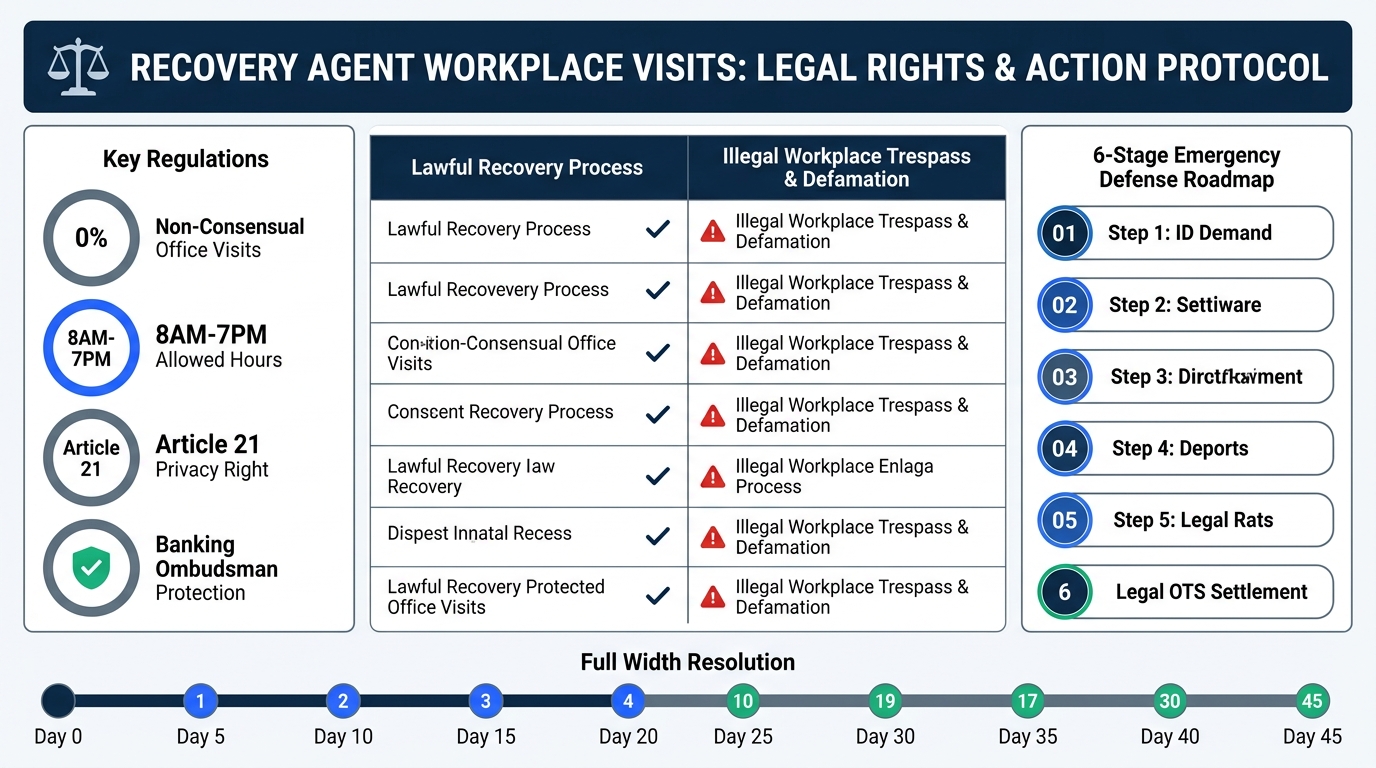
6. Step-by-Step Defense Action Plan: What to Do When an Agent Arrives
If a recovery agent physically reaches your office building or calls your office desk, execute this exact 6-stage legal protocol immediately:
Hold the Agent at Security / Visitor Lobby
Never allow the agent inside your office work floor or meeting rooms. Instruct the front-desk security executive to keep them seated in the public visitor holding area.
Demand Credentials (Bank Letter, Agency ID & DRA Certificate)
Under RBI regulations, you have the absolute legal right to inspect: 1) Bank Identity Card or Official Authorization Letter; 2) Collection Agency ID; 3) Indian Institute of Banking & Finance (IIBF) Debt Recovery Agent Certificate. If they fail to produce all three, they are illegal trespassers.
Activate Evidentiary Audio / Video Recording
Politely inform the agent that the interaction is being recorded for legal submission. Take photos of their identity cards and preserve visitor logbook timestamps as evidence for the RBI Banking Ombudsman.
State Your Formal Privacy & Trespass Objection
Deliver this clear legal statement: "This office is private corporate property. Under RBI Master Directions on Outsourcing, you have no consent to visit my workplace. You are instructed to leave immediately. All further notice must be sent in writing via registered email or through my legal counsel."
Instruct Security to Escort the Agent Out
If the agent refuses to leave or creates a loud scene, request building facility management and security guards to escort them off the premises for illegal commercial trespass. Inform the agent that a Police Dial 112 call is being placed for breach of peace.
start Advocate Legal Cease-and-Desist Notice via SettleLoans
Immediately submit the incident details to SettleLoans. Our empaneled advocates draft and dispatch a formal legal notice to the bank's Managing Director and Principal Nodal Officer, freezing all field recovery agency mandates within 48 hours.
7. Official Draft Complaint Templates: Bank PNO, RBI CMS & Police
To create legal deterrence, you must establish an official documentary trail against the lending institution. Below is the ready-to-use complaint format to send to the Bank's Principal Nodal Officer (PNO) and attach to your RBI Ombudsman filing.
To,
The Principal Nodal Officer (PNO) / Grievance Redressal Officer,
[Bank / NBFC Name]
[Address / Email Address]

Subject: URGENT COMPLAINT & CEASE-AND-DESIST: ILLEGAL WORKPLACE HARASSMENT, CRIMINAL TRESPASS, AND VIOLATION OF RBI FAIR PRACTICES CODE (Loan A/c No: [Account Number])

Respected Sir/Madam,

I am writing to register an urgent grievance against the unlawful, coercive, and criminal conduct of your recovery agents/collection agency regarding Loan Account No: [Your Account Number].

On [Date] at about [Time], an agent identifying as representing your institution arrived at my workplace situated at [Office Address] and attempted to breach reception, interrogate office security, and demand access to my HR department regarding alleged loan arrears.

This conduct constitutes an egregious violation of:
1. RBI Master Directions on Outsourcing of Financial Services & Fair Practices Code: Strict prohibition against contacting borrowers at their place of work without explicit consent or disclosing debt status to employers/third parties.
2. Supreme Court of India Landmark Judgments (ICICI Bank v. Shanti Devi Sharma): Strict condemnation of strong-arm recovery tactics and harassment at work.
3. Indian Penal Code / Bharatiya Nyaya Sanhita: Criminal Trespass (Sec 441/447 IPC), Criminal Intimidation (Sec 503/506 IPC), and Defamation (Sec 499/500 IPC).

DEMANDS FOR IMMEDIATE REDRESSAL:
1. Immediately withdraw and blacklist the third-party recovery agency assigned to my file.
2. Provide a written undertaking that no field agent shall contact my employer, colleagues, or visit my workplace.
3. Conduct all future notice solely in writing via registered email or through my designated legal counsel at SettleLoans.

Failing receipt of a formal confirmation within 48 hours, I shall escalate this matter to the RBI Banking Ombudsman (CMS Portal), file a Police Complaint / FIR for criminal intimidation, and institute civil cases for damages to my professional reputation.

Yours faithfully,
[Your Full Name]
[Contact Number]
[Registered Email Address]
Key Regulatory Escalation Authorities in India
| Escalation Authority | Jurisdiction / Mandate | Official Filing Portal | Expected Response Window |
|---|---|---|---|
| Bank Principal Nodal Officer (PNO) | Highest internal appellate grievance authority of the lending bank. | Bank Official Website / PNO Email | 48 to 72 Hours |
| RBI Banking Ombudsman (RB-IOS 2021) | Statutory appellate regulator; awards up to ₹20L relief + ₹1L damages. | cms.rbi.org.in | 30 Days |
| Local Police Station / Cyber Cell | Criminal trespass, criminal intimidation, and extortion under IPC/BNS. | In-person FIR or State Police Portal | Immediate (24–48 Hours) |
| District Consumer Disputes Commission | Deficiency of banking service, mental harassment & reputation damages. | consumerhelpline.gov.in | 45 to 90 Days |
8. Permanent Debt Relief: One-Time Settlement (OTS) with SettleLoans
While legal cease-and-desist notices immediately stop illegal field harassment, the underlying debt default remains active on bank balance sheets. As long as the account remains delinquent, it continues compounding penal interest (up to 36% p.a.) and risks being transferred to alternate collection agencies every few months.
The only permanent, definitive resolution is a legally executed One-Time Settlement (OTS):
large Financial Waiver
SettleLoans negotiates waivers of 40% to 70% on accumulated penal interest and outstanding principal.
Official Bank Sanction Letter
Every settlement is approved on authentic bank letterhead with zero third-party mediator risk.
Permanent ₹0 NDC & Closure
Secure an official No Dues Certificate (NDC) that permanently extinguishes debt liability and halts all recovery.

Settle Loan is India's trusted debt relief and loan settlement platform. We help borrowers overcome financial distress by negotiating with banks and NBFCs to legally settle personal loans and credit card debts. With our transparent, performance-based approach, you can achieve debt freedom and regain your financial peace of mind.
COMPUTER
9. Frequently Asked Questions: Recovery Agents & Workplace Rights
Under RBI Master Directions, recovery agents are strictly prohibited from visiting your workplace without prior consent. The Reserve Bank of India (RBI) circulars on the Fair Practices Code and Outsourcing of Financial Services (updated 2022 and 2023) mandate that recovery agents must first exhaust residential notice. They cannot show up at your office, factory, or corporate workplace unless you have explicitly provided written consent or have become entirely untraceable at your registered residential address. Even in authorized visits, agents are barred from creating any public scene or speaking to colleagues.
No, absolutely not. Disclosing debt details to third parties is illegal. Under RBI regulations, the Banking Codes and Standards Board of India (BCSBI) guidelines, and the landmark Supreme Court judgment on privacy (K.S. Puttaswamy v. Union of India), lenders and their agents are bound by strict customer confidentiality. Calling office landlines or emailing HR departments about personal financial arrears constitutes actionable civil defamation (Section 499/500 IPC). It is also a major regulatory violation that attracts heavy monetary penalties against the lending bank.
Follow this 4-step emergency protocol when an agent visits. First, do not panic and ask the receptionist to keep the agent seated in the visitor holding area. Second, immediately demand their Bank Authority Letter, Agency Identity Card, and IIBF DRA Certification. Third, clearly inform the agent on audio recording that the premises are private commercial property and that they must vacate immediately. Finally, if they become aggressive, instruct security to remove them for illegal trespass, and contact SettleLoans to serve a legal notice to the bank's Principal Nodal Officer.
The RBI has fixed the permissible window for customer contact strictly between 8:00 AM and 7:00 PM. Any phone calls, WhatsApp messages, or personal visits conducted before 8:00 AM or after 7:00 PM are illegal. also, persistent calling, spamming multiple times an hour, or sending threatening messages during office hours constitutes criminal harassment.
A personal loan default is a civil contractual dispute, not an employment crime. Under Indian labor and employment laws, an employer cannot legally end a confirmed employee solely because of a personal financial dispute with a bank. To safeguard your workplace reputation against third-party nuisance, submit a confidential disclosure to your HR manager. Explain that an external agency is acting unlawfully, and clarify that legal cases against the lender are underway.
You can start criminal complaints under multiple statutory provisions. First, invoke Criminal Trespass (Section 441/447 IPC / Section 329 BNS) for entering private office premises without authorization. Second, cite Criminal Intimidation (Section 503/506 IPC / Section 351 BNS) if they threaten your job or safety. Third, file for Defamation (Section 499/500 IPC / Section 356 BNS) for tarnishing your professional standing. Finally, report Extortion (Section 383/384 IPC / Section 308 BNS) if they demand spot cash under duress.
First, submit a formal written complaint to the bank's Principal Nodal Officer (PNO) via registered email, citing the date, time, and agent details. If the bank fails to provide a satisfactory resolution within 30 days, file an online complaint on the RBI Complaint Management System (CMS portal: cms.rbi.org.in) under the Reserve Bank - Integrated Ombudsman Scheme, 2021. The Ombudsman has the power to award relief up to ₹20 Lakhs for financial loss and up to ₹1 Lakh for mental harassment and loss of time.
When an empaneled SettleLoans advocate issues a legal cease-and-desist notice directly to the bank's Managing Director and Principal Nodal Officer, the bank is placed on formal legal notice of vicarious liability. Because banks face severe regulatory audits and fines from the RBI for agent misconduct, their central legal and compliance division immediately issues a "Hard Stop" instruction to the collection agency, recalling the physical visit mandate.
Yes. A formal One-Time Settlement (OTS) is the most definitive, permanent legal solution. Through SettleLoans, experienced financial negotiators represent your genuine financial hardship to the bank's stressed asset committee, securing a large waiver (often 40% to 70% of total dues). Once the OTS sanction letter is issued and the compromise amount paid, the bank recalls all collection agencies and issues an official No Dues Certificate (NDC), permanently closing the account.
No, in fact it dramatically strengthens your negotiating leverage. When you legally document clear violations of RBI Fair Practices Code, trespass, and privacy breaches, the bank recognizes that continued unlawful pressure exposes them to Ombudsman penalties and consumer court litigation. This motivates the bank's recovery division to approve a swift, favorable One-Time Settlement on terms you can afford.
Statutory Authorities & Official Regulatory References
- Reserve Bank of India (RBI) - Master Direction on Outsourcing of Financial Services & Fair Practices Code
- RBI Complaint Management System (CMS) - Integrated Ombudsman Scheme, 2021
- Supreme Court of India - Landmark Rulings on Debtor Privacy & Anti-Harassment Jurisprudence
- TransUnion CIBIL - Credit Information Companies (Regulation) Act, 2005 Dispute Guidelines
- eCourts Services - National Judicial Data Grid for Debt Recovery & Lok Adalat Settlement Awards