- Universal Regulatory Jurisdiction: The Reserve Bank - Integrated Ombudsman Scheme, 2021 covers all Scheduled Commercial Banks, Non-Banking Financial Companies (NBFCs), Small Finance Banks, and authorized digital Lending Service Providers (LSPs) across India.
- Prohibited Harassment Conduct: Calling before 8:00 AM or after 7:00 PM, calling family members or colleagues, physical intimidation, abusive profanity, and accessing smartphone contacts directly violate RBI Master Directions and Supreme Court rulings.
- Statutory 30-Day Mandatory Protocol: Borrowers must first lodge a formal written grievance with the lending institution's Grievance Redressal Officer. Once 30 days elapse without resolution, complaints are immediately escalated to the RBI CMS portal at
cms.rbi.org.in. - Monetary relief Powers: Under Section 16(2) of RB-IOS 2021, the Ombudsman possesses statutory power to award up to ₹1,00,000 for mental agony and harassment, alongside up to ₹20,00,000 for actual consequential financial losses.
- Settlement talks Catalyst: Formal RBI Ombudsman cases trigger direct intervention from senior bank compliance officers, enabling advocates to convert contentious collection files into structured 50%–65% One-Time Settlements with mandatory zero-balance No Dues Certificates.
1. RBI Integrated Ombudsman Scheme & Jurisdiction
The Reserve Bank of India enacted the Reserve Bank - Integrated Ombudsman Scheme, 2021 (RB-IOS 2021) for financial customer protection. This framework introduced a single, unified quasi-judicial mechanism. Operating under Section 35A Banking Regulation Act 1949, Section 45L RBI Act 1934, and Section 18 PSSA 2007, the Integrated Ombudsman holds statutory authority over all Regulated Entities (REs). It eliminates jurisdictional barriers based on loan size or state boundaries. Grievance redressal is now consolidated under the Centralised Receipt and Processing Centre (CRPC) in Chandigarh and the digital Complaint Management System (CMS).
Every Indian Scheduled Commercial Bank falls squarely under the Ombudsman's supervisory mandate. This includes SBI, HDFC Bank, ICICI Bank, Axis Bank, Kotak Mahindra Bank, Regional Rural Banks, Co-operative Banks, and NBFCs. also, under RBI Guidelines on Digital Lending (RBI/2022-23/111), banks and NBFCs remain vicariously liable for their partners. They are held strictly accountable for coercive tactics committed by Lending Service Providers (LSPs) and outsourced recovery agencies.
Borrowers often default on personal loans or credit cards due to genuine hardship, such as illness, business loss, or job loss. In response, lenders frequently outsource overdue portfolios to aggressive third-party collection agencies. These agencies sometimes operate in defiance of central bank directives. The RBI Ombudsman exists to regulate these corporate excesses. It penalizes institutional deficiencies in service and protects the legal rights of distressed citizens.
2. Prohibited Recovery Tactics Under RBI Master Directions
The Reserve Bank of India enforces strict codes of conduct for loan recovery under Circular RBI/2022-23/108 on Outsourcing of Financial Services. Indian jurisprudence unequivocally holds that loan default is strictly a civil breach of contract, never a criminal offense. The Supreme Court of India in ICICI Bank Ltd. v. Shanti Devi Sharma (2008) and Justice K.S. Puttaswamy (Retd.) v. Union of India (2017) established clear limits. Debt recovery cannot involve strong-arm tactics, privacy violations, or psychological intimidation.
Actionable Regulatory Violations Explicitly Barred by RBI Mandates
- •Unlawful Calling Hours: Contacting borrowers, co-borrowers, or guarantors before 8:00 AM in the morning or after 7:00 PM in the evening constitutes a prima facie regulatory breach.
- •Third-Party Contact & Shaming: Calling family members, parents, spouses, siblings, neighbors, or corporate workplace colleagues regarding a borrower's overdue balance violates Section 21 Right to Privacy.
- •Verbal Abuse & Threatening Tone: Using unparliamentary language, issuing physical threats, or making humiliating remarks during tele-calls or physical visits constitutes actionable harassment.
- •Unannounced Physical Intrusions: Visiting a borrower's home or office without proper prior intimation, refusing to display institutional identity cards and Indian Institute of Banking and Finance (IIBF) DRA accreditation, or creating a public disturbance.
- •Fraudulent Legal Notices & Fake Summons: Sending forged court notices, fake police arrest threats, fabricated warrants, or simulated magistrate summons designed to induce extreme panic.
- •Digital Contact Scraping & Image Defamation: Unlawful harvesting of smartphone address books, photo galleries, or sending morphed photographs to emergency contacts via messaging platforms.
When a bank or NBFC engages in any of these prohibited actions, the borrower gains immediate legal standing to start formal regulatory cases. The RBI Ombudsman treats recovery harassment not merely as an person consumer grievance, but as a systemic compliance breakdown that exposes the financial institution to severe administrative penalties and supervisory audit ratings downgrades.
3. Statutory Pre-Conditions: 30-Day Grievance Protocol
Under Clause 10 of the Reserve Bank - Integrated Ombudsman Scheme, 2021, the Ombudsman will reject complaints if the mandatory preliminary grievance protocol is bypassed. The legal architecture requires that the regulated financial institution be given an institutional opportunity to redress the consumer's grievance internally before the central banking authority assumes active jurisdiction. Navigating this pre-filing sequence methodically ensures that your eventual RBI CMS petition is legally bulletproof and cannot be dismissed on preliminary procedural grounds.
Branch / Desk Grievance
Submit a formal written complaint via registered email or speed post to the Branch Manager and the bank's Level-1 Customer Service Desk. Secure an official Service Request (SR) tracking number.
Principal Nodal Officer (PNO)
If unresolved within 7 days, escalate the matter to the bank's Principal Nodal Officer (PNO) and Internal Ombudsman (IO), outlining detailed recovery harassment violations with attached evidence.
30-Day Maturity & CMS Trigger
Once 30 calendar days elapse from the initial complaint date—or immediately upon receiving an unsatisfactory or dismissive written rejection—the right to file before the RBI Ombudsman ripens automatically.
It is vital to retain all notice logs, automated acknowledgment emails, and speed post delivery receipts. The RBI CMS portal strictly requires the initial complaint date and the institutional response reference number during electronic registration. If the bank fails to respond within 30 days, that statutory failure in itself constitutes an independent deficiency in banking service under the Scheme.
4. Bank Accounting, Stressed Assets & Ombudsman Risk
An RBI Ombudsman complaint provides strong talks leverage due to banking capital dynamics. When a retail loan defaults past 90 days, RBI Prudential Norms (IRACP) mandate classification as a Non-Performing Asset (NPA). As NPAs age through Sub-Standard, Doubtful, and Loss stages, lenders must lock 15% to 100% of the ledger balance in idle provisioning capital.
Commercial banks evaluate delinquent retail portfolios through a cold quantitative mathematical model known as Net Present Value (NPV) Recovery Modeling. Under normal situations, lenders evaluate whether to pursue aggressive third-party agency collections, file summary civil suits under Order 37 CPC, or start arbitration cases. However, the introduction of a formal RBI Ombudsman complaint dramatically destabilizes the bank's expected financial return by introducing heavy regulatory friction costs and supervisory penalties:
Here C_t represents estimated recoveries over time, and r is the internal discount rate. Deductions account for multi-year litigation costs, locked Tier-1 capital reserves, and the imminent risk of RBI regulatory fines or relief awards.
When a borrower files documented proof of harassment with the Ombudsman, the bank's risk committee must formally answer to the RBI. Defending an open regulatory inquiry exceeds the residual value of a delinquent balance. so, bank stressed-asset managers shift from aggressive recovery to compromise. They frequently authorize 45% to 65% principal haircuts to achieve a swift settlement and close the regulatory docket.
5. RBI Integrated Ombudsman Grievance Roadmap
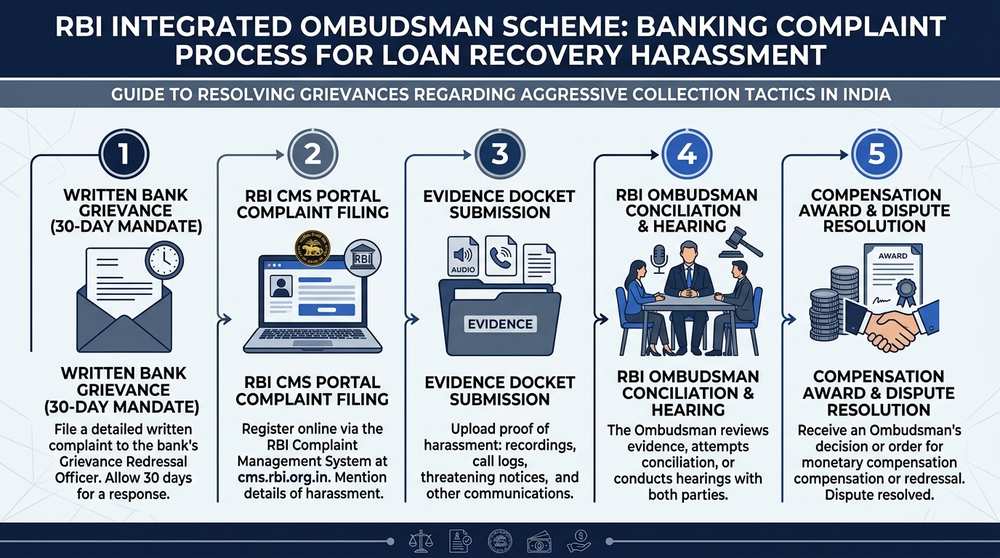
The visual roadmap below details the 5-stage escalation framework. It covers initial written grievances, CMS portal filing, evidentiary dockets, conciliation hearings, and securing zero-balance settlement letters.
6. Blueprint: Filing on the RBI CMS Portal
Filing an electronic complaint through the RBI Complaint Management System (CMS) portal is a structured legal submission. Every statement entered on the portal becomes part of an official quasi-judicial record reviewed by the Ombudsman and the bank's senior executive management. To ensure maximum impact and prevent procedural delays, adhere strictly to the following 6-step operational procedure:
Step 1: Access the Centralized Portal & Verify Identity
Navigate to https://cms.rbi.org.in and click on "File a Complaint". Complete the initial SMS/OTP mobile verification. Ensure that the mobile number matches the contact details registered with your loan account.
Step 2: Select Regulated Entity Category & Account Particulars
Select the appropriate institutional category (e.g., Scheduled Commercial Bank, NBFC, or Small Finance Bank). Choose the exact legal name of the entity from the drop-down menu, enter the parent branch details, and specify your loan or credit card account number.
Step 3: Establish the 30-Day Statutory Pre-Condition
Input the exact date when your initial written complaint was lodged with the bank's Grievance Redressal Officer. Upload the copy of your original email/letter along with the bank's tracking reference number or proof of speed post delivery.
Step 4: Select Accurate Complaint Sub-Categories
Under the grievance classification taxonomy, select "Loans and Advances" followed by the exact sub-categories: "Engagement of Recovery Agents / Non-adherence to Fair Practices Code", "Harassment / Coercive Tactics", and "Levy of Charges Without Prior Notice".
Step 5: Draft the Factual Chronology & Regulatory Grounds
Provide a concise chronological narrative. Detail loan origins, specific call dates and timestamps, and caller numbers. Highlight violations of the 8:00 AM to 7:00 PM calling window, abusive language, and third-party workplace disclosures alongside relevant RBI circular citations.
Step 6: Upload the Evidentiary Docket & Submit
Compile all evidence into a single, organized PDF file (under the portal's file size limit) containing time-stamped call records, WhatsApp screenshots, audio recording transcripts, CCTV snapshots, and formal notices. Review the draft, submit, and record the unique Complaint Reference Number (CRN).
Alternatively, borrowers facing digital access hurdles can mail physical petitions. Post them to the Centralised Receipt and Processing Centre (CRPC), Reserve Bank of India, 4th Floor, Sector 17, Chandigarh - 160017. Use the standardized Form-B format prescribed under the Scheme via registered post.
7. Formulating relief Claims Under Section 16(2)
A key provision of RB-IOS 2021 is the Ombudsman's statutory authority to award relief for non-financial injury. Under Clause 16(2), the Ombudsman can order lenders to pay up to ₹1 Lakh to the complainant. This covers loss of time, expenses, harassment, and mental anguish resulting from service deficiencies.
To substantiate relief claims, advocates construct an Injury Dossier. First, we establish a Causal Link proving harm resulted directly from unlawful recovery tactics. Second, we provide Documentary Proof such as medical prescriptions, employer warnings, or income losses. Third, we request Quantified Relief, including the immediate cessation of recovery, waiver of penal interest, relief, and credit bureau remediation.
For direct financial losses—such as unauthorized automatic debits or wrongful asset seizures—Clause 16(1) empowers the Ombudsman to award relief. Relief covers actual damages up to ₹20 Lakhs. Framing these claims with legal precision ensures banks treat cases with institutional urgency.
8. Ombudsman Conciliation & Enforcing ₹0 NDC Mandates
The primary operational mode of the RBI Ombudsman under Clause 14 of RB-IOS 2021 is conciliation and mediation. Once the complaint is admitted, the Ombudsman forwards the evidentiary dossier to the regulated entity with a strict 15-day deadline to submit a formal Written Response. Recognizing the high probability of an adverse finding or regulatory reprimand, the bank's central legal department frequently reaches out directly to the borrower or their legal counsel to propose an amicable out-of-court settlement.
This conciliation window offers an ideal setting for negotiating a One-Time Settlement (OTS). Rather than enduring endless collection calls, advocates leverage active regulatory cases. We negotiate to eliminate penal charges and secure 45% to 65% principal haircuts based on documented financial distress.
Mandatory Regulatory Protections for Executed Loan Settlements
Upon mutually agreeing on settlement terms, the agreement must be executed via an official bank-issued Sanction Letter detailing the final discounted amount and payment schedule. Under RBI Circular RBI/2023-24/60 on "Release of Movable / Immovable Property Documents and No Dues Certificates", the bank is legally obligated to:
- Issue an official, unconditional zero-balance No Dues Certificate (NDC) within 30 calendar days of final payment clearance.
- Update all four credit information companies (CIBIL, Experian, Equifax, CRIF High Mark) to reflect the account status as "Settled" or "Closed" with ₹0 outstanding balance within the mandatory 30-day reporting cycle.
- Pay a mandatory statutory relief of ₹5,000 per day of delay directly to the borrower if the NDC or property documents are delayed beyond 30 days without justifiable cause.
Once settlement terms are met and the No Dues Certificate is issued, parties file a joint closure memo on the RBI CMS portal. This formally closes the regulatory complaint and guarantees permanent debt relief.
9. Dispute Resolution & Legal Escalation Comparative Matrix
Borrowers facing aggressive debt collection tactics often struggle to evaluate which legal forum best suits their specific situation. The comprehensive comparative matrix below analyzes the timeline, cost structure, recovery deterrence, and settlement efficacy across all primary grievance mechanisms in India:
| Escalation Forum | Governing Statute | Filing Fee & Cost | Resolution Timeline | Harassment Deterrence | Settlement Efficacy |
|---|---|---|---|---|---|
| RBI Integrated Ombudsman (CMS) | RB-IOS 2021 / BR Act Sec 35A | ₹0 (Completely Free) | 30 to 60 Days | Very High (Direct Regulatory Exposure) | Exceptional (Forces 45%–65% OTS) |
| Bank Internal Grievance (PNO) | Internal Bank Grievance Policy | ₹0 (Internal) | 15 to 30 Days | Moderate (Internal Bank Review) | Moderate (Standard Restructuring) |
| Consumer Commission (DCDRC) | Consumer Protection Act, 2019 | Nominal Court Fee | 12 to 24 Months | High (Interim Injunction Orders) | High (Court-Supervised Settlement) |
| Police FIR / Magistrate Complaint | BNS Sec 351/356 (IPC 503/506) | Advocate Legal Fees | 6 to 18 Months | Immediate (Criminal Deterrence) | Moderate (Requires Cross-talks) |
| National Lok Adalat | Legal Services Authorities Act, 1987 | ₹0 (Free Forum) | Single-Day Hearing | Low (Pre-Existing Stage) | High (Non-Appealable Consent Award) |
As showed by the empirical matrix, the RBI Integrated Ombudsman Scheme offers the fastest, most cost-effective, and institutionally potent mechanism for neutralizing recovery agent harassment while simultaneously opening an official window for debt compromise talks.
10. Institutional Defense: Safeguarding Borrowers & OTS
Navigating an institutional confrontation with a major national bank or well-funded NBFC can be daunting for an person borrower already enduring severe financial stress. SettleLoans bridges this power asymmetry by providing dedicated legal advocacy, regulatory petition drafting, and senior-level financial talks for distressed borrowers across India.
Our seasoned team of banking litigation advocates and debt resolution specialists applies a rigorous 4-stage institutional defense protocol:
We issue a formal legal representation notice to the lender's Chief Legal Officer and Grievance Desk, demanding the immediate cessation of third-party tele-calling and unannounced field visits under penalty of regulatory prosecution.
Our legal team structures your call recordings, WhatsApp messages, and financial records into a forensic evidentiary docket showing clear violations of RBI Master Directions.
We draft and file a comprehensive complaint on the RBI Complaint Management System, incorporating statutory relief claims under Section 16(2) of RB-IOS 2021 for mental agony.
We represent you during conciliation talks, converting regulatory pressure into a binding One-Time Settlement with maximum principal waiver and securing an official No Dues Certificate.

Settle Loan is India's trusted debt relief and loan settlement platform. We help borrowers overcome financial distress by negotiating with banks and NBFCs to legally settle personal loans and credit card debts. With our transparent, performance-based approach, you can achieve debt freedom and regain your financial peace of mind.
COMPUTER
11. FAQs: RBI Ombudsman Complaints & Recovery Rights
Find clear, authoritative legal answers to the most critical questions regarding RBI Complaint Management System procedures, recovery agent restrictions, relief limits, and debt settlement execution:
What is the RBI Integrated Ombudsman Scheme (RB-IOS 2021)?
The Reserve Bank - Integrated Ombudsman Scheme (RB-IOS 2021) is a unified quasi-judicial framework. Established by the RBI, it provides cost-free and impartial grievance resolution. It covers all RBI-regulated entities, including Commercial Banks, Regional Rural Banks, NBFCs, Co-operative Banks, and authorized payment system participants across India.
When can I file a complaint with the RBI Ombudsman for recovery harassment?
You can file an Ombudsman complaint if you first submitted a written grievance to the lender and received no reply within 30 days, or received an unsatisfactory rejection. The complaint must be filed within one year of the bank's formal response.
What recovery practices are strictly prohibited by RBI guidelines?
Under RBI directives, recovery agents cannot call before 8:00 AM or after 7:00 PM. They are barred from using abusive language, threatening physical harm, or contacting friends, relatives, and workplace colleagues. Unannounced visits and social media shaming are strictly illegal.
Can the RBI Ombudsman award monetary relief for mental harassment?
Yes. Under Section 16(2) of RB-IOS 2021, the Ombudsman can award relief up to ₹20 Lakhs for consequential losses, plus up to ₹1 Lakh for mental harassment, loss of time, and out-of-pocket expenses.
How does filing an RBI Ombudsman complaint help in negotiating a loan settlement?
When an active RBI Ombudsman complaint is lodged, it escalates directly to the bank's Senior Compliance and Stressed Asset Management teams. Regulated entities face regulatory audit scrutiny, reputational damage, and financial penalties for recovery agent violations. To close open regulatory inquiries swiftly, banks frequently agree to withdraw third-party recovery agencies, waive penal compound interest, and execute an amicable One-Time Settlement (OTS) with 45% to 65% principal haircuts.
What evidence is required to prove loan recovery harassment before the Ombudsman?
Crucial evidence includes time-stamped call recordings, screenshots of threatening WhatsApp messages, and CCTV footage of unannounced visits. Maintain proof of initial written grievances sent to the bank as primary records.
Is there any fee to file a complaint on the RBI Complaint Management System (CMS)?
No. The entire grievance redressal mechanism under the RBI Integrated Ombudsman Scheme is completely free of charge. Neither the Reserve Bank of India nor the Ombudsman charges any filing fees, hearing fees, or administrative processing costs to the borrower.
Can an NBFC or FinTech lending app be reported to the RBI Ombudsman?
Yes. All Non-Banking Financial Companies (NBFC-D, NBFC-ND-SI with asset size of ₹100 Crore or more, and deposit-taking NBFCs) as well as Lending Service Providers (LSPs) operating under digital lending guidelines are covered under RB-IOS 2021. If a digital loan app accesses unauthorized phone permissions or harasses emergency contacts, the parent NBFC/Bank is directly liable for penal action.
What happens if a bank fails to comply with an RBI Ombudsman Award?
An Ombudsman Award becomes binding on the bank once accepted in writing by the complainant within 30 days. If the bank fails to apply the Award, the Ombudsman reports the non-compliance to the RBI's Department of Supervision, which can impose heavy regulatory monetary penalties, regulatory restrictions on lending operations, and mandatory supervisory directions.
Does filing an RBI complaint stop recovery agents from visiting my home?
Yes. Once an official grievance is logged and an RBI CMS acknowledgement token is generated, presenting this reference number to the bank's collection department creates an immediate compliance hold. Senior bank management instructs ground collection agencies to suspend field visits and third-party recovery while the matter is under regulatory review.