- Mandatory 3 Credentials. Agents must show a Bank Auth Letter, Photo ID, and IIBF DRA Certificate.
- Legal Right to Refuse. You can lawfully deny entry if papers are missing.
- Criminal Trespass Protections. Agents refusing to leave face Section 441/447 IPC and Section 329 BNS.
- Strict 8 AM – 7 PM Hours. RBI Fair Practices Code bans visits outside these hours.
- Advocate-Led 55% OTS. Documented violations help advocates win a 45% to 65% OTS.
1. The Crisis of Doorstep Debt Collection
Doorstep visits cause severe stress. Borrowers facing job loss or illness face sudden home visits. Agents arrive in groups. They speak in harsh tones. They demand instant cash. They threaten police action or public shaming.
This doorstep pressure is a deliberate trap. Agencies know home visits trigger embarrassment. They panic borrowers into taking bad loans. Under Indian law, your home is private property. You have no duty to open your door. You do not have to let agents inside. Check papers through a closed grill. Keep unlawful trespassers out.
2. Mandatory RBI Doorstep Credentials
Under the RBI Master Direction on Fair Practices Code, rules are strict. No agent can visit without three papers. If any paper is missing, deny entry at once.
The first document is an official Bank Authorization Letter. It uses bank letterhead. It states your name, PAN. And loan account number. It names the recovery agency and agent. It carries the signature and seal of a Scale-II or Scale-III Bank Officer. Generic photocopies are invalid.
The second paper is a valid Photo ID Card. It must show a clear photo, full name, Agent ID code. And agency name. Modern banks add QR codes for instant online checks. The back must list bank customer care numbers.
The third paper is the IIBF Debt Recovery Agent (DRA) 100-Hour Certificate. The Indian Institute of Banking &. Finance issues this award. Agents complete 100 hours of legal training. They must pass a national exam. Agents must also hold a Police Clearance Certificate (PCC).
Check Your Loan Settlement Options
Answer 2 quick questions to evaluate your settlement eligibility.
1. What type of loan do you want to settle?
3. The Absolute Legal Right to Refuse Entry
Many think loan default lets banks enter private property. That is false. Default on an unsecured loan is a civil contract breach under the Indian Contract Act, 1872. It is not a crime. It gives agents zero entry rights.
Under Section 441 and 447 IPC, entering private property to intimidate is Criminal Trespass. Section 329 BNS covers this under new criminal laws. Staying unlawfully brings jail time. Section 503 and 506 IPC (Section 351 BNS) punish Criminal Intimidation. Threatening arrest or asset seizure brings up to seven years in prison.
The Supreme Court protects borrower rights firmly. In Justice K.S. Puttaswamy v. Union of India (2017), the court protected financial privacy under Article 21. Shaming borrowers before neighbors is illegal defamation. In ICICI Bank Ltd. v. Prakash Kaur (2007) and ICICI Bank v. Shanti Devi Sharma (2008), the court banned musclemen. Debt recovery must follow lawful court steps.
4. Bank DRA Accounting & Agency Economics
Bank accounting rules explain why agencies use aggressive home visits. Banks operate under strict RBI provisioning rules. These rules force banks to set aside capital reserves as loans stay unpaid.
In SMA-0 to SMA-2 stages (up to 90 days late), banks hold small reserves. Once default crosses 90 days, loans become Substandard Non-Performing Assets (NPAs). Banks must lock 25% in capital reserves. For Doubtful (D1/D2) or Loss Asset loans, banks lock 100% of the loan amount.
Third-party collection agencies earn 10% to 25% contingency commissions. That is why agents use fake threats at doorsteps. They falsely claim court warrants are active. In truth, seizing assets takes years under Order 37 CPC or Section 138 NI Act.
When advocates challenge banks with recorded violations, banks review the Net Present Value (NPV) formula:
Here C_t is expected recovery cash flow. The term r is the discount rate. Deductions cover court delays, advocate retainers, RBI Ombudsman fines. And locked NPA reserves.
Faced with rising NPA costs and Ombudsman fines, banks recall agents. They approve a 45% to 65% principal waiver via an official OTS.
5. DRA Verification Strategic Roadmap
The visual guide below shows our 4-stage verification plan. Use it to inspect agents, verify papers, invoke legal rights. And stop doorstep harassment.
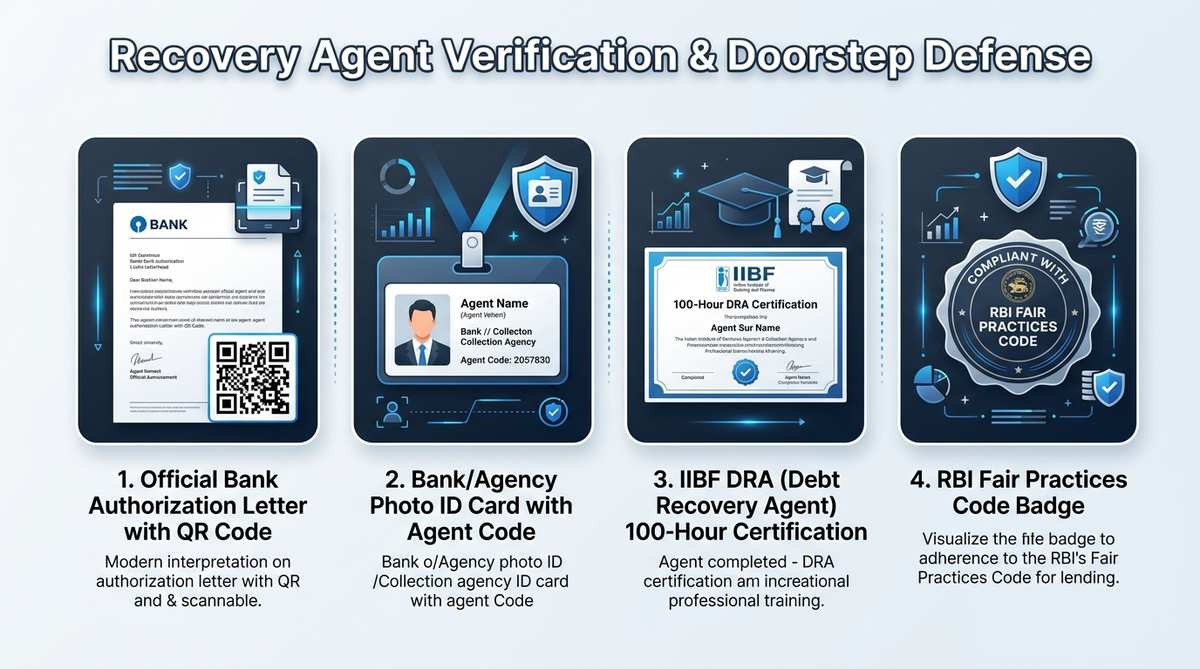
This guide helps borrowers step by step. Learn how to inspect bank letters, verify ID badges, scan QR codes, check IIBF DRA cards. And take legal action under RBI rules.
6. The 4-Stage Doorstep Defense Protocol
When aggressive agents visit your home, emotional arguments increase stress. Debt defense advocates suggest a 4-stage action plan.
In Stage 1, keep your door locked. Speak through the grill. Tell them that under RBI rules, they must show their Bank Auth Letter, Photo ID, and IIBF DRA Certificate first.
In Stage 2, verify credentials digitally. Ask agents to hold papers up to the door viewer. Take photos of their ID cards and vehicle plates. Scan any QR code to verify details online. If papers are fake or missing, tell them to leave.
In Stage 3, record video and call police. If agents refuse to leave or shout, record video. Inform them that staying is Criminal Trespass under Section 441 IPC (Section 329 BNS) and Section 503 IPC (Section 351 BNS). Dial Police at 112.
In Stage 4, pursue advocate escalation. Retain counsel to serve legal notices on the bank MD and Nodal Officer. File a complaint on the RBI CMS portal (cms.rbi.org.in) with video proof. This forces banks to recall agents.
7. Converting Doorstep Harassment into Leverage
Aggressive doorstep visits show lender quarter-end pressure. When an uncertified agency breaks RBI rules, the bank faces heavy Ombudsman fines. Experienced advocates use these violations to win an official One-Time Settlement (OTS).
Our advocates bypass field agents. We negotiate directly with the bank's Zonal Stressed Assets Desk. We submit a Hardship Dossier with salary slips, medical bills, or job loss letters. This proves bona fide financial distress.
Using documented violations as leverage, advocates secure a 100% waiver on penal fees. We win a 45% to 65% cut on principal debt. The deal ensures the bank recalls files and halts all visits.
The negotiated settlement is split into 2 to 4 monthly installments. Borrowers clear debt safely without fear.
8. Sanction Letter Forensics & DRA Verification NDC
Loan settlements require careful verification. Rogue agents send fake letters on WhatsApp. They pocket cash that never reaches your loan account. Never pay money until your advocate inspects the sanction letter.
An authentic settlement letter uses bank letterhead. It carries a valid reference code. It lists your name, PAN. And loan account number. It states that all remaining dues and legal claims end upon payment. Pay all dues directly into your official loan account.
Under RBI Circular RBI/2023-24/60, lenders must issue a No Dues Certificate (NDC) within 30 days. They must update credit bureaus (CIBIL, Experian, Equifax, CRIF High Mark) to zero balance. Delays bring a mandatory penalty of ₹5,000 per day paid to you.
After settlement, credit bureaus list the loan as Settled with a ₹0 balance. Scores drop 70 to 120 points briefly. But default stops. And collection calls end permanently. Using a secured card, borrowers rebuild credit above 750 within 18 to 24 months.
9. DRA Verification Legal Defense Matrix
Comparing agent types helps borrowers handle doorstep visits with confidence:
| Operational Parameter. | Uncertified Collection Agent. | Verified IIBF DRA Agent. | Advocate-Led 55% OTS. |
|---|---|---|---|
| Mandatory Credentials. | None or fake copies. | Bank Auth Letter, Photo ID, IIBF DRA Certificate. | Formal Vakalatnama &. Legal Representation. |
| Doorstep Entry Right. | Zero. Refusing entry is 100% legal. | Requires borrower consent. No forced entry. | Direct bank desk talks. Zero home visits. |
| Permitted Contact Hours. | Violates rules. Late nights or early mornings. | Strictly 8:00 AM to 7:00 PM only. | Official banking hours via formal legal notices. |
| Third-Party Disclosure. | Illegal contact with neighbors and family. | Strictly prohibited by Fair Practices Code. | 100% Private Client-Advocate Privilege. |
| Financial Outcome. | Demands full sum with penal fees. | Attempts collecting overdue EMIs. | 45%–65% Principal Haircut with official ₹0 NDC. |
This matrix shows uncertified agents break statutory rules. Advocate-led settlements secure total debt closure, legal protection. And credit score repair.
10. SettleLoans DRA Compliance Legal Defense
Handling unverified agents requires experienced banking defense advocates. We enforce RBI Master Directions, cite Supreme Court privacy rulings. And serve criminal trespass notices. SettleLoans provides complete legal defense across India. We serve cease-and-desist notices, file RBI Ombudsman complaints, protect family privacy. And negotiate 45% to 65% principal waivers with official No Dues Certificates.

Settle Loan is India's trusted debt relief and loan settlement platform. We help borrowers overcome financial distress by negotiating with banks and NBFCs to legally settle personal loans and credit card debts. With our transparent, performance-based approach, you can achieve debt freedom and regain your financial peace of mind.
COMPUTER
11. FAQs: Recovery Agent Verification & Doorstep Rights
Clear, legally verified answers on bank recovery agent ID cards, IIBF DRA certificates. And doorstep borrower rights in India.
What specific credentials must a bank recovery agent show during a home visit?
Under RBI Master Directions, agents must show three papers. First is a Bank Auth Letter. Second is an official Photo ID. Third is an IIBF DRA Certificate. Never talk without seeing these papers.
Is it legal to refuse entry or conversation to a recovery agent without an ID or DRA certificate?
Yes. Refusing entry is 100% legal. If an agent lacks papers, deny entry. Keep your main door locked. Ask them to leave your home.
What is an IIBF DRA Certificate and why is it mandatory?
The IIBF DRA certificate is a mandatory license. It is issued by the Indian Institute of Banking & Finance. Agents complete 100 hours of legal training. RBI bans home visits without this card.
What should I do if an unverified recovery agent refuses to leave my premises?
Keep your gate locked. Record video from safety. Warn them that staying is Criminal Trespass under Section 441/447 IPC and Section 329 BNS. Dial Police at 112 right away.
What are the permitted hours for recovery agents to visit or call a borrower?
Under RBI Fair Practices Code, agents cannot visit before 8:00 AM or after 7:00 PM. Night or early visits violate RBI rules. Report violations to the RBI Ombudsman.
Can recovery agents disclose my debt details to neighbors, landlords, or family members?
No. Under the Puttaswamy privacy ruling, debt details are confidential. Agents cannot talk to neighbors or family. Revealing debt is Criminal Defamation under Section 499/500 IPC and Section 356 BNS.
How can I verify whether a Bank Authorization Letter is genuine?
A genuine letter uses bank letterhead. It states your name, PAN. And loan account number. It names the recovery agency. It carries a Scale-II or Scale-III Bank Officer seal.
Can I pay cash directly to a recovery agent at my doorstep?
Never pay cash to agents at your doorstep. Handing cash to agents creates high fraud risks. Pay all dues directly to your loan account number. Use NEFT, UPI, or branch counters.
How does doorstep harassment help negotiate a One-Time Settlement (OTS)?
When advocates prove doorstep violations, banks face heavy RBI fines. To protect their name, bank heads recall agents. They grant a 45% to 65% debt waiver via an official OTS.
What is the timeline for receiving a No Dues Certificate after completing a settlement?
Under RBI Circular RBI/2023-24/60, banks must issue an NDC within 30 days. They must update credit bureaus to zero balance. Delays bring a ₹5,000 daily penalty paid to you.