- Mandatory Female Recovery Staff Rule: Under RBI rules, banks and NBFCs must send female recovery staff to meet female debtors. Male agents cannot visit women who are alone at home.
- Criminal Law Protection under BNS 2023: Verbal abuse, shouting, threats. or lewd remarks by agents are serious crimes. Debtors can file charges under Sections 74, 75. and 79 BNS for outraging or insulting modesty.
- National Commission for Women (NCW) Action: The NCW has legal power to summon bank leaders. The commission can inspect collection agencies and order state police to file criminal cases against rogue agents.
- Privity of Contract Protects Housewives: A housewife has zero personal liability for loans taken only by her husband. Lenders cannot demand money from non-debtor family members or threaten them.
- Turning abuse into 55% OTS: Formal advocate notices citing criminal bad conduct force banks to halt collection visits. Lenders often agree to a 45% to 65% One-Time Settlement with a clear No Dues Certificate.
1. The Menace of Predatory Debt Recovery Targeting Women
Personal loans, credit cards. And digital loan apps have grown fast across India. When money troubles arise, third-party recovery agencies often target the home. Male recovery agents frequently arrive during daytime hours when working men are away. They deliberately confront female debtors, elderly mothers. or housewives alone at home.
These agents use harsh pressure. They shout in hallways and bang loudly on doors. They use abusive language and make fake threats of police arrest. They create scenes in front of neighbors to cause shame. Their goal is to force women into panic. They push them to borrow from relatives, sell jewelry. or spend family savings.
Groups of male agents visiting homes to threaten women break the law. Entering private property without permission to issue threats is criminal trespass. Indian civil and criminal laws ban this conduct entirely.
Under the Indian Contract Act, 1872, only loan signatories owe the debt. A housewife who is not a co-signer or backer has zero liability. Demanding payment from her is illegal extortion.
Indian law strictly prohibits physical and verbal threats in debt collection. The Reserve Bank of India and the Supreme Court protect debtors. Banks face severe fines when their collection agents break these rules.
2. RBI Protections for Women Borrowers
The Reserve Bank of India (RBI) sets clear conduct rules for bank banks, NBFCs. and Direct Recovery Agencies (DRAs). These regulations protect the safety, dignity. And privacy of female debtors.
In ICICI Bank Ltd. v. Prakash Kaur (2007) and Shanti Devi Sharma v. State (2008), the Supreme Court of India ruled that banks cannot use musclemen or abusive agents to collect debt. The Court confirmed that debt recovery must follow the rule of law. Lenders must respect human dignity under Article 21 of the Constitution of India.
Under the RBI Fair Practices Code, lenders must send female staff to speak with female debtors. Male agents cannot visit women who are alone at home.
Agents can only call or visit between 8:00 AM and 7:00 PM. Calling or visiting early in the morning or late at night is illegal abuse.
Agents cannot discuss your debt with neighbors, landlords. or building guards. Sharing loan details with outsiders violates privacy rights established in the Puttaswamy case.
When a bank or NBFC allows male agents to harass women at home, the lender is legally responsible. Lenders cannot shift the blame to outsourced collection agencies.
Check Your Loan Settlement Options
Answer 2 quick questions to evaluate your settlement eligibility.
1. What type of loan do you want to settle?
3. Criminal Law Protections for Women
abuse of female debtors goes beyond civil banking disputes. It is a serious criminal offense. Under the Bharatiya Nyaya Sanhita (BNS), 2023 and earlier Indian Penal Code (IPC) sections, strong criminal laws protect women from abusive agents:
Outraging Modesty of a Woman (Section 74 BNS / Section 354 IPC)
Anyone using force to outrage a woman's modesty commits a non-bailable crime. Agents who block doorways, make harsh physical gestures. or touch a woman face one to five years in jail and heavy fines.
Sexual Harassment & Lewd Conduct (Section 75 BNS / Section 354A IPC)
Agents who make unwelcome physical contact, demand favors. or make vulgar remarks in person or over phone calls face up to three years of rigorous imprisonment.
Insulting the Modesty of a Woman (Section 79 BNS / Section 509 IPC)
Anyone who utters rude words, makes offensive gestures. or invades a woman's privacy faces up to three years in jail. Shouting insults in front of neighbors falls squarely under this law.
Criminal Intimidation & Trespass (Sections 351, 352 & 329 BNS / Sections 503, 506 & 441 IPC)
Threatening injury or entering a private home unlawfully to cause fear gives the police legal power to arrest the offending agents right away.
Police must register an FIR for offenses under Section 74 or Section 79 BNS. If local officers hesitate, you can report the incident to the Mahila Police Desk. You can also file a Section 175(3) BNSS request before the Judicial Magistrate.
4. Bank Provisions & Harassment Liabilities
Knowing bank accounting helps debtors fight back against recovery abuse. bank banks and NBFCs must follow strict RBI reserves rules. When an unsecured personal loan or credit card goes unpaid for 90 days, it becomes a defaulted Asset (NPA). The bank must then set aside capital reserves:
| Asset default Class. | Overdue Aging Timeline. | Mandatory RBI Capital Provision. | OTS Haircut Potential. |
|---|---|---|---|
| SMA-1 / SMA-2. | 31 – 90 Days Overdue. | 5% General Balance Sheet Provision. | Late Fee & Penal Interest Waivers. |
| Substandard NPA. | 91 – 365 Days Overdue. | 25% Unsecured Capital Provision. | 35% – 45% Principal Haircut. |
| Doubtful NPA 1 (D1). | 12 – 24 Months Default. | 100% Unsecured Capital Provision. | 45% – 55% Principal Haircut. |
| Doubtful NPA 2 / Loss Asset. | 24+ Months / Written-Off. | 100% Full Provision & Ledger Write-Off. | 55% – 65% Principal Haircut. |
Collection agencies earn high commissions of 15% to 30% on recovered funds. Because their payouts drop as loans age into deeper NPA brackets, rogue agents resort to harsh tactics. Once bank leadership receives a formal legal notice detailing criminal abuse, the bank evaluates the case using the Net Present Value (NPV) of Recovery model:
Where C_t is the expected recovery amount. And r is the discount rate. Deductions include 3 to 5 years of legal costs, ombudsman fines. And locked capital reserves.
Banks know that fighting criminal allegations and ombudsman complaints costs more than settling the debt. Sanctioning a settlement with a 45% to 65% principal waiver is the bank's most profitable choice.
5. Women Legal Defense Strategic Roadmap
The roadmap below shows the 5-step process used by banking advocates to stop collection abuse, file NCW complaints. And secure an official loan settlement.
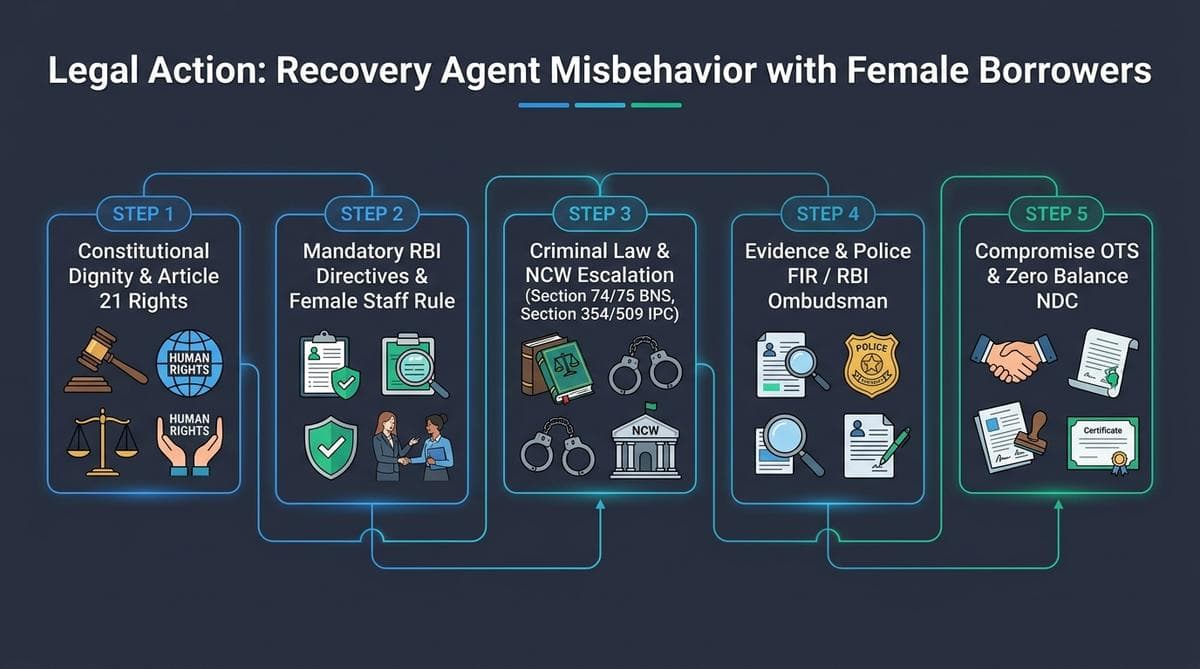
6. The 4-Stage Legal Counter-Action Protocol
When recovery agents act aggressively toward women, getting angry or panicking does not help. Collection agencies thrive on fear. Instead, legal advocates follow a proven 4-stage protocol to stop abuse and protect your family:
Stage 1: Forensic Evidence Preservation & Identification Capture
Record all phone calls on your device. Take videos of visiting agents or save CCTV footage. Ask for the agent's bank ID card, DRA certificate. And authorization letter. Write down dates, times, vehicle numbers. And caller IDs.
Stage 2: Serving Advocate Cease-and-Desist & Criminal Defamation Notice
Your lawyer sends an urgent legal notice to the bank's Managing Director and Principal Nodal Officer. The notice cites violations under Section 74/75/79 BNS and the RBI Fair Practices Code to stop home visits.
Stage 3: National Commission for Women (NCW) & Police Mahila Thana Filing
If agents trespass or use abusive words, counsel files a complaint on the NCW portal (ncwapps.nic.in). A formal complaint is also filed at the Mahila Police Thana and on the RBI CMS portal (cms.rbi.org.in).
Stage 4: Strategic Transition to Structured Debt Resolution (OTS)
With collection visits halted and bank leaders facing regulatory complaints, our lawyers settle directly with the bank's Stressed Asset Desk to secure an affordable settlement.
This structured legal approach stops agent abuse and restores peace to your household.
7. Negotiating a 45%–65% Settlement on Harassment
Recovery agent abuse shows that the lender cannot collect through normal legal paths. By documenting these violations with a lawyer, you gain strong leverage to settle a formal One-Time Settlement (OTS).
Instead of paying inflated fines, our banking advocates settle structured settlement terms:
Compile proof of income loss, job changes. or medical issues to show that your loan default was genuine.
Get a full waiver on late fees and penal interest,. a 45% to 65% reduction on the principal loan balance.
Include a clear clause in the settlement requiring the bank to recall the file and stop all agency visits.
Split the final agreed payment into 2 to 4 monthly installments so your family can settle without money strain.
8. Sanction Letter Forensics & NDC for Women Borrowers
Debtors must be careful when accepting a loan settlement. Rogue agents often share fake settlement letters on WhatsApp to collect quick funds. Never transfer any money until your legal counsel verifies the sanction letter.
- Official Bank Letterhead: The sanction letter must be printed on official bank stationery with a verifiable reference number and an officer's signature.
- Exact Name & Account Details: The letter must state your full name, PAN. And exact loan account number without mistakes.
- Absolute Debt closure Clause: The document must state that the paid amount settles the debt in full with no balance left.
- Direct Bank Account payment: Payments must go directly to your official loan account via NEFT, RTGS. or the bank portal. Never pay an agent directly.
Under RBI Circular RBI/2023-24/60, lenders must issue a formal No Dues Certificate (NDC) within 30 days of full settlement. They must also update CIBIL, Experian, Equifax. and CRIF to show zero balance. Any delay beyond 30 days entitles the debtor to ₹5,000 per day in payout.
CIBIL Bureau Reporting & Post-Settlement Credit Rehabilitation
After settlement, credit bureaus mark the loan as "Settled" with an outstanding balance of ₹0. This may cause a temporary drop of 60 to 100 points. But it stops default accumulation and ends abuse. You can rebuild your score above 750 in 18 to 24 months with a secured credit card and timely payments.
9. Women Borrower Legal Defense Matrix
Evaluating the legal remedies available to female debtors and families facing harsh collection tactics highlights the power of formal legal action:
| Action Channel. | Legal Framework. | Protection Level. | Solution Time. | Final Legal Effect. |
|---|---|---|---|---|
| Illegal Male Agent Visits. | Breaks RBI Fair Practices Code and Article 21. | Zero safety. High mental distress risk. | Continuous. | Exposes lender to police FIRs and RBI fines. |
| Mahila Police Thana / Zero FIR. | Sections 74, 75, 79 & 351 BNS (IPC 354/509). | Fast police safety and local station help. | 24 – 48 Hours. | Criminal charges on agents. Immediate stop to visits. |
| National Commission for Women (NCW). | National Commission for Women Act, 1990. | High level inquiry and bank summons. | 15 – 30 Days. | Directs bank MD to take strict action. |
| Advocate-Led 55% OTS. | Consensual settlement Agreement. | Full stop to calls and total debt relief. | 15 – 30 Days. | Full debt closure with official ₹0 NDC. |
10. SettleLoans Women Borrower Legal Protection
Dealing with rude recovery agents requires prompt legal action. SettleLoans provides complete legal defense for women debtors and families across India. Our banking advocates serve legal notices, file complaints with the NCW and RBI Ombudsman, stop illegal home visits. And secure 45% to 65% loan waivers with official No Dues Certificates.

Settle Loan is India's trusted debt relief and loan settlement platform. We help borrowers overcome financial distress by negotiating with banks and NBFCs to legally settle personal loans and credit card debts. With our transparent, performance-based approach, you can achieve debt freedom and regain your financial peace of mind.
COMPUTER
11. FAQs: Recovery Misbehavior & Women Borrower Protections
Clear, legally verified answers to key questions regarding recovery agent bad conduct toward female debtors, housewives. And legal remedies in India.
Can a male recovery agent visit a female borrower or housewife alone at home?
No. Under RBI Master Directions on Fair Practices Code, banks must send female staff to meet female debtors. If a woman is alone at home, male agents cannot visit her alone. Unannounced visits by unaccompanied male agents break RBI rules.
What criminal laws protect women against abusive recovery agents under Bharatiya Nyaya Sanhita (BNS)?
Under the Bharatiya Nyaya Sanhita (BNS) 2023, women have strong legal rights. Key laws include Section 74 (outraging modesty), Section 75 (sexual abuse). and Section 79 (insulting modesty). Debtors can also invoke Section 351 and 352 for criminal threats and Section 329 for criminal trespass.
How do I file an emergency complaint with the National Commission for Women (NCW)?
You can file an online complaint on the NCW portal at ncwapps.nic.in. You can also call the Women Helpline at 7827170170. Share the lender name, agent details, dates. And call recordings. The NCW can summon bank leaders and ask the police to register an FIR.
Can a recovery agent shout, use abusive language, or create a scene outside my house?
No. Agents cannot shout, use foul words, bang on doors. or shame you in public. This violates the RBI Fair Practices Code. It is also an offense under Section 79 BNS for insulting modesty and Section 356 BNS for slander. Lenders face strict fines for such acts.
What should a housewife do if recovery agents demand payment for her husband's loan?
Under the Indian Contract Act, a housewife is not liable for a loan taken only by her husband. She is only responsible if she signed as a co-signer or backer. Demanding money from a non-debtor spouse or threatening her is illegal extortion.
Can recovery agents call or visit female borrowers late in the evening or early morning?
No. The RBI allows recovery calls and home visits only between 8:00 AM and 7:00 PM. Any call, text. or visit before 8:00 AM or after 7:00 PM breaks RBI rules. You can report these odd-hour contacts to the banking ombudsman right away.
Can I file an FIR at the local Mahila Police Thana against a recovery agent?
Yes. You can file a complaint or Zero FIR at the nearest Mahila Police Thana. Do this if an agent uses bad words, makes threats, enters your home. or acts inappropriately. You can also dial 112 or 1090 for urgent police help.
How does legal action against misbehavior help negotiate a loan settlement (OTS)?
When lawyers send legal notices for RBI violations and Section 74 or 75 BNS crimes, lenders face high risks. Banks want to avoid police cases and NCW summons. Bank managers quickly recall the agents. They often offer a fast One-Time Settlement with a 45% to 65% waiver.
What documents are required to verify an authentic loan settlement sanction letter?
An authentic settlement letter must be on official bank letterhead with a clear reference number. It must show your name and loan account number correctly. It must state the agreed waiver amount and payment dates. It must confirm full loan closure and instruct payment directly to the bank loan account.
What is the RBI rule on issuing No Dues Certificates (NDC) after settlement?
Under RBI Circular RBI/2023-24/60, banks must issue a No Dues Certificate (NDC) within 30 days of final payment. They must also update CIBIL and other bureaus to show zero balance. If the bank delays past 30 days, it must pay the debtor ₹5,000 per day.