- Admissibility of Single-Party Recordings. Audio recordings of threat calls are valid proof. Supreme Court rulings confirm this rule. A statutory certificate makes them valid in court.
- Mandatory Electronic Certification. Section 63 BSA requires a sworn affidavit. Legacy cases use Section 65B Evidence Act. It verifies device health. It confirms SHA-256 file hashes.
- Cognizable Criminal Offenses. Abusive calls are crimes. Extortion falls under Section 308 BNS / 384 IPC. Criminal threats fall under Section 351 BNS / 506 IPC.
- Judicial Escalation Mechanisms. If police refuse an FIR, act fast. Escalate to the SP under Section 173(4) BNSS. Or petition the magistrate under Section 175(3) BNSS.
- Strategic Leverage for Debt Resolution. Criminal proof exposes bank violations. It forces bank leaders to stop agencies. Banks then grant a 45% to 65% One-Time Settlement.
1. Recovery Harassment & Audio Evidence Law
Borrowers face verbal abuse from recovery agents. Agents make illegal threats daily. Borrowers record these calls on phones. They take raw audio to local police. But police often refuse an FIR. Officers call it a civil debt dispute.
Why does this happen? Raw audio lacks legal certification. Under evidence law, audio is secondary proof. It needs hash checks. It needs time stamps. It requires a sworn legal certificate. Without it, police dismiss the case.
The Supreme Court protects call recordings. In R.M. Malkani v. State of Maharashtra, the court allowed phone recordings as key evidence. The voice must be clear. In K.S. Puttaswamy v. Union of India, the court upheld recording threats. Capturing proof of crimes is fully legal.
Never edit or trim your audio file. Do not use audio filter apps. Any edit alters the file hash. Defense lawyers will claim file tampering.
2. Section 63 BSA & Section 65B Evidence Act
The Bharatiya Sakshya Adhiniyam, 2023 (BSA) replaced the Evidence Act. Section 65B governed digital proof earlier. Today, Section 63 BSA governs call audio files. It sets clear rules for audio files. It applies to call logs too.
To make call recordings valid evidence, draft a Section 63 BSA certificate. Old cases use Section 65B Evidence Act. This certificate is a sworn affidavit. It proves device integrity. It proves chain of custody. It confirms zero software errors occurred.
A valid Section 63 BSA certificate needs four key points. First, state device details like make, model, and IMEI. Second, confirm you held lawful control of the phone. Third, describe how you copied files to a CD or USB drive. Fourth, list the SHA-256 or MD5 hash value. This proves the file is an exact copy.
Check Your Loan Settlement Options
Answer 2 quick questions to evaluate your settlement eligibility.
1. What type of loan do you want to settle?
3. Substantive Criminal Law
Recovery agents claim loan default is only a civil dispute. But Indian law draws a clear line. Unpaid EMIs are a civil contract breach. Yet verbal abuse and physical threats are serious crimes. The Bharatiya Nyaya Sanhita, 2023 (BNS) and IPC punish these acts.
A strong police complaint maps recorded threats to specific laws. Threatening home raids or assault is extortion. Section 308 BNS and Section 383/384 IPC apply. Inducing fear for money is a serious crime.
Threats to harm your job violate the law. Contacting your boss is illegal too. Section 351 BNS covers criminal threats. Section 503/506 IPC applies too. Section 356 BNS covers defamation. Section 499/500 IPC applies too. Abusing female borrowers is a crime. Section 79 BNS and Section 509 IPC apply.
When agents use fake numbers or pose as police, cyber laws apply. Sections 66C and 66D of the IT Act punish cyber fraud. They punish impersonation. These charges carry jail terms.
4. NPA Accounting Realities, Bank Provisioning
Filing a police complaint creates immense settlement leverage. Banks follow strict accounting rules. Under RBI IRACP norms, 90-day defaults become bad loans (NPAs).
NPA status forces banks to lock cash reserves. Provisions range from 15% to 100% of the loan. This cuts bank profits. It hurts capital ratios. Credit committees assess recovery using Net Present Value (NPV) math.
A certified police complaint shifts the bank's risk model. Citing Prakash Kaur (2007) and Shanti Devi Sharma (2008) creates full legal blame. Banks face RBI Ombudsman fines up to ₹20 Lakhs. Bank officers risk court summons. To cut losses, credit committees approve a 45% to 65% OTS debt waiver.
Here C_t is expected recovery cash flow. The letter r is cost of capital. Deductions cover court trials, RBI Ombudsman fines, and locked reserves.
5. Process Roadmap
The roadmap below shows our 4-stage plan. It turns recorded threat calls into an FIR. It helps you secure debt relief. Follow legal proof rules to stop harassment.
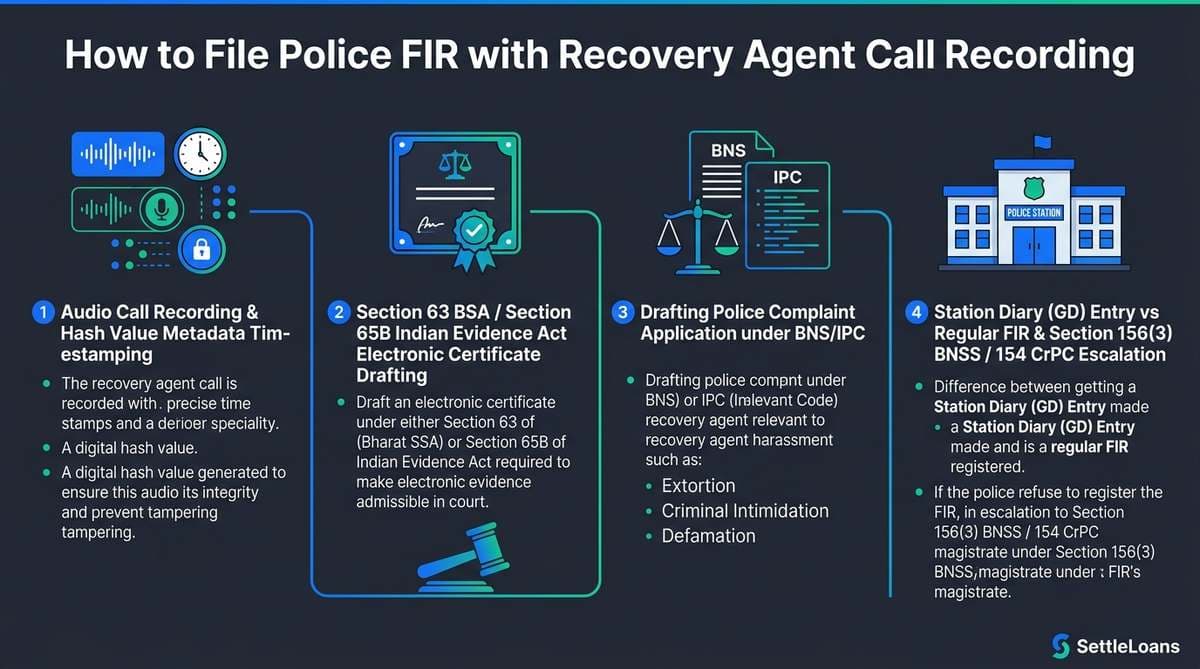
6. Step-by-Step Procedure
A simple grievance letter rarely works. Station House Officers (SHOs) ignore casual complaints. You must draft a formal petition under Section 173 BNSS. Present chronological facts. Cite statutory laws. Attach certified electronic proof.
First, state police station jurisdiction. Give your home address. State where you took calls. Name the accused clearly. Identify recovery agents and agencies. Name the lending bank as vicariously liable.
Next, build a chronological incident table. List call dates, times, caller numbers, and call durations. Add exact quotes of verbal abuse. Highlight extortion threats and home raid threats.
Cite RBI Master Directions on Recovery Agents. Note that calls before 8 AM or after 7 PM are banned. Cite Section 308 BNS for extortion. Cite Section 351 BNS for criminal intimidation. Add Section 79 BNS for insults to women. Pray for an FIR, Call Detail Records (CDR) seizure, and police protection.
Every police complaint file needs key papers: (1) Signed Police Complaint Application. (2) Sworn Certificate under Section 63 BSA / 65B Evidence Act on stamp paper. (3) CD or USB drive with audio files. (4) Full phone call logs. (5) Loan statements. (6) Photo ID copy.
7. Overcoming Police Inaction
Police must register an FIR for cognizable crimes. The Lalita Kumari v. Govt of UP ruling mandates this. Yet police often give only a General Diary (GD) entry. Or they give a Non-Cognizable Report (NCR).
Do not wait if police refuse an FIR. After 48 hours, escalate to senior police. Send your file to the SP under Section 173(4) BNSS. Section 154(3) CrPC applies to older cases. Use registered post. Or use the cyber portal.
If the SP fails to act, take court action. Hire a defense advocate. File a plea before the Judicial Magistrate under Section 175(3) BNSS. Section 156(3) CrPC applies to older cases. The magistrate reviews the Section 63 BSA certificate. The court orders an FIR right away.
Your advocate can file a complaint under Section 223 BNSS. Section 200 CrPC applies to older cases. Bank leaders must appear in court. Lenders quickly halt agents. They offer an OTS settlement.
8. Sanction Letter Forensics
Be careful when finalizing a debt settlement. Fraudulent agents issue fake settlement letters. They collect tokens and pocket cash. The debt remains open on bank records.
A genuine OTS settlement letter comes from the official bank email domain. Or it carries an authorized manager signature and seal. It states your name, PAN, and loan account number. It specifies the exact settlement sum and due dates. It includes a full waiver clause.
Under RBI Circular RBI/2023-24/60, lenders must issue an NDC. The deadline is 30 days. They must update all credit bureaus to zero balance. Any delay beyond 30 days incurs a mandatory penalty. The bank must pay ₹5,000 per day to you.
9. Illegal Recovery Violations vs Legal Remedies Matrix
Compare illegal recovery threats against statutory protections under Indian law:
| Recovery Agent Threat / Violation. | Legal Reality & Statutory Invalidity. | Applicable Criminal / Civil Law. | Definitive Borrower Remedy. |
|---|---|---|---|
| Calling before 8 AM or after 7 PM. | Breaches RBI Master Directions and privacy rights. | RBI Fair Practices Code and Article 21 privacy rules. | Submit call logs with Section 63 BSA certificate to RBI and police. |
| Threatening arrest or warrants. | Loan default is civil. Only magistrates issue warrants. | Section 351 BNS (Section 506 IPC) and Section 66D IT Act. | File a police complaint for intimidation and impersonation. |
| Demanding cash under threats. | Extortion with threat of harm is a crime. | Section 308 BNS (Section 384 IPC). | File a police FIR backed by audio recordings. |
| Contacting family, friends, or HR. | Third-party contact violates privacy rules. | Section 356 BNS defamation and RBI Outsourcing norms. | Send legal notice. Report to RBI Principal Nodal Officer. |
| Refusing NDC after settlement. | Breaches settlement terms and RBI timelines. | RBI Circular RBI/2023-24/60 with ₹5,000 daily penalty. | Claim daily delay penalty. File RBI Ombudsman complaint. |
10. SettleLoans Recovery FIR Legal Support
SettleLoans is India's leading debt harassment defense platform. We protect professionals and families from abusive collection agencies. Our team includes banking advocates and defense attorneys.
We extract audio proof. We draft Section 63 BSA certificates. Old cases use Section 65B affidavits. We file petitions before Judicial Magistrates. We negotiate 45% to 65% OTS debt waivers. SettleLoans protects your dignity and finances.

Settle Loan is India's trusted debt relief and loan settlement platform. We help borrowers overcome financial distress by negotiating with banks and NBFCs to legally settle personal loans and credit card debts. With our transparent, performance-based approach, you can achieve debt freedom and regain your financial peace of mind.
COMPUTER
11. FAQs: Police FIRs & Call Recording Admissibility
Is recording a recovery agent's phone call legal in India?
Yes. Recording calls to capture criminal threats is legal in India. Supreme Court rulings confirm this rule. See R.M. Malkani and K.S. Puttaswamy cases. Audio records are valid proof in court. A legal certificate makes them valid.
What is a Section 63 BSA or Section 65B Evidence Act certificate?
A Section 63 BSA certificate is a sworn legal affidavit. Old cases use Section 65B Evidence Act. It confirms the phone worked normally. It proves the audio copy is exact. It includes device details, call times, and SHA-256 hash values.
What criminal sections apply to abusive recovery agents under BNS and IPC?
Abusive calls violate multiple laws. Section 308 BNS covers extortion. Section 383/384 IPC applies too. Section 351 BNS covers threats. Section 503/506 IPC applies too. Section 79 BNS covers insults to women. Section 509 IPC applies too. Section 356 BNS covers defamation. Sections 66D and 67 IT Act apply too.
What should I do if the local police refuse to register an FIR?
Demand a General Diary (GD) entry first. Then, write to the SP or DCP under Section 173(4) BNSS. If inaction continues, hire an advocate. File a plea before the Judicial Magistrate under Section 175(3) BNSS. The court will order an FIR.
How does filing a police complaint with call recordings help in loan settlement?
A police complaint creates legal leverage. It exposes lenders to ₹20 Lakh RBI Ombudsman fines. The Supreme Court holds banks liable for agent crimes. To avoid court trials, banks recall agencies. They approve a 45% to 65% OTS debt waiver.
Can a recovery agent call my family members, friends, or workplace?
No. Under RBI Master Directions, agents cannot contact third parties. They cannot call family, friends, or employers. Doing so breaches privacy laws. It amounts to illegal defamation.
What technical metadata must be included in the electronic evidence certificate?
The certificate must list phone brand, model, and IMEI. It must record date, time, caller number, and call length. It must name the audio format like .mp3. It must include a SHA-256 hash value to prove zero tampering.
What is the difference between a General Diary (GD) entry and an FIR?
A General Diary (GD) entry is only a desk record. It does not start an investigation. An FIR under Section 173 BNSS starts a formal criminal case. Police must investigate, seize proof, and file a court charge sheet.
Can bank executives be held liable for threats made by outsourced recovery agents?
Yes. Supreme Court rulings confirm this rule. See Prakash Kaur and Shanti Devi Sharma cases. Banks cannot blame third-party agents. Lenders face full legal blame for recovery crimes.
What is the mandatory timeline for banks to issue an NDC after settlement?
Under RBI Circular RBI/2023-24/60, lenders must issue an NDC. The deadline is 30 days. They must update credit bureaus to ₹0 balance. Delays beyond 30 days trigger a penalty. The bank must pay ₹5,000 per day to the borrower.