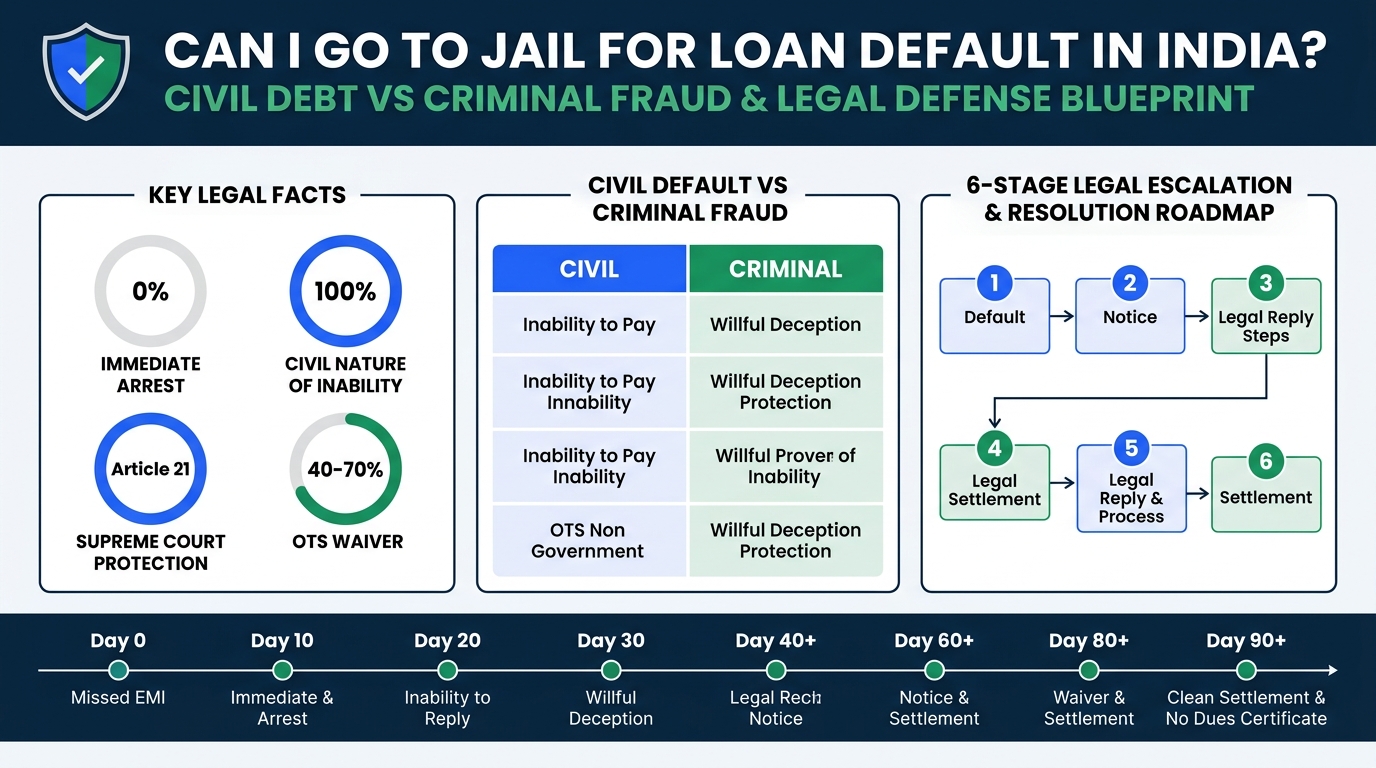
- Zero Immediate Police Arrest: Defaulting on an unsecured personal loan due to financial inability is a civil breach of contract under the Indian Contract Act, 1872. Police have zero authority to register an FIR or arrest you.
- Supreme Court Constitutional Protection: In Jolly George Varghese v. Bank of Cochin (1980), the Supreme Court ruled that jailing an honest debtor who lacks the financial capacity to pay violates Article 21 of the Indian Constitution.
- Bail as a Matter of Right: Even if a bank initiates court proceedings for cheque dishonour (Section 138 NI Act) or NACH bounce (Section 25 PSSA), these are bailable quasi-criminal offenses where regular bail is granted on day one.
- Strict RBI Anti-Harassment Mandates: Recovery agents threatening police arrest, sending fake court summons on WhatsApp, or visiting workplaces unannounced commit punishable criminal offences under Indian penal laws.
- One-Time Settlement (OTS) Dissolves All Liability: A formal debt settlement through SettleLoans permanently closes the loan account, halts legal notices, and secures a 100% binding No Dues Certificate (NDC).
1. Can You Go to Jail for Loan Default in India?
When financial catastrophe strikes—whether triggered by sudden employment termination, drastic salary cuts, business insolvency, or catastrophic family medical emergencies—hundreds of thousands of honest salaried professionals across India face the terrifying prospect of defaulting on their personal loans. In this state of acute vulnerability, third-party collection agencies deploy aggressive psychological warfare, bombarding borrowers with alarming messages claiming that police squads are arriving at their doorstep or that a non-bailable arrest warrant has been issued.
"To cast a person in prison because of his poverty and consequent inability to meet his contractual liability is a violation of Article 21 of the Constitution... The simple default to pay is not enough; there must be some element of bad faith beyond mere indifference to pay, some deliberate or dishonest evading on the part of the debtor."
— Supreme Court of India in Jolly George Varghese & Anr. v. The Bank of Cochin (1980) 2 SCC 360
Let us establish the foundational legal reality with absolute clarity: In India, defaulting on an unsecured personal loan due to genuine inability to pay is NOT a criminal offense. It is strictly a civil breach of contract governed by the Indian Contract Act, 1872. You cannot be thrown into jail simply because you ran out of money to service your personal loan or credit card debt.
Under the Indian legal framework, lending institutions are commercial entities that price the risk of unsecured default into their interest rates (which typically range from 12% to 28% per annum). The law explicitly distinguishes between an unfortunate debtor who genuinely lacks the financial capacity to pay and a fraudulent imposter who intentionally cheated the lender from inception.
2. Civil Debt vs Criminal Fraud: Legal Demarcation
To eliminate borrower anxiety, it is essential to analyze how Indian criminal law (the Indian Penal Code, 1860 and the Bharatiya Nyaya Sanhita, 2023) defines financial crimes versus civil contract breaches. Recovery agents routinely drop terms like "Section 420 IPC" or "FIR for cheating" to intimidate borrowers into borrowing from relatives or illegal loan sharks to pay the bank.
| Legal Parameter | Civil Debt Default (Your Scenario) | Criminal Fraud (Cheating / Forgery) |
|---|---|---|
| Governing Statutes | Indian Contract Act, 1872 & Civil Procedure Code (CPC), 1908 | Section 420 IPC / Section 318 BNS & Section 468 IPC (Forgery) |
| Intent (Mens Rea) | Zero fraudulent intent. Loan availed in good faith; payments made until financial distress occurred. | Deliberate, fraudulent intent to cheat the lender present right from the day of application. |
| Documentation Provided | Genuine PAN, Aadhaar, authentic salary slips, and legitimate bank statements. | Forged salary slips, synthetic identity, fabricated bank statements, or shell company credentials. |
| Repayment Track Record | Paid several EMIs diligently until unexpected crisis (job loss, illness, insolvency) occurred. | Absconded immediately after loan disbursal without paying even a single installment. |
| Police / Arrest Authority | Zero police power. Police cannot register FIR or arrest debtor. | Police can investigate and arrest upon FIR registered with Magistrate sanction. |
| Legal Remedy for Lender | Civil summary suit for money recovery (Order 37 CPC) or consensual Lok Adalat settlement. | Criminal trial before Sessions Court / Metropolitan Magistrate. |
Why Section 420 IPC / Section 318 BNS Cannot Be Applied to Honest Defaulters
For a bank to successfully register an FIR or maintain a criminal complaint under Section 420 IPC (Cheating) or Section 318 of the Bharatiya Nyaya Sanhita (BNS), they must establish beyond reasonable doubt that the borrower had a dishonest intention to deceive from day one.
In dozens of landmark judgments, the Supreme Court and High Courts have consistently quashed frivolous criminal complaints filed by banks against defaulters, observing that commercial lenders cannot convert a purely civil recovery dispute into a criminal intimidation tool. If you took a loan honestly and paid your initial EMIs, any subsequent inability to pay is 100% civil.
Check Your Loan Settlement Options
Answer 2 quick questions to evaluate your settlement eligibility.
1. What type of loan do you want to settle?
3. What Happens When You Stop Paying Your Personal Loan
When you stop paying your personal loan EMIs, the bank follows a standardized, regulatory-governed escalation pathway established by the Reserve Bank of India (RBI). Knowing this timeline strips away the fear of the unknown:
Days 1–30: SMA-0 (Special Mention Account 0) & Initial Grace
When the first EMI auto-debit bounces, the bank assesses a bounce fee (₹400–₹600) and penal interest. Automated SMS alerts, emails, and gentle reminder calls begin. At this stage, your credit report reflects a 30-day DPD (Days Past Due). No legal action is taken.
Days 31–60: SMA-1 & Escalated Tele-Calling
After missing two consecutive EMIs, the account is categorized as SMA-1. Calls from the bank's internal collection team increase in frequency (3–5 calls daily). The bank may offer a short-term restructuring or request partial token payments.
Days 61–90: SMA-2 & Third-Party Agency Assignment
With three unpaid EMIs, the bank transfers the file to external third-party recovery agencies (Direct Recovery Agents - DRAs). This is when aggressive collection calls, unannounced home visits, and deceptive legal threats peak. Borrowers must remain calm and assert their RBI Fair Practice rights.
Day 90+: Formal NPA Classification (Non-Performing Asset)
Under RBI prudential norms, continuously overdue accounts crossing 90 days are officially classified as Non-Performing Assets (NPAs). The bank writes off unpaid interest and makes standard provisioning on its balance sheet. This triggers formal statutory legal demand notices and opens the window for One-Time Settlement (OTS) negotiations.
Days 90–180+: Formal Legal Notices & Settlement Window
The bank dispatches formal advocate demand notices (Loan Recall Notice, Section 138 notice for bounced cheques, Section 25 PSSA notice for bounced NACH, or pre-litigation Lok Adalat notices). At this stage, engaging professional debt settlement representation like SettleLoans allows you to secure a 40% to 70% OTS waiver and permanently close the debt.
4. Quasi-Criminal Traps: Section 138 & Section 25 PSSA
While a standard personal loan default is purely civil, banks frequently attempt to introduce criminal pressure through two specific statutory mechanisms: bouncing physical Post-Dated Cheques (Section 138 NI Act) and bouncing electronic NACH auto-debit mandates (Section 25 PSSA).
Understanding these provisions is vital to demystifying your situation and realizing why you will NOT be abruptly arrested:
- Trigger: Dishonour of a physical signed cheque / PDC for insufficient funds.
- Notice Requirement: Mandatory 30-day statutory demand notice with 15-day cure window.
- Bail Status: 100% Bailable and Non-Cognizable. Police cannot arrest without judicial warrant.
- Settlement: 100% Compoundable under Section 147 NI Act at any stage.
- Trigger: Dishonour of electronic NACH e-Mandate / ECS auto-debit instructions.
- Notice Requirement: Statutory demand notice within 30 days of receiving the return memo.
- Bail Status: Bailable as a statutory right upon first court appearance.
- Settlement: Fully compoundable and dismissable upon One-Time Settlement (OTS).
The Supreme Court Shield on Security Cheques (Dashrathbhai Patel Precedent)
Banks often collect blank, undated security cheques during initial loan sanction. When you default after paying 12 or 24 EMIs, the bank unilaterally fills the original total loan amount plus inflated penalties onto that security cheque and presents it for clearing.
In Dashrathbhai Trikambhai Patel v. Hitesh Mahendrabhai Patel (2022), the Supreme Court ruled that under Section 56 of the NI Act, a cheque must represent the exact, legally enforceable, crystallized debt on the date of presentation. If the bank fails to endorse prior EMI repayments on the cheque and presents an inflated instrument, the Section 138 prosecution is legally invalid and liable to be dismissed.
Can I Go to Jail for Loan Default in India? Legal Reality & Process Overview
5. Dismantling Agent Coercion: Arrest & Warrant Myths
The immense fear borrowers suffer rarely stems from actual court proceedings—it stems from unlawful psychological harassment by outsourced collection agents. Unethical agents weaponize legal misinformation to coerce panic repayments.
Lie #1: "Police officers are arriving with an arrest warrant today."
The Legal Fact: Police have zero jurisdiction over civil loans. Arrest warrants can only be issued by a Judicial Magistrate after months of ignored judicial summonses. Recovery agents have zero authority to summon the police.
Lie #2: "We will seize your furniture, electronics, and ancestral house tomorrow."
The Legal Fact: Personal loans are completely unsecured. The SARFAESI Act does NOT apply. A lender cannot confiscate a single household item without a formal civil court decree and execution warrant, which takes years.
Lie #3: "We will call your HR and get you terminated from your job."
The Legal Fact: Contacting third parties, employers, or relatives is explicitly prohibited by RBI Master Directions and constitutes actionable criminal defamation (Section 499/500 IPC / Section 356 BNS) and workplace intrusion.
RBI Fair Practices Code & Supreme Court Ruling in ICICI Bank v. Prakash Kaur
In ICICI Bank v. Prakash Kaur (2007) 2 SCC 711, the Supreme Court severely condemned the use of musclemen and abusive recovery agents, ruling that banks must adhere strictly to the rule of law.
The Reserve Bank of India's updated Master Direction on Recovery Agents (August 2022 & June 2023) establishes binding rules:
- Calls permitted only between 8:00 AM & 7:00 PM
- Mandatory display of Bank DRA authorization ID
- Zero contact with friends, relatives, or colleagues
- Strict prohibition of abusive, threatening language
6. Borrower Defense Toolkit & Cease-and-Desist Template
If collection agents are harassing you, you must establish a formal paper trail. Sending a structured Cease-and-Desist legal notice immediately shifts the legal leverage in your favor:
REGISTERED SPEED POST / FORMAL EMAIL LEGAL NOTICE

To,
The Principal Nodal Officer / Grievance Redressal Officer,
[Lending Bank / NBFC Name],
[Bank Branch / Corporate Headquarters Address]

Subject: Formal Notice to Cease & Desist Unlawful Harassment, Extortionary Coercion, and False Threats of Criminal Prosecution regarding Loan Account No: [Loan Account Number].

Sir / Madam,

I am writing this formal communication to place on judicial record the persistent, unlawful, and coercive tactics deployed by your recovery agents and collection representatives regarding my unsecured personal loan account [Loan Account Number].

1. CIVIL NATURE OF FINANCIAL HARDSHIP:
I have experienced genuine, involuntary financial distress resulting from [job loss / severe medical crisis / business insolvency], which has temporarily impaired my cash flows. Under the Indian Contract Act, 1872, and the landmark Supreme Court ruling in Jolly George Varghese v. The Bank of Cochin (1980) 2 SCC 360, inability to repay an unsecured civil loan due to poverty is strictly a civil matter and does not constitute a criminal offence.

2. GROSS VIOLATION OF RBI FAIR PRACTICES CODE:
Your recovery representatives have repeatedly engaged in prohibited actions under the RBI Master Direction on Fair Practices Code (Aug 2022 & June 2023), including:
a) Calling at inappropriate hours (before 8:00 AM / after 7:00 PM);
b) Threatening immediate police arrest, non-bailable warrants, and criminal FIR registration under Section 420 IPC / Section 318 BNS;
c) Contacting unauthorized third parties, family members, and workplace colleagues to cause public humiliation.

3. CRIMINAL INTIMIDATION & IMPERSONATION:
Threatening arrest without judicial authority and impersonating law enforcement officers constitutes Criminal Intimidation (Section 506 IPC / Section 351 BNS) and Extortion (Section 384 IPC / Section 308 BNS). Under Supreme Court directives in ICICI Bank v. Prakash Kaur (2007), banks are vicariously liable for the criminal acts of their outsourced collection agencies.

DEMAND FOR ACTION:
I hereby call upon your institution to immediately:
1. Cease all third-party, workplace, and off-hours communication;
2. Direct your collection agencies to communicate solely in writing via registered post or official email;
3. Initiate formal, bona fide discussions for a structured One-Time Settlement (OTS) or restructuring under RBI prudential frameworks.

Failure to immediately halt these unlawful practices within 48 hours will compel me to lodge formal complaints before the RBI Integrated Ombudsman (CMS Portal), the Cyber Crime Cell, and institute civil damages suits against your bank and recovery agency for reputational harm.

Yours faithfully,

[Borrower Full Name]
[Registered Mobile Number & Email]
[Residential Address]
How to Dispatch This Cease & Desist Notice:
- Fill in your loan account number, bank details, and specific agent names/dates of calls.
- Email the notice directly to the bank's Principal Nodal Officer (PNO) and Customer Care Head.
- Send a physical copy via Registered Speed Post to the bank's regional branch.
- Retain the postal tracking receipt and email delivery confirmation as judicial evidence.
7. Legitimate Civil Remedies Available to Banks for Unsecured Loans
While banks cannot imprison you, they do possess legitimate civil legal recourses to recover outstanding debts. Understanding what these actual legal procedures are enables you to respond proactively:
1. Civil Summary Suit (Order 37 CPC)
Lenders can file a summary suit in a civil court for debt recovery. The borrower is served formal summons and has 10 days to enter appearance and seek "Leave to Defend" highlighting financial hardship, disputing penal calculations, or requesting installment schedules.
2. National Lok Adalat (NALSA)
Conducted quarterly across India under the Legal Services Authorities Act, 1987. Lok Adalat is a voluntary, non-adversarial dispute resolution platform where bank officials and borrowers agree to mutually acceptable OTS compromises.
3. Commercial Arbitration
Some loan contracts include an arbitration clause. However, under Supreme Court precedents (Perkins Eastman, 2019), banks cannot unilaterally appoint a sole biased arbitrator without borrower consent or court appointment under Section 11 of the Arbitration Act.
8. One-Time Settlement: Legally Binding Clean Debt Exit
If you cannot afford to repay your accumulated personal loan principal and ballooning penal charges, continuing in indefinite default is counterproductive. The ultimate legal resolution is a structured One-Time Settlement (OTS) negotiated directly with the bank's authorized management.
How SettleLoans Protects Borrowers & Negotiates Clean Exits
We scrutinize your loan agreement, recalculate unlawful compound penalties, and compile certified financial hardship documentation.
Our empaneled advocates issue registered legal replies to bank demand notices, halting recovery harassment and establishing your legal defenses.
We negotiate directly with the bank's credit committee to secure massive waivers on penal interest, late fees, and principal balance.
We ensure payment is made only against an official bank compromise sanction letter, securing an authentic No Dues Certificate (NDC) and court case compounding.

Settle Loan is India's trusted debt relief and loan settlement platform. We help borrowers overcome financial distress by negotiating with banks and NBFCs to legally settle personal loans and credit card debts. With our transparent, performance-based approach, you can achieve debt freedom and regain your financial peace of mind.
COMPUTER
Frequently Asked Questions
Straightforward, legally verified answers regarding loan defaults, recovery agent threats, court summons, and debt settlement in India.
No. Under Indian law, defaulting on an unsecured personal loan due to financial inability is strictly a civil breach of contract, not a crime. The Supreme Court of India in the historic judgment Jolly George Varghese v. The Bank of Cochin (1980 2 SCC 360) affirmed that detaining or imprisoning an honest debtor merely on the grounds of poverty or inability to fulfill a contractual obligation violates Article 21 (Right to Life and Personal Liberty) of the Constitution of India and Article 11 of the International Covenant on Civil and Political Rights (ICCPR).
A civil default occurs when a borrower acts in good faith, makes initial payments, but subsequently suffers unexpected financial distress (such as job termination, business failure, or medical catastrophe) and cannot service the debt. A criminal offense (Section 420 IPC / Section 318 BNS) requires conclusive proof of fraudulent intention right from loan origination (mens rea)—such as forged salary certificates, fabricated bank statements, synthetic identities, or deliberate siphoning of disbursed funds without ever intending to pay a single EMI.
No, absolutely not. The police have zero jurisdiction to intervene in standard civil loan defaults or arrest borrowers for missed EMIs. Police officers cannot register an FIR for non-payment of an unsecured loan. Any recovery agent claiming they are calling from a police station or arriving with police escorts is engaging in Criminal Intimidation (Section 506 IPC / Section 351 BNS) and Extortion (Section 384 IPC / Section 308 BNS), both of which are severely punishable under Indian law.
When an electronic auto-debit bounces for insufficient funds, the lending institution may file a complaint under Section 25 of the Payment and Settlement Systems Act, 2007 (PSSA). While framed as a quasi-criminal statutory provision similar to cheque dishonour, Section 25 is bailable, non-cognizable, and compoundable. The police cannot arrest you. When a magistrate court issues summons, your legal counsel enters an appearance and secures same-day bail on a personal bond. The underlying matter can then be settled amicably and withdrawn.
If the bank deposits a physical Post-Dated Cheque (PDC) or security cheque collected during loan disbursal and it is returned unpaid, they can issue a statutory 15-day demand notice under Section 138 of the Negotiable Instruments Act, 1881. However, Section 138 is bailable as a matter of right. Furthermore, under the landmark Supreme Court ruling in Dashrathbhai Trikambhai Patel (2022), if the bank deposited an undated security cheque for the entire original principal without deducting EMIs already paid (violating Section 56 NI Act), the criminal complaint is legally defective and maintainable.
The Reserve Bank of India (RBI) under its Master Direction on Fair Practices Code strictly mandates that lenders and their recovery agents must NOT: 1) Call borrowers before 8:00 AM or after 7:00 PM; 2) Use abusive, intimidating, or profane language; 3) Contact family members, friends, or employers; 4) Threaten criminal prosecution or police arrest; 5) Visit homes unannounced without displaying legitimate bank ID cards. Breaches must be escalated directly to the bank's Principal Nodal Officer and the RBI Integrated Ombudsman (CMS Portal).
No. Personal loans and credit card debts are unsecured financial instruments with zero hypothecation or mortgage attached. The SARFAESI Act, 2002 (which empowers lenders to seize assets without court intervention) applies exclusively to secured loans like home loans or property mortgages. A lender cannot confiscate your personal belongings, furniture, or home for an unsecured loan without an explicit money recovery decree and execution order from a competent civil court.
When an unsecured personal loan defaults (classified as an NPA after 90 days), banks have the following lawful recourses: 1) Report adverse payment history to credit information companies (CIBIL, Experian, Equifax), lowering your credit score; 2) Issue statutory recall notices; 3) File a Civil Summary Suit under Order 37 of the Code of Civil Procedure, 1908; 4) Refer the dispute to National Lok Adalat for mutual compromise; 5) Initiate Section 138 NI Act or Section 25 PSSA proceedings if cheques or NACH mandates bounced.
A One-Time Settlement (OTS) is an official compromise agreement sanctioned by the bank under its board-approved recovery policy. The bank agrees to waive 100% of accumulated penal interest, late fees, and legal charges, along with 40% to 70% of the outstanding principal balance. Once the agreed settlement figure is paid, the bank issues a legally binding No Dues Certificate (NDC), withdraws all pending legal notices, and compounds any court complaints under Section 147 NI Act.
Do not panic and never make a panic payment. Indian judicial courts and police authorities never serve arrest warrants or criminal summons through informal WhatsApp messages. These fake documents are fabricated by unethical collection agencies. Take immediate screenshots, record the sender's phone number, preserve all chat transcripts, and engage SettleLoans advocates to issue a strict criminal intimidation complaint to the bank's Nodal Officer and local cyber crime authorities.
Authoritative Legal & Regulatory Sources
- Supreme Court of India — Landmark Rulings on Article 21 & Debtor Inability (Jolly George Varghese, 1980)
- Reserve Bank of India (RBI) — Master Direction on Fair Practices Code for Lenders & Recovery Agents
- Ministry of Law & Justice — The Indian Contract Act, 1872 (Act No. 9 of 1872)
- National Legal Services Authority (NALSA) — National Lok Adalat Pre-Litigation & Loan Settlement Guidelines
- RBI Integrated Ombudsman Scheme (CMS Portal) — Redressal of Unlawful Bank & Recovery Agent Harassment