- Zero Legal Standing Under RBI Rules: Loans from unregistered apps or APKs are void ab initio under Section 23 of the Indian Contract Act, 1872 and RBI Digital Lending Guidelines.
- Fast National Helpline 1930 & Portal: Report scams on cybercrime.gov.in and dial 1930 to freeze scammer bank accounts and dummy UPI IDs.
- Chakshu Portal Number Blocking: Reporting threat numbers on sancharsaathi.gov.in triggers mobile number cancellation and IMEI hardware blacklisting.
- Strict Criminal Charges on Blackmailers: Extortion and morphed photo threats carry 3 to 7 years in jail under BNS Sections 308, 318, 351, 356 and IT Act Sections 66E, 67, 67A.
- Complete CIBIL & Police Immunity: Illegal apps cannot report to credit bureaus or file police cases. Borrowers are victims of cybercrime and face zero legal risk.
1. Anatomy of 7-Day Chinese Loan App Scams
Across India, many smartphone users fall into illegal loan app traps. Scammers promote apps on social media and fake websites. They use names like Cash Advance, Speed Loan, or Rupee Master. They promise fast cash with no paperwork.
These platforms are run by organized cyber fraud rings. A borrower applies for a loan of ₹5,000. The app deducts large fees and sends only ₹2,800. After 5 to 7 days, agents demand ₹8,000 or more. The interest rate exceeds 2,000% per year.
When borrowers question these rates, agents start blackmailing them. The app acts as spyware. It steals contact lists, photos, and location data. Agents make vulgar threats and send voice notes. They create morphed photos using AI tools. They threaten to send these photos to family and coworkers.
These scammers run extortion rings, not real banks. Paying money will never stop the threats. Filing a police FIR and getting legal help is the only way to end the harassment.
2. Statutory Cyber Crime & BNS Legal Framework
Illegal loan apps violate multiple criminal laws and RBI directives. Indian law provides strong protections to victims while punishing scammers with non-bailable prison terms.
The main legal laws used against loan app blackmail include:
Extortion is punishable under Section 308 BNS (legacy Section 384 IPC). Cheating falls under Section 318 BNS (Section 420 IPC). Criminal intimidation falls under Section 351 BNS (Section 506 IPC). Defamation falls under Section 356 BNS, and insulting women falls under Section 79 BNS.
Data theft violates Section 43 & 66. Identity theft violates Section 66C. Privacy breach violates Section 66E. Morphed photo sharing violates Sections 67 & 67A, carrying up to 7 years in prison.
Digital loans must come only from RBI-regulated banks or NBFCs. Apps cannot access contacts, photos, or call logs. Unregulated lending apps are illegal.
Contracts with unlawful purposes are void ab initio. Because illegal lending apps violate banking acts, the loan has zero legal existence.
In the Puttaswamy (2017) case, the Supreme Court ruled that privacy is a fundamental right under Article 21. Stealing phone contacts and morphing photos violates constitutional rights. Victims have the right to state protection and legal relief.
3. Deconstructing the Blackmail Playbook
Predatory loan apps use fear and shame to force quick payments. Understanding their playbook helps you stop their threats:
The extortion ring operates in five distinct phases:
Stage 1: Invasive Spyware Infiltration via Sideloaded APKs
When users install sideloaded APKs, the app asks for contact, storage, and camera access. A hidden script steals phone contacts and photos to remote servers.
Stage 2: Synthetic Default & Automated Harassment Blitz
On day 5 or 6, automated systems send abusive SMS and VoIP calls. Scammers pretend to be police or court officers to threaten fake home raids.
Stage 3: AI-Facial Morphing & Obscene Defamation Collateral
Scammers take the borrower's selfie and create morphed vulgar photos using AI tools. They create graphic posters labeling the borrower a fraud.
Stage 4: WhatsApp Group Creation & Direct Relative Intimidation
Scammers create temporary WhatsApp groups with the victim's family, friends, and coworkers. They share morphed photos and demand immediate payment.
Stage 5: Hawala Laundering Through Layered Mule Accounts
Extorted funds move through stolen bank accounts (mule accounts). Funds are converted to cryptocurrency and sent offshore.
This playbook proves scammers have no legal power over you. Their only weapon is shame. Once you inform your contacts and file an FIR, their power is gone.
4. The Extortion Trap Economics
Many victims make the mistake of paying blackmail money. But in cyber extortion, paying money only proves that threats work.
The table below compares paying extortion versus taking legal action:
| Scenario Parameter | Path of Compliance (Paying Extortion) | Path of Legal Resistance (FIR & Defense) |
|---|---|---|
| Financial Loss | Losses grow from ₹3,000 to ₹2,00,000+ | ₹0 extra payments; complete financial stop |
| Harassment Duration | Never ends; new apps demand more money | Stops in 24 to 72 hours after FIR & blocking |
| Contact Exposure | High risk; scammers keep your data | Protected by warning contacts in advance |
| Legal Protection | Zero police record; ongoing risks | Official police cyber FIR and telecom blocking |
| CIBIL Bureau Impact | ₹0 impact (unregulated apps cannot report) | ₹0 impact (unregulated apps cannot report) |
Extortion syndicates track compliant targets using standard fraud models:
Extortion risk rises when you pay money. It drops to zero when you file an FIR, block numbers on Chakshu, and get legal counsel.
Because the loan is void ab initio, you do not owe any money. The law protects you completely.
5. Emergency Cyber Crime Redressal & FIR Visual Roadmap
This 5-step roadmap shows how to stop loan app blackmail fast. Save your chat evidence. File a complaint on cybercrime.gov.in. Block scam numbers on the Chakshu portal. Convert your complaint to a police FIR. Use RBI rules to stop harassment.
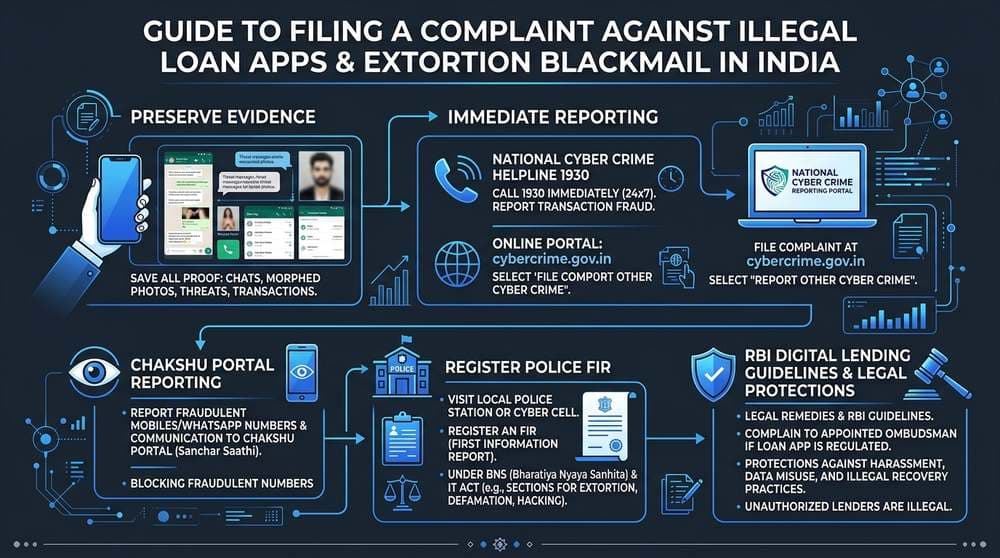
6. Step-by-Step Guide
The Ministry of Home Affairs runs the National Cyber Crime Reporting Portal (NCRP) at cybercrime.gov.in. You can also dial the 24x7 Financial Fraud Helpline 1930. Filing a complaint creates an official police record. It alerts cyber crime teams across India to track the scammers.
Follow these simple steps to file your cyber complaint:
Do not delete apps or block numbers yet. Take screenshots of all threat messages, WhatsApp chats, and call records. Record threat calls if you can. Take screenshots of the app showing loan amounts and bank accounts or UPI IDs used by scammers. Save all screenshots into one PDF file.
If you sent money to scammers, call 1930 right away. Give the officer your bank account details, transaction UTR numbers, and scammer UPI IDs. The 1930 team contacts banks to freeze stolen funds in scammer accounts before cash is taken out.
Visit cybercrime.gov.in and click "Register a Complaint". If scammers use morphed or obscene photos, choose "Report Crime Against Women/Children" for fast priority action. For other threats, choose "Report Other Cyber Crime". Log in using your mobile number and OTP. Select your state and district.
Choose "Cyber Blackmail / Threatening" or "Online Cyber Extortion" as the category. In suspect details, enter scammer phone numbers, app names, APK links, and UPI IDs. In the incident box, explain how scammers stole your contacts and made threats. Attach your PDF evidence file and submit.
After submitting, you will get a 15-digit NCRP Acknowledgement Number. Download and print the PDF receipt. Take two copies with your evidence to your local police station or Cyber Cell. Ask the police to register an FIR under BNS Sections 308, 318, 351, 356 and IT Act Sections 66, 66E, 67, 67A.
Police stations cannot reject your NCRP cyber complaint. Ministry rules require police to accept online cyber slips. They cannot tell you to pay or settle with illegal apps. Officers must register your complaint and take legal action.
7. Chakshu Portal Reporting
The Department of Telecommunications (DoT) runs the Chakshu facility on the Sanchar Saathi portal (sancharsaathi.gov.in/sfc). Chakshu lets citizens report fake calls, threat SMS, and WhatsApp messages fast.
Reporting scam numbers on Chakshu leads to rapid action:
Telecom companies like Airtel, Jio, Vi, and BSNL check reported numbers. If numbers use fake KYC or send threat messages, telecom firms disconnect them across India.
Through the Central Equipment Identity Register (CEIR), the government blocks the phone IMEI numbers used by scammers. Their mobile devices cannot connect to any Indian phone network.
Reports sent to WhatsApp lead to permanent bans on scammer accounts. This stops scammers from sending threat messages or making fake contact groups.
Payment authorities and banks freeze scammer UPI IDs and merchant accounts. This stops fraud rings from collecting or moving extorted money.
How to Submit a Chakshu Report in 3 Minutes
- Open sancharsaathi.gov.in and click the Chakshu tab.
- Under Medium, choose "Call", "SMS", or "WhatsApp".
- Under Fraud Category, pick "Fake Loan / Extortion".
- Enter the scammer phone number, time of call, and upload screenshots of threat messages.
- Verify your number with an OTP and submit. Save your complaint reference number.
8. Legal Immunity Protocols
Scammers often threaten to call your family, friends, and employer. Taking fast action removes the fear of blackmail before scammers cause harm.
Follow these 4 defense steps to protect yourself and your family:
Send a quick broadcast message and post a WhatsApp status to your contacts. Warn them that cyber criminals hacked your device data and are sending fake morphed images. Ask everyone to block unknown numbers and report threat calls. Telling people early removes the scammer's power to shame you.
Delete the fake loan app right away. Open Android Settings and check App Permissions. Turn off contact, storage, and camera access for unknown apps. Back up your files and do a factory reset on your phone to remove hidden spyware. Change your email and bank passwords, and turn on Two-Factor Authentication (2FA).
If domestic call centers call you, our debt lawyers send a legal Cease-and-Desist Notice. This notice cites RBI Fair Practices Code, Section 308 BNS, and the IT Act. It warns agency directors of criminal charges and civil lawsuits if they contact your friends or family.
If scammers threaten your office, write a short email to your HR team. Attach your official NCRP Cyber Crime Complaint Slip. HR teams know about loan app scams across India. Showing an official police complaint proves you are a victim of cyber crime and protects your job.
9. Legitimate NBFC Digital Lenders vs. Illegal Extortion
Knowing the difference between legal digital lenders and illegal loan scams helps you take the right legal steps:
| Evaluation Parameter | RBI-Regulated Digital Lenders (Banks / NBFCs) | Illegal 7-Day Lending Apps (Cyber Syndicates) |
|---|---|---|
| Regulatory Registration | Must have RBI NBFC license or bank permit | Fake shell apps and illegal download APKs |
| Loan Tenure & APR | 3 to 36 months; clear interest rates disclosed upfront | 5 to 7 days; fake fees with 2,000%+ interest |
| Device Permissions | No access to contacts, photos, or call records (RBI 2022) | Forces contact theft, photo access, and GPS tracking |
| Credit Bureau Reporting | Reports monthly to CIBIL, Experian, Equifax, and CRIF | Zero bureau access; cannot harm your CIBIL score |
| Recovery Practices | Strict RBI Fair Practices rules; calls only 8 AM to 7 PM | Violent threats, morphed photos, and contact blackmail |
| Legal Recourse | Civil court claims, arbitration, or Lok Adalat settlements | Void ab initio; zero legal power; subject to police FIR |
10. SettleLoans Emergency Cyber Defense
Dealing with loan app blackmail is stressful. SettleLoans provides fast legal help. Our team files cyber complaints on cybercrime.gov.in and helps register police FIRs under BNS and IT Act laws. We report scam numbers on Chakshu to block phone lines. We serve legal cease-and-desist notices to recovery agencies to stop all harassment and protect your family.

Settle Loan is India's trusted debt relief and loan settlement platform. We help borrowers overcome financial distress by negotiating with banks and NBFCs to legally settle personal loans and credit card debts. With our transparent, performance-based approach, you can achieve debt freedom and regain your financial peace of mind.
COMPUTER
11. FAQs: Cyber Crime Complaints Against Loan Apps
Here are clear answers to common questions about illegal loan app blackmail, filing cyber FIRs, and borrower rights in India.
What should I do immediately if an illegal loan app is blackmailing me with morphed photos?
Take timestamped screenshots and screen recordings of all threat messages, call logs, and morphed photos. Do NOT pay any money. Call the National Cyber Crime Helpline at 1930 right away. File a formal complaint at cybercrime.gov.in. Report scammer phone numbers on the Chakshu portal (sancharsaathi.gov.in). Send a warning text to your contacts about the data breach.
Are loans from 7-day unregistered mobile lending apps legally enforceable in India?
No. Under RBI Digital Lending Guidelines and Section 23 of the Indian Contract Act, 1872, loans from unregistered entities are void ab initio. These scam apps operate outside banking laws. They have zero legal right to collect debts or report to CIBIL.
How do I file a cyber crime complaint against an illegal loan app on cybercrime.gov.in?
Visit the National Cyber Crime Reporting Portal at cybercrime.gov.in. Click 'Register a Complaint'. Select 'Report Crime Against Women/Children' for morphed images, or 'Report Other Cyber Crime'. Enter the incident date, time, and details. Upload screenshots and UPI transaction proof. Submit the form and save the 15-digit Acknowledgement Number for your police FIR.
What is the Chakshu portal and how does it stop loan app recovery callers?
The Chakshu portal on sancharsaathi.gov.in lets citizens report fraud calls, SMS, and WhatsApp threats. When you report numbers with proof, telecom operators verify the scam. They disconnect the mobile numbers, cancel the SIM cards, and blacklist the phone IMEI across India.
Which criminal sections of BNS and the IT Act apply to loan app blackmail and extortion?
Blackmailers face charges under multiple laws: Section 308 BNS for Extortion, Section 318 BNS for Cheating, Section 351 BNS for Criminal Intimidation, Section 356 BNS for Defamation, and Section 79 BNS for Insulting Modesty. Under the IT Act, 2000, Sections 43/66 penalize hacking, Section 66C penalizes identity theft, Section 66E penalizes privacy breach, and Sections 67/67A penalize obscene media sharing with up to 7 years in jail.
Can illegal Chinese loan apps ruin my CIBIL credit score?
No. Only RBI-regulated banks and NBFCs can report to credit bureaus under the Credit Information Companies Act, 2005. Unregistered 7-day loan apps have zero access to credit bureaus. They cannot report debts or damage your CIBIL score.
Will the local police arrest me if an illegal loan app claims I committed fraud?
No. Victims of illegal loan apps are victims of cybercrime, not criminals. The Supreme Court and police advisories make this clear. The police will not arrest you for non-payment. Instead, police will register an FIR against the scam operators.
Why does paying extortion money to illegal loan apps never end the blackmail?
Paying blackmail money never stops the threats. Scammers mark paying victims as easy targets. They demand more money or credit unwanted funds to extort you again. The only way to stop extortion is to cut contact, file an FIR, block numbers on Chakshu, and get legal defense.
What device permissions do RBI Digital Lending Guidelines strictly prohibit loan apps from accessing?
Under RBI Digital Lending Guidelines of September 2022, loan apps cannot access phone contacts, call logs, SMS texts, or photo galleries. Blanket device access is illegal. Apps that demand these permissions violate RBI rules.
How can legal counsel assist victims trapped in illegal loan app extortion syndicates?
Banking and cyber lawyers draft criminal complaints under the BNS and IT Act. They help convert portal entries into registered police FIRs. Lawyers coordinate with police to freeze mule accounts, issue cease-and-desist notices, and protect your family and career.