- Legality of Recording: Recording an incoming call from a recovery agent without their prior knowledge is completely legal in India when gathered to prove criminal extortion, intimidation, or regulatory non-compliance.
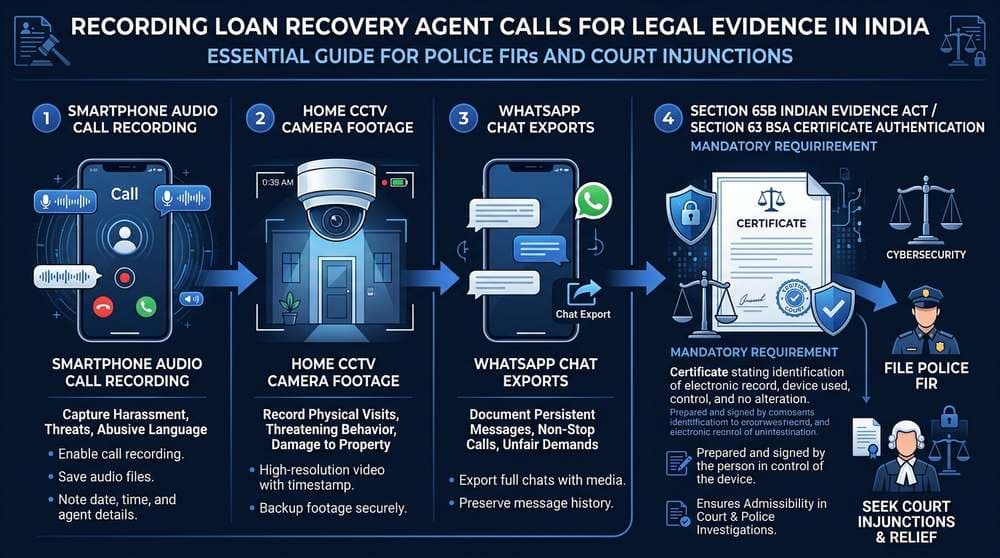
- Mandatory Certification: Electronic audio, video, and chat records require a formal certificate under Section 65B of the Indian Evidence Act or Section 63 of the Bharatiya Sakshya Adhiniyam to be admitted in court.
- Tripartite Evidence Suite: Combining smartphone audio files, unedited WhatsApp raw exports, and timestamped CCTV footage creates an unassailable dossier for police complaints and civil court injunctions.
- Criminal Penalties for Agents: Documented threats of bodily harm, public humiliation, or fabricated police warrants expose collection agents and bank recovery executives to prosecution under Sections 506, 384, and 509 IPC / corresponding BNS provisions.
- Settlement Leverage: Presenting verified digital evidence to senior bank nodal officers halts third-party recovery immediately and triggers favorable institutional One-Time Settlement (OTS) terms.
1. Admissibility & Single-Party Consent
When borrowers face defaults on personal loans or credit cards, recovery agencies often cross statutory boundaries. Agents resort to abusive profanity, aggressive shouting, and threats of imminent arrest, violating the RBI Fair Practices Code.
Under the Indian legal framework, there is no blanket statutory prohibition that prevents an person participant in a conversation from recording audio for their own legal protection. Unlike certain international jurisdictions that enforce strict two-party consent laws, Indian jurisprudence recognizes the evidentiary value of contemporaneous voice recordings when offered to establish a civil right or prove the commission of a criminal offense. The foundational landmark ruling of the Supreme Court of India in R.M. Malkani v. State of Maharashtra (1973) 1 SCC 471 established that a contemporaneous tape-recorded conversation is admissible as a document under the Indian Evidence Act, provided three critical legal conditions are satisfied:
- Identification of Voice: The voice of the speaker (the recovery agent) must be clearly identified and corroborated by circumstantial or direct evidence.
- Relevance and Accuracy: The subject matter of the recorded conversation must be directly relevant to the matters in dispute (such as extortion, abusive harassment, or illegal demands).
- Elimination of Erasure or Tampering: The recording must be shown to be continuous, complete, and devoid of any subsequent editing, digital splicing, or alteration.
In K.S. Puttaswamy v. Union of India (2017), the Supreme Court elevated privacy to a fundamental right. However, recording a phone call in which you are an active participant to document criminal intimidation, extortion, or regulatory violations does not violate privacy laws.
2. Electronic Evidence Authentication: Section 65B & BSA
Recording an abusive phone call is merely the initial operational step; converting that raw audio file into legally incontrovertible proof requires meticulous compliance with statutory authentication rules. Under Indian law, electronic records such as MP3 audio files, WAV voice recordings, and digital transcripts are classified as secondary electronic evidence. Historically, Section 65B of the Indian Evidence Act, 1872 governed the admissibility of electronic records. Under the revised criminal jurisprudence, this framework is codified under Section 63 of the Bharatiya Sakshya Adhiniyam, 2023 (BSA).
In Arjun Panditrao Khotkar (2020) 7 SCC 1, the Supreme Court held that statutory electronic certification is mandatory when submitting digital evidence. Under Section 63 of the Bharatiya Sakshya Adhiniyam, 2023 (BSA), recorded phone conversations require an electronic certificate.
Mandatory Elements of a Section 65B / Section 63 BSA Certificate
1. Device Identification & Lawful Custody
The certificate must specify the make, model, IMEI, and operating system of the recording device. It must confirm that the device was operating properly and declare that the recording has not been spliced or tampered with.
2. Normal Operation & Unbroken Integrity
It must be affirmed that during the relevant period, the device was operating regularly without any software malfunction or hardware compromise that could alter the accuracy or contents of the recording.
3. Cryptographic Hash Verification (BSA Schedule)
Under Section 63 of the BSA, best practices mandate generating a cryptographic hash (such as SHA-256) of the raw audio file. Generating this hash at the moment of capture proves digital chain-of-custody and prevents allegations of audio manipulation.
3. The Tripartite Evidence Gathering Protocol
To build an unassailable evidentiary portfolio that compels police action and immediately shifts institutional bargaining power during debt settlement, borrowers must apply a structured, multi-channel records protocol. When dealing with aggressive collection departments, rely on a tripartite strategy:
Ensure auto-call recording is enabled on your device or use a secondary hardware recorder during speakerphone calls. When answering, remain composed and prompt the caller into establishing their identity on record: ask for their full name, agency affiliation, principal lending institution, and employee identification number. Allow the agent to speak without interruption while they make unlawful demands or threats, noting down the exact date, time, and incoming SIM number.
If collection agents conduct physical visits to your residence or workplace, ensure external entrance CCTV cameras are configured to record in high-definition with synchronized network time protocol (NTP) timestamps. Immediately export the raw video files (.mp4 or .dav format) encompassing the agent arrival, physical posturing, trespassing into private premises, or interactions with neighbors. Do not alter video frame rates or compress the files.
When recovery agents transmit threatening messages, fabricated legal notices, or simulated police warrants via messaging applications, do not delete the conversation thread. Capture continuous scrolling screenshots displaying the agent full unmasked phone number and profile picture. use the "Export Chat with Media" feature to generate a complete unedited archive containing all attached voice notes, images, and text timestamps.
4. Bank Accounting Realities: NPA Provisioning & NPV
Understanding why commercial banks tolerate aggressive collection agencies—and why authenticated digital evidence completely dismantles their leverage—requires analyzing the financial mechanics of Non-Performing Assets (NPAs). When a borrower defaults for over 90 days, the Reserve Bank of India mandates aggressive provisioning against bank operating profits under the Master Direction on Prudential Norms on Income Recognition and Asset Classification (IRAC):
- Substandard NPA (0 to 12 months default): Mandatory 15% provisioning on total outstanding exposure.
- Doubtful-1 NPA (12 to 24 months default): 25% provisioning for secured portions and 100% full write-down on unsecured credit balances.
- Doubtful-2 & Loss Assets: 100% complete provisioning deduction directly eroding institutional equity.
Lenders outsource delinquent accounts to recovery agencies on a commission model ranging between 8% and 22% of collected funds. This financial structure incentivizes rogue agencies to use intimidation rather than lawful recovery channels.
Here, C_t represents estimated recoveries over time, while r is the bank's cost-of-capital discount rate. Deductions account for legal fees, regulatory audit penalties, and provisioning capital locked in delinquent accounts.
When a borrower exposes severe criminal misconduct and regulatory violations by presenting verified Section 65B audio evidence, the bank calculation shifts instantly. The prospective cost of regulatory sanctions from the RBI Ombudsman and criminal litigation against bank executives far outweighs the unrecovered debt, compelling the institution to accept an immediate One-Time Settlement (OTS) with large principal waivers.
6. Filing Police FIRs for Intimidation & Extortion
Armed with authenticated digital recordings, borrowers possess the statutory power to transition from defensive targets to proactive legal complainants. Third-party collection agents routinely commit multiple cognizable and non-bailable offenses under the Indian Penal Code (IPC) and the corresponding Bharatiya Nyaya Sanhita (BNS):
Section 503 & 506 IPC / Sec 351 BNS
Criminal Intimidation: Threatening bodily harm, property damage, or reputational destruction to compel repayment carries up to 7 years imprisonment.
Section 383 & 384 IPC / Sec 308 BNS
Extortion: Intentionally putting a person in fear of injury to dishonestly induce delivery of money constitutes criminal extortion.
Section 509 IPC / Sec 79 BNS
Outraging Modesty: Using abusive, sexually suggestive, or derogatory language towards female borrowers or family members is strictly non-bailable.
Section 499 & 500 IPC / Sec 356 BNS
Defamation: Contacting office colleagues, human resource departments, or neighbors to publicly shame the borrower constitutes criminal defamation.
When filing a police complaint, attach a written transcript of the call and a USB drive containing the original audio. Include the statutory Section 63 BSA certificate to substantiate charges under BNS Section 351 (Criminal Intimidation) and Section 308 (Extortion).
7. Civil Injunctions & Restraining Orders
Digital evidence also serves as the bedrock for securing urgent civil relief. When presented before civil courts, verified recordings show immediate necessity for temporary injunctions against unauthorized workplace and home visits.
By presenting transcriptions of threatening call recordings alongside verified CCTV footage of unauthorized residential visits, defense counsel can establish all three prerequisite pillars for obtaining an ex-parte ad-interim injunction:
- Prima Facie Case: showing that the bank recovery personnel are operating in blatant violation of the RBI Fair Practices Code and statutory privacy rights.
- Irreparable Injury: Proving that persistent harassment, workplace interference, and threats of violence cause irreversible damage to health, family safety, and professional livelihood.
- Balance of Convenience: Showing that while the bank retains adequate civil remedies to recover genuine contractual dues through established legal forums, the borrower suffers immediate physical and mental harm in the absence of an injunction.
8. Escalation to RBI Ombudsman & Remittance Safeguards
Under the RBI Integrated Ombudsman Scheme, 2021, commercial banks and NBFCs face stringent scrutiny. Submitting time-stamped call recordings alongside customer service complaints forces internal grievance cells to halt recovery activity.
Once the lender agrees to transition from hostile recovery to an amicable One-Time Settlement (OTS), borrowers must ensure rigorous adherence to settlement remittance protocols:
1. Sanction Letter Authentication
Ensure the compromise letter is generated directly on official bank letterhead with an authorized signatory, unique reference number, and explicit waiver clauses.
2. Direct Bank Remittance
Remit settlement funds solely via direct RTGS, NEFT, or demand draft to the designated bank loan account; never transfer funds to recovery agents.
3. Stamped NDC & CIBIL Update
Obtain the stamped No Dues Certificate within 30 days under RBI Circular RBI/2023-24/60, and ensure CIBIL reflects the settled closure.
9. Evidence Admissibility Matrix: Electronic Proof in Court
The evidentiary threshold and procedural requirements for electronic evidence vary across judicial and quasi-judicial forums in India. The following comparative matrix outlines these distinctions:
| Legal Forum / Authority | Governing Statutory Law | Section 65B/63 BSA Mandate | Primary Remedy / Outcome | Strategic Borrower Advantage |
|---|---|---|---|---|
| Police Station / Cyber Cell | CrPC / BNSS & IPC / BNS | Mandatory with formal complaint | Registration of FIR (Sec 506/384) | Immediate cessation of harassment and agent arrest |
| City Civil Court / High Court | CPC Order 39, Rules 1 & 2 | Mandatory at stage of evidence | Ad-Interim Restraining Injunction | Judicial bar against residential/workplace visits |
| RBI Integrated Ombudsman | RBI Ombudsman Scheme, 2021 | Recommended for rapid disposal | Institutional penalty & relief | Direct regulatory pressure on bank management |
| Consumer Disputes Commission | Consumer Protection Act, 2019 | Affidavit mode with digital exhibits | relief for unfair trade practice | Monetary damages for mental agony and harassment |
| Direct Institutional OTS Committee | RBI Prudential Compromise Norms | Direct presentation to Nodal Officer | 50% to 70% OTS Debt Settlement | Clean No Dues Certificate and closure of dispute |
10. SettleLoans Legal Defense Protocol
Navigating electronic evidence, statutory certificates, and harassment complaints requires specialized legal expertise. SettleLoans advocates provide complete legal support to protect borrower rights and enforce compliance with RBI directives.

Settle Loan is India's trusted debt relief and loan settlement platform. We help borrowers overcome financial distress by negotiating with banks and NBFCs to legally settle personal loans and credit card debts. With our transparent, performance-based approach, you can achieve debt freedom and regain your financial peace of mind.
COMPUTER
11. FAQs: Recording Recovery Agent Calls & Legal Evidence
Comprehensive, legally vetted answers regarding call recording admissibility, Section 65B certificates, and anti-harassment remedies in India.
Is it legal to record phone calls with loan recovery agents without their consent in India?
Yes. Under Indian law and landmark Supreme Court jurisprudence including R.M. Malkani v. State of Maharashtra, tape-recorded conversations are admissible in evidence provided the voice is identifiable, the conversation is relevant to the dispute, and the recording is contemporaneous and unaltered. India does not have a strict two-party consent statutory regime for criminal harassment, meaning a participant in a conversation can record abusive or extortionate demands to safeguard their legal rights.
What is a Section 65B certificate and why is it mandatory for audio evidence in court?
Section 65B of the Indian Evidence Act, 1872 (now Section 63 of the Bharatiya Sakshya Adhiniyam, 2023) mandates that secondary electronic records such as printed call logs, pen drives, CDs, or audio files played from auxiliary storage cannot be admitted as substantive evidence without a signed statutory certificate. As settled by the Supreme Court in Arjun Panditrao Khotkar v. Kailash Kushanrao Gorantyal (2020), the certificate must identify the electronic device, confirm its lawful control and regular operation, and verify that the data has not been tampered with.
How does Section 63 of the Bharatiya Sakshya Adhiniyam (BSA) change electronic evidence rules?
Section 63 of the Bharatiya Sakshya Adhiniyam, 2023 modernizes Section 65B by formally incorporating cloud storage, mobile device data, encrypted notices, and digital hash values into the evidentiary framework. The BSA introduces a standardized statutory certificate format (under the Schedule) that requires detailing the device serial numbers, operating system environment, hashing algorithms (such as SHA-256), and custody logs, thereby establishing strict chain-of-custody standards.
What specific criminal sections apply to abusive recovery agent phone calls?
Abusive recovery calls violate multiple criminal provisions: Section 503 and 506 IPC / Section 351 BNS (Criminal Intimidation), Section 383 and 384 IPC / Section 308 BNS (Extortion), Section 504 IPC / Section 352 BNS (Intentional insult with intent to provoke breach of the peace), Section 509 IPC / Section 79 BNS (Insulting the modesty of women), and Section 499/500 IPC / Section 356 BNS (Defamation through unauthorized workplace or family shaming).
How should I export and preserve WhatsApp chat threats from recovery agents?
Do not delete or clear the chat history. Take complete scrolling screenshots capturing the sender unmasked phone number, profile picture, date, and exact timestamps. Then use the 'Export Chat with Media' function to generate a raw text file (.txt) alongside all audio notes, voice notes, and images. Back up the raw exported folder to a dedicated offline hard drive and calculate its cryptographic hash value to prove non-tampering.
Can home CCTV footage be used to stop recovery agents from visiting my house?
Yes. High-definition CCTV footage capturing recovery agents trespassing on private residential premises, shouting, threatening family members, or arriving outside the RBI-permitted window of 8:00 AM to 7:00 PM constitutes conclusive evidence. The footage can be submitted alongside a Section 65B/63 BSA certificate to obtain an ex-parte police protection order, an interim civil injunction, or immediate disciplinary action from the RBI Ombudsman.
What information should I extract during a recovery call to build rock-solid evidence?
During an incoming recovery call, remain calm and ask the caller to state: (1) their full name and employee ID, (2) the exact recovery agency or debt collection company they represent, (3) the principal bank or NBFC that assigned the debt, and (4) the specific loan account number. Record the exact date, call duration, incoming phone number, and any threats or abusive language verbatim.
How does digital evidence assist in negotiating a loan settlement?
When a borrower possesses authenticated recordings of illegal recovery conduct, the bank faces severe regulatory exposure under RBI Master Directions, consumer liability, and potential criminal prosecution of its collection vendors. Debt settlement advocates present this evidence directly to senior bank grievance executives, prompting the institution to halt coercive recovery immediately and approve a favorable One-Time Settlement (OTS) with 50% to 70% principal waivers.