- Illegal Telemarketing Practice: Using unregistered 10-digit mobile SIMs or VoIP software for debt collection violates TRAI TCCCPR (2018) rules, which strictly restrict commercial recovery calls to approved telecom series.
- Ineffectiveness of Handset Blocking: Cloud-hosted auto-dialers cycle through pools of hundreds of virtual CLIs (Calling Line Identifications), making standard mobile blocklists completely futile without regulatory telecom intervention.
- DoT Chakshu Disconnection Power: Reporting offending numbers on the Department of Telecommunications Chakshu portal triggers algorithmic cross-carrier audits, KYC re-verification, and permanent blacklisting of rogue SIM connections.
- Strict RBI Contact Boundaries: RBI Master Directions categorically forbid calls outside the 8:00 AM to 7:00 PM window, persistent repeated calling within minutes, and any form of verbal intimidation or family harassment.
- Legal Counsel Channeling: Serving a statutory Cease-and-Desist notice mandates lenders to halt all outsourced recovery calls immediately and direct all communications solely through the borrower's appointed legal counsel.
1. The Virtual Number & Auto-Dialer Recovery Trap
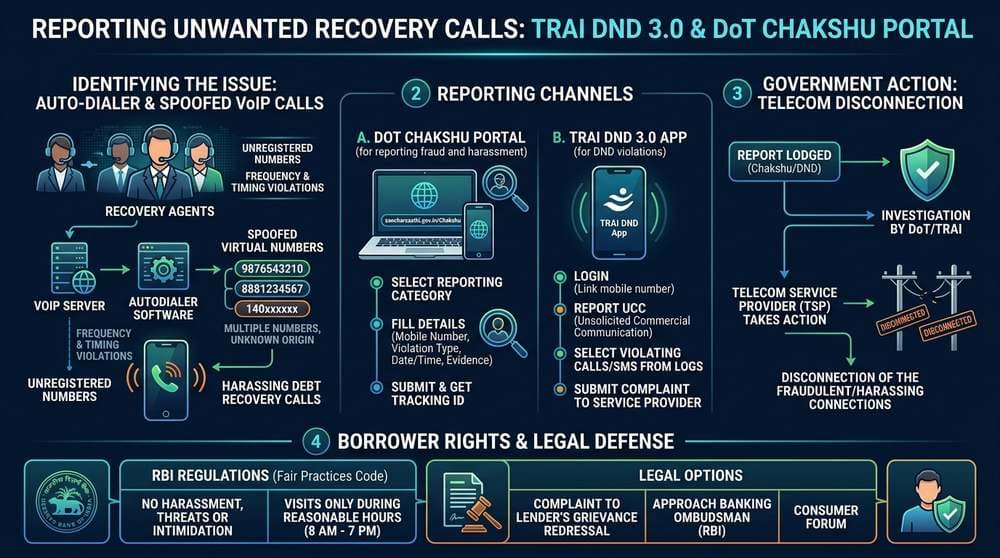
Borrowers facing unsecured loan or credit card distress across India are increasingly confronted by an invasive form of digital harassment: automated collection dialers operating through virtual VoIP numbers. Traditional debt collection relied on identifiable bank branch landlines or designated collection representatives. Today, third-party recovery agencies utilize cloud telephony software integrated with predictive auto-dialers. These systems blast hundreds of automated calls per day, intentionally cycling through random 10-digit mobile numbers, disguised Voice-over-IP (VoIP) trunk lines, and automated WhatsApp bots.
When a borrower blocks an incoming number on their smartphone or through caller identification applications, the auto-dialer software instantly switches to the next unallocated number in its virtual pool. This dynamic number spoofing renders standard device-level blocking obsolete. Borrowers frequently receive thirty to fifty calls each day from numbers that appear to originate from different telecom circles, including Delhi, Mumbai, Bengaluru, and Hyderabad. The resulting psychological toll is deliberate; recovery agencies exploit continuous telephonic friction to induce extreme distress, hoping the borrower will surrender to unfair financial demands.
Handset-level call blocking cannot resolve virtual number harassment because the caller is not a single individual, but an automated algorithm drawing from a rotating bank of hundreds of telecom identities. Lasting protection requires regulatory number disconnection and statutory legal defense.
This digital onslaught constitutes a severe breach of both telecommunications law and banking consumer protection codes. An unpaid loan represents a civil dispute governed exclusively by the Indian Contract Act, 1872. A financial default does not grant lenders or their outsourced recovery contractors the legal entitlement to invade a citizen's digital life, bypass constitutional privacy rights, or deploy deceptive telecommunication technologies designed to harass and intimidate.
2. Telecom Regulations: TCCCPR 2018 & DoT Directives
The regulatory architecture governing telephonic communications in India is established by the Telecom Regulatory Authority of India (TRAI) and the Department of Telecommunications (DoT). The primary statutory mechanism is the Telecom Commercial Communications Customer Preference Regulations, 2018 (TCCCPR). Under these regulations, any telephonic contact initiated for commercial recovery, credit evaluation, or payment solicitation is classified as Commercial Communication. Telecom regulations strictly prohibit commercial entities from placing recovery calls from standard, individual 10-digit subscriber numbers.
Under TRAI directives, commercial entities and telemarketers are mandated to register on the Distributed Ledger Technology (DLT) blockchain platform. Furthermore, financial institutions and their authorized collection agencies are required to utilize designated telecom numbering series. Historically, transactional and promotional communications were restricted to the 140-number series. To eliminate consumer confusion and curb financial fraud, TRAI and DoT introduced the 160-number series exclusively for service and transactional calls from financial entities, including banks, insurance firms, and SEBI-regulated entities.
Ban on Unregistered Telemarketers (UTMs)
Entities that transmit commercial communications without valid registration on telecom DLT platforms are classified as Unregistered Telemarketers. Placing commercial collection calls from ordinary prepaid or postpaid SIMs is an explicit regulatory offense.
Prohibition of CLI Spoofing & Dynamic Trunking
Altering Calling Line Identification (CLI) to mask true originating phone numbers or utilizing unverified Session Initiation Protocol (SIP) gateways violates Indian Telegraph Rules and telecom license agreements, subjecting operators to severe financial penalties.
Customer Preference Override Restrictions
Even if a borrower has defaulted on a loan, collection agencies cannot bypass Do Not Disturb (DND) registrations through predatory spam mechanisms. All debt collection inquiries must adhere to verifiable headers and institutional identity tags.
When a recovery agency acquires bundles of unregistered SIM cards or routes calls through overseas virtual PBX servers to harass borrowers in India, they commit direct violations of DoT licensing guidelines. Regulatory authorities possess the statutory power to order the immediate disconnection of these lines, seize equipment, and penalize the originating financial institution for utilizing illicit collection channels.
Check Your Loan Settlement Options
Answer 2 quick questions to evaluate your settlement eligibility.
1. What type of loan do you want to settle?
3. RBI Fair Practices Code on Debt Collection Calls
The Reserve Bank of India exercises strict supervisory authority over scheduled commercial banks, non-banking financial companies (NBFCs), and housing finance institutions. Through the Master Direction on Managing Risks and Code of Conduct in Outsourcing of Financial Services, read alongside the Fair Practices Code (FPC), the central bank has established unambiguous parameters governing telephonic debt recovery. The RBI recognizes that while lenders retain the right to demand repayment of lawful dues, such recovery must never compromise the borrower's dignity or personal privacy.
The RBI Master Direction explicitly makes banks and NBFCs directly accountable for the misconduct of their outsourced recovery agents. A financial institution cannot absolve itself of liability by blaming an independent call center or agency. If an outsourced partner deploys auto-dialers or threatens a borrower, the RBI considers the lender itself to have violated prudential operating standards, exposing the institution to formal supervisory intervention, public censures, and severe monetary penalties.
Permissible Contact Hours (8:00 AM to 7:00 PM)
Recovery calls initiated before 8:00 AM or after 7:00 PM are illegal under RBI guidelines, regardless of the borrower's delinquency stage.
Prohibition of Repeated Harassing Calls
Repeated calling, continuous redialing within minutes, and automated algorithmic calling bursts constitute actionable harassment under central bank directives.
Zero Third-Party Disclosure
Agents are strictly barred from contacting relatives, friends, or employers, or disclosing debt status to third parties without explicit legal authority.
Mandatory Agency & Caller Disclosure
Every collection caller must immediately state their full name, agency identity, and the specific lender they represent, maintaining a civil tone at all times.
In addition to these restrictions, the RBI Integrated Ombudsman Scheme provides borrowers with a direct avenue for financial restitution. Where systemic telephonic harassment is established through call logs and audio recordings, the Banking Ombudsman possesses the statutory authority to direct the lender to pay compensation of up to ₹20 Lakhs for loss of time, mental anguish, and reputational injury.
4. Statutory Penalties Under BNS and IT Act, 2000
When recovery agents use technological trickery to conceal their caller identities while making threatening demands, their conduct crosses the threshold from civil contractual non-compliance into criminal offense. Under the Bharatiya Nyaya Sanhita, 2023 (BNS), which replaced the Indian Penal Code, and the Information Technology Act, 2000 (IT Act), individuals and corporate entities deploying deceptive telephonic mechanisms face rigorous statutory prosecution.
Under Section 351 of the Bharatiya Nyaya Sanhita (corresponding to Section 503 and Section 506 of the IPC), criminal intimidation occurs whenever a person threatens another with injury to their person, reputation, or property with the intent to cause alarm. When an auto-dialer or recovery representative makes verbal threats to harm a borrower's employment, visit their family home, or circulate fabricated legal notices, the caller commits a cognizable offense punishable by imprisonment for up to two years, a fine, or both. If the threat involves grave injury, the imprisonment may extend up to seven years.
Section 308 BNS (Extortion) / Section 383 & 384 IPC
Intentionally putting any person in fear of injury and thereby dishonestly inducing them to deliver money or property constitutes extortion. Coercing immediate digital transfers through terrorizing phone calls fulfills the statutory definition of this non-bailable offense.
Section 66D of the Information Technology Act, 2000
Cheating by personation by using computer resources—such as spoofing telephone lines, deploying deceptive VoIP headers, or masquerading as court officers—attracts mandatory imprisonment of up to three years and fines up to ₹1 Lakh.
Section 79 IT Act & Intermediary Guidelines
Telecom service providers and VoIP software platforms lose safe harbor immunity if they fail to act upon notifications regarding illegal telecommunications, aiding the enforcement of criminal liability against rogue collection infrastructure.
Furthermore, the constitutional right to privacy established by the Supreme Court of India in Justice K.S. Puttaswamy (Retd.) v. Union of India (2017) affirms that every citizen possesses an inviolable right to informational and personal repose. Unauthorized automated phone dialing that impairs a citizen's tranquility and disrupts their livelihood represents an actionable constitutional wrong for which civil damages can be sought in competent courts.
6. DoT Chakshu Portal Guide for Number Disconnection
To combat the rising menace of cyber fraud, spoofed calls, and malicious telecom communications, the Department of Telecommunications launched the Chakshu facility under the unified Sanchar Saathi initiative (sancharsaathi.gov.in). Unlike conventional spam filters, Chakshu is an official government enforcement mechanism that interfaces directly with all Indian Telecom Service Providers (TSPs), including Reliance Jio, Bharti Airtel, and Vodafone Idea. When citizens report suspected communication on Chakshu, the DoT initiates an automated forensic audit that can result in the nationwide disconnection of the offending number and the blacklisting of the caller's handset IMEI.
Filing an actionable complaint on Chakshu requires structured digital evidence. Follow this verified five-step protocol to ensure rapid telecom enforcement:
Step 1: Access the Official Sanchar Saathi Portal
Navigate to sancharsaathi.gov.in and click on the "Chakshu - Report Suspected Fraud Communication" link. Avoid third-party mirror websites to ensure data security.
Step 2: Select Communication Medium & Category
Choose the medium through which harassment occurred (Voice Call, SMS, or WhatsApp). Under the category selection, choose "Unsolicited Commercial Communication / Harassment / Fake Impersonation."
Step 3: Upload Exact Call Logs & Evidence Files
Attach clear screenshots of your handset call log showing the exact incoming phone numbers, date, and timestamps. You may also upload audio snippets or screenshots of threatening text messages.
Step 4: Detail the Harassment Incident
In the text description box, clearly state that an unregistered debt collection agency is utilizing rotating virtual numbers and auto-dialers to bypass handset blocks in violation of TRAI TCCCPR (2018) regulations.
Step 5: Verify via Aadhaar-Linked OTP & Track
Enter your personal mobile number, verify the submission using the One-Time Password (OTP) sent to your device, and record the unique Complaint Reference Number for legal records.
Once submitted, DoT systems track the reported Calling Line Identification across carrier networks. If the system detects that multiple complaints have been filed against the same SIM cluster or VoIP gateway, the telecom operator is legally obligated to freeze the connection pending immediate physical KYC re-verification. If the agency cannot demonstrate legitimate subscriber credentials, the entire trunk line is terminated, permanently cutting off the auto-dialer stream.
7. TRAI DND 3.0 App & Telecom Operator Escalation
In addition to the central DoT Chakshu portal, the Telecom Regulatory Authority of India provides an automated mobile application known as TRAI DND 3.0 (Do Not Disturb). Available on official mobile app stores, the application enables subscribers to register their telecommunication preferences and lodge formal statutory complaints against Unsolicited Commercial Communications (UCC) directly from their device call and messaging logs.
To report a recovery agent calling from a virtual or personal mobile number on TRAI DND 3.0, launch the application, verify your phone number via SMS OTP, and navigate to the "Report UCC" tab. The application automatically populates your recent call records. Select the offending number, choose the classification "Unregistered Telemarketer (UTM)," and enter a brief factual statement: "Repeated unauthorized debt collection calls from unregistered 10-digit mobile line utilizing automated dialer software."
3-Day Window for Complaint Submission
Under TCCCPR regulations, DND complaints must be submitted within three calendar days of receiving the offending call or message to enable automated call-detail-record (CDR) verification.
30-Day Carrier Investigation Mandate
The originating telecom provider must investigate the call logs within 30 days. If the caller is identified as an unregistered commercial telemarketer, the carrier issues a formal warning, followed by the capping of telecom resources.
Two-Year Nationwide Telecom Blacklisting
On the third verified violation, telecom regulations require all telecom operators across India to disconnect all telecom resources allocated to the offending individual or entity for a mandatory period of up to two years.
If your telecom service provider fails to resolve the complaint or rejects the UCC report without a valid justification, you can escalate the matter to the Appellate Authority of your service provider or submit a formal grievance on the Department of Telecommunications Centralized Public Grievance Redress and Monitoring System (CPGRAMS) portal. Regulatory escalation creates an official audit trail that severely limits the recovery agency's ability to operate undetected.
8. Bank NPA Provisioning & The NPV Recovery Model
To counter collection agency tactics effectively, borrowers must understand the underlying financial mechanics that drive these aggressive telemarketing operations. Banks and NBFCs do not deploy automated dialers because they possess overwhelming legal power; they deploy them because civil litigation for unsecured loans is slow, costly, and financially inefficient for the lender. Under the Reserve Bank of India's Prudential Norms on Income Recognition, Asset Classification and Provisioning (IRACP), an unpaid loan becomes a Non-Performing Asset (NPA) once repayments remain overdue for 90 consecutive days.
Asset classification rules force financial institutions to freeze interest recognition and divert substantial operational capital from their balance sheet into loan loss provisioning reserves. For an unsecured personal loan or credit card balance, the bank must set aside a mandatory 15% provision during the Substandard phase (first 12 months), escalating to an onerous 100% provision once the asset enters the Doubtful category or is classified as a loss asset. This locked provisioning capital directly diminishes the bank's net interest margins and profitability metrics.
When a bank contemplates civil legal recovery through Summary Suits under Order 37 of the Code of Civil Procedure (CPC) or arbitration proceedings, it faces substantial upfront expenditures: court fees ranging from 1% to 3% of the claim, advocate retainers, process fees, and a procedural delay typically spanning three to five years. Furthermore, Section 60 of the CPC explicitly exempts essential household goods, clothing, and primary residential tools from attachment. Recognizing this reality, institutional credit risk committees evaluate distressed debt recovery using a Net Present Value (NPV) recovery valuation model:
Where C_t represents estimated recoveries in year t, r is the bank discount rate, and deductions account for 3–5 years of court friction, legal overhead, and capital locked in mandatory NPA loss provisions.
Because lengthy court proceedings drastically diminish the net present value of recovery, financial institutions maintain internal One-Time Settlement (OTS) policies. When an experienced banking advocate challenges their abusive telemarketing practices and presents a verified financial hardship brief, the bank readily agrees to a negotiated settlement. Granting a 40% to 65% waiver allows the lender to recover immediate liquid capital, reverse its locked provisioning reserves back into profits, and close the delinquent file permanently.
9. Comparative Matrix: Telecom Channels vs Remedies
Navigating digital collection harassment requires understanding the distinct legal jurisdictions, operational authority, and corrective remedies available across different telecommunication channels in India. The comparative matrix below outlines the regulatory boundaries governing these channels:
| Communication Channel | Operational Mechanism | Statutory Legality | Regulatory Violations | Primary Legal Remedy |
|---|---|---|---|---|
| Unregistered 10-Digit Mobile SIMs | Prepaid SIM cards rotated manually or via low-cost GSM gateway modems | Illegal for Commercial Recovery | TRAI TCCCPR (2018) Rule on Unregistered Telemarketers | Report on TRAI DND 3.0 App & DoT Chakshu portal for swift carrier disconnection |
| Virtual VoIP & Cloud Auto-Dialers | SIP trunking software rotating dynamic CLIs and overseas IP gateways | Strictly Regulated / Often Illicit | Violation of DoT CLI verification and Indian Telegraph Act licensing terms | DoT Chakshu portal fraud reporting and carrier gateway blacklisting |
| Automated WhatsApp Bots | Bulk messaging software blasting automated notices to borrower contacts | Explicit Privacy & RBI Violation | Breach of RBI FPC third-party disclosure rules & IT Act Section 66D | Meta grievance officer escalation, police cyber complaint under Section 351 BNS |
| Official 140 / 160 Telecom Series | Registered telecom headers allocated to verified financial institutions | Lawful Channel (Subject to Conduct Rules) | Violations occur if calls are placed outside 8 AM – 7 PM or involve threats | Formal complaint to Bank Principal Nodal Officer and Banking Ombudsman |
| Advocate Legal Notice / Formal Letter | Written communication served via Registered Post with Acknowledgment Due | 100% Lawful Due Process | No telecom violations; governed strictly by Civil Procedure Code | Statutory reply through appointed debt relief advocate within 15 to 30 days |
As demonstrated above, private collection agencies rely predominantly on the first three illicit mechanisms to exploit the borrower's lack of technical and legal awareness. Enforcing the statutory remedies outlined above dismantles their operational leverage and compels the lender to return to the formal, lawful path of negotiated compromise.
10. SettleLoans Legal Defense & Cease-and-Desist
Enduring relentless auto-dialer harassment from anonymous virtual phone numbers can destabilize your personal and professional life. At SettleLoans, our experienced banking and telecommunication defense advocates provide immediate institutional intervention. We issue formal Cease-and-Desist notices to the lender's managing director, principal nodal officer, and outsourced recovery agencies, citing Section 351 BNS criminal liabilities, TRAI TCCCPR (2018) regulations, and RBI Fair Practices Code violations. Under central bank rules, the service of formal legal representation mandates the lender to cease all telephonic outreach and route all communications exclusively through our legal team.
Once the digital harassment is halted, our senior debt resolution advocates take charge of your file. We conduct a rigorous forensic review of your loan statements, identify illegal penal charges, and prepare a comprehensive financial hardship dossier. We then negotiate directly with the bank's credit committee to secure an institutional One-Time Settlement (OTS) featuring a 40% to 65% waiver, flexible payment tranches, and a genuine bank-stamped No Dues Certificate (NDC). With SettleLoans by your side, you regain your peace of mind and achieve permanent financial freedom.

Settle Loan is India's trusted debt relief and loan settlement platform. We help borrowers overcome financial distress by negotiating with banks and NBFCs to legally settle personal loans and credit card debts. With our transparent, performance-based approach, you can achieve debt freedom and regain your financial peace of mind.
COMPUTER
11. FAQs: TRAI DND Complaints & Virtual Recovery Calls
Authoritative statutory answers addressing recovery agent auto-dialers, DoT Chakshu portal reporting, TRAI DND 3.0 mechanics, and borrower legal defense rights in India.
Can recovery agents legally call borrowers from unregistered private mobile numbers or virtual VoIP lines?
No. Under TRAI Telecom Commercial Communications Customer Preference Regulations (TCCCPR, 2018) and DoT directives, commercial entities and recovery agents must use dedicated registered telemarketing series (such as 140-series and newly mandated 160-series for transactional communications). Operating auto-dialers through personal 10-digit SIM cards, VoIP software, or disguised virtual lines violates telecom licensing conditions and constitutes an illegal telemarketing practice.
How do recovery agencies use auto-dialers and virtual numbers to bypass phone call blocking?
Recovery agencies deploy automated predictive dialers and Session Initiation Protocol (SIP) trunking systems connected to rotating virtual number pools. When a borrower blocks a number, the software switches immediately to another unallocated 10-digit CLI (Calling Line Identification) or VoIP gateway. This automated cycling bypasses standard handset blocklists, creating continuous digital distress without human manual dialing.
What immediate evidence must I preserve before filing a complaint on the DoT Chakshu portal?
Preserve exact call logs showing date, timestamps, and incoming numbers; record voice calls capturing abusive threats, background call center noise, or refusal to identify the agency; take screenshots of incoming SMS or WhatsApp collection messages; and note the name of the bank, NBFC, or loan app the caller claims to represent. Chakshu requires digital evidence uploads within 30 days of the incident.
How does the Department of Telecommunications (DoT) Chakshu portal take action against offending numbers?
Once a complaint is submitted on Chakshu (sancharsaathi.gov.in), the DoT intelligence unit cross-references the caller CLI across telecom service providers (TSPs). If widespread spoofing, unregistered telemarketing, or cyber harassment is established, DoT instructs mobile operators to re-verify subscriber KYC. If re-verification fails, the telecom connection, IMEI handset, and associated SIM clusters are permanently blacklisted and disconnected.
Can I report recovery harassment on the TRAI DND 3.0 mobile application?
Yes. The TRAI DND 3.0 mobile app allows registered users to log Unsolicited Commercial Communications (UCC) directly from recent call and SMS history. When reporting an unregistered debt collector, select the 'Unregistered Telemarketer (UTM)' category, attach call records, and submit. The originating telecom service provider must investigate within 30 days and penalize or disconnect repeat offenders.
What are the permissible calling hours and frequency limits under RBI Master Directions?
Under RBI Master Directions on Outsourcing and Fair Practices Code, recovery agents are strictly restricted to contacting borrowers between 8:00 AM and 7:00 PM. Persistent repetitive calling, calling multiple times within an hour, calling at odd night hours, contacting family members or workplace colleagues, and using abusive language are categorically prohibited and attract severe supervisory penalties.
Does filing a TRAI DND or Chakshu complaint wipe out or settle my underlying loan debt?
No. Reporting telecom violations penalizes illegal collection practices and disconnects rogue numbers, but it does not extinguish the civil contract of debt. To permanently eliminate the financial liability and prevent legal litigation, borrowers must execute a formal, advocate-supervised One-Time Settlement (OTS) directly with the lender to obtain a valid No Dues Certificate.
How does a formal Cease-and-Desist legal notice stop auto-dialer recovery calls permanently?
A formal legal notice served by a debt relief advocate to the bank's principal officers, nodal grievance team, and outsourced collection partners establishes formal legal representation. Under RBI guidelines, once an advocate files representation, the bank must cease third-party telephonic collection and redirect all communication exclusively to legal counsel, stopping auto-dialer harassment immediately.