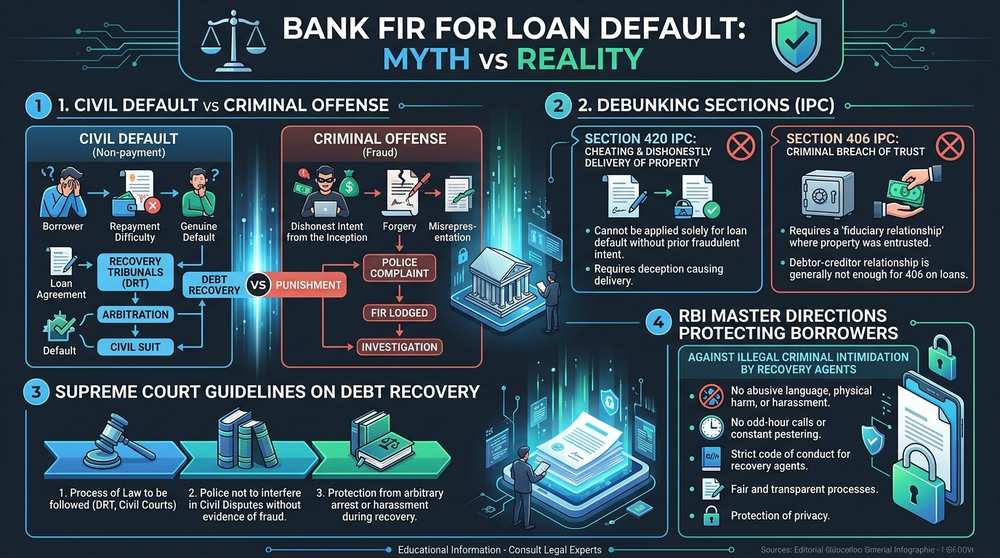
- Civil Nature of Debt: An inability to pay loan installments due to genuine financial distress does not constitute a cognizable criminal offense under Indian law.
- Section 420 & 406 IPC Debunked: Cheating requires proven fraudulent intention at the exact time of loan disbursement; post-disbursement default does not satisfy criminal ingredients.
- Apex Court Shield: Supreme Court rulings explicitly bar police stations and magistrates from converting commercial defaults into criminal trials.
- Actionable Intimidation: Fake police summons, morphed legal drafts, or threats of imminent arrest by recovery agents violate RBI directives and IPC Sections 383, 503, and 506.
- Compromise Route: Engaging professional legal advocates shifts institutional aggression toward structured One-Time Settlement (OTS) with significant principal waivers.
1. Demystifying FIR Threats: Civil Default vs Crime
When a borrower faces financial hardship—such as job loss, medical emergencies, or business insolvency—missing EMIs often triggers aggressive recovery maneuvers. Within weeks of an account slipping past the 90-day mark into Non-Performing Asset (NPA) classification, collection callers send alarming messages. They often falsely claim that a First Information Report (FIR) has been lodged at a local police station.
To understand the legal reality, one must distinguish between civil and criminal jurisprudence in India. A personal loan agreement is a bilateral commercial contract governed by the Indian Contract Act, 1872. Missing repayments represents a civil breach of contract, entitling the lender to civil recovery suits, Order 37 CPC cases, or arbitration. Under no provision of Indian commercial law does an honest financial default transform into a crime.
The Indian Constitution and the Code of Criminal Procedure strictly prohibit the deployment of the state police apparatus for commercial debt recovery. Defaulting on debt is not an arrestable offense in the absence of established, pre-planned fraud.
2. Statutory Legal Protections: Section 420 & 406 IPC Debunked
Collection agencies frequently invoke Section 420 (Cheating) and Section 406 (Criminal breach of trust) of the IPC, now under the Bharatiya Nyaya Sanhita (BNS). Understanding why these sections do not apply to genuine loan defaults requires examining their essential legal ingredients.
For an offense under Section 420 IPC to stand, the complainant must prove dishonest intention (mens rea) at the very inception of the transaction. In a standard personal loan, the borrower provides legitimate KYC records and services the loan faithfully for months before defaulting. Subsequent failure to repay due to adverse situations is a commercial inability, entirely devoid of initial deceit.
Landmark Supreme Court Jurisprudence
Hridaya Ranjan Prasad Verma v. State of Bihar (2000) 4 SCC 168
The Supreme Court drew a clear boundary: mere failure to keep a promise cannot give rise to criminal liability for cheating unless fraudulent intention is showed from the inception of the contract.
Dalip Kaur & Ors. v. Jagnar Singh & Anr. (2009) 14 SCC 696
The apex court unequivocally affirmed that a pure dispute arising out of breach of contract cannot be allowed to be converted into a criminal prosecution to exert pressure.
Prof. R.K. Vijayasarathy v. Sudha Seetharam (2019) 16 SCC 739
The Supreme Court held that filing a criminal complaint for an essentially civil commercial claim is a clear abuse of judicial process liable to be quashed under Section 482 of the CrPC.
Similarly, Section 406 IPC requires the entrustment of property in a fiduciary capacity. When a bank disburses a personal loan, the legal ownership of the money passes unconditionally to the borrower, creating a creditor-debtor relationship rather than a trustee-beneficiary arrangement. so, criminal breach of trust cannot legally arise from the non-repayment of a personal loan.
3. Intimidation Dangers: Fake Summons & Agent Extortion
Because institutional civil recovery in Indian courts is time-consuming and expensive, third-party recovery agencies frequently deploy psychological pressure to extract immediate payments. Unregulated agents routinely forge formal-looking police summons, craft digital documents bearing fictitious crime branch seals, and issue fabricated "Warrant Notice" alerts through messaging applications like WhatsApp.
These aggressive tactics violate not only ethical standards but substantive criminal statutes. When a recovery agent threatens a borrower with police custody, communicates with relatives or workplace superiors without authorization, uses abusive language, or visits residences outside permitted hours, the agent commits cognizable offenses:
Section 383 & 384 IPC (Extortion)
Intentionally putting any person in fear of injury or social disgrace to dishonestly induce payment of money constitutes criminal extortion.
Section 503 & 506 IPC (Intimidation)
Threatening bodily harm, reputation destruction, or illegal police detention constitutes criminal intimidation punishable by imprisonment.
Section 465 & 468 IPC (Forgery)
Fabricating fake court seals, simulated police summons, or counterfeit magistrate notices amounts to non-bailable criminal forgery.
RBI Fair Practices Code
RBI Master Directions strictly forbid contacting borrowers before 8:00 AM or after 7:00 PM, contacting workplace HR, or issuing false legal claims.
4. Bank Accounting Realities: NPA Provisioning & NPV
To understand why banks permit recovery agencies to use aggressive bluffs rather than filing legitimate court cases, one must examine commercial banking balance sheet mechanics. When a borrower misses three consecutive monthly installments (90 days), the Reserve Bank of India mandates that the loan be classified as a Non-Performing Asset (NPA). Under RBI Master Directions on Prudential Norms on Income Recognition, Asset Classification and Provisioning, the bank must set aside large capital reserves:
- Substandard NPA (Up to 12 months): Mandatory 15% provisioning on total outstanding exposure.
- Doubtful-1 NPA (12 to 24 months): 25% provisioning for secured portions and 100% for unsecured balances.
- Doubtful-2 & Loss Assets: 100% full provisioning write-down against quarterly bank profits.
When a bank starts a civil lawsuit, it must pay 1% to 3% upfront court fees and retain external counsel. It also faces a 36 to 60-month courtroom trajectory with low probability of recovery on unsecured debt. so, institutional risk committees evaluate recovery using a Net Present Value (NPV) model:
Where C_t represents estimated recoveries across time periods t, r represents the institutional cost of capital discount rate, and deductions account for protracted civil litigation costs and locked regulatory provisioning capital.
Because protracted litigation yields a negative Net Present Value on unsecured debt, banks have strong commercial incentive to execute an OTS. They routinely waive 45% to 65% of the ledger balance to release locked regulatory provisions and recover immediate liquidity.
6. How Legal Representation Defangs Criminal Threats & Forces OTS
When an person borrower attempts to explain financial hardship directly to recovery agents, the agency often doubles down on aggressive psychological intimidation. However, the operational dynamic changes entirely when a specialized debt defense advocate steps in with formal legal representation.
Upon being retained, our legal team executes a multi-pronged intervention protocol:
Formal Cease-and-Desist & Vakalatnama Service
Advocates serve formal notices to the bank collection head and nodal grievance officer, establishing that all notices must occur through legal counsel. Third-party calling stops immediately.
Criminal Counter-Notices for Coercion (Sections 506 & 383 IPC)
If agents sent forged summons or issued threats of arrest, our advocates document the electronic evidence and file formal complaints with the State Cyber Crime Police and local District Magistrate.
Escalation to RBI Integrated Ombudsman
Under the Reserve Bank - Integrated Ombudsman Scheme, 2021, banks face severe institutional penalties and relief liabilities up to ₹20 Lakhs for recovery agent violations.
Direct Institutional Compromise talks
With harassment neutralized, advocates submit a documented financial hardship dossier directly to bank zonal settlement committees, negotiating a 50% to 70% principal waiver.
7. Sanction Letter Forensics & Section 482 CrPC Quashing
In rare cases where a lender attempts a private criminal complaint under Section 156(3) or 200 CrPC alleging cheating, defense advocates act swiftly. They file High Court quashing petitions under Section 482 CrPC (now Section 528 BNSS) to dismiss groundless claims.
High Courts across Indian jurisdictions routinely quash such malicious cases at the admission stage itself by performing forensic examination of the original sanction documents:
- Absence of Deceptive Inducement: showing that the borrower identity, income proof, and residential verification were vetted and approved through the bank own credit underwriting algorithms.
- History of Genuine Part-Performance: Proving that the borrower serviced initial EMIs, conclusively negating any fraudulent intent at inception.
- Standard Commercial Dispute Character: Establishing that the dispute revolves solely around unsettled balances, compound interest accruals, or unfair penal charges.
- Abuse of Criminal Process: Citing Supreme Court directives in State of Haryana v. Bhajan Lal to establish that the criminal complaint was instituted with an ulterior motive for wreaking vengeance or exerting extra-judicial pressure.
8. Remittance Protocols, Zero-Dues Mandate & Credit Repair
A critical danger for unrepresented borrowers is making informal cash or transfer payments to recovery agents based on verbal settlement assurances. Such payments are invariably credited as partial interest installments, leaving the loan account active, compounding penalties, and subjecting the borrower to continued legal exposure.
Under professional legal supervision, every settlement must strictly adhere to statutory protocols:
1. Official Sanction Letter
Settlement letter generated directly on official bank letterhead with unique reference number, specific agreed waiver amount, and explicit payment schedule.
2. Direct Account Remittance
Payment made solely via RTGS, NEFT, or demand draft payable directly to the bank loan account, never to third-party collection agents.
3. Stamped NDC & CIBIL Update
Delivery of formal No Dues Certificate within 30 days under RBI Circular RBI/2023-24/60, with updated CIBIL status reflecting settled closure.
9. Dispute Resolution Comparative Matrix: Recovery Mechanisms in India
The following comparative table illustrates the jurisdictional boundaries, procedural timelines, and realistic borrower exposure across various dispute resolution avenues in Indian banking practice:
| Recovery Mechanism | Legal Forum / Authority | Statutory Basis | Criminal Exposure | Typical Settlement Outcome |
|---|---|---|---|---|
| FIR Police Complaint | Local Police Station / CCTNS | Section 420 / 406 IPC | Zero (Rejected for genuine defaults) | Quashed or closed as purely civil dispute |
| Summary Recovery Suit | City Civil / Commercial Court | Order 37, CPC 1908 | None (Purely Monetary) | Compromise decree or installment order |
| Institutional Arbitration | Sole Arbitrator / Arbitral Tribunal | Arbitration Act, 1996 | None (Civil Award) | Section 30 Consent Award (45%–60% OTS) |
| Section 138 NI Act | Metropolitan / Judicial Magistrate | Negotiable Instruments Act | Quasi-criminal (Bailable) | Compounding of offense via negotiated payment |
| Lok Adalat Conciliation | District Legal Services Authority (DLSA) | Legal Services Authorities Act | None (Voluntary Conciliation) | Final non-appealable award with 50%–70% waiver |
10. SettleLoans Defense Framework Across India
Navigating recovery intimidation, false police summons, and collection harassment requires experienced legal counsel. SettleLoans provides comprehensive legal defense for borrowers nationwide. We serve cease-and-desist notices to halt unlawful harassment and hold abusive agencies accountable. also, we negotiate directly with bank zonal authorities to secure maximum principal haircuts backed by official, bank-stamped No Dues Certificates.

Settle Loan is India's trusted debt relief and loan settlement platform. We help borrowers overcome financial distress by negotiating with banks and NBFCs to legally settle personal loans and credit card debts. With our transparent, performance-based approach, you can achieve debt freedom and regain your financial peace of mind.
COMPUTER
11. FAQs: Bank FIR for Loan Default Reality Check
Clear, legally verified answers to common questions regarding bank FIR threats, Section 420 IPC allegations, and borrower protections in India.
Can a bank legally file an FIR for personal loan or credit card default in India?
No. Inability to repay an unsecured personal loan or credit card debt is purely a civil breach of contract, not a cognizable criminal offense. The Supreme Court of India has repeatedly ruled that police cannot register an FIR under Section 420 (cheating) or Section 406 (criminal breach of trust) for mere financial default unless the bank proves fraudulent intention, forged documents, or impersonation existing at the exact moment the loan was originally disbursed.
Why do recovery agents send fake police notices and FIR warnings?
Third-party collection agencies rely on psychological intimidation because civil recovery suits take 3 to 5 years in Indian courts and require heavy upfront court fees. By forging police letterheads or invoking Section 420 IPC over WhatsApp and phone calls, agents exploit borrowers fear of social stigma and arrest to force immediate payments, even though doing so constitutes criminal intimidation under Section 503 and 506 of the IPC.
What is the difference between Section 420 cheating and genuine financial default?
To establish an offense under Section 420 IPC, the prosecution must show mens rea (fraudulent and dishonest intention) at the very inception of the loan transaction. If a borrower applied with genuine KYC documents, made several regular EMI payments, and later defaulted due to job loss, illness, or business failure, it is a bona fide commercial default where Section 420 is legally inapplicable.
What landmark Supreme Court rulings prohibit criminal cases on civil loan defaults?
Landmark Supreme Court judgments including Hridaya Ranjan Prasad Verma v. State of Bihar, Dalip Kaur v. Jagnar Singh, and Prof. R.K. Vijayasarathy v. Sudha Seetharam explicitly establish that every breach of contract does not constitute cheating. The apex court held that converting purely civil disputes into criminal cases is an abuse of judicial process liable to be quashed under Section 482 of the CrPC.
Can local police summon or arrest me for an unpaid personal loan?
No. Police officers have no statutory authority to act as debt collection agents or summon borrowers to police stations for civil defaults. If a malicious complaint is submitted, police must conduct a preliminary inquiry, and the Supreme Court in Arnesh Kumar v. State of Bihar mandated that no mechanical arrests can be made without judicial scrutiny.
What should I do if I receive a fake FIR notice on WhatsApp or email?
Do not panic or transfer money under coercion. Preserve complete digital evidence including screenshots, phone recordings, and sender contact numbers. Verify the authenticity on the state police CCTNS portal. Immediately consult a debt defense advocate to serve a legal notice on the bank and lodge complaints with the RBI Ombudsman, the Cyber Crime portal, and the local Magistrate.
What legal remedies do banks actually have for loan default?
Banks have strictly civil and statutory remedies: filing a summary recovery suit under Order 37 of the Civil Procedure Code (CPC), starting civil arbitration under the Arbitration and Conciliation Act 1996, approaching the Debt Recovery Tribunal (DRT) for claims exceeding ₹20 Lakhs, referring to Lok Adalat for conciliation, or negotiating a mutually agreed One-Time Settlement (OTS).
Can a Section 138 cheque bounce case lead to an FIR?
No. Section 138 of the Negotiable Instruments Act is a quasi-criminal private complaint filed directly before a Judicial Magistrate, not an FIR registered with the police. It is a bailable offense where the court issues a summons, and it is routinely settled through compromise payments or Lok Adalat without custodial arrest.
How does advocate representation stop criminal threats and secure an OTS?
When a specialized debt settlement advocate issues a formal response citing Supreme Court precedents and RBI Master Directions, the bank recovery department immediately pulls the file from abusive third-party agencies. The bank legal officers transition the account from hostile coercion to structured commercial talks, enabling a 45% to 65% principal waiver and an official No Dues Certificate.