- Deficiency in Service Statutory Ground: Unlawful debt recovery, abusive calling, and third-party defamation constitute actionable deficiency of service under Section 2(42) and unfair trade practices under Section 2(47) of the Consumer Protection Act, 2019.
- Supreme Court Vicarious Liability: In landmark rulings such as ICICI Bank v. Prakash Kaur, the Supreme Court established that lenders are strictly liable for the tortious acts and criminal intimidation executed by their outsourced recovery agents.
- Substantial Monetary Compensation: District Consumer Commissions (DCDRC) are empowered under Section 39(1)(d) to award significant monetary damages for mental agony, reputational damage, and loss of business or employment.
- Digital Filing via National Consumer Helpline (consumerhelpline.gov.in): Aggrieved borrowers can initiate nationwide complaints electronically through the official National Consumer Helpline (consumerhelpline.gov.in) portal, eliminating procedural friction and enabling prompt judicial notice issuance.
- Converting Litigation to 50%–70% OTS: The institutional threat of regulatory scrutiny and adverse consumer court orders compels bank legal desks to halt harassment and sanction compromise settlements with complete debt discharge.
1. Bank Harassment Under Consumer Protection Act, 2019
When a borrower defaults on an unsecured personal loan, credit card balance, or business credit facility due to genuine financial distress—such as severe medical emergencies, enterprise liquidation, or involuntary employment termination—commercial banks and Non-Banking Financial Companies (NBFCs) frequently deploy aggressive third-party Direct Recovery Agents (DRAs). While financial institutions maintain a legitimate legal right to pursue civil recovery of outstanding dues, Indian law draws an uncompromising boundary between lawful debt demand and extra-judicial harassment, criminal intimidation, and public defamation.
Under the Consumer Protection Act, 2019 (CPA 2019), banking services fall squarely within the definition of 'service' under Section 2(42). When a lending institution or its authorized agents violate statutory lending standards, breach borrower confidentiality, or deploy coercive recovery tactics, the borrower is legally classified as an aggrieved consumer subjected to 'Deficiency in Service' and 'Unfair Trade Practice' under Section 2(47).
Aggrieved borrowers are not defenseless victims. The Consumer Protection Act provides a powerful, specialized adjudicatory forum through District Consumer Disputes Redressal Commissions (DCDRC), enabling borrowers to initiate judicial counter-offensives against predatory lenders, secure protective interim injunctions, and claim substantial monetary compensation for severe mental trauma and reputational damage.
Statutory Definition: Section 2(11) Deficiency in Service
Deficiency means any fault, imperfection, shortcoming, or inadequacy in the quality, nature, and manner of performance that is required to be maintained by or under any law for the time being in force, or has been undertaken to be performed by a person in pursuance of a contract or otherwise in relation to any service. Deploying abusive debt collectors directly violates banking covenants and RBI statutory standards.
2. Statutory Legal Protections, Supreme Court Precedents & Vicarious Liability
The legal foundation holding banks liable for recovery harassment rests upon a robust matrix of Reserve Bank of India (RBI) Master Directions, constitutional fundamental rights under Article 21, and binding Supreme Court jurisprudence. The Reserve Bank of India has established unambiguous standards in its Master Direction – Fair Practices Code for Lenders and circular on Recovery Agents engaged by Regulated Entities:
- Strict Calling Hours: Recovery agents are strictly prohibited from contacting borrowers before 8:00 AM and after 7:00 PM under any circumstances.
- Privacy & Third-Party Non-Contact: Agents cannot contact friends, relatives, workplace superiors, or residential neighbors, nor disclose debt information to third parties.
- Prohibition of Coercion & Abusive Language: Threatening bodily harm, verbal abuse, public humiliation, or staging unannounced dharnas outside a residence or workplace is explicitly prohibited and constitutes a criminal offense.
- Prior Due Notice & Identification: Agents must carry official bank authorization cards and provide proper identification upon requesting an interview with the borrower.
In the landmark ruling of ICICI Bank Ltd. v. Prakash Kaur (2007) 2 SCC 711, the Supreme Court of India delivered a scathing condemnation of aggressive banking recovery tactics, establishing that financial institutions cannot utilize musclemen or extra-judicial muscle power to recover debts. The Apex Court reiterated that banks operate in a civilized society governed by the rule of law and must strictly adhere to judicial processes for recovery.
| Judicial Landmark / Authority | Legal Principle Established | Application in Consumer Commission |
|---|---|---|
| ICICI Bank v. Prakash Kaur (SC) | Absolute ban on musclemen and physical coercion for loan recovery. | Ground for exemplary damages against bank management. |
| Standard Chartered v. N.P. Mathew (NCDRC) | Bank is vicariously liable for torts and harassment by outsourced recovery agents. | Overrules bank defense that agency operated independently. |
| Charan Singh v. Healing Touch Hospital (SC) | Quantification of damages for mental agony, emotional distress, and loss of dignity. | Establishes methodology to claim ₹5L–₹25L compensation. |
| RBI Master Direction (DOR.ORG.REC.65) | Mandatory training (IIBF certified) and code of conduct for debt collection agents. | Failure to produce agent audit logs proves institutional deficiency. |
Under the common law doctrine of vicarious liability, lending institutions cannot evade accountability by outsourcing debt collection to third-party recovery firms. The National Consumer Disputes Redressal Commission (NCDRC) has consistently held that because recovery agencies act under an explicit agency agreement for the financial benefit of the principal bank, any act of intimidation, defamation, or breach of statutory conduct by the agent is legally imputed directly to the bank.
Check Your Loan Settlement Options
Answer 2 quick questions to evaluate your settlement eligibility.
1. What type of loan do you want to settle?
3. Documenting Tortious Harassment & The Evidentiary Threshold for DCDRC Claims
In consumer commission litigation, the burden of proving deficiency of service and harassment rests upon the complainant. Vague, unsubstantiated allegations will not survive judicial scrutiny or bank legal rebuttals. Building an unassailable evidentiary dossier is paramount to securing immediate court intervention and substantial financial awards.
An aggrieved borrower must systematically preserve all digital and documentary evidence the moment rogue collection practices commence:
Telephonic & Digital Recordings
Preserve unedited audio recordings of all inbound collection calls showing dates, timestamps, abusive phrasing, and calls placed outside the 8:00 AM to 7:00 PM window. Retain certified Telecom Call Detail Records (CDR) proving excessive repeated dialing.
Electronic Messaging Transcripts
Capture timestamped screenshots and cloud backups of threatening WhatsApp messages, SMS alerts, fake legal notices, and illicit social media messages sent by agents to relatives or colleagues, backed by Section 65B Electronic Evidence Certificates.
CCTV & Third-Party Witness Statements
Secure CCTV footage from housing society gates, apartment lobbies, or office reception desks documenting unauthorized agent visits, aggressive confrontations, or unlawful trespass, supplemented by signed affidavits from security guards or coworkers.
Medical & Psychological Impact Records
Obtain medical prescription slips, clinical diagnostic reports, and psychological evaluation notes showing acute anxiety, severe hypertension, clinical depression, or sleep disorders directly triggered by persistent collection harassment.
4. Bank NPA Accounting, Provisioning Burdens & Recovery NPV Dynamics
To understand why consumer court litigation gives borrowers immense leverage during settlement negotiations, one must analyze the regulatory accounting framework governing non-performing assets (NPAs). Under RBI prudential norms on Income Recognition, Asset Classification and Provisioning (IRACP), when an unsecured loan account remains overdue past 90 days, it is classified as a Substandard NPA.
As overdue duration extends, the bank is legally compelled to lock its own tier-1 capital into escalating loss reserves:
| Delinquency Stage | Overdue Timeline | RBI Mandatory Capital Provision | Bank Settlement Willingness |
|---|---|---|---|
| SMA-1 / SMA-2 | 31 – 90 Days Overdue | 5% General Capital Provision | Penal Interest & Late Fee Waivers |
| Substandard NPA | 91 – 365 Days Overdue | 25% Unsecured Provisioning | 35% – 45% Principal Haircut |
| Doubtful NPA 1 (D1) | 12 – 24 Months Default | 100% Unsecured Capital Provision | 45% – 60% Principal Haircut |
| Doubtful NPA 2 / Loss Asset | 24+ Months / Written-Off | 100% Full Balance Sheet Write-Off | 60% – 70% Principal Haircut |
When a borrower files a consumer complaint in DCDRC claiming ₹10 Lakhs to ₹25 Lakhs in damages, the bank's risk assessment changes dramatically. Instead of treating the loan as a standard retail recovery matter, the bank's legal and credit risk committee evaluates the Net Present Value (NPV) of Recovery factoring in legal exposure:
Where C_t represents estimated future debt recoveries, r is the regulatory cost of capital, and deductions account for judicial damage awards under CPA Section 39, advocate retainers, brand reputation impairment, and 100% locked capital provisioning.
Because defending a severe harassment complaint before a District Consumer Commission involves extensive advocate fees, executive depositions, and the imminent danger of adverse judicial strictures, the net expected return of continued litigation turns sharply negative for the bank. Consequently, bank zonal managers prefer resolving the dispute through an upfront 35% to 50% cash compromise settlement.
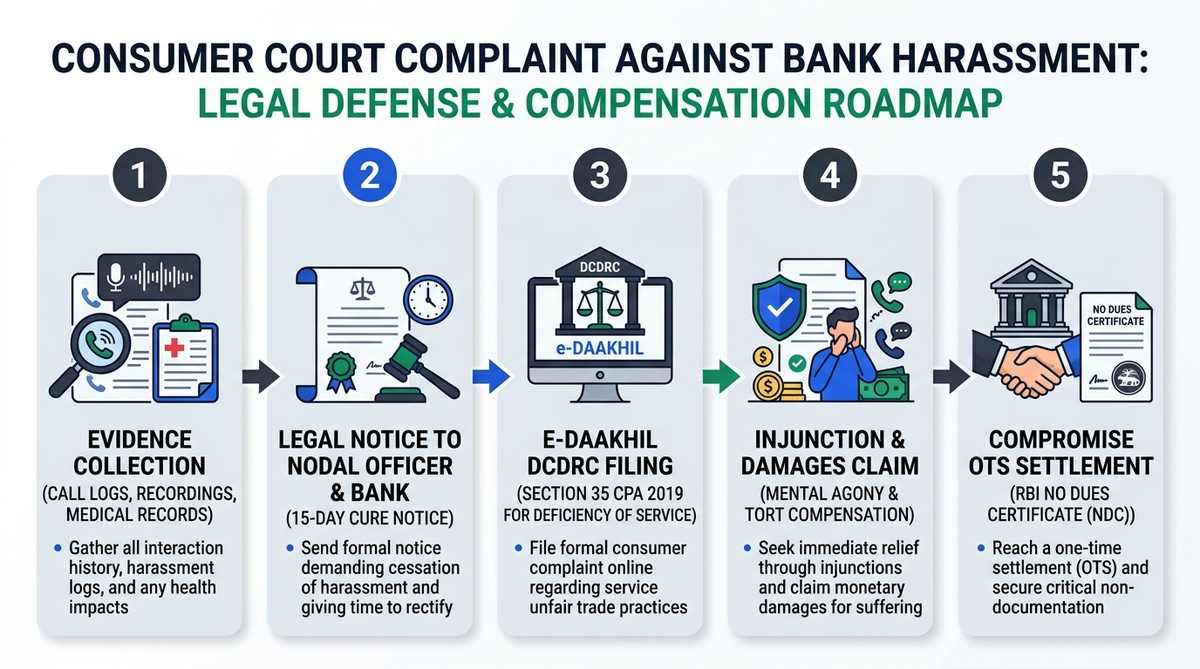
5. Consumer Court Complaint & Settlement Visual Roadmap
The visual roadmap below illustrates the structured 5-stage institutional progression from evidence preservation and advocate notice to National Consumer Helpline (consumerhelpline.gov.in) DCDRC filing, claiming tort damages, and executing an advantageous One-Time Settlement with a complete debt discharge.
6. Step-by-Step DCDRC Filing Procedure via National Consumer Helpline (consumerhelpline.gov.in) & Advocate Pleadings
Filing a consumer complaint against a major bank or NBFC has been streamlined by the National Consumer Commission through the online National Consumer Helpline (consumerhelpline.gov.in) portal (consumerhelpline.gov.in). The complaint must be drafted with precise legal structure to ensure immediate admission and prevent procedural rejection:
Before approaching the commission, your advocate serves a formal 15-day statutory legal notice upon the bank's Managing Director, Principal Nodal Officer, and local branch manager. The notice specifies the exact acts of harassment, regulatory breaches, and gives the lender 15 days to cease illegal collections and provide redress.
The complaint petition is drafted under Section 35 of the CPA 2019, setting out: (1) Details of the original loan transaction; (2) Genuine causes of financial distress; (3) Detailed chronology of harassment incidents; (4) Explicit violations of RBI Fair Practices Code and Supreme Court directives; and (5) Itemized compensation prayers.
Alongside the main complaint, file an urgent application for interim relief praying for immediate directions restraining the bank, its recovery agents, and collection officers from visiting the complainant's residence, workplace, or making telephonic contact during the pendency of proceedings.
Upload digitized pleadings, sworn affidavits, vakalatnama, and evidence exhibits onto National Consumer Helpline (consumerhelpline.gov.in). Under Consumer Protection Rules, claims up to ₹5 Lakhs require zero court fees, while claims from ₹5 Lakhs to ₹50 Lakhs require only nominal fees (₹200 to ₹1,000), making consumer court immensely cost-effective.
The Commission conducts an initial admission hearing (often virtually). Upon satisfaction of a prima facie case, the bench issues formal judicial notice to the bank, mandating a written reply within 30 days.
7. Quantifying Monetary Damages: Mental Agony, Defamation & Tort Claims
Section 39(1)(d) of the Consumer Protection Act, 2019 explicitly empowers Consumer Commissions to direct the opposing party to pay such amount as may be awarded by it as compensation to the consumer for any loss or injury suffered by the consumer due to the negligence of the opposite party. In banking harassment litigation, compensation claims are categorized across distinct legal heads:
Compensation for Severe Mental Agony & Trauma
Awarded for emotional distress, psychological trauma, anxiety disorders, and insomnia triggered by abusive collection calls and constant threats. Supported by clinical psychological evaluations and psychiatric consultation records.
Damages for Defamation & Reputational Tort
Awarded when recovery agents unlawfully visit the borrower's workplace, interrogate corporate HR, or broadcast default details to neighbors, causing severe public humiliation and career impairment.
Actual Economic & Livelihood Losses
Reimbursement for direct financial losses, such as loss of employment, contract terminations resulting from workplace disturbances, medical hospitalization expenses, and out-of-pocket litigation costs.
Punitive & Exemplary Damages
Imposed upon banks by the Commission under Section 39(1)(g) to penalize gross institutional contempt for RBI regulations and deter systemic predatory debt collection practices.
8. Strategic Settlement Leverage: Converting Consumer Litigation into 55%–70% OTS
While the primary objective of a consumer court complaint is to halt harassment and secure compensation for injury, its greatest practical value lies in creating extraordinary settlement leverage. Under standard collection circumstances, retail branch managers refuse loan haircuts, insisting on full principal, penal interest, and compounding overdue charges.
However, when a case is actively pending before the DCDRC, the matter is escalated from branch telecallers to the bank's Zonal Legal & Stressed Assets Division. Experienced debt resolution advocates utilize this institutional friction to execute a dual-track strategy:
The Dual-Track Resolution Mechanism
Under this framework, the bank agrees to waive 100% of accumulated penal charges, provide a 50% to 70% haircut on the outstanding principal, and issue a formal No Dues Certificate (NDC) alongside credit bureau rectification. In return, upon complete payment of the agreed settlement sum, the borrower withdraws the consumer complaint with mutual satisfaction recorded on the judicial record.
9. Bank Harassment Legal Redressal Comparative Matrix
Borrowers subjected to aggressive recovery tactics often weigh multiple redressal channels. The comparative matrix below outlines the jurisdictional scope, timeline, damage-awarding power, and settlement leverage across Indian legal forums:
| Redressal Forum | Legal Mechanism | Resolution Timeline | Monetary Damages Power | Settlement Leverage |
|---|---|---|---|---|
| District Consumer Court (DCDRC) | Section 35 Consumer Protection Act, 2019 | 6 – 18 Months | High (₹5L – ₹25L+ for mental agony & tort) | Extremely High (Threat of punitive orders forces 60% OTS) |
| RBI Integrated Ombudsman | Reserve Bank Integrated Ombudsman Scheme | 3 – 6 Months | Limited (Statutory cap of ₹20 Lakhs / ₹1 Lakh trauma) | Moderate (Internal regulatory pressure on Nodal desk) |
| Police FIR / Criminal Complaint | BNS / IPC Sec 503, 506 (Criminal Intimidation), 441 (Trespass) | 12 – 36 Months | None (Criminal prosecution only; no compensation) | High (Immediate halt of local agent physical visits) |
| Civil Court Tort Suit | Civil Procedure Code (Order 7 Rule 1) | 3 – 7 Years | Unlimited (Subject to high ad-valorem court fees) | Low to Moderate (Delayed civil trial process) |
| Advocate-Led Direct OTS Negotiation | Institutional Hardship Representation & Legal Notice | 30 – 60 Days | Indirect (Converted into 50%–70% loan debt waiver) | Maximum (Fastest path to debt discharge & ₹0 NDC) |
10. SettleLoans Consumer Legal Defense & Debt Resolution Advisory
Navigating complex consumer litigation while facing intense collection pressure requires experienced legal counsel and tactical financial negotiation. At SettleLoans, our nationwide panel of senior banking advocates, consumer litigation specialists, and debt negotiators provides an unyielding shield for distressed borrowers.
From drafting pre-litigation cease-and-desist notices and preserving digital evidence with Section 65B compliance to filing National Consumer Helpline (consumerhelpline.gov.in) DCDRC complaints and negotiating 50%–70% One-Time Settlements, we ensure our clients regain dignity, peace of mind, and financial freedom.

Settle Loan is India's trusted debt relief and loan settlement platform. We help borrowers overcome financial distress by negotiating with banks and NBFCs to legally settle personal loans and credit card debts. With our transparent, performance-based approach, you can achieve debt freedom and regain your financial peace of mind.
COMPUTER