1. The ₹3 Lakh Crisis: Borrower Profile, Workplace
In October 2024, Vikram Malhotra, a 32-year-old mid-level operations analyst working at an IT services multinational in Hinjawadi Infotech Park, Pune, availed an unsecured personal loan of ₹3,00,000 from Bajaj Finance Limited. The credit facility was structured over a 36-month tenure at an effective interest rate of 16.5% per annum, translating into a monthly equated installment (EMI) of ₹10,630. For eighteen consecutive months, Vikram maintained a flawless repayment track record through automated National Automated Clearing House (NACH) mandates debited directly from his salary account.
In May 2026, a severe domestic medical emergency struck when Vikram's father suffered an acute cardiac episode requiring immediate emergency angioplasty and extended intensive care hospitalization. The unanticipated medical outlays depleted Vikram's liquid savings entirely, forcing him into a acute liquidity crunch. Compounding this distress, his employer delayed project incentive disbursements, leaving him unable to fund his bank account for the June 2026 NACH presentation. The mandate bounced, incurring statutory penal charges and triggering automated tele-collection workflows.
By August 2026, with three consecutive EMIs unpaid, the overdue balance crossed 90 days past due (DPD). Rather than engaging in constructive restructuring discussions, Bajaj Finance outsourced the delinquent account to a third-party field recovery agency. In late August, two aggressive collection agents arrived unannounced at the reception of Vikram's corporate tech-park office. Speaking loudly to front-desk staff, demanding security entry badges, and interrogating administrative executives about Vikram's salary and presence, the agents caused immense professional mortification and threatened daily visits until full cash recovery was achieved.
Third-party recovery agencies frequently deploy high-pressure tactics such as unannounced workplace visits and social shaming to induce panic payments. Under Reserve Bank of India regulations, such actions are strictly illegal and create severe vicarious liability for the regulated lending institution.
2. Regulatory Red Lines: RBI Master Directions vs. Ground Recovery Tactics
The Reserve Bank of India has established comprehensive, binding regulations governing loan recovery practices through the Master Direction – Non-Banking Financial Company – Systemically Important Non-Deposit taking Company (Reserve Bank) Directions and the landmark Circular on Recovery Agents engaged by Regulated Entities (DOR.ORG.REC.65/21.04.158/2022-23). These statutory directives strictly define the permissible boundaries of debt collection.
Under paragraph 7.14 of the RBI Master Directions, regulated entities including Non-Banking Financial Companies (NBFCs) like Bajaj Finance are held vicariously liable for the unlawful actions of their recovery vendors. The regulatory guidelines explicitly prohibit: (1) Visiting a borrower's workplace or office unless the borrower has provided explicit, written prior consent; (2) Contacting or harassing the borrower outside the mandated operational window of 08:00 AM to 07:00 PM; (3) Disclosing debt details, overdue amounts, or default status to any third party, including employers, coworkers, friends, or family members; (4) Using abusive language, intimidation, psychological coercion, or physical threats.
The following statutory comparison highlights the stark divergence between mandatory RBI compliance and the illegal field practices observed in Vikram's case:
| Operational Parameter | RBI Master Directions Mandate | Ground Collection Practice | Statutory Legal Remedy |
|---|---|---|---|
| Workplace Office Visits | Strictly prohibited without written consent | Unannounced visits at reception desk | Legal Cease-and-Desist Notice |
| Third-Party Disclosure | Complete borrower confidentiality mandated | Informing HR, security, and colleagues | Article 21 Privacy & Defamation Claim |
| Calling Hours & Frequency | Restricted between 08:00 AM and 07:00 PM | 30+ automated calls from virtual numbers | RBI Integrated Ombudsman Filing |
| Agent Identification | Mandatory authorization badge and ID card | Refusal to show lender identity cards | Police Intimation for Intimidation |
3. Anatomy of Workplace Harassment: Privacy Violations & Tortious Interference
When recovery agents infiltrate a corporate workspace, they commit multiple concurrent violations under Indian civil, criminal, and constitutional law. In the landmark nine-judge bench ruling in Justice K.S. Puttaswamy (Retd.) v. Union of India (2017), the Supreme Court of India established informational privacy and personal dignity as intrinsic fundamental rights protected under Article 21 of the Constitution. A commercial financial default does not extinguish a citizen's right to privacy or permit corporate vigilante tactics.
Furthermore, by confronting receptionists, security officers, and team managers, recovery agents commit the civil tort of intentional infliction of emotional distress and tortious interference with contractual relations. By creating an environment where an employee faces disciplinary inquiry or loss of employment reputation due to private financial obligations, the recovery agency and its principal lender expose themselves to substantial damages under the Law of Torts.
Under the Indian Penal Code, 1860 (now Bharatiya Nyaya Sanhita, 2023), aggressive on-site harassment fulfills the statutory ingredients of Criminal Intimidation (Section 503/506 IPC), Intentional Insult with Intent to Provoke Breach of Peace (Section 504 IPC), and Defamation (Section 499/500 IPC). The Supreme Court's categorical directive in ICICI Bank Ltd. v. Prakash Kaur (2007) reiterated that banks cannot employ musclemen or extra-judicial coercion to recover debt, holding that recovery processes must strictly follow the rule of law.
4. The SettleLoans Legal Intervention: Serving the Statutory Cease-and-Desist Notice
Upon being onboarded by Vikram, SettleLoans initiated an immediate multi-tiered legal defense strategy designed to neutralize physical harassment within 24 hours. The primary legal instrument deployed was a comprehensive Statutory Cease-and-Desist Legal Notice served concurrently via registered email and speed post to the Managing Director of Bajaj Finance Limited, the Principal Nodal Officer (PNO), and the designated local collection agency partner.
The legal notice established four non-negotiable legal directives:
First, it formally documented the specific timestamped violations committed by field agents at the Hinjawadi corporate facility, citing CCTV log registrations and security incident reports. Second, it cited the binding RBI Master Directions on Recovery Agents, warning that repeated unauthorized visits would trigger immediate complaints before the RBI Integrated Ombudsman and the Banking Supervision Department. Third, it invoked the doctrine of vicarious liability, putting Bajaj Finance on formal notice for criminal defamation and civil damages. Fourth, it exercised the borrower's legal right of representation, directing the lender to route 100% of future communication exclusively through SettleLoans' appointed legal counsel.
By shifting the dispute from an uncontrolled confrontation with unregulated street agents to an audited, legally binding dialogue with corporate compliance officers, SettleLoans established immediate institutional protection for the client.
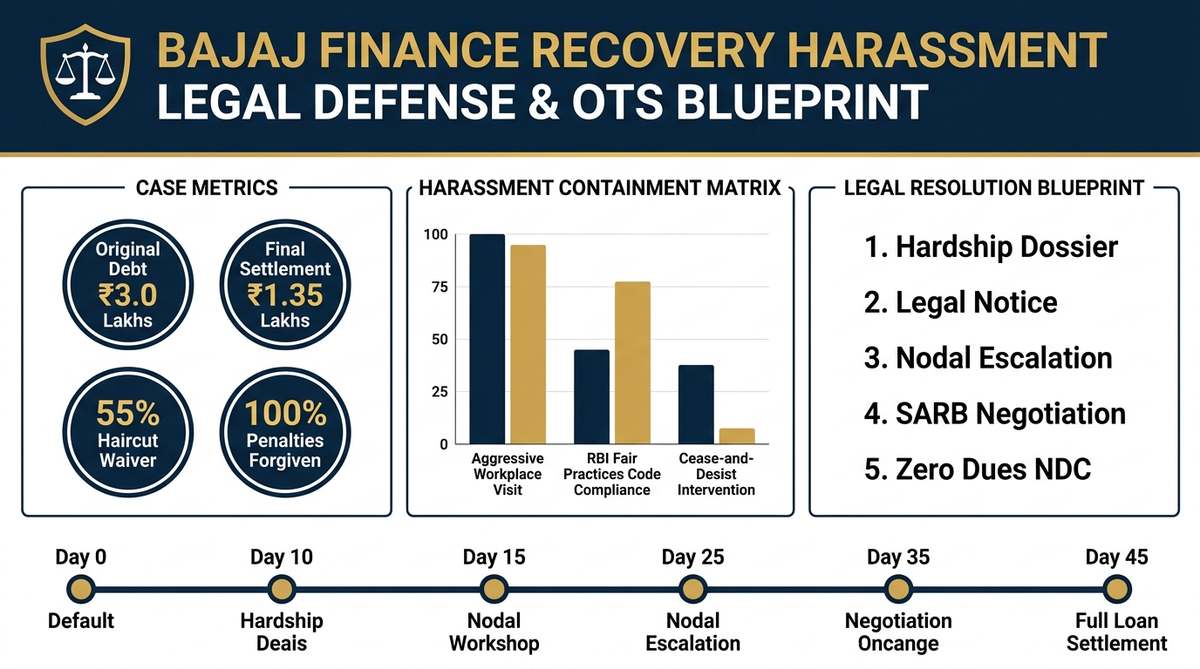
Bajaj Finance Harassment Defense & Settlement Blueprint
6. Ground Containment: Principal Nodal Officer Escalation & Immediate Withdrawal
The institutional impact of the cease-and-desist notice was immediate and decisive. Within 48 hours of service, the Chief Grievance Redressal Officer and Principal Nodal Officer of Bajaj Finance issued a formal written acknowledgement via email, confirming that the account was withdrawn from the local third-party agency and reassigned to the internal Central Stressed Assets Resolution Desk in Pune.
All physical visits to Vikram's Hinjawadi workplace were terminated immediately. The automated dialer lists were suppressed, reducing the barrage of daily collection calls to zero. The corporate legal desk confirmed that future interactions regarding account resolution would proceed exclusively through structured, documented correspondence with SettleLoans advocates.
This rapid containment demonstrates a fundamental truth of retail banking collections: unregulated third-party collection agencies operate on fear and asymmetry of legal knowledge. When confronted with precise statutory provisions, empirical evidence of violations, and formal regulatory escalations, corporate compliance officers act swiftly to mitigate institutional liability.
7. Behind the Balance Sheet: NBFC NPA Provisioning & Settlement Willingness
With physical harassment contained, the strategic focus transitioned to negotiating a sustainable financial resolution. To understand why Bajaj Finance agreed to waive 55% of the principal debt and 100% of accumulated penal fees, one must analyze the regulatory accounting rules governing Non-Banking Financial Companies under the Indian Accounting Standards (Ind AS 109) and RBI prudential asset classification norms.
Under Ind AS 109, lenders must categorize financial assets into three stages based on Expected Credit Loss (ECL) credit risk deterioration:
| Ind AS 109 Stage | Delinquency Horizon | Credit Risk Classification | Mandatory ECL Provisioning |
|---|---|---|---|
| Stage 1: Performing | 0 – 29 Days Past Due | Standard Asset | 12-Month Expected Credit Loss (0.5%–1.5%) |
| Stage 2: Underperforming | 30 – 89 Days Past Due | Significant Increase in Credit Risk (SICR) | Lifetime Expected Credit Loss (15%–35%) |
| Stage 3: Credit-Impaired (NPA) | 90+ Days Past Due | Defaulted Non-Performing Asset | 70% to 100% Specific Loss Provision |
Because Vikram's ₹3,00,000 personal loan was completely unsecured with zero underlying collateral, Bajaj Finance had already absorbed substantial provisioning charges against its quarterly profit and loss ledger once the account entered Stage 3 NPA status. In retail lending economics, pursuing an unsecured debtor through civil recovery suits or summary arbitration takes 3 to 5 years, incurring heavy legal retainers with low realization probability.
SettleLoans compiled and submitted an audited Financial Hardship Dossier comprising hospital discharge summaries, cardiac treatment invoices, bank account statements proving income depletion, and an audited household expense sheet. Using this empirical documentation, SettleLoans demonstrated to Bajaj Finance's Credit Committee that an immediate cash settlement yielded a higher Net Present Value (NPV) than protracted litigation.
8. The OTS Compromise: Negotiating 55% Haircut (₹1.35L) & Penalty Waiver
Negotiating directly with Bajaj Finance's Zonal Settlement Committee, SettleLoans structured a formal One-Time Settlement (OTS) proposal under the RBI Framework for Compromise Settlements and Technical Write-offs. By eliminating inflated bounce penalties, interest surcharges, and legal levies, the negotiation focused strictly on the core principal balance.
Over three structured negotiation rounds, SettleLoans established that Vikram's extended family could pool a one-time relief fund of ₹1,35,000 to achieve a permanent, full-and-final settlement. Recognizing the validity of the medical hardship and the zero-recovery risk of protracted legal action, the Credit Committee sanctioned a 55% principal waiver (a discount of ₹1,65,000) along with a 100% waiver of all accumulated overdue interest and penal fees amounting to ₹48,600.
| Financial Ledger Component | Pre-Settlement Claim | Sanctioned OTS Terms | Waiver / Haircut Savings |
|---|---|---|---|
| Outstanding Principal Amount | ₹3,00,000 | ₹1,35,000 | ₹1,65,000 (55% Principal Waiver) |
| Accrued Penal & Overdue Interest | ₹36,400 | ₹0 | ₹36,400 (100% Waived) |
| NACH Bounce & Late Payment Charges | ₹12,200 | ₹0 | ₹12,200 (100% Waived) |
| Total Settlement Obligation | ₹3,48,600 | ₹1,35,000 | ₹2,13,600 Total Benefit (61.3% Total Haircut) |
9. Sanction Letter Forensics, ₹0 NDC Issuance & Credit Bureau Rehabilitation
Before remitting any funds, SettleLoans advocates conducted an exhaustive forensic audit of the formal One-Time Settlement Sanction Letter issued by Bajaj Finance Limited. The verification verified five vital legal covenants: (1) The letter was generated on authentic corporate letterhead bearing authorized digital signatures and employee authorization codes; (2) The sanctioned figure of ₹1,35,000 was explicitly described as full and final discharge of all liabilities; (3) It contained a categorical clause confirming that upon payment, all pending legal notices, arbitration petitions, or Section 25 PSSA complaints would be immediately withdrawn; (4) It specified direct payment into Vikram's unique loan account number via official banking gateways; (5) It guaranteed the issuance of a formal No Dues Certificate (NDC) within 30 days.
Vikram remitted the ₹1,35,000 settlement amount directly through NEFT into his Bajaj Finance loan account. Within 21 calendar days, in strict compliance with RBI Circular RBI/2023-24/60 on Release of Property Documents and Loan Closure Certificates, Bajaj Finance issued the official No Dues Certificate confirming zero remaining balance.
Following closure, Bajaj Finance updated its monthly credit data transmission to TransUnion CIBIL, Experian, CRIF High Mark, and Equifax, reflecting the loan status as 'Settled' with an outstanding balance of ₹0. To restore Vikram's credit score back to the 750+ prime tier, SettleLoans established a personalized 18-month credit rehabilitation roadmap utilizing a secured fixed-deposit credit card with automated 25% utilization thresholds.
10. Strategic Resolution Matrix: Self-Defense vs. SettleLoans Legal Representation
When retail borrowers attempt to handle aggressive NBFC recovery tactics without legal representation, they frequently fall victim to verbal intimidation, unauthorized cash payments to field agents, or fraudulent verbal settlement promises that leave debts active on bureau records. The following comparative matrix outlines the stark difference between unrepresented distress and professional legal defense:
| Dispute Dimension | Self-Management / Unrepresented | SettleLoans Legal Representation |
|---|---|---|
| Workplace & Home Visits | Repeated unannounced visits, office humiliation, family threats | Immediate containment via statutory Cease-and-Desist notices |
| Negotiation Level & Authority | Interacting with commission-driven third-party telecallers | Direct representation before Senior Credit & Zonal Committees |
| Haircut & Debt Waiver Depth | Minimal 10%–20% waiver with full penal interest retention | 50% to 65% principal haircut with 100% penal interest waiver |
| Settlement Verification | Risk of fake WhatsApp/email letters and unallocated payments | 100% verified corporate letterhead sanction with employee code |
| Post-Closure Protection | Unresolved legal notices, lingering debt claims, damaged score | Guaranteed ₹0 NDC delivery and structured CIBIL rehabilitation |

Settle Loan is India's trusted debt relief and loan settlement platform. We help borrowers overcome financial distress by negotiating with banks and NBFCs to legally settle personal loans and credit card debts. With our transparent, performance-based approach, you can achieve debt freedom and regain your financial peace of mind.
COMPUTER
Frequently Asked Questions: Stopping Bajaj Recovery Harassment
No. Under the Reserve Bank of India (RBI) Master Directions on Recovery Agents and the Fair Practices Code for NBFCs, recovery agents are strictly prohibited from visiting a borrower's workplace unless explicitly requested or agreed to in writing. Creating a public scene, disclosing debt details to colleagues, HR managers, or security personnel, and intimidating the borrower at work constitute severe violations of RBI guidelines and fundamental privacy rights under Article 21 of the Indian Constitution.
A formal legal cease-and-desist notice drafted by a debt defense advocate formally places Bajaj Finance and its third-party recovery agencies on statutory record for violations of the RBI Master Directions, the IT Act, and the Indian Penal Code (criminal intimidation, extortion, and defamation). It directs the lender to halt all unannounced physical visits, cease contacting third parties, and route all future communication exclusively through the borrower's appointed legal counsel.
Following the containment of physical harassment via statutory notices, SettleLoans presented a verified financial hardship dossier (medical bills and cash-flow depletion records) directly to Bajaj Finance's Central Stressed Asset Management Desk. By proving genuine inability to service regular EMIs and demonstrating that litigation costs would yield lower recovery under NBFC provisioning rules, SettleLoans negotiated a 55% principal waiver, settling the ₹3,00,000 balance for ₹1,35,000 with 100% waiver of penal interest.
Borrowers should systematically gather: (1) Office visitor logs or CCTV footage capturing recovery agents at reception; (2) Audio or video recordings of aggressive conversations, threats, or abusive language; (3) Call logs and SMS/WhatsApp messages received outside permitted hours (08:00 AM to 07:00 PM); (4) Written statements from colleagues or HR personnel who witnessed the confrontation; and (5) Agent identification badges or visiting cards.
Borrowers can file complaints through four escalating channels: (1) Bajaj Finance Principal Nodal Officer (PNO) and Chief Grievance Redressal Officer; (2) The Reserve Bank of India (RBI) Integrated Ombudsman Portal (cms.rbi.org.in); (3) The local police station or Cyber Crime Cell for criminal intimidation (Section 503/506 IPC); and (4) The National Consumer Disputes Redressal Commission (NCDRC) for deficiency of service and harassment damages.
Unsecured personal loan default is strictly a civil dispute arising from breach of contract under the Indian Contract Act, 1872. The police cannot register an FIR, summon you, or make an arrest for bona fide financial inability to pay. However, if repayment cheques bounce or NACH auto-debits fail, the lender may issue statutory notices under Section 138 of the Negotiable Instruments Act or Section 25 of the Payment and Settlement Systems Act, which must be addressed and closed via legal settlement.
Borrowers must verify that: (1) The settlement letter is generated on official Bajaj Finance Limited letterhead bearing authorized digital signatures and employee codes; (2) The letter explicitly states the exact settlement amount (e.g., ₹1,35,000) as full and final discharge; (3) It confirms complete waiver of remaining principal, overdue interest, and bounce charges; (4) It guarantees issuance of a No Dues Certificate (NDC) and closure of legal notices; and (5) Payment is remitted directly to the official loan account, never to agent personal accounts.
Settling a loan results in a 'Settled' or 'Post-Write-off Settled' status on credit bureau records with a ₹0 balance, causing an initial drop of 75 to 120 points. However, active default accumulation stops immediately. By utilizing a secured fixed-deposit credit card, keeping credit utilization below 30%, and ensuring timely utility payments, borrowers can systematically rehabilitate their credit score back to 750+ within 18 to 24 months.
SettleLoans can draft and serve an urgent statutory legal cease-and-desist notice to Bajaj Finance's Principal Nodal Officer and designated collection partners within 2 to 4 business hours of case onboarding. This formal legal shield immediately alerts the NBFC of impending regulatory liability, typically halting physical visits and unauthorized calls within 24 to 48 hours.
Official Statutory & Regulatory References
- Reserve Bank of India (RBI): Circular on Recovery Agents Engaged by Regulated Entities (DOR.ORG.REC.65/21.04.158/2022-23)
- Reserve Bank of India (RBI): Framework for Compromise Settlements and Technical Write-offs (DOR.STR.REC.20/21.04.048/2023-24)
- RBI Integrated Ombudsman Portal: Complaint Filing & Redressal for NBFC Recovery Violations
- Supreme Court of India: ICICI Bank Ltd. v. Prakash Kaur (2007) 2 SCC 711 — Prohibition of Coercive Debt Recovery
- National Legal Services Authority (NALSA): Pre-Litigation Conciliation & Lok Adalat Settlement Guidelines