- Zero Family Account Liability: Banks and collection agents cannot freeze or debit bank accounts of spouses, parents, or siblings.
- Strict PAN Separation: Under Indian contract law, debts attach only to the borrower's own PAN card.
- Banker Set-Off Limits: The Banker's Right of Set-Off requires mutual debts. It cannot touch family accounts.
- Severe RBI Violations: Threatening family accounts violates the RBI Fair Practices Code and is illegal harassment.
- Leveraging Violations for 55% OTS: Legal notices against family harassment help win One-Time Settlements with deep waivers.
1. The Anatomy of Coercive Threats
When job loss or medical crises hit, loan EMIs can fall behind. In these times, collection agents use illegal pressure. They call family members and make scary threats. Agents claim they will freeze a spouse's salary. They threaten to take a parent's pension or block family UPI apps.
These threats are false. Recovery agencies work on high commissions. Agents want fast cash bonuses. When borrowers cannot pay, agents turn to family members to cause panic. They invent fake terms like "Family Account Liens". to force families into selling gold.
The legal rule in India is plain. Banks and recovery agents cannot freeze or debit family bank accounts. Unless a relative signed as a co-borrower or guarantor, they have zero link to your debt.
Agents claim that families share joint debt. They claim living together lets banks freeze family accounts and seize salaries.
Indian contract law protects individual legal identity. A lender cannot touch family funds without a contract. Freezing a relative's account is illegal.
Knowing your legal rights helps you stop threats, protect family assets. And settle your debt safely.
2. PAN Separation & Privity of Contract
Debt liability in India is strictly individual. Every adult citizen is an independent legal person with separate rights. This separation is tracked by the Permanent Account Number (PAN). Banks must link each loan and account to an individual PAN.
Under the Indian Contract Act, 1872, a loan agreement binds only the bank and the borrower. Family members are strangers to the contract. No court or bank can force a relative to pay.
To hold a family member liable, the bank must have a signed Contract of Guarantee under Section 126 of the Indian Contract Act, 1872. In unsecured loans, relatives are never guarantors. They are only listed as reference contacts.
Marriage does not make debts joint. A husband's loan cannot touch his wife's salary, savings, or Streedhan.
Parents do not owe debts of adult children. Pension funds, gratuity. And parental assets are fully safe.
A reference contact is not a guarantor. References have zero legal liability for the loan.
Credit bureaus track credit scores by individual PAN. A loan default goes only on the borrower's PAN. It has zero impact on family credit scores.
Check Your Loan Settlement Options
Answer 2 quick questions to evaluate your settlement eligibility.
1. What type of loan do you want to settle?
3. Banker Set-Off vs Family Account Rules
Recovery agents often use terms like Banker Lien to scare borrowers. Under Indian law, these rules never apply to family accounts.
Banker's Right of General Lien (Section 171, Indian Contract Act, 1872)
Under Section 171 of the Indian Contract Act, 1872, bank liens apply only to goods in trust. Lien rules never apply to savings accounts or family money.
The Equitable Right of Set-Off & The Mutuality Requirement
Banker Set-Off applies only to the same person. It requires mutual debts. A bank cannot debit a spouse or parent's account.
Debiting family funds violates consumer law and RBI rules. File an urgent Ombudsman complaint for a fast refund.
4. Civil Court Garnishee & Joint Account Rules
Agents often claim they hold court warrants to seize family goods. This claim is false. Civil attachment follows the Code of Civil Procedure, 1908 (CPC). A bank must sue under Order XXXVII CPC and seek execution under Order XXI CPC.
Under Order XXI Rule 46 CPC, courts can issue Garnishee Orders. These orders apply only to the borrower's own money. Courts cannot attach family assets.
In a joint bank account, set-off does not apply. Joint holders can show income proof. The court then frees their funds right away.
Separate your joint bank accounts early. Single-holder accounts prevent bank errors during debt collection.
Section 60(1)(i) CPC protects your salary. The first ₹1,000 is fully exempt. Two-thirds of the rest is protected. EPF, PPF. And pensions are safe.
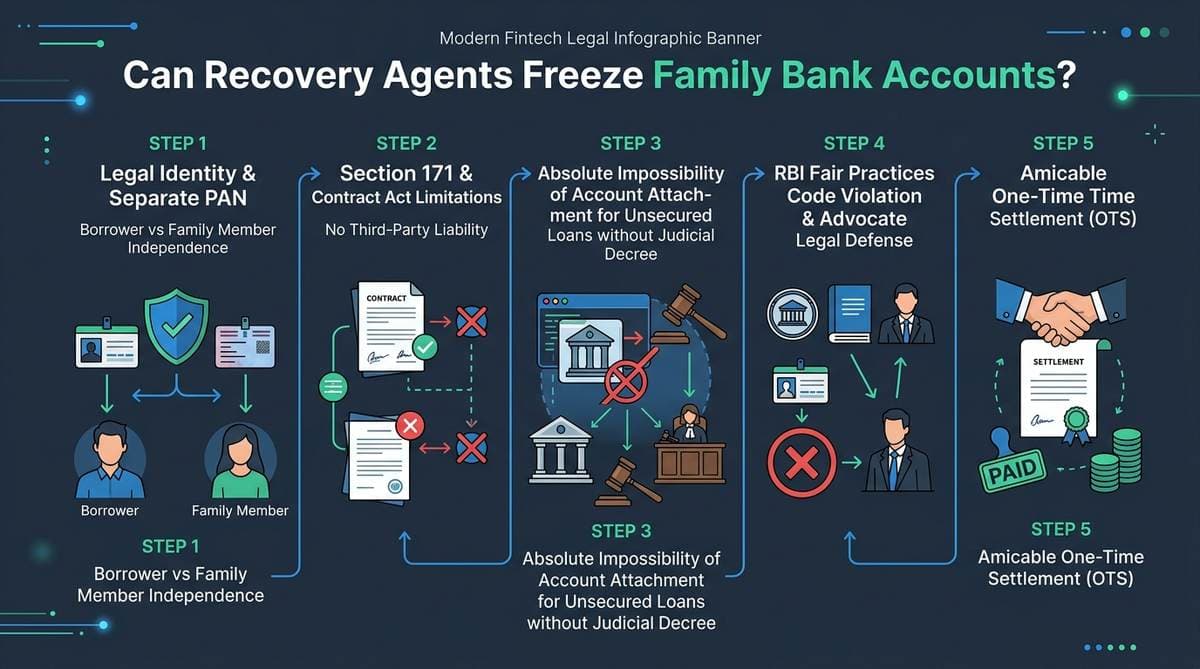
5. Family Protection & OTS Roadmap
This roadmap covers five debt defense stages. It details PAN protection and legal options.
6. Bank NPA Provisioning & Settlement
Why do agencies target family members? They follow aggressive internal NPA rules. Loans become NPA after 90 days.
Banks must stop counting interest income. They must set aside capital reserves.
| Asset Category. | Overdue Period. | Mandatory RBI Reserve. | Settlement Scope. |
|---|---|---|---|
| SMA-1 / SMA-2. | 31 to 90 Days Overdue. | 5% General Provision. | Penal Interest &. Late Fee Waivers. |
| Substandard NPA. | 91 to 365 Days Overdue. | 25% Unsecured Provision. | 35% to 45% Principal Haircut. |
| Doubtful NPA 1 (D1). | 12 to 24 Months Default. | 100% Capital Provision. | 45% to 55% Principal Haircut. |
| Doubtful NPA 2 / Loss Asset. | 24+ Months / Full Write-Off. | 100% Balance Sheet Write-Off. | 55% to 65% Principal Haircut. |
Banks use NPV to evaluate debt. They compare court costs against settlement.
C_t is the expected cash recovery. r is the bank discount rate. Deductions include legal and capital costs.
Civil suits take years and money. Section 60 CPC limits court recovery. Banks prefer quick cash settlements today.
7. 4-Stage Defense Against Agent Coercion
If recovery agents harass your family, take action. Follow this 4-stage legal defense protocol built by banking lawyers:
Stage 1: Systematic Evidence Archiving & Call Recording
Record all recovery calls. Save WhatsApp chats and voice notes. Keep agent phone numbers as proof.
Stage 2: Cease-and-Desist Advocate Statutory Legal Notice
Have a lawyer send a formal notice. Address the bank MD and nodal officer. Cite Section 506 IPC and RBI rules.
Stage 3: Escalation to the RBI Integrated Ombudsman & Law Enforcement
File a complaint on the RBI portal (cms.rbi.org.in). Report physical threats to local police.
Stage 4: Strategic Transition to Zonal Stressed Assets Desk
Bypass third-party recovery agents completely. Move talks to bank zonal managers. Negotiate a structured One-Time Settlement.
This legal strategy stops family harassment. It opens talks for a deep waiver.
8. Converting Harassment into a 55% OTS
Harassing family members violates RBI rules. When lawyers show proof of threats, banks settle. Borrowers use this leverage to secure an OTS.
A structured settlement clears your loan safely:
Lawyers submit proof of job loss or illness. This evidence justifies a large OTS waiver.
Lawyers get all late fees waived. They win a 45% to 65% principal cut.
Settlement terms order banks to delete family numbers. All calls stop permanently.
Pay the settlement in 1 to 4 installments. This structure fits your monthly budget.
9. Sanction Forensics & RBI ₹0 NDC Mandate
Watch out for fake settlement letters from rogue agents. Never pay cash on unofficial WhatsApp links. Always verify your settlement letter before paying.
- Official Bank Letterhead: The letter must feature official bank stationery and manager sign.
- Accurate Details: The letter must list your full name, PAN. And loan account.
- Full Debt Discharge: The letter must confirm the settlement clears all dues in full.
- Legal Case Withdrawal: The bank must agree to withdraw all pending legal notices.
Under RBI Master Circular RBI/2023-24/60, banks must issue an NDC within 30 days. Lenders must update credit bureaus within 30 days of final payment. Delays cost the bank a penalty of ₹5,000 per day.
Credit Score Trajectory & Credit Profile Rehabilitation
After settlement, the bank marks your loan as "Settled". with ₹0 balance. Your credit score drops briefly. Using a secured credit card rebuilds your score to 750+ in 18 to 24 months.
10. Legal Matrix: Reality vs. Agent Myths
This matrix compares agent threats against law:
| Recovery Agent Threat. | Legal Reality &. Statutory Truth. | Governing Indian Law / Regulation. | Borrower &. Family Protection Scope. |
|---|---|---|---|
| Freezing Family Bank Accounts. | Illegal without co-borrower or guarantor status. | Indian Contract Act, 1872. | 100% protection for all family members. |
| Deducting Money from Spouse's Salary. | Unlawful. violates mutual debt rules. | Banking Regulation Act rulings. | Immediate Ombudsman claim for full refunds. |
| Attaching Parental / Ancestral House. | Unsecured loans carry zero property rights. | SARFAESI Act, 2002 rules. | Ancestral properties remain 100% safe. |
| Calling Third Parties &. Relatives. | Strictly banned criminal harassment. | RBI Fair Practices Code. | Grounds for formal police complaints. |
| Damage to Family Members&apos. CIBIL. | Credit scores link to individual PAN. | Credit Information Companies Act. | Zero negative impact on family score. |
| Advocate-Led Compromise (OTS). | Formal bank settlement with big waiver. | RBI Stressed Assets Framework. | Debt closure with official NDC. |
11. SettleLoans Legal Defense Advisory
Protecting your family requires skilled banking lawyers. SettleLoans defends borrowers across India daily. We send notices to stop harassment. We challenge all illegal bank liens. We secure big OTS waivers for clients.

Settle Loan is India's trusted debt relief and loan settlement platform. We help borrowers overcome financial distress by negotiating with banks and NBFCs to legally settle personal loans and credit card debts. With our transparent, performance-based approach, you can achieve debt freedom and regain your financial peace of mind.
COMPUTER
12. Frequently Asked Questions
Find clear legal answers on family account safety, PAN rules. And loan settlement in India.
Can a bank or recovery agent legally freeze my family member's bank account for my loan default?
No. Under the Indian Contract Act, 1872, loan debt is strictly personal. Family members have zero liability. Banks and agents have no legal power to freeze or debit their accounts.
Can a bank deduct money from my spouse's salary account for my personal loan or credit card debt?
No. A spouse has a separate PAN card. Under Banker Set-Off rules, a bank cannot take money from a spouse's account. This rule applies even in the same bank branch.
What happens if I maintain a joint bank account with my spouse or parent?
A bank cannot seize a joint account under set-off rules. The joint holder can show income proof to court. The court then protects their share of funds.
Can recovery agents contact my parents, siblings, or workplace colleagues regarding my debt?
No. The RBI Fair Practices Code bans agents from calling relatives, friends, or coworkers. Contacting third parties violates privacy laws and is illegal.
Does an individual loan default impact my family members' CIBIL credit scores?
No. Credit bureaus track credit scores by individual PAN numbers. Your loan default only affects your PAN. It has zero impact on family credit scores.
Can a bank attach parental or ancestral property for an unsecured personal loan default?
No. Unsecured loans and credit cards have no collateral. Banks cannot use SARFAESI on ancestral property. Parents are not liable for debts of adult children.
Can recovery agents block or suspend family members' UPI IDs, Google Pay, or PhonePe?
No. Recovery agents have zero control over UPI systems run by NPCI. Threats to block family payment apps or UPI IDs are fake and illegal.
What legal steps should I take if recovery agents threaten to freeze my family's bank accounts?
Record all calls and save text messages. Have a lawyer send a legal notice to the bank nodal officer. File a complaint on the RBI Ombudsman portal (cms.rbi.org.in).
Why do recovery agents threaten family members if it is legally impossible to freeze their accounts?
Agents earn recovery commissions. They use fear and social pressure. They try to make panicked relatives pay money for a debt they do not owe.
How does an advocate-led One-Time Settlement (OTS) protect my family from future harassment?
A lawyer negotiates an official OTS letter with a 45% to 65% waiver. Once paid, the bank issues a No Dues Certificate and closes the loan.