- Mandatory Pre-requisite Notice: Send a written grievance to the bank Grievance Redressal Officer (GRO) first. Wait 30 days before moving to the RBI Ombudsman.
- Unified CMS Portal Lodging: File your complaint online at cms.rbi.org.in. Pick 'Loans and Advances'. Then select 'Recovery Agents / Non-adherence to Fair Practices Code'.
- Strict Electronic Evidence Standards: Call logs, audio files, and WhatsApp chats serve as valid proof. Section 63 of Bharatiya Sakshya Adhiniyam, 2023 applies.
- Substantial Statutory payout: The Ombudsman can award up to ₹20 Lakhs for money loss. You can also get up to ₹1 Lakh for mental stress.
- Catalyst for Debt Compromise: An active Ombudsman case pushes lenders to stop abuse. Banks often agree to a fast One-Time Settlement (OTS).
1. Recovery Harassment & RBI Ombudsman
Unsecured loans and credit cards have grown fast across India. Many borrowers face debt trouble after job loss or illness. When payments stop, third-party agents often use harsh methods to collect money. These agents make endless calls at odd hours. They use foul words. They send threats to relatives. They also show up at homes and workplaces.
Many borrowers believe missing a loan payment is a crime. That is false. Under the Indian Contract Act, 1872, a loan default is a simple civil breach of contract. It is not a crime. Lenders can seek civil remedies in court. But they cannot threaten or harass you. To stop these abuses, the RBI created the Reserve Bank - Integrated Ombudsman Scheme, 2021 (RB-IOS 2021). This scheme gives borrowers a strong path to hold banks and NBFCs accountable for agent misconduct.
Under the RBI Master Directions on Outsourcing of Financial Services, banks and NBFCs stay fully liable for their agents. A lender cannot blame an outside agency. The Ombudsman treats recovery agent abuse as a direct rule violation by the bank itself.
The RBI Ombudsman operates under key banking laws. These include Section 35A of the Banking Regulation Act, 1949. They include Section 45L of the Reserve Bank of India Act, 1934. Section 18 of the Payment and Settlement Systems Act, 2007 also applies. The scheme gives citizens a free way to stop agent abuse. You can hold banks liable and win cash relief for mental agony.
2. Mandatory Prerequisite
Every borrower must follow one key rule before filing an RBI complaint. Under Clause 10 of the Integrated Ombudsman Scheme, you must write to the bank first. You must give the bank a fair chance to fix the issue. Skipping this step leads to case dismissal.
First, draft a clear complaint to the Principal Nodal Officer (PNO) or Grievance Redressal Officer (GRO) of the bank or NBFC. List specific dates, phone numbers, agent words, and RBI Fair Practices Code violations. Send this notice by email and registered post. This builds a solid written record.
The Statutory 30-Day Timeline & Escalation Windows
Once you send your complaint, the lender gets exactly 30 calendar days to reply. You can escalate to the RBI Ombudsman in three clear situations:
Scenario A: Total Non-Response (Lapse of 30 Days)
If the bank sends no reply within 30 days, you can file on the RBI CMS portal on Day 31.
Scenario B: Formal Rejection of Grievance
If the lender rejects your complaint before 30 days, you can file on the CMS portal right away.
Scenario C: Unsatisfactory Resolution
If the bank gives a weak reply and fails to stop the abuse, you can escalate immediately.
Note the legal deadline. You must file your RBI Ombudsman complaint within one year of receiving the bank's final reply. If the bank never replied, file within one year and 30 days from your complaint date. Missing these deadlines ends your right to seek relief under the scheme.
Check Your Loan Settlement Options
Answer 2 quick questions to evaluate your settlement eligibility.
1. What type of loan do you want to settle?
3. Statutory Grounds
Your complaint must state exact rules that the lender broke. The Reserve Bank of India sets clear standards across key rules. These include the Master Direction – Reserve Bank of India (Managing Risks and Code of Conduct in Outsourcing of Financial Services by Regulated Entities) Directions. They include the Master Circular on Fair Practices Code. The Guidelines on Digital Lending (2022) also protect borrowers.
Key statutory grounds for recovery complaints include:
Violation of Permissible Contact Hours
Agents can only call or visit between 8:00 AM and 7:00 PM. Calls outside this daily window violate RBI rules.
Third-Party Disclosure &. Privacy Breach
Contacting friends, relatives, or employers about your debt breaks banking secrecy laws and Puttaswamy privacy rules.
Abusive Language &. Criminal Intimidation
Using foul words, shouting, or issuing fake arrest threats violates Section 351 of the Bharatiya Nyaya Sanhita (BNS) and RBI codes.
Uncertified &. Unverified Recovery Personnel
Agents must hold Debt Recovery Agent (DRA) certification from the Indian Institute of Banking and Finance (IIBF) and carry official bank ID cards.
Workplace Intrusion &. Public Shaming
Visiting your office, creating scenes in lobbies, or emailing your HR team breaks privacy and fair practice rules.
Ignoring Legal Advocate Representation
Once your legal counsel sends a formal notice, the bank must direct recovery talks to your advocate.
When you list these specific violations with exact RBI circular citations, the Ombudsman prioritizes your case. The bank then has little legal defense.
4. Step-by-Step Guide
The Reserve Bank of India Complaint Management System (CMS) is an easy online portal. It lets you register and track complaints quickly. Follow this six-stage guide to file your complaint without errors:
Stage 1: Access Portal &. Initiate Registration
Go to https://cms.rbi.org.in. Click "File a Complaint". Enter your mobile number. Complete OTP check. Enter your name, home address, email. And state.
Stage 2: Select Regulated Entity &. Account Particulars
Pick your entity type: "Scheduled Commercial Bank", "Non-Banking Financial Company (NBFC)", or "Payment System Participant". Select the bank name. Enter your loan or card account number and branch details.
Stage 3: Verify Pre-requisite GRO Complaint Data
The portal asks if you wrote to the lender. Click "Yes". Enter the date you sent the complaint to the GRO. Add the bank ticket number and proof.
Stage 4: Category &. Sub-Category Selection
Under category, pick "Loans and Advances". Under sub-category, choose "Recovery Agents / Collection Agencies / Non-adherence to Fair Practices Code". This routes your file fast.
Stage 5: Input Detailed Grievance Statement
Write a brief factual note under 2,000 characters. State your loan number, call dates. And caller numbers. Note abusive words and refer to your PDF file.
Stage 6: Upload PDF Evidence Dossier &. Submit
Upload one indexed PDF file under 10MB. Include your GRO notice, bank replies, call logs, chats, and ID proof. Submit to get your Complaint Tracking Number.
After submission, you will receive an SMS and email with your CMS Complaint Reference ID. Use this ID to track updates and review bank replies online.
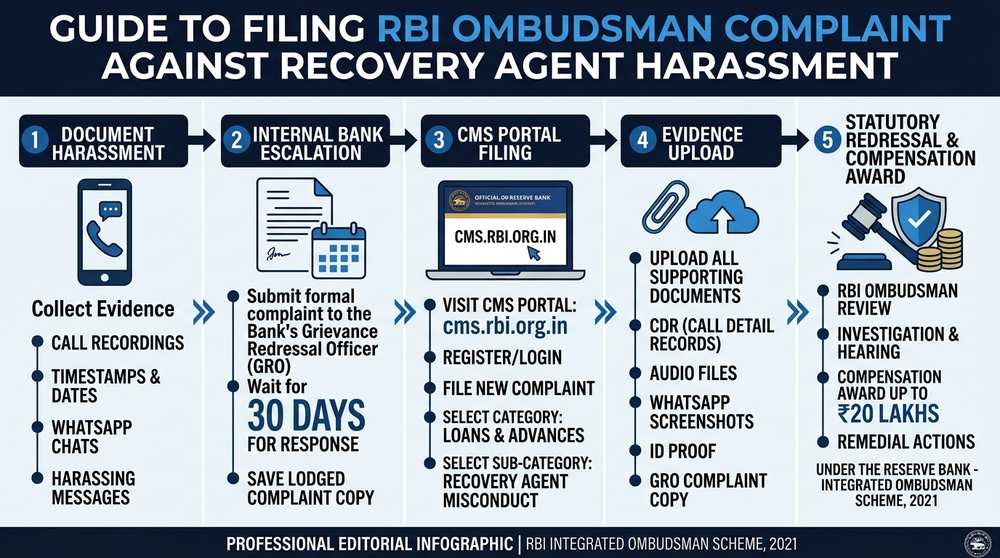
6. Evidentiary Forensics
Your RBI Ombudsman case depends on solid proof. Banks often deny that recovery agents acted abusively. Clear digital evidence proves your claims beyond dispute.
Under Section 63 of the Bharatiya Sakshya Adhiniyam, 2023 (BSA). This replaced Section 65B of the Indian Evidence Act, 1872. Digital files serve as valid legal evidence. This includes call recordings and WhatsApp messages. SMS threats and phone call logs with timestamps also count.
Mandatory Evidentiary Compilation Checklist
1. Raw Audio Files with Unaltered Hash &. Timestamps
Keep original audio files on cloud storage. Write a word-for-word transcript noting caller number, date, call time. And duration.
2. Telecom Call Detail Records (CDRs) &. Frequency Logs
Download monthly call logs from your telecom carrier. Showing 20 to 50 calls in one day proves repeated harassment.
3. WhatsApp &. SMS Chat Transcripts with Sender Identifiers
Save full screenshots showing sender phone numbers (+91...), dates, times. And abusive messages or fake court notices.
4. CCTV Footage &. Doorstep Audio-Video Recordings
If agents visit your home or office, save video clips showing them shouting, refusing to leave, or lacking bank ID cards.
Combine all screenshots and text records into one clear PDF document. For audio files, store them on Google Drive or DigiLocker. Include direct access links inside your PDF file.
7. Claiming Statutory Compensation Up to ₹20 Lakhs
The Reserve Bank - Integrated Ombudsman Scheme, 2021 gives the Ombudsman power to award money to borrowers. Under Clause 15(3), the Ombudsman can award up to ₹20 Lakhs for direct financial loss caused by bank service issues. The Ombudsman can also award up to ₹1 Lakh for mental agony, lost time. And legal expenses.
To claim payout, show your actual losses clearly. This includes lost job contracts, medical bills from stress. And legal fees spent defending against threats.
Lenders act fast under Ombudsman review. Under RBI rules, banks must set aside funds for unpaid loans. An active Ombudsman complaint adds regulatory risk. Banks judge recovery value using Net Present Value (NPV):
Where C_t is expected recovery over time t, r is the bank discount rate. And deductions cover court costs and locked capital.
An active Ombudsman case cuts recovery value. Facing a possible ₹20 Lakh penalty and audits, banks prefer to pull back agents. They often offer a 40% to 65% One-Time Settlement waiver instead.
8. Post-Ombudsman OTS & Sanction Letter
A strong RBI complaint does more than stop calls. It helps you settle your debt on fair terms. Once the Ombudsman steps in, the bank moves your file to its settlement desk.
Follow these three steps for a clean debt exit:
1. Authentic Sanction Letter
Get an official One-Time Settlement (OTS) letter on bank letterhead. It must show digital signatures, account numbers. And payment terms.
2. Stamped No Dues Certificate
Ensure the bank issues a signed No Dues Certificate (NDC) under RBI Circular RBI/2023-24/60 confirming zero remaining balance.
3. Credit Bureau Rectification
Ensure the bank updates CIBIL, Experian, Equifax, and CRIF High Mark within 30 days to show the loan as 'Settled&apos. or 'Closed'.
Never pay cash to recovery agents. Always pay through net banking, NEFT, or RTGS directly into your bank loan account. After getting your NDC, you can rebuild your credit score step by step.
9. Grievance Redressal Forums Comparison Matrix
Borrowers facing recovery harassment have multiple legal paths under Indian law. The table below compares the speed, cost. And powers of each option:
| Redressal Forum. | Statutory Authority. | Average Resolution Time. | Financial Cost to Borrower. | payout &. Enforcement Powers. |
|---|---|---|---|---|
| RBI Integrated Ombudsman (CMS). | Section 35A Banking Regulation Act / RB-IOS 2021. | 30 to 90 Days. | ₹0 (Completely Free) | Awards up to ₹20 Lakhs direct damages. Awards ₹1 Lakh for mental agony. Enforces direct bank supervisory sanctions. |
| Bank Internal Nodal Desk (GRO). | RBI Fair Practices Code Mandate. | 15 to 30 Days. | ₹0 (Completely Free) | Internal reprimands. Mandatory step before Ombudsman escalation. |
| District Consumer Disputes Redressal Commission. | Consumer Protection Act, 2019. | 12 to 24 Months. | Nominal Court Fees + Advocate Charges. | Awards cash damages for poor bank service and unfair trade practices. |
| National Cyber Crime Reporting Portal. | Information Technology Act, 2000 &. BNS. | 30 to 60 Days. | ₹0 (Completely Free) | Freezes fraud bank accounts. Registers FIR for illegal lending apps and blackmail. |
| National Lok Adalat. | Legal Services Authorities Act, 1987. | Single-Day Hearing. | ₹0 (Court fee refunded if pending) | Final civil compromise decree with mutual waiver. |
10. SettleLoans RBI Ombudsman Representation
Filing an RBI Ombudsman case needs legal care. Our legal team at SettleLoans helps borrowers resolve debt disputes and stop harassment nationwide.
We handle the full process: drafting 30-day notices to bank Grievance Officers, preparing evidence under Section 63 BSA. And filing on cms.rbi.org.in. We also negotiate 40% to 65% One-Time Settlements with official bank sanction letters and No Dues Certificates.

Settle Loan is India's trusted debt relief and loan settlement platform. We help borrowers overcome financial distress by negotiating with banks and NBFCs to legally settle personal loans and credit card debts. With our transparent, performance-based approach, you can achieve debt freedom and regain your financial peace of mind.
COMPUTER
11. FAQs: RBI Ombudsman Complaints & Recovery Rules
Clear answers regarding the RBI Complaint Management System, recovery agent restrictions, evidence submission. And payout claims.
Can I file an RBI Ombudsman complaint against recovery agents without complaining to the bank first?
No. You must complain to the bank first. Under Clause 10 of the Reserve Bank - Integrated Ombudsman Scheme, 2021. You must write to the bank GRO first. The bank gets 30 days to reply. You can go to the RBI Ombudsman if the bank rejects your plea. You can also file if the bank ignores you for 30 days.
What is the official website to file an online RBI Ombudsman complaint?
The official portal is at https://cms.rbi.org.in. This is the RBI Complaint Management System (CMS). You can also email crpc@rbi.org.in. You can also send post to Centralised Receipt and Processing Centre (CRPC). The address is Reserve Bank of India, 4th Floor, Sector 17, Chandigarh - 160017.
Which complaint category and sub-category should I choose on cms.rbi.org.in for recovery agent harassment?
On the CMS portal, pick 'Loans and Advances' as the category. Next, choose 'Recovery Agents / Collection Agencies / Non-adherence to Fair Practices Code' as the sub-category. In the text, cite RBI Master Directions on Outsourcing of Financial Services. Also report calls outside 8:00 AM to 7:00 PM.
What maximum compensation can the RBI Ombudsman award for recovery agent harassment?
Under Clause 15(3) of the Reserve Bank - Integrated Ombudsman Scheme. The Ombudsman can award up to ₹20 Lakhs for money loss. The Ombudsman can also award up to ₹1 Lakh for mental agony and costs.
Are mobile call recordings and WhatsApp screenshots accepted as evidence by the RBI Ombudsman?
Yes. Digital audio files, call logs, SMS, and WhatsApp chats serve as valid proof. Under Section 63 of the Bharatiya Sakshya Adhiniyam, 2023. This replaced Section 65B of the Indian Evidence Act. Clean digital records with timestamps prove violations.
Can the RBI Ombudsman penalize NBFCs and digital lending loan apps for recovery agent harassment?
Yes. The Integrated Ombudsman Scheme covers all Scheduled Commercial Banks. It covers Regional Rural Banks and Urban Co-operative Banks. It also covers all NBFCs and digital loan apps registered with the RBI.
How long does the RBI Ombudsman take to resolve a recovery harassment complaint?
The Ombudsman usually acts in 30 to 60 days. The office first helps both sides settle. If talks fail, the Ombudsman reviews bank records. A final statutory Award comes within 90 days.
Will filing an RBI Ombudsman complaint stop ongoing recovery calls and home visits?
Yes. Once you file on CMS, RBI alerts the bank. Banks freeze collection calls on disputed accounts right away. They do this to avoid fines and regulatory audits.
Can I settle my loan while an RBI Ombudsman complaint is pending?
Yes. An RBI complaint speeds up One-Time Settlement (OTS) talks. Banks want to avoid penalties. Bank panels often offer 40% to 65% waivers and issue a No Dues Certificate (NDC).