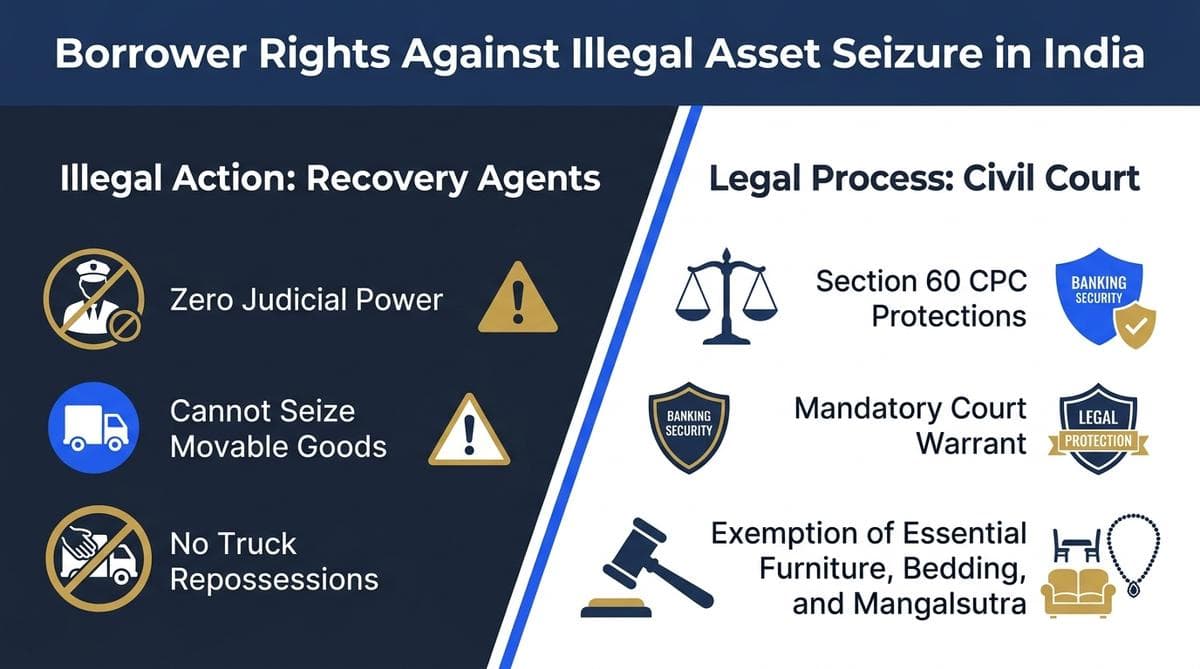
- Zero Repossession Power: Bank recovery agents have no right or court warrant to seize household furniture, appliances, or personal goods.
- Section 60 CPC Statutory Shield: Civil law strictly protects basic household items, beds, cooking pots, and women's ornaments like Mangalsutras from court attachment.
- No SARFAESI for Unsecured Debt: The SARFAESI Act applies only to secured loans. Personal loans are unsecured debts with no claim on home goods.
- Actionable Criminal Offenses: Entering without consent or threatening to take goods is criminal trespass (Section 329 BNS), extortion (Section 308 BNS), and intimidation (Section 351 BNS).
- Advocate-Led Resolution: Hiring a lawyer stops coercive visits at once. It redirects talks toward a structured One-Time Settlement (OTS) with 40% to 65% waivers.
1. The Property Confiscation Myth
Financial distress can strike through job loss, medical costs, or inflation. Borrowers with overdue personal loans often face harsh collection tactics. Many recovery agencies make false threats of property seizure. They call or visit homes, threatening to bring trucks for sofas, TVs, fridges, and gold.
To protect your rights, know how debt collection works. Collection agents are private workers hired by banks. They hold zero police or court powers. They are not court bailiffs. They hold no attachment warrants. They cannot enter your home without permission. Their threats to take goods are empty bluffs to create fear.
No agency, bank manager, or agent can take movable goods for unsecured debt without a stamped court warrant.
Personal loans and cards are unsecured under the Indian Contract Act, 1872. When taking a personal loan, you do not mortgage your goods. Unpaid debt is a civil matter. The lender can only file a court suit. They have no legal claim over items in your home.
2. Section 60 CPC Property Protections
Even if a bank wins a court lawsuit, Indian law protects families. The key shield is Section 60 of the Code of Civil Procedure, 1908 (CPC). This section governs property attachment during court execution.
Section 60 CPC is rooted in human dignity. Parliament ensures no court process leaves a family without basic goods. Section 60(1) provisos list items that are strictly safe from attachment:
Statutory Exemptions Under Section 60(1) Provisos (Code of Civil Procedure, 1908)
Proviso (a): Wearing Apparel, Cooking Utensils & Bedding
Clothes, cooking pots, beds, and bedding for the family. It protects Mangalsutras.
Proviso (b): Tools of Artisans & Implements of Husbandry
Tools of trade, farm tools, cattle, and seed grain.
Proviso (c): Houses of Agriculturists & Domestic Servants
Homes belonging to farmers, workers, or laborers.
Proviso (g) & (k): Pensions, Gratuity & Provident Funds
Pensions, family funds, and savings in PPF and EPF.
Indian law protects wedding ornaments and Strihidhan. Under Indian law, Strihidhan belongs solely to a married woman. Even if her husband defaults on a loan, no one can attach her gold. Demanding a woman's jewelry for family debt is illegal.
Check Your Loan Settlement Options
Answer 2 quick questions to evaluate your settlement eligibility.
1. What type of loan do you want to settle?
3. The SARFAESI Act vs. Unsecured Debt
Recovery agents often use confusing terms to scare borrowers. They show letters quoting the SARFAESI Act, 2002. Agents claim that under SARFAESI rules, the bank can take your home and auction furniture without a court order.
This claim is false. The SARFAESI Act applies only to secured loans. It covers home loans or mortgage loans backed by property. Under Section 13(2) and 13(4) SARFAESI, lenders can only repossess assets pledged as security.
Personal loans and cards are unsecured. The bank holds no charge over household items. Using SARFAESI notices for unsecured debt is illegal. Agents making such threats break banking rules.
Key Distinctions: Secured Repossession vs. Unsecured Recovery
Secured Loans (Home / Auto Loans)
The home or car is pledged security. Lenders can repossess that asset under SARFAESI. But they cannot touch general household items.
Unsecured Loans (Personal / Credit Cards)
Zero collateral is pledged. The lender has no claim over furniture or gold. Recovery is limited to civil suits.
4. Bank NPA Accounting & Seizure Economics
Why do recovery agencies make false threats instead of going to court? The answer lies in bank balance sheets. Under RBI rules, unpaid loans turn into Non-Performing Assets (NPAs) after 90 days.
When an account turns into an NPA, the bank cannot book interest as profit. It must lock away funds as provisions:
- Substandard Assets (Up to 12 Months NPA): 15% provisioning on unsecured loans.
- Doubtful Assets - Category 1 (12 to 24 Months NPA): 100% provisioning on unsecured loans.
- Loss Assets / Written-Off Portfolio: 100% full balance sheet write-off against reserves.
Filing a court suit for ₹5 Lakhs takes 3 to 5 years. It costs heavy legal fees. Household goods have zero auction value. They are protected under Section 60 CPC. Thus, court suits yield poor returns. Banks judge recovery via Net Present Value (NPV):
Here, C_t is the expected cash recovery. The letter r is the bank discount rate. Deductions cover legal fees and locked funds.
Court cases yield low returns. Thus, banks prefer a fast One-Time Settlement (OTS). A 40% to 65% waiver gives the bank quick cash. It frees locked funds. Threats of trucks are cheap scare tactics before settlement talks begin.
6. Criminal Countermeasures & Penal Remedies
Entering a home without consent or threatening to take goods is a crime. Under the Bharatiya Nyaya Sanhita (BNS) and IPC, such acts trigger criminal charges:
Section 329 BNS (Section 441 IPC: Trespass)
Entering without consent to threaten or insult is criminal trespass. It carries jail time.
Section 308 BNS (Section 383 IPC: Extortion)
Using fear of public shame or loss of goods to force payment is extortion.
Section 351 BNS (Section 503 IPC: Intimidation)
Threats to your person, name, or home to force payment constitute intimidation.
RBI Master Directions on Outsourcing
The RBI holds banks liable for agent actions. The Ombudsman can order compensation up to ₹20 Lakhs.
In ICICI Bank Ltd. v. Prakash Kaur & Ors. (2007) 2 SCC 711, the Supreme Court banned musclemen for debt collection. The court ordered banks to follow civil steps.
When our legal team steps in, we save call records and video clips. We send a Cease-and-Desist notice to bank leaders and nodal officers. This halts home visits at once. It starts peaceful settlement talks.
7. Civil Court Execution Realities for Assets
How does a real court attachment work in India? A bank cannot get a property attachment order overnight. The process under the Code of Civil Procedure, 1908 involves 5 slow stages:
Stage 1: Filing of Civil Suit / Order 37 Summary Suit
The bank files a case in court. Summons are sent to the borrower. You can file a reply and defend yourself.
Stage 2: Adjudication & Trial
Both sides show evidence. They argue disputed fees over 2 to 4 years.
Stage 3: Passing of Money Decree
If the court rules for the bank, it passes a money decree.
Stage 4: Execution Petition Under Order XXI CPC
The bank files an execution plea under Order 21 CPC to find non-exempt assets.
Stage 5: Official Execution by Court Bailiff
Any attachment is done only by a Court Bailiff with a court warrant. They must follow Section 60 CPC exemptions.
This shows agent threats are empty bluffs. Banks rarely file court execution cases for small personal loans. A negotiated settlement is best for both sides.
8. OTS Settlement & NDC for Unsecured Debt
Never make cash or UPI payments to agents. Agents may say, "Pay ₹30,000 today and we will not bring the truck." But cash is often lost. The bank marks it as penal interest. Harassment resumes next month.
To settle personal loans or credit cards safely, follow three clear rules:
1. Official Sanction Letter
Get an OTS letter on bank letterhead. It must show the waiver sum.
2. Direct Bank Remittance
Pay into your loan account via NEFT or RTGS.
3. Stamped NDC & CIBIL Update
Get a stamped No Dues Certificate. Check credit bureau updates.
Credit bureaus update your file to 'Settled'. This ends legal risk. It stops all agent visits for good.
9. Asset Seizure & Property Protection Matrix
The comparative matrix below details legal limits, authority, and borrower protections across recovery channels in India:
| Recovery Channel | Legal Authority | Power to Seize Household Items | Power to Seize Gold / Jewelry | Applicable Legal Remedies |
|---|---|---|---|---|
| Third-Party Recovery Agents | Private Agency Contract (Zero Judicial Authority) | Zero. Seizure is illegal and criminal trespass. | Zero. Taking gold is extortion under Section 308 BNS. | Section 329 BNS complaint. RBI Ombudsman. Cease-and-Desist notice. |
| Civil Court Execution (Order 21 CPC) | Judicial Warrant executed by Official Court Bailiff | Strictly Limited. Section 60 CPC protects beds, clothes, and basic furniture. | Zero for Strihidhan / Mangalsutra. Bullion only if decreed. | Order XXI Rule 58 CPC plea. Section 60 CPC exemptions. |
| SARFAESI Act Proceedings | Authorized Officer under SARFAESI Act, 2002 | Zero for unsecured loans. Only pledged collateral for secured debt. | Zero unless pledged under a formal gold loan. | Section 17 plea before DRT. |
| Lok Adalat Settlement | Statutory Conciliation under Legal Services Authorities Act | None. Voluntary mutual compromise forum. | None. Consensual settlement with 40%–65% waiver. | Final consent award with no court cases. |
| Section 138 NI Act (Cheque Bounce) | Metropolitan / Judicial Magistrate Court | Zero. Quasi-criminal case with no asset seizure. | Zero. Bailable process focusing on loan resolution. | Bail plea. Legal defense. Compounding via OTS. |
10. SettleLoans Asset Seizure Defense
Living in fear of debt agents is stressful. At SettleLoans, our team defends borrowers across India. We enforce rights under Section 60 CPC and RBI rules. We send Cease-and-Desist notices to stop harassment. We then negotiate 40% to 65% OTS waivers and No Dues Certificates.

Settle Loan is India's trusted debt relief and loan settlement platform. We help borrowers overcome financial distress by negotiating with banks and NBFCs to legally settle personal loans and credit card debts. With our transparent, performance-based approach, you can achieve debt freedom and regain your financial peace of mind.
COMPUTER
11. FAQs: Can Agents Take Household Goods or Gold?
Clear answers on recovery agent limits, property attachment rules, Section 60 CPC exemptions, and borrower defense.
Can a bank recovery agent legally enter my house and seize furniture or electronics for an unpaid personal loan?
No. Bank recovery agents have zero legal power to seize movable items. They cannot enter your home without your permission. Personal loans and credit cards are unsecured debts under civil contract law. Entering without permission is criminal trespass under Section 329 BNS (Section 441 IPC). Forcible removal of goods is theft or robbery.
Can recovery agents take my wife's gold jewelry or Mangalsutra to recover credit card dues?
No. Recovery agents have no legal power to touch or take personal jewelry. Under Section 60(1)(a) CPC, even courts cannot attach personal ornaments like a Mangalsutra or religious jewelry. Strihidhan is the personal property of a woman. It cannot be taken for her husband's or family debts.
What should I do if a recovery agent threatens to bring a truck to repossess household goods?
Save all phone recordings, messages, and videos as proof. Tell the agent that loan default is a civil matter. Threats of extra-judicial seizure are criminal intimidation under Section 351 BNS (Section 506 IPC) and extortion under Section 308 BNS (Section 383 IPC). Contact an advocate, notify the bank, and file police and RBI complaints.
Can a bank attach my household goods through a court order for personal loan default?
A bank can only seek property attachment after winning a civil recovery suit and getting a court decree. Attachment must be done by an official Court Bailiff with a sealed court warrant, never by recovery agents. Moreover, Section 60 CPC exempts basic bedding, clothing, utensils, tools of trade, and basic furniture.
Does the SARFAESI Act allow banks to take household items for unsecured loans?
No. The SARFAESI Act, 2002 applies only to secured loans where specific property is mortgaged or hypothecated, like home or car loans. Personal loans and credit cards have no collateral. Banks cannot use SARFAESI Section 13(2) or 13(4) repossession against unsecured loans.
What items are completely exempt from seizure under Section 60 of the Code of Civil Procedure (CPC)?
Section 60(1) CPC exempts clothes, cooking pots, beds, and bedding. It also protects sacred ornaments like Mangalsutras, artisan tools, farm equipment, farm produce, account books, and homes of farmers or laborers. Basic household furniture is legally safe.
What are the permissible hours and rules for recovery agent visits under RBI guidelines?
Under RBI rules and Fair Practices Codes, agents can only visit or call between 8:00 AM and 7:00 PM. Agents must not use physical force, shouting, abusive words, or threats. They cannot harass family or create scenes in your neighborhood.
How does hiring a debt settlement advocate stop illegal property confiscation threats?
A debt settlement advocate files a Vakalatnama and sends a Cease-and-Desist notice. Under RBI rules, lenders must route all communications through the lawyer once hired. If agents harass you, the lawyer files criminal and RBI Ombudsman complaints while securing a 40% to 65% OTS.