- Dual Accounting Conflict: Lenders generate this notation when internal technical write-offs clash with subsequent compromise settlement credits.
- Underwriting Disqualification: Automated retail lending algorithms interpret post-write-off settled entries as unmitigated credit losses, triggering automatic rejections.
- Statutory Correction Right: Section 21 of CICRA 2005 legally obligates credit institutions to report accurate, complete, and reconciled credit information.
- Nodal Escalation Requirement: Branch managers cannot modify centralized memorandum registers, necessitating Principal Nodal Officer intervention.
- Ombudsman Remedy: Unresolved reporting disputes qualify for Banking Ombudsman escalation carrying mandatory ₹100 daily delay compensation.
1. Anatomy of Post-Write-Off Settled Status in CIBIL
Borrowers who settle delinquent debts with commercial banks reasonably expect credit bureaus to reflect a resolved status once compromise proceeds are remitted. In practice, however, borrowers reviewing their TransUnion CIBIL, Equifax, Experian, or CRIF High Mark credit reports often discover a damaging notation: Post-Write-Off Settled. This remark appears even when the borrower complied with all settlement covenants and secured payment receipts.
The notation represents an operational conflict between internal core banking registers and automated bureau feeds. While a standard Settled status reflects an agreed compromise under Section 63 of the Indian Contract Act, Post-Write-Off Settled indicates the lender wrote off the asset before finalizing the compromise. Automated underwriting algorithms treat this remark with the same severity as a charge-off, causing instant rejections across retail loan applications.
2. Bank Accounting Mechanics: Technical vs Prudential Write-Offs
Understanding this classification requires analyzing bad debt accounting under RBI Master Directions on Prudential Norms on IRACP. When an account remains delinquent past ninety days, it is classified as a Non-Performing Asset. If delinquency extends past 180 days, banks face mandatory capital provisioning burdens between 25 and 100 percent, directly depressing profitability.
To cleanse active balance sheets and optimize capital adequacy under Basel III, lenders execute technical write-offs. The loan is derecognized from branch registers and transferred to a memorandum ledger, designated as the Advance Under Collection Account (AUCA). An internal write-off does not extinguish civil debt liability. However, when the borrower remits settlement funds, branch software credits the memorandum account without central reconciliation, prompting automated bureau feeds to transmit the conflicting Post-Write-Off Settled remark.
Check Your Loan Settlement Options
Answer 2 quick questions to evaluate your settlement eligibility.
1. What type of loan do you want to settle?
3. Statutory Framework: CICRA 2005 and RBI Master Directions
Credit reporting in India is governed by strict statutory mandates designed to maintain financial transparency. The Credit Information Companies (Regulation) Act, 2005 (CICRA) establishes enforceable consumer protections. Under Section 21 of CICRA, credit institutions must collect, process, and furnish accurate, complete, and current credit data. Reporting an active unmitigated loss post lawful settlement constitutes an actionable violation of credit reporting regulations.
Under Section 63 of the Indian Contract Act, 1872, creditor acceptance of compromise proceeds legally discharges the debt, terminating residual claims. Furthermore, under RBI Circular RBI/2023-24/73, commercial banks must resolve credit reporting grievances within thirty calendar days. Failure to rectify inaccurate bureau notations within thirty days entitles the borrower to statutory compensation of ₹100 per day of delay.
Statutory accuracy mandate for debt discharge.
Full discharge on compromise acceptance.
Mandatory 30-day dispute resolution timeline.
Statutory ₹100 daily delay compensation.
When a borrower complies with settlement terms and holds a No Dues Certificate, the debt is extinguished. Continuing to broadcast an active loss violates statutory reporting mandates.
4. Residual Ledger Economics and the NPV Balance Recovery Model
Branch managers cannot rectify a Post-Write-Off Settled remark because they lack system permissions to adjust centralized AUCA registers. Any modification to a written-off asset requires formal authorization from zonal credit committees and centralized credit operations.
From an institutional standpoint, banks evaluate upgrading an account from Post-Write-Off Settled to Closed by weighing recovery value against capital provision reversals. When an account is written-off, 100 percent provision is locked. By reconciling memorandum balances through an advocate-led petition, the bank unlocks regulatory capital under RBI prudential guidelines.
| Account Metric | At Default | Technical Write-Off | Reconciled Closed |
|---|---|---|---|
| Active Ledger | ₹12.0L NPA | Moved to AUCA Memo | ₹0 Balance |
| Provisioning | 100% Provisioned | Booked Loss | Provision Reversal |
| Settlement Sum | Full Recovery | Internal Loss | Compromise Paid |
| Bureau Status | 90+ DPD | Written-Off | Closed Status |
Where R_t represents residual compromise inflow, k is capital cost, and deductions account for capital adequacy gains unlocked by derecognizing memorandum assets upon closure.
5. Step-by-Step Bureau Status Rectification Roadmap
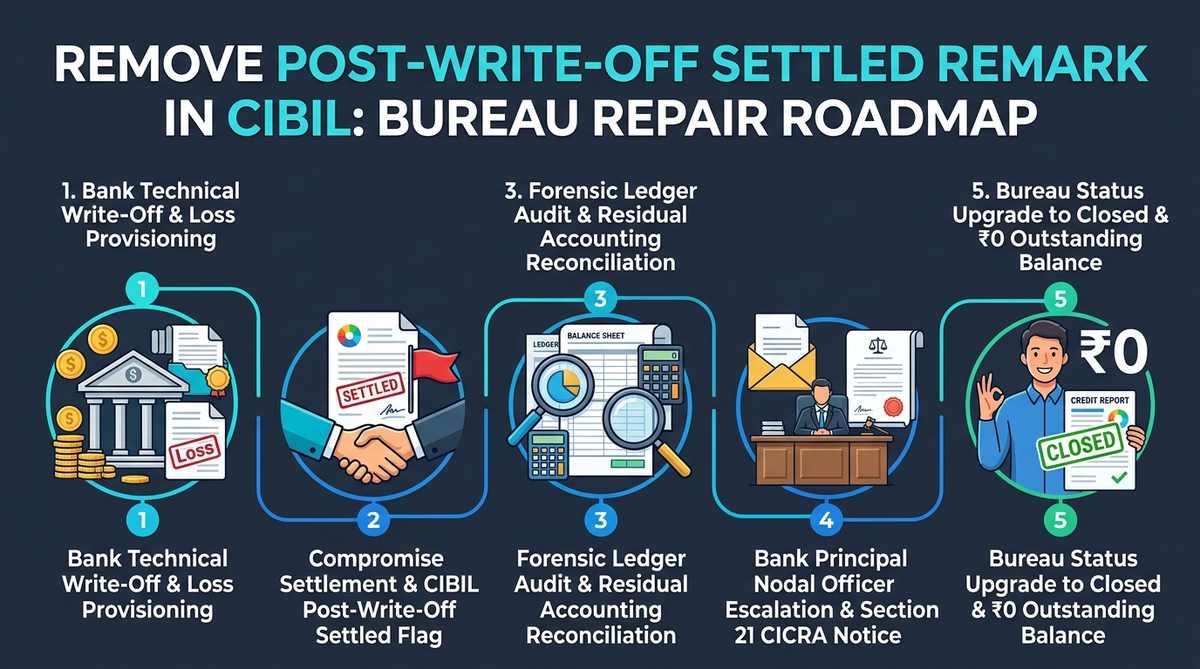
Upgrading a Post-Write-Off Settled remark to a Closed classification requires a disciplined multi-stage protocol that synchronizes internal banking ledgers with regulatory bureau reporting systems.
The roadmap below details the structured five-stage journey required to audit settlement documentation, reconcile memorandum ledgers, issue statutory notices to the Principal Nodal Officer, and secure a bureau correction batch resetting balances to zero.
6. Escalation Protocol: Approving Upgrades via Nodal Officers
Because local branch staff cannot modify centralized registers, attempting resolution at the retail branch yields circular delays. The only viable pathway is an advocate-led escalation to the bank's Principal Nodal Officer (PNO) designated under the RBI Internal Grievance Redressal framework.
Advocates compile an audited dossier comprising the settlement sanction letter, deposit receipts, and credit bureau reports. Counsel then serves a formal statutory demand notice under Section 21 of CICRA 2005 upon the Principal Nodal Officer, demanding memorandum reconciliation and bureau file modification. If the institution fails to resolve the grievance within thirty days, advocates file an immediate complaint under Clause 10 of the Reserve Bank Integrated Ombudsman Scheme.
Compiling sanction terms, receipts, and CIR reports.
Serving Section 21 CICRA demand upon the PNO.
Resolving residual internal audit ledger entries.
Invoking Clause 10 for mandatory rectification.
7. Forensic Audit of Sanction Letters and NDC Rectification
The viability of a credit bureau upgrade rests upon the contractual phrasing in the settlement sanction letter and No Dues Certificate. Agreements drafted by collection agencies often contain ambiguous clauses or loss reservations that compromise borrower rights.
Banking advocates conduct forensic audits across key contractual checkpoints. First, counsel verifies that the sanction letter features authorized executive signatures rather than unverified collection agency stamps. Second, terms are audited under Section 63 of the Indian Contract Act to guarantee unconditional debt discharge. Third, counsel demands an official No Dues Certificate confirming zero outstanding liability across active and memorandum accounts.
Verified signatures of delegated bank authority.
Full discharge under Section 63 Contract Act.
Excluding post-settlement write-off reporting.
Confirmation of zero balance across all books.
Verbal assurances that CIBIL will show Closed hold zero legal validity. Only written sanction terms provide actionable proof before the Nodal Officer and Banking Ombudsman.
8. CIBIL Data Discrepancy Dispute and ₹0 Balance Updating
Filing an online dispute directly on the TransUnion CIBIL portal without prior bank clearance leads to automatic rejection. Credit bureaus are passive repositories that verify disputes against the lender's monthly reporting feed; an unreconciled internal ledger causes the bank system to confirm the adverse remark.
The correct procedure requires securing written closure approval and a reconciled No Dues Certificate from the Principal Nodal Officer. Central Credit Operations then generates a Segment 004 correction batch. This file updates Account Status from Post-Write-Off Settled to Closed, resets current balances and overdues to zero, and clears residual write-off figures.
- Segment 004 Transmission: Central operations submits an out-of-cycle correction batch upgrading account status to Closed.
- Current Balance Reset: Reporting feeds reset active balance and overdue fields to ₹0, terminating delinquency indicators.
- Written-Off Amount Purging: Historical written-off figures are reconciled, eliminating adverse loss flags from underwriting systems.
- Multi-Bureau Synchronization: Corrected data is ingested by CIBIL, Experian, Equifax, and CRIF High Mark within twenty-one business days.
9. Comparative Matrix: Post-Write-Off Settled vs Closed Status
Comparing operational differences between compromised entries and closed accounts demonstrates why securing a bureau upgrade is vital for financial recovery:
| Evaluation Parameter | Post-Write-Off Settled | Standard Settled | Fully Closed Status |
|---|---|---|---|
| Bureau Account Tag | Post-Write-Off Settled | Settled | Closed / Normal Closure |
| Reported Write-Off Loss | Substantial loss recorded | Zero write-off flagged | Zero write-off flagged |
| Current Outstanding | ₹0 Balance | ₹0 Balance | ₹0 Balance |
| Underwriting Treatment | Immediate automated rejection | Manual risk review | Standard lending eligibility |
| Credit Score Trajectory | Suppressed below 650 | Rebounds in 18-24 months | Recovers above 750 |
10. SettleLoans Forensic Legal Defense and Bureau Restoration
Navigating core banking systems and credit bureau regulations requires experienced legal advocacy. SettleLoans provides complete forensic representation to resolve credit reporting disputes across India. Our advocates audit documentation, petition Principal Nodal Officers under Section 21 of CICRA, reconcile memorandum registers, and escalate disputes to the RBI Ombudsman to secure authentic No Dues Certificates and verified bureau upgrades to Closed.

Settle Loan is India's trusted debt relief and loan settlement platform. We help borrowers overcome financial distress by negotiating with banks and NBFCs to legally settle personal loans and credit card debts. With our transparent, performance-based approach, you can achieve debt freedom and regain your financial peace of mind.
COMPUTER
11. Frequently Asked Questions: CIBIL Bureau Status Repair
Direct, legally verified answers to common questions regarding post-write-off settled remarks, technical write-offs, bank Nodal Officer escalations, and CIBIL status upgrades in India.
What does post-write-off settled mean on a CIBIL credit report?
This notation indicates the lender executed an internal technical write-off before finalizing a compromise settlement. Automated bureau engines record both the accounting loss and recovery, creating an adverse flag.
Why does this remark damage credit scores more than standard settled status?
Standard settled records reflect a compromise without prior book write-offs. A post-write-off settled notation signals an unrecovered loss, causing automated underwriting engines to treat the entry as an involuntary default.
Can a borrower legally demand the removal of a post-write-off remark?
Yes. Under Section 21 of CICRA 2005, lenders must report accurate credit data. Broadcasting an active written-off loss post full settlement compliance violates statutory accuracy mandates.
What is the core difference between a technical write-off and debt waiver?
A technical write-off is an internal accounting adjustment moving debt to memorandum registers. A debt waiver under Section 63 of the Indian Contract Act is a bilateral accord extinguishing borrower liability.
Why are local branch managers unable to rectify this entry in CIBIL?
Branch staff lack core banking permissions to modify centralized memorandum registers or transmit Segment 004 correction batches to credit bureaus without Principal Nodal Officer approval.
What mandatory documents are required to approach the bank Nodal Officer?
Borrowers must submit the original settlement sanction letter, deposit receipts, the unconditional No Dues Certificate, and a current full-form CIBIL CIR report.
How does the settled to closed upgrade protocol function in practice?
When residual memorandum balances prevent status revision, advocates negotiate an administrative reconciliation entry, enabling the Principal Nodal Officer to authorize an updated closure batch.
What recourse exists if the bank Principal Nodal Officer fails to respond?
Borrowers can escalate to the Reserve Bank Integrated Ombudsman under Clause 10. Under RBI Circular RBI/2023-24/73, delayed rectification entitles the borrower to ₹100 daily compensation.
How long does TransUnion CIBIL take to display the updated closed status?
Once the bank transmits a Segment 004 correction batch, credit bureaus update registers within fifteen to twenty-one business days, resetting balances to ₹0 and upgrading status to Closed.