- Shifting Negotiation Forum: An active RBI CMS complaint bypasses collection tele-callers and places settlement authority with the bank's Principal Nodal Officer and executive compliance committee.
- 60% to 70% Haircut Window: Lenders prefer executing a mutual conciliation compromise under Clause 14 rather than risking adverse Ombudsman awards, supervisory audits, or Section 47A financial penalties.
- Immediate Harassment Shield: Once regulatory proceedings commence on the CMS portal, banks issue internal restraint directives halting recovery calls, third-party disclosures, and residential visits.
- Binding Legal Finality: Settlements executed during Banking Ombudsman conciliation constitute legally enforceable compromise contracts that preclude future claims across civil courts, DRTs, or Lok Adalats.
- Statutory 30-Day NDC Delivery: Upon receiving settlement remittance, lenders must issue an official No Dues Certificate and update credit bureaus within 30 days under RBI Circular RBI/2023-24/60.
1. The RBI Ombudsman Leverage in Loan Settlement
When a borrower suffers severe economic hardship—such as severe medical emergencies, job termination, business collapse, or sudden income reduction—unsecured personal loans, credit cards, and business credit lines quickly enter default. Lenders routinely assign delinquent accounts to aggressive collection agencies that rely on pressure tactics, while branch managers assert they lack discretionary authority to waive penal charges or approve principal haircuts.
This power imbalance dissolves when a borrower strategically invokes the Reserve Bank - Integrated Ombudsman Scheme, 2021 (RB-IOS 2021) via the Complaint Management System (CMS) portal at cms.rbi.org.in. Registering a formal regulatory grievance elevates the case above external collection agencies directly to the bank's executive compliance leadership and Principal Nodal Officer (PNO).
In commercial banking regulation, the Banking Ombudsman operates as the supervisory arm of the Reserve Bank of India. When an institution receives a formal inquiry regarding unfair debt recovery, compounding penal interest, or failure to consider verified financial distress, it faces acute compliance scrutiny. To avoid supervisory penalties and adverse public awards, lenders become highly motivated to negotiate an amicable compromise featuring a 60% to 70% principal haircut.
2. Statutory Grounding: RB-IOS 2021 & Conciliation Rules
Navigating an institutional loan settlement requires grounding in Reserve Bank of India statutory frameworks. Notified on November 12, 2021, the Reserve Bank - Integrated Ombudsman Scheme, 2021 consolidated earlier disparate banking, NBFC, and digital transaction ombudsman frameworks into a single quasi-judicial mechanism covering commercial banks, regional rural banks, scheduled cooperative banks, and systemically important NBFCs. Four critical clauses govern the debt settlement process:
Authorizes complaints for deficiencies including fair practices violations, harassment by outsourced recovery agents, and improper penal interest compounding.
Mandates initial grievance submission to the bank's PNO. Jurisdiction activates if unresolved, rejected, or unanswered within 30 calendar days.
Directs the Ombudsman to facilitate an amicable settlement through conciliation or mediation between the borrower and senior bank officials.
Empowers the Ombudsman to issue binding awards granting compensation up to ₹20 lakhs for direct loss and ₹1 lakh for harassment.
Indian High Courts consistently affirm that settlements reached during Banking Ombudsman conciliation represent binding statutory contracts. Once recorded on the CMS portal, lenders cannot unilaterally alter terms or initiate civil suits, protecting borrowers against secondary litigation or unnotified ARC debt assignments.
Check Your Loan Settlement Options
Answer 2 quick questions to evaluate your settlement eligibility.
1. What type of loan do you want to settle?
3. CMS Portal Pressure & Bank Compliance Escalation
To understand why lenders concede significant principal write-offs during Ombudsman proceedings, one must consider internal bank governance. When a borrower complains only to collection executives, the complaint is routinely ignored. Conversely, registering a dispute on the RBI CMS portal creates an immutable electronic docket that cannot be bypassed, suppressed, or arbitrarily deleted by operational staff.
Under RBI directives, every CMS complaint is routed directly to the bank's Principal Nodal Officer (PNO), an executive accountable to the Reserve Bank's Department of Supervision. Banks are also subject to the mandatory Internal Ombudsman (IO) mechanism, which prohibits rejecting consumer grievances without independent IO review. When presented with comprehensive hardship evidence, the IO routinely advises settlement over contentious regulatory hearings.
Under Section 47A(1)(b) of the Banking Regulation Act, 1949, the Reserve Bank can impose multi-crore fines on institutions exhibiting systemic customer service failures. Resolving a grievance through mutual conciliation under Clause 14 closes the ticket as "Settled through Mutual Agreement," shielding the bank from formal supervisory penalties and facilitating generous settlement waivers.
4. Bank Provisioning Burden & NPV Recovery Calculus
Bank settlement committees evaluate debt compromises through strict accounting mathematics governed by the RBI Master Direction on Prudential Norms on Income Recognition, Asset Classification and Provisioning (IRACP). When unsecured retail debt defaults beyond 90 days, lenders must allocate scarce capital reserves against the delinquent advance:
| Asset Classification | Overdue Aging Horizon | Mandatory Capital Provision | Target OTS Haircut Scope |
|---|---|---|---|
| SMA-2 (Special Mention) | 61 – 90 Days Overdue | 5% General Contingency Provision | 0% – 15% (Fee Waivers Only) |
| Substandard (Unsecured) | 91 Days – 12 Months Default | 25% Core Capital Provision | 35% – 50% Principal Haircut |
| Doubtful 1 (D1 Unsecured) | 12 – 24 Months Default | 100% Full Capital Provision | 50% – 65% Principal Haircut |
| Doubtful 2 / Loss Asset | 24+ Months / Total Default | 100% Complete Balance Sheet Write-Off | 65% – 75% Principal Haircut |
Because unsecured retail debt requires full 100% capital provisioning once classified as Doubtful, holding delinquent loans on balance sheets drains operating profits. Stressed asset committees evaluate compromise offers against civil litigation using the Net Present Value (NPV) recovery equation:
Where C_t represents estimated recoveries, r is the discount rate, and deductions account for 3 to 5 years of court friction, advocate retainers, and capital locked in idle NPA provisions.
With court litigation consuming three to five years in DRT or civil jurisdictions, recovering 30% to 40% of the loan principal immediately under an Ombudsman conciliation delivers a vastly higher net present value than pursuing an unsecured borrower through protracted legal battles.
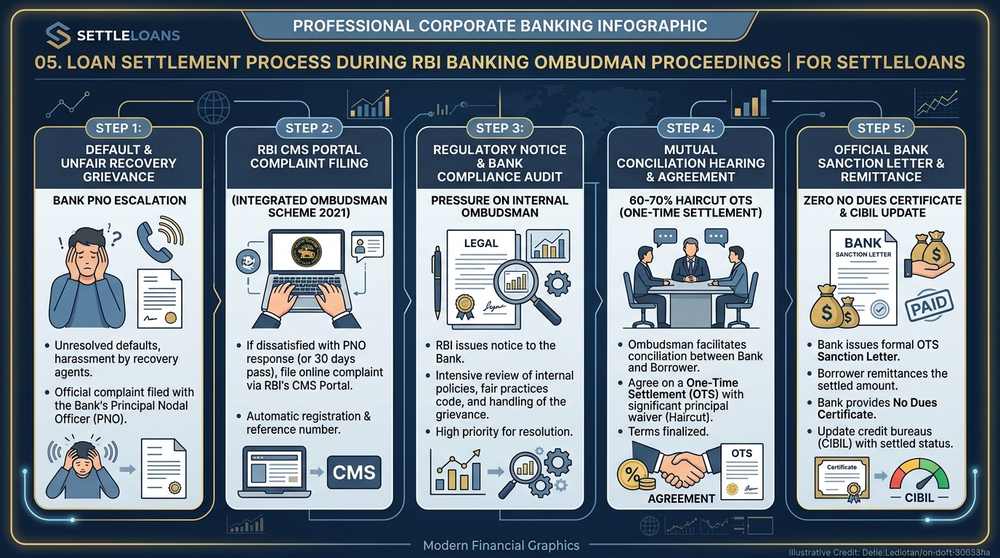
5. Banking Ombudsman Loan Settlement Visual Roadmap
The visual roadmap below details the five-stage institutional progression of settling a delinquent loan under the Reserve Bank - Integrated Ombudsman Scheme, from initial grievance logging to final credit score restoration:
6. Step-by-Step Conciliation & 60%–70% Haircut Talks
Achieving a 60% to 70% debt haircut requires structured negotiation rather than informal appeals. Professional debt resolution advocates guide borrowers through a disciplined four-phase conciliation roadmap:
Advocates serve a detailed legal representation to the Principal Nodal Officer, establishing verified hardship, disputing unlawful penal fees, and starting the mandatory 30-day clock.
The grievance is formally lodged on cms.rbi.org.in with verified evidence of medical distress, income loss, call recordings, and the unaddressed PNO petition.
The Ombudsman convenes conciliation sessions. Advocates present balance sheet provisioning analyses and cash settlement offers, negotiating deep principal haircuts with senior bank managers.
Terms are formalized into a binding conciliation agreement submitted to the Ombudsman, concluding proceedings under Clause 14 with full legal immunity.
Negotiating within a formal statutory forum ensures absolute procedural transparency, protecting the borrower from false promises, unauthorized verbal concessions, or rogue recovery agency interference.
7. Forensic Checklist for Ombudsman OTS Sanction Letters
Before disbursing settlement funds, borrowers must verify the One-Time Settlement sanction letter with forensic precision. Handing over money against informal emails or verbal assurances leaves the loan active and accumulating interest.
The sanction letter must feature registered zonal office details, corporate reference numbers, and signatures from an authorized Scale-IV/V officer.
Must explicitly enumerate your 16-digit account number, customer identification code, PAN, and confirm permanent facility revocation.
Terms must state that payment of the compromised sum constitutes full satisfaction, with all residual principal and charges permanently waived.
Mandates immediate release of account freezes and unconditional withdrawal of all pending civil or Section 138 NI Act proceedings.
Never remit funds to collection agency UPI codes or individual bank accounts. All settlement remittances must be paid directly into your verified bank loan account through RTGS, NEFT, or an Account Payee Demand Draft.
8. Settlement Remittance, ₹0 NDC & CIBIL Bureau Update
Remitting the settlement sum satisfies the compromised financial obligation, but full legal rehabilitation requires obtaining official closure documentation and updating credit information bureaus.
Under RBI Circular RBI/2023-24/60, lenders must deliver an official No Dues Certificate and update credit bureaus within 30 calendar days of receiving settlement remittance. Lenders failing to meet this deadline are statutorily liable to pay compensation of ₹5,000 per day of delay to the borrower.
Understanding credit bureau adjustments is essential for restoring financial standing:
- Settled Bureau Classification: Credit bureaus report the account status as 'Settled' or 'Post-Write-Off Settled' with outstanding balance updated to zero.
- Halting Default Compounding: A zero balance permanently halts monthly 90+ Days Past Due reporting, stopping ongoing credit score destruction.
- 12-Month Cooling Horizon: Regulated lenders observe a standard 12-month cooling period before assessing new unsecured credit applications.
- Systematic Score Rebuilding: Utilizing secured credit cards backed by fixed deposits and maintaining on-time repayments restores credit scores above 750 within 18 to 24 months.
9. Ombudsman Conciliation vs Other Resolution Pathways
Comparing Ombudsman conciliation with conventional debt resolution avenues highlights why regulatory proceedings provide unmatched leverage for severely distressed borrowers:
| Resolution Pathway | Governing Forum & Authority | Typical Haircut Range | Resolution Speed | Enforceability & Risk Profile |
|---|---|---|---|---|
| RBI Ombudsman Conciliation | RBI CMS Portal (Clause 14 RB-IOS 2021) | 60% – 70% Principal Haircut | 45 – 75 Days | Highest leverage; zero court fees; mandatory compliance oversight |
| National Lok Adalat Settlement | Legal Services Authorities Act, 1987 | 40% – 60% Principal Haircut | Single Session | Enforceable civil decree; limited supervisory pressure |
| Direct Bilateral Bank OTS | Local Branch / Stressed Asset Desk | 25% – 45% Principal Haircut | 60 – 120 Days | Subject to branch bureaucratic delays and agency pressure |
| Civil Court / DRT Litigation | Order 37 CPC / RDB Act Adjudication | 0% – 20% (Subject to decree) | 3 – 5 Years | Substantial legal expenses; compounding interest decrees |
While Lok Adalat resolves consensual disputes quickly, it lacks supervisory enforcement. Banking Ombudsman conciliation combines intense regulatory oversight on senior bank leadership with formal conciliation powers to unlock maximum lawful haircuts.
10. SettleLoans Legal Defense & Ombudsman Representation
Navigating Banking Ombudsman loan settlement requires experienced banking advocates who understand RBI CMS workflows, Principal Nodal Officer accountability, and credit committee compromise guidelines. SettleLoans represents stressed borrowers across India: serving formal statutory notices, assembling unassailable hardship dossiers, halting illegal recovery harassment, and securing 60% to 70% debt haircuts backed by authentic, bank-stamped No Dues Certificates.

Settle Loan is India's trusted debt relief and loan settlement platform. We help borrowers overcome financial distress by negotiating with banks and NBFCs to legally settle personal loans and credit card debts. With our transparent, performance-based approach, you can achieve debt freedom and regain your financial peace of mind.
COMPUTER
11. Frequently Asked Questions: RBI Ombudsman Settlement
Direct, legally verified answers to essential questions regarding loan settlement negotiations, regulatory conciliation, and borrower protections under the RBI Integrated Ombudsman Scheme.
Can I settle a loan during active RBI Ombudsman proceedings?
Yes. Clause 14 of the Integrated Ombudsman Scheme mandates the Ombudsman to facilitate conciliation and mutual settlement between borrowers and banks, transferring discussions to senior compliance teams to structure deep principal waivers.
How does a CMS complaint create leverage for a 60% to 70% haircut?
CMS complaints trigger direct oversight from the bank's Principal Nodal Officer and Internal Ombudsman. To avoid Section 47A penalties and adverse public awards, banks routinely grant substantial compromise haircuts to register mutual conciliation closures.
What mandatory step must happen before filing on the RBI CMS portal?
Borrowers must first submit a formal written grievance to the bank's internal redressal cell and Principal Nodal Officer. The Ombudsman assumes jurisdiction only if the complaint is rejected, unresolved, or unanswered after 30 days.
Which clauses of RB-IOS 2021 govern debt settlement conciliation?
Clause 10 covers grounds of complaint regarding service deficiencies, Clause 11 specifies online CMS filing procedures, and Clause 14 governs formal conciliation and mediation proceedings that result in binding settlement agreements.
Will filing an Ombudsman complaint stop recovery agent harassment immediately?
Yes. Registering a complaint on the CMS portal alerts executive compliance desks, prompting the Principal Nodal Officer to issue internal directives restraining outsourced agencies from calling or visiting during active proceedings.
What happens if a bank rejects reasonable conciliation proposals?
If conciliation under Clause 14 fails due to lender obstinacy, the Ombudsman adjudicates the dispute under Clause 15, holding authority to pass binding awards granting up to ₹20 lakhs compensation for financial injury.
What role does the bank's Internal Ombudsman play in debt settlement?
Under RBI rules, banks cannot reject consumer complaints without review by their independent Internal Ombudsman. The IO frequently advises credit committees to approve compromise settlements rather than defend flawed cases before the RBI.
Can a bank challenge an Ombudsman settlement agreement in civil court later?
No. A conciliation agreement signed under Clause 14 represents a binding compromise contract. Once executed and paid, the bank is legally barred from initiating recovery claims for the waived portion in any court.
What is the timeline for receiving a No Dues Certificate after settlement?
Under RBI Circular RBI/2023-24/60, lenders must deliver the official No Dues Certificate and update credit bureaus within 30 calendar days. Delays obligate the bank to pay statutory compensation of ₹5,000 per day to the borrower.