1. The Myth of the Public CIBIL Defaulter List: Legal
Every month, thousands of borrowers across India search anxiously for ways to check if their name appears on an alleged "CIBIL Defaulter List." This pervasive anxiety is often stoked by aggressive third-party recovery agents who unlawfully threaten borrowers that failing to pay an overdue personal loan or credit card bill will lead to their name being publicly published on a nationwide blacklist, ruining their social reputation and employment prospects.
The absolute legal reality under Indian financial law is straightforward: there is no such thing as a public CIBIL Defaulter List for individual retail borrowers. TransUnion CIBIL, along with India's other three RBI-licensed credit bureaus (Experian, Equifax, and CRIF High Mark), does not maintain, compile, or publish any public registry or social blacklist of individuals who have defaulted on loans.
Under the statutory mandate of the Credit Information Companies (Regulation) Act, 2005 (CICRA), credit bureaus function exclusively as private, regulated data repositories. Section 15 of CICRA imposes strict statutory confidentiality requirements on credit institutions and bureaus. Credit data cannot be made public, searched openly on internet search engines, or disclosed to unauthorized parties such as neighbors, prospective landlords, or unvetted private employers.
Credit Information Companies are legally prohibited from publishing individual retail credit records to the general public. Access to your Credit Information Report is restricted strictly to you and RBI-regulated member credit institutions after obtaining your explicit, traceable digital or written consent during an active credit underwriting process.
2. What CIBIL Actually Reports: Deciphering CIR Data, DPD & Asset Classification
Rather than classifying individuals into arbitrary "defaulter" categories, TransUnion CIBIL compiles an individualized, technical document known as a Credit Information Report (CIR). The CIR provides member financial institutions with an objective, historical audit trail of a borrower's credit accounts, sanctioned limits, outstanding balances, and monthly payment punctuality over a rolling 36-month period.
The cornerstone metric within any CIR is the Days Past Due (DPD) indicator. DPD captures the exact number of days a payment was delayed past its contractual due date for each credit facility month by month. When an underwriting system evaluates your profile, it reviews these numerical strings to gauge financial stability rather than checking a static blacklist.
Indian banking regulations established by the Reserve Bank of India govern how lenders classify credit assets based on these DPD metrics. When payments stall, the account transitions through specific asset quality tiers that directly govern bank provisioning norms and risk assessments:
RBI Asset Classification & CIBIL DPD Reporting Matrix
| Asset Classification | DPD Timeline | CIBIL Report Code | Impact on Future Credit Eligibility |
|---|---|---|---|
| Standard Asset | 0 Days (On-Time) | 000 / STD | Prime eligibility; competitive interest rates across all banks. |
| Special Mention Account (SMA-0) | 1 – 30 Days Overdue | 030 | Minor score drop; automated payment reminders and late fees. |
| Special Mention Account (SMA-1) | 31 – 60 Days Overdue | 060 | Moderate score reduction; credit line freezes and high-risk flags. |
| Special Mention Account (SMA-2) | 61 – 90 Days Overdue | 090 | Severe score deduction (50–90 pts); pre-NPA legal warning notices. |
| Non-Performing Asset (Sub-Standard) | 91 – 180 Days Overdue | SUB / 120–180 | Immediate loan rejection; formal legal demand notices initiated. |
| Doubtful / Loss Asset | 180+ Days Overdue | DBT / LSS / W-OFF | Severe credit impairment; lender provisions 100% loss or seeks OTS. |
Check Your Loan Settlement Options
Answer 2 quick questions to evaluate your settlement eligibility.
1. What type of loan do you want to settle?
3. RBI Wilful Defaulter List vs. Individual Retail Default: Critical Legal Distinctions
A primary source of confusion among borrowers is the difference between an ordinary retail loan default and the official RBI Wilful Defaulter and Suit-Filed List. The Reserve Bank of India, in coordination with the Central Repository of Information on Large Credits (CRILC) and Credit Information Companies, does publish periodic data regarding commercial entities and individuals categorized as wilful defaulters. However, the legal and financial parameters governing this list are fundamentally different from ordinary retail defaults.
Under the RBI Master Directives on Wilful Defaulters, an individual or business entity can only be declared a "Wilful Defaulter" if specific statutory conditions are proven through a rigorous quasi-judicial inquiry:
- The borrower possessed the verified financial capacity to meet repayment obligations but intentionally chose not to pay.
- The borrowed funds were diverted or siphoned off for purposes other than the specific sanctioned commercial objective.
- The borrower disposed of or transferred secured hypothecated assets or collateral without lender permission.
- The aggregate default exposure equals or exceeds the statutory threshold of ₹25 Lakhs (or ₹1 Crore for suit-filed commercial accounts).
If you are an individual retail borrower who missed monthly installments on a personal loan, credit card, or educational loan due to economic distress, involuntary unemployment, health emergencies, or business revenue loss, you cannot be classified as an RBI Wilful Defaulter. Honest financial insolvency is not a criminal act under Indian law, and your information remains strictly within confidential credit bureau records.
4. Step-by-Step Protocol: How to Check Your Official Credit Report for Free
If you wish to verify how lenders have reported your loan repayment history, you should obtain your authentic Credit Information Report directly from the authorized credit bureaus. Under RBI regulations, every consumer in India is entitled to receive one free full credit report per calendar year from each of the four licensed credit information companies.
To access your official CIBIL report safely without falling prey to unverified third-party phishing portals or predatory lead-generation websites, follow this verified regulatory protocol:
Navigate to the Official Bureau Portal
Visit the official TransUnion CIBIL website (cibil.com) and select "Get Your Free Annual CIBIL Score & Report."
Enter Identity Authentication Details
Provide your official full legal name, Permanent Account Number (PAN), date of birth, current residential address, and active mobile number registered with your banking accounts.
Complete Two-Factor OTP Verification
Authenticate your identity through the One-Time Password (OTP) dispatched to your Aadhaar/PAN-linked mobile number or answer credit verification security questions.
Download and Audit Your Full CIR
Download your comprehensive multi-page CIR PDF. Audit all four key sections: Personal Details, Contact Information, Account Information (DPD & Status), and Enquiries.
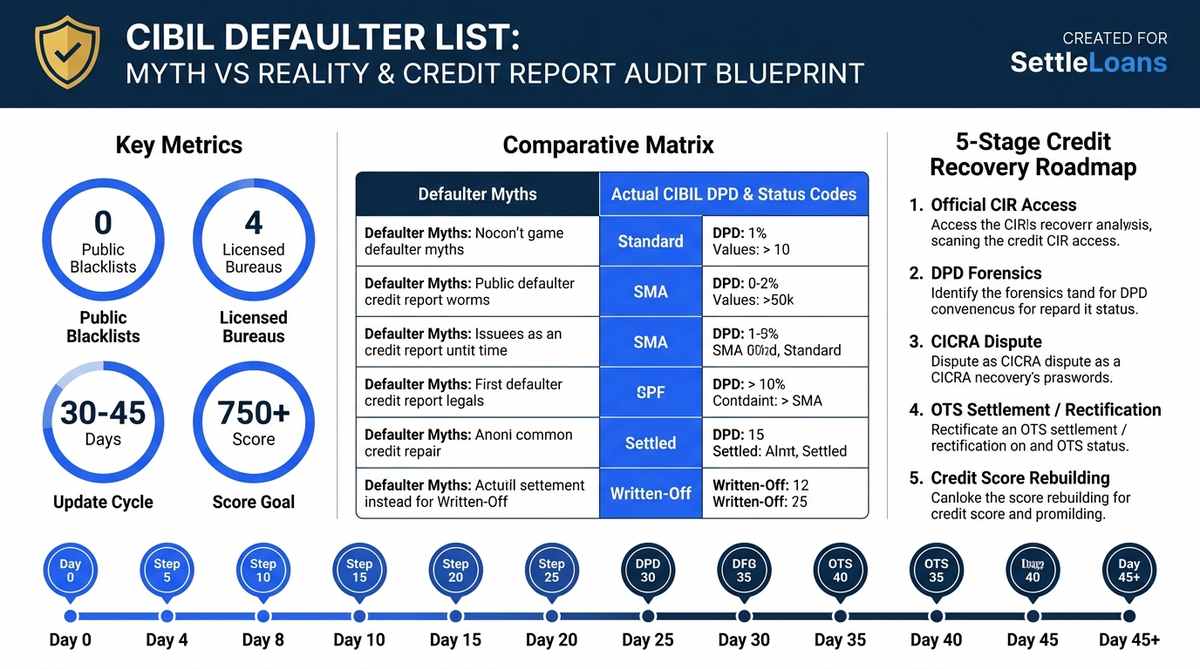
5. Decoding CIBIL Status Codes: Settled, Written-Off, SMA & Suit Filed
When reviewing your Credit Information Report, the most crucial analytical section is the "Account Information" tab. Each loan or credit card account displays a specific status remark reflecting the commercial resolution or ongoing status of that debt facility. Understanding these codes is essential for diagnosing the exact health of your profile:
| CIBIL Status Remark | Commercial & Legal Meaning | Legal Liability Status | Credit Score Recovery Strategy |
|---|---|---|---|
| Closed | Loan repaid 100% in full with all interest and fees. Zero financial loss to bank. | Zero liability. Account fully discharged. | Maintains positive scoring trajectory; baseline for prime 750+ score. |
| Settled | Bank accepted a discounted compromise lump sum (OTS) and waived residual dues. | Legally concluded. Bank cannot claim residual balance. | Rebuild with secured FD credit cards over 18–24 months or pay residual balance. |
| Written-Off | Bank provisioned debt as uncollectible for tax purposes after prolonged default. | Active liability. Bank retains legal recovery and litigation rights. | Negotiate a formal One-Time Settlement (OTS) or structured closure to stop claims. |
| Post-Write-Off Settled | Account was written off, but borrower subsequently negotiated an OTS settlement. | Legally concluded. Recovery actions terminated. | Score rebounds steadily as outstanding balance reflects ₹0. |
| Suit Filed / Wilful Defaulter | Bank initiated formal recovery litigation (DRT, Section 138 NI Act, or SARFAESI). | Active court litigation with judicial summons. | Immediate legal representation required to seek Lok Adalat or court compromise. |
6. Correcting Erroneous Entries: The CICRA 2005 Dispute Resolution Framework
In many instances, borrowers find themselves unfairly penalized by clerical mistakes, outdated data synchronization, or identity theft. Common errors include a fully closed loan continuing to display an active overdue balance, an incorrect DPD entry caused by banking server delays, or an unfamiliar credit card appearing due to PAN duplication.
Section 21 of the Credit Information Companies (Regulation) Act, 2005 provides a robust, legally enforceable dispute resolution mechanism designed to protect consumer rights. When an individual lodges a formal dispute with TransUnion CIBIL or any licensed bureau, the statutory procedure unfolds under strict timelines:
- Dispute Filing: Submit an online dispute via the CIBIL Dispute Resolution portal specifying the exact Account Number and disputed field (e.g., DPD string, Ownership, or Outstanding Balance).
- Bureau Verification: CIBIL logs a formal Dispute ID and transmits the verification notice directly to the Principal Nodal Officer of the reporting lending institution.
- Mandatory 30-Day Turnaround: Under RBI Master Directions, the lending institution must verify its internal records and respond with data confirmation or correction within 30 calendar days.
- Data Rectification: If the bank confirms the error or fails to validate the disputed entry within the statutory timeframe, CIBIL is legally required to expunge or update the record immediately.
- Ombudsman Escalation: If a bank refuses to rectify a demonstrable reporting mistake, the borrower can escalate the dispute to the RBI Banking Ombudsman under the Reserve Bank - Integrated Ombudsman Scheme, 2021, claiming compensation for credit reputation damage.
7. Resolving Genuine Overdue Debts: Strategic OTS Negotiation & Debt Relief
When loan defaults reflect genuine financial hardship rather than reporting errors, ignoring the problem causes severe compound damage. Unresolved default accounts accumulate contractual interest, penal charges, and late payment penalties, causing total dues to balloon rapidly. Simultaneously, continued non-payment can trigger legal notices under Section 138 of the Negotiable Instruments Act (for cheque bounce) or Section 25 of the Payment and Settlement Systems Act (for NACH/e-mandate default).
The most lawful, pragmatic route for distressed borrowers is to execute a structured One-Time Settlement (OTS) directly with the lending institution. Under RBI Compromise Settlement guidelines, banks and NBFCs possess board-approved policies allowing them to negotiate discounted lump-sum closures for non-performing loans, waiving accumulated penalties and a substantial portion of accrued interest based on Net Present Value (NPV) recovery assessments.
A legally sound settlement negotiated with advocate representation guarantees three indispensable protections: it caps total financial liability, permanently stops aggressive recovery agent harassment under RBI Fair Practices Codes, and ensures the issuance of a binding No Dues Certificate (NDC) confirming ₹0 outstanding balance across all credit bureaus.
8. The 18–24 Month Score Rebound Plan: Proven Steps to Restore 750+ CIBIL Score
Experiencing a loan settlement or past default does not permanently end your financial future. Credit scoring algorithms operate on mathematical models that assign exponential weight to recent repayment behavior while discounting historical delinquency over time. By executing a disciplined credit rebuilding protocol, borrowers can systematically elevate their CIBIL score from sub-600 levels back into the prime 750+ range within 18 to 24 months:
| Recovery Phase | Target Operational Milestones | Recommended Credit Instruments | Target Score Range |
|---|---|---|---|
| Month 1 – 3 | Obtain official NDC, verify ₹0 balance across all 4 bureaus, resolve lingering disputes. | ₹20,000 – ₹50,000 Secured FD Credit Card (e.g. IDFC WOW / Kotak 811) | 550 – 600 |
| Month 4 – 12 | Maintain Credit Utilization Ratio strictly below 25%; automate 100% on-time payments. | Secured Card + Utility Bill Autopayments | 630 – 690 |
| Month 13 – 18 | Introduce a small installment credit line to diversify credit mix; avoid hard inquiries. | Small Consumer Durable / 2-Wheeler Financed Loan | 700 – 745 |
| Month 19 – 24+ | Achieve prime borrower standing; qualify for standard unsecured credit cards & home loans. | Standard Unsecured Cards, Prime Auto/Mortgage Loans | 750 – 800+ (Prime) |
Rule 1: Keep Credit Utilization Ratio (CUR) Below 30%
If your secured credit card has a limit of ₹50,000, keep monthly spending capped under ₹15,000. High credit utilization signals financial distress and depresses score recovery.
Rule 2: Eliminate Multiple Hard Loan Inquiries
Do not submit speculative loan applications across multiple bank websites. Each hard bureau inquiry reduces your score by 5 to 10 points and flags credit desperation.
Rule 3: Convert "Settled" to "Closed" When Liquidity Permits
If your financial circumstances improve, you can approach your original lender, repay the waived OTS balance, and obtain an updated "Closed" status across all credit bureaus.

Settle Loan is India's trusted debt relief and loan settlement platform. We help borrowers overcome financial distress by negotiating with banks and NBFCs to legally settle personal loans and credit card debts. With our transparent, performance-based approach, you can achieve debt freedom and regain your financial peace of mind.
COMPUTER
9. Frequently Asked Questions (FAQ)
Authoritative answers to the most urgent legal, regulatory, and credit scoring questions regarding CIBIL default records in India.
No, TransUnion CIBIL does not publish any public defaulter list or blacklist. Under Section 15 of the Credit Information Companies (Regulation) Act, 2005 (CICRA), credit bureaus are strictly governed by statutory confidentiality mandates. CIBIL operates as a regulated information repository that generates individualized Credit Information Reports (CIR). These private records can only be accessed by the specific borrower or by RBI-registered credit institutions upon obtaining explicit borrower consent during a formal credit application. There is no open public registry where employers, neighbors, or relatives can search names.
To check whether a lender has reported an overdue payment or default status, you must pull your official Credit Information Report directly from cibil.com or any of the other three RBI-licensed bureaus (Experian, Equifax, or CRIF High Mark). Under RBI mandates, every citizen is entitled to one full free credit report per calendar year. Once authenticated via your PAN, mobile number, and date of birth, navigate to the "Accounts Information" section to review your Days Past Due (DPD) history and account status tags.
DPD stands for Days Past Due. It indicates the precise number of days a payment has been overdue past the agreed monthly installment due date over a rolling 36-month tracking window. A healthy report displays "000" or "STD" (Standard) across all months, indicating perfect compliance. Numerical entries such as "030", "060", or "090+" denote escalating delinquency, triggering Non-Performing Asset (NPA) classification and substantial credit score drops.
A retail default arises from genuine economic stress, job loss, business downturns, or medical emergencies, resulting in overdue DPD or a "Settled" status on a private credit report. In contrast, an RBI Wilful Defaulter is a specialized commercial classification defined by RBI Master Directions. It applies exclusively to entities or individuals with aggregate defaults of ₹25 Lakhs or more who deliberately siphoned borrowed funds or refused repayment despite having adequate financial means, following quasi-judicial review and formal legal suit filing.
No, individual credit reports are strictly confidential. Under CICRA 2005 data privacy rules, unauthorized third parties—such as landlords, neighbors, or unvetted private employers—cannot search or view your credit history. Only regulated credit institutions holding valid bureau memberships can access your CIR, and only when you submit an active application for credit and explicitly execute a digital consent authorization.
"Written-Off" represents an accounting decision where the lending bank, after 180+ days of unresolved default, removes the non-performing asset from its balance sheet to optimize tax provisions, while retaining all statutory legal recovery rights. "Settled" signifies a negotiated compromise where the borrower and lender formalize a One-Time Settlement (OTS), resulting in partial payment and the complete legal cessation of further claims upon issuance of a formal No Dues Certificate.
If your credit report contains inaccurate overdue amounts or wrongful default remarks, you can lodge an online dispute via the CIBIL Dispute Resolution Portal under Section 21 of CICRA 2005. The bureau is legally mandated to cross-verify the data with the reporting bank within 30 calendar days. If the lender acknowledges clerical error or fails to validate the claim within the statutory window, the credit bureau must immediately expunge or rectify the erroneous record.
Yes, you can upgrade your credit status from "Settled" or "Written-Off" to "Closed". When your liquidity improves, you can approach the Stressed Asset Resolution Branch of the original lending institution and offer to pay the residual waived balance. Once received, the bank will issue a Comprehensive No Dues Certificate and transmit an updated status of "Closed" to all four credit bureaus within 30 to 45 days, removing the negative compromise tag permanently.
Under Indian credit reporting practices governed by CICRA 2005, historical repayment records and adverse status tags are maintained for up to 7 years. However, credit scoring algorithms give maximum weight to recent financial behavior over the past 12 to 24 months. By adopting secured credit instruments, maintaining credit utilization below 30%, and eliminating hard inquiries, borrowers can successfully rebuild a prime credit score of 750+ well before the 7-year mark.
Official Regulatory Sources & Legal Authorities
- Reserve Bank of India (RBI) — Master Directives on Compromise Settlements & CRILC Reporting
- TransUnion CIBIL — Credit Information Companies (Regulation) Act, 2005 Compliance Portal
- Supreme Court of India — Judgments on Fair Debt Recovery & Borrower Privacy Protection
- Insolvency and Bankruptcy Board of India (IBBI) — Individual Debt Resolution Standards
- RBI Integrated Ombudsman Scheme — Consumer Credit Reporting Grievance Redressal Mechanism