A high-level synthesis of how SettleLoans converted a historical "Settled" loan remark to "Closed" and unlocked a ₹75 Lakh home loan approval:
Why Banks Reject Home Loans for Settled Accounts
Indian retail lenders evaluate credit eligibility across two dimensions: quantitative credit scoring and qualitative credit taxonomy. A borrower may raise their numerical CIBIL score above 740 through disciplined payments. However, automated underwriting engines of major mortgage lenders mandate an automatic rejection upon detecting negative account tags.
In retail banking credit risk policies, a "Settled" or "Written-Off" status represents a haircut where the lending institution surrendered contractually due capital. Mortgage underwriting committees operate under strict guidelines established by the Reserve Bank of India Master Directions on Retail Lending, which dictate that past institutional write-offs indicate heightened default probability. Consequently, automated mortgage sanction engines instantly reject applications containing unsettled or settled default tags within the preceding seven years, irrespective of current income stability or high asset net worth.
Borrowers frequently find themselves in an administrative impasse: local bank branch managers cannot override automated underwriting rejections because institutional credit engines require a completely clean bureau history. The only viable pathway to unlocking large-ticket secured credit facilities is to execute a formal post-settlement account upgrade that eradicates the loss tag at the institutional data source.
The CIBIL Status Taxonomy: "Closed" vs "Settled" vs "Written-Off"
Credit bureaus operate as statutory data repositories under the Credit Information Companies (Regulation) Act, 2005 (CICRA). They do not independently determine account status; rather, they reflect the precise data codes transmitted by member credit institutions through standard monthly SFTP batch feeds. Understanding the technical taxonomy of these reporting codes is essential for diagnosing why a settled loan obstructs future borrowing.
When an account is tagged as "Closed", the Core Banking System reports an Asset Classification code of Standard Asset with an Outstanding Balance of ₹0 and a Written-Off Amount of ₹0. This signifies that every single rupee of principal, regular interest, and charges was satisfied contractually, reflecting impeccable credit hygiene. In contrast, an account tagged as "Settled" reports an Outstanding Balance of ₹0 but records a substantial positive balance in the "Amount Written Off (Total)" and "Amount Written Off (Principal)" data fields.
When an account remains tagged as "Written-Off", the lender has transferred the defaulted balance to off-balance-sheet non-accrual ledgers without receiving compromise funds, maintaining an ongoing overdue status. Converting a record from "Settled" to "Closed" requires compelling the bank to update both the account status flag and clear the historical Written-Off amount fields to zero.
Check Your Loan Settlement Options
Answer 2 quick questions to evaluate your settlement eligibility.
1. What type of loan do you want to settle?
Client Profile & Financial Breakdown: The ₹12L Personal Loan Case
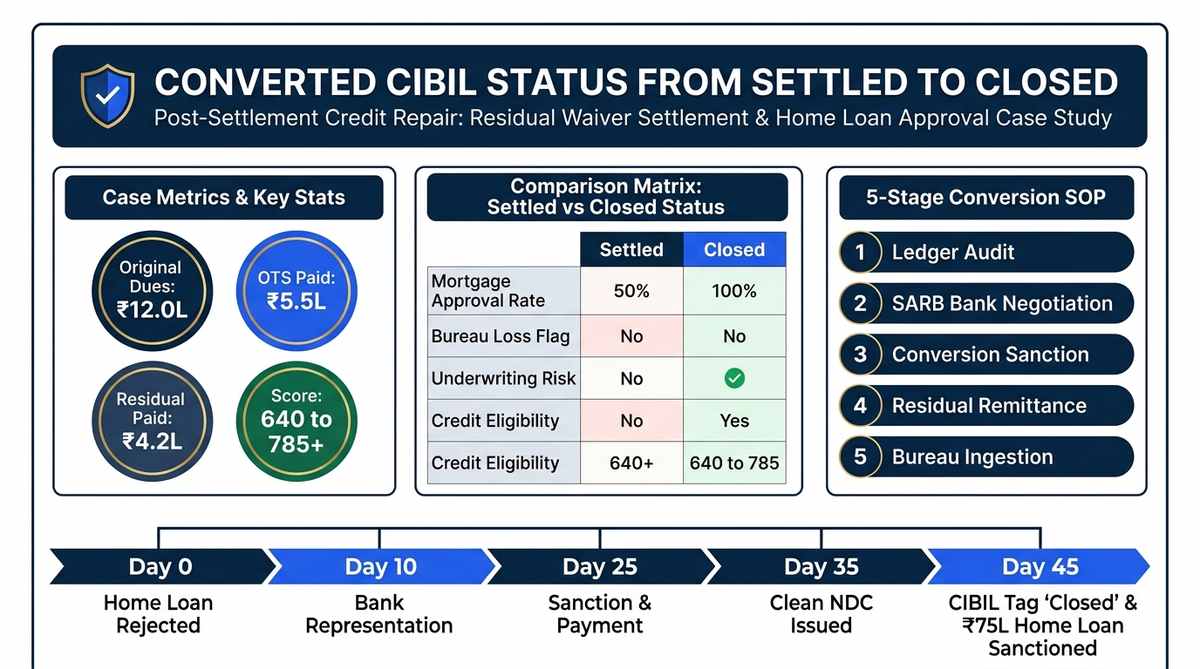
In July 2024, our client Anirudh Sharma applied for a ₹75 Lakh home loan through a leading public sector bank. He was a senior software architect earning ₹22 Lakhs annually. Despite zero active defaults, low debt-to-income ratio, and a 742 CIBIL score, his application was rejected during centralized credit processing.
The credit appraisal report cited a historical personal loan with HDFC Bank that was settled two years prior during a period of unexpected medical distress. In the original 2022 settlement, the claimed total dues stood at ₹12,00,000 (comprising ₹8,50,000 principal and ₹3,50,000 in accrued interest and penalties). The client had negotiated an OTS of ₹5,50,000, receiving a waiver of ₹6,50,000. While the bank issued an initial settlement letter and marked the account balance as zero, the CIBIL report reflected a "Settled" tag with a recorded written-off principal loss of ₹3,00,000 and interest loss of ₹3,50,000.
Financial Ledger Forensics & Status Upgrade Math
| Financial Component | Original 2022 OTS Terms | Claimed Dues at Reopening | SettleLoans Negotiated Terms |
|---|---|---|---|
| Total Claimed Outstanding | ₹12,00,000 | ₹6,50,000 (Residual Waiver) | ₹4,20,000 (Pure Principal) |
| Principal Component | ₹8,50,000 | ₹3,00,000 (Unpaid Balance) | ₹3,00,000 (100% Satisfied) |
| Accrued Penalties & Interest | ₹3,50,000 | ₹3,50,000 (Compound Interest) | ₹1,20,000 (Waiver of ₹2.3L Penalties) |
| Total Borrower Outflow | ₹5,50,000 (Initial OTS) | ₹6,50,000 (Full Bank Demand) | ₹4,20,000 (Residual Settlement) |
| Final CIBIL Account Tag | Settled (Mortgage Blocked) | Disputed Default | Closed (Zero Dues / Loss ₹0) |
When the client independently approached his local bank branch to pay the residual amount, branch personnel stated that settled accounts could not be reopened under standard retail workflows. Recognizing that institutional intervention was necessary, the client engaged SettleLoans to execute a formal legal representation with the bank's centralized Stressed Assets Resolution Branch and Credit Committee.
Visual Blueprint: The 5-Stage "Settled to Closed" Conversion Roadmap
The infographic below illustrates the workflow deployed by SettleLoans. We audit historical loan ledgers and negotiate residual waiver payments with credit committees. We then obtain stamped conversion sanctions and enforce out-of-cycle credit bureau updates under RBI guidelines.
Strategic Comparison: Status Upgrade vs Alternative Credit Repair Methods
When facing a credit block due to a settled account, borrowers have several options. They can wait out the seven-year bureau purge cycle, use secured cards, or execute a structured residual conversion. The comparative analysis below shows why direct institutional conversion remains the only definitive solution for mortgage approvals.
Credit Repair Methodology Matrix
| Credit Repair Strategy | Home Loan Feasibility | Timeframe Required | Capital Investment | Bureau Status Outcome |
|---|---|---|---|---|
| Residual Status Upgrade | Immediate (100% Eligible) | 30 to 45 Days | Residual Principal Only | Converted to "Closed" |
| Secured Card Rebuilding | Zero (Underwriting Block) | 24 to 36 Months | FD Collateral (₹50k - ₹2L) | Remains Tagged "Settled" |
| Passive Aging / Waiting | Zero for 7 Years | 7 Full Years | Zero Outflow | Historical Loss Retained |
| Bureau Dispute Raising | Zero (Bank Validates) | 30 Days (Rejected) | Zero Outflow | Confirmed as "Settled" |
While secured credit cards help improve your numerical credit score, they cannot remove the qualitative "Settled" flag. Mortgage underwriting systems evaluate both the numerical score and individual account remarks. Direct institutional status conversion resolves both requirements simultaneously.
The 5-Stage SOP: How SettleLoans Upgraded CIBIL Status to "Closed"
Converting a settled loan record requires navigating bank credit committee hierarchies, stressed asset accounting protocols, and credit bureau data pipelines. SettleLoans executes this procedure through five disciplined stages.
Our legal team reviewed the original One-Time Settlement sanction letter, bank payment vouchers, and comprehensive Credit Information Reports across all four bureaus. We reconstructed the historical loan ledger to isolate the unrecovered principal from unearned compound interest, late payment levies, and GST charges added after loan default.
Local branches lack the authority to reopen settled files. SettleLoans submitted a formal legal representation directly to the National Stressed Assets Resolution Branch and the Principal Nodal Officer of the bank. We proposed a structured residual repayment covering 100% of the waived principal while demanding a complete waiver of penal charges in exchange for a full account status upgrade.
The bank's Retail Credit Committee approved the proposal and issued a stamped "Settled to Closed Conversion Sanction Letter". This document explicitly guaranteed that upon receipt of ₹4,20,000, the bank would extinguish all residual claims, update its Core Banking System records to "Standard Closed", and transmit corrected data files to all credit bureaus.
Payment was remitted directly to the bank's centralized collection clearing account with exact reference to the conversion sanction terms. Within seven business days, the bank issued an unconditional, official No Dues Certificate declaring the account "Closed in Full with Zero Outstanding Balance and Zero Loss".
Rather than waiting for the standard 45-day monthly reporting cycle, SettleLoans ensured the bank transmitted an out-of-cycle SFTP correction file to TransUnion CIBIL, Experian, Equifax, and CRIF High Mark. We also lodged a high-priority dispute on the CIBIL portal referencing the new NDC, securing a clean "Closed" status reflection within 21 calendar days.
Core Banking Accounting & Out-of-Cycle SFTP Ingestion
Post-settlement credit repair often fails without legal oversight due to disconnects between branch accounting and bureau reporting systems. When an OTS is approved, core banking systems (like Finacle or BaNCS) record the waived amount as an institutional loss under Master Circular guidelines.
When a borrower pays residual funds at a branch without an authorized conversion sanction, teller personnel frequently credit the payment to general suspense ledgers without reversing the loss write-off entries in the core system. Consequently, subsequent automated SFTP data feeds continue transmitting the historical "Settled" status code to credit information companies month after month.
SettleLoans resolves this hurdle by requiring the bank's Centralized Operations to execute a ledger reclassification. This reverses the write-off entry and updates the asset code to "Standard Account Closed (00)". It sets written-off amounts to zero and transmits a Correction Record through the bureau gateway under Section 21 of CICRA 2005.
Specialized Real-World Post-Settlement Scenarios
Post-settlement credit repair varies significantly depending on the nature of the defaulted credit facility, the lending institution's institutional policy, and the specific underwriting requirements of the prospective loan.
Settled Credit Card with 42% APR Penalties
Credit card settlements frequently involve large write-offs of finance charges. SettleLoans isolates genuine transaction principal from compounding interest charges, enabling borrowers to upgrade the status at a fraction of the original claimed waiver.
Joint Home Loan Mortgage Applications
When a co-applicant holds a settled personal loan, primary home loan sanctions are immediately declined. Executing an expedited 30-day status upgrade on the co-applicant's record restores joint borrowing eligibility.
Multiple Settled Accounts Across Lenders
Borrowers with multiple settled accounts must sequence residual negotiations strategically, prioritizing private bank cards and high-exposure personal loans that trigger hard underwriting declines.
ARC Assigned Settled Accounts
When written-off loans have been assigned to Asset Reconstruction Companies, SettleLoans coordinates bilateral closures between the originating bank and the ARC to ensure complete bureau record reconciliation.

Settle Loan is India's trusted debt relief and loan settlement platform. We help borrowers overcome financial distress by negotiating with banks and NBFCs to legally settle personal loans and credit card debts. With our transparent, performance-based approach, you can achieve debt freedom and regain your financial peace of mind.
COMPUTER
Frequently Asked Questions on Converting CIBIL Status to Closed
Below are authoritative legal and financial answers regarding the post-settlement residual payment process, CIBIL status conversions, and mortgage loan eligibility in India.
Yes. A borrower can legitimately convert a 'Settled' loan remark to 'Closed'. You must approach the original lending bank and negotiate to pay the residual principal waiver amount. Once paid, obtain a formal conversion sanction letter and an updated No Dues Certificate.
Underwriting algorithms and mortgage credit committees treat a 'Settled' tag as an indicator of past financial loss and unrecovered credit. Even with a high numerical CIBIL score, institutional credit policies strictly prohibit mortgage sanctions until the past default loss is fully resolved.
You are typically required to pay the principal balance that was waived off during the original settlement. SettleLoans negotiates with the bank's credit committee to waive accrued compound penal interest, late fees, and legal charges, minimizing the total cash outflow.
'Closed' indicates that 100% of the loan obligations were satisfied in full without any financial loss to the lender. 'Settled' indicates that the bank accepted a compromise payment and wrote off a portion of the dues as an institutional loss.
The end-to-end process typically takes between 30 and 45 calendar days. This includes 10 to 15 days for bank credit committee approval and sanction letter issuance, followed by 15 to 30 days for out-of-cycle SFTP bureau transmission and CIBIL report reflection.
Yes. When the bank updates the account from 'Settled' to 'Closed' with zero overdue amounts, negative underwriting flags are removed. This typically drives an immediate 40 to 80 point score improvement and restores full mortgage eligibility.
You must secure an official Bank Conversion Sanction Letter approving the residual settlement, a payment acknowledgment receipt, and a comprehensive, unconditional No Dues Certificate confirming full closure with zero balance.
Yes. SettleLoans conducts a forensic audit of the loan ledger. We separate compounding penal interest, late fees, and GST from pure residual principal. We then negotiate directly with bank authorities to settle only the legitimate balance principal.
Branch staff often lack the administrative authority to modify historical settlement records. SettleLoans escalates the case directly to the Bank's Stressed Assets Division, National Asset Operations, and Principal Nodal Officer to secure executive approval.
Under Section 21 of CICRA 2005 and RBI Master Direction RBI/2023-24/72, credit institutions must transmit corrected account data to all four credit bureaus within 30 calendar days. Delays beyond 30 days entitle the consumer to statutory compensation of ₹100 per day.