1. The Anatomy of Erroneous CIBIL Entries: Why Inaccuracies Happen
A sudden and unexplained plunge in your credit score often traces back to inaccurate, outdated, or outright fraudulent data entries in your Credit Information Report (CIR). In the modern Indian lending ecosystem, credit decisions are heavily automated. When an erroneous overdue tag or a phantom loan appears against your Permanent Account Number (PAN), retail automated underwriting algorithms instantly flag your file as high risk, triggering immediate loan rejections, credit limit reductions, and exorbitant interest rate penalties.
These discrepancies rarely stem from intentional malice by credit bureaus. Under the statutory framework of the Credit Information Companies (Regulation) Act, 2005 (CICRA), TransUnion CIBIL, Experian, Equifax, and CRIF High Mark operate strictly as specialized data repositories. They do not generate raw account histories independently; rather, they passively ingest structured monthly data feeds transmitted by over 4,000 member credit institutions, including public sector banks, private banks, NBFCs, and housing finance companies.
The core breakdowns occur at the institutional reporting layer. Banks transmit vast batches of loan records via secure File Transfer Protocol (SFTP) data pipelines every 30 to 45 days. When a Core Banking System (CBS) experiences synchronization glitches, when branch personnel fail to flag a loan as closed upon receipt of full settlement, or when optical character recognition (OCR) systems misread alphanumeric PAN characters, erroneous default records are etched onto the borrower's credit profile. Understanding the technical mechanics behind these reporting failures is the first step toward demanding full regulatory rectification.
Section 21 of the Credit Information Companies (Regulation) Act, 2005 guarantees every borrower the statutory right to dispute inaccurate, incomplete, or misleading credit information. Credit institutions and bureaus are legally mandated to investigate and rectify substantiated data errors without imposing administrative charges on the consumer.
2. The Four Major CIBIL Dispute Categories
Before initiating a formal dispute with TransUnion CIBIL, you must accurately categorize the nature of the reporting defect. Classifying the error correctly within CIBIL's automated intake portal determines whether the inquiry is routed to the originating lender's reconciliation team or flagged for specialized identity fraud investigation. In practice, retail reporting inaccuracies fall into four distinct operational classifications.
The most frequent error is the Paid Loan Showing Active Overdue category, where a borrower has fully cleared their personal loan, auto loan, or credit card, yet the lender continues to report an ongoing outstanding balance and escalating Days Past Due (DPD) strings. The second classification involves Inaccurate DPD Strings & Overdue Amounts, where minor billing disputes or clerical posting delays result in severe 30-day, 60-day, or 90-day delinquency marks despite timely repayments.
The third category comprises Fraudulent Loan Accounts & Synthetic PAN Misuse, where digital lending apps or unscrupulous fintech intermediaries sanction credit facilities to unauthorized third parties using compromised KYC credentials. Finally, the fourth category encompasses Status Code Mismatches on Settled Accounts, where a loan legitimately resolved through an authorized One-Time Settlement (OTS) is improperly coded on the credit report as an active default or uncompromised "Written-Off" asset with an inflated residual overdue balance.
CIBIL Error Classification & Evidence Matrix
| Dispute Category | Underlying Root Cause | Typical Score Damage | Required Evidentiary Documents |
|---|---|---|---|
| Paid Loan Reflecting Overdue | CBS batch transmission failure; missing branch closure flag. | 50 – 100 Points | Bank No Dues Certificate (NDC), final loan statement, closure receipt. |
| Wrong DPD / Delinquency String | Clerical posting delay; technical payment gateway mismatch. | 30 – 80 Points | Bank account passbook/statement showing timely NEFT/UPI/NACH debits. |
| Fraudulent PAN Identity Theft | Fintech KYC breach; synthetic identity cloning on instant apps. | 80 – 140 Points | Cyber Crime Portal complaint receipt/FIR, identity affidavit, PAN copy. |
| Settled Account Tagged Written-Off | Lender failed to transmit compromise agreement codes under OTS. | 40 – 90 Points | Official Bank OTS Sanction Letter, settlement payment receipts, NDC. |
Check Your Loan Settlement Options
Answer 2 quick questions to evaluate your settlement eligibility.
1. What type of loan do you want to settle?
3. Statutory Framework: CICRA 2005 & Mandatory ₹100/Day RBI Delay Compensation
For years, retail borrowers faced immense frustration when attempting to correct erroneous credit records, often encountering endless administrative finger-pointing between unresponsive bank grievance desks and credit bureaus. To eliminate this operational deadlock, the Reserve Bank of India enacted strict regulatory reforms through comprehensive Master Directions and circular RBI/2023-24/72, fundamentally shifting the balance of power in favor of the consumer.
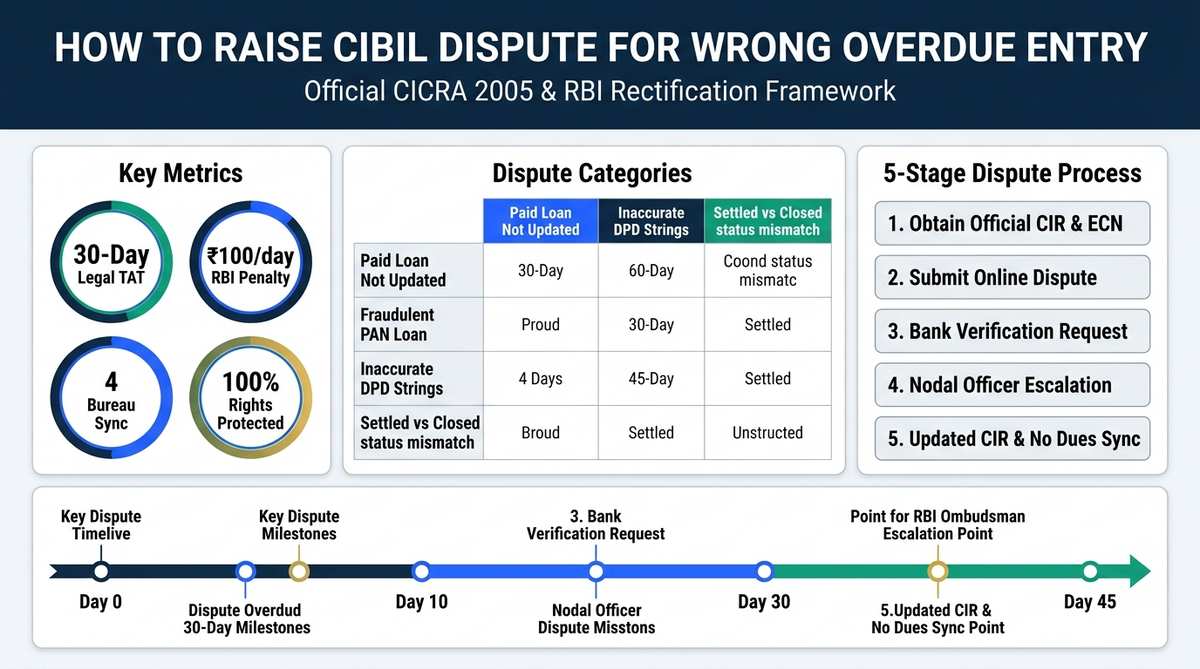
Under the revised framework, a strict statutory 30-calendar-day Turnaround Time (TAT) governs the resolution of all credit reporting disputes. When a borrower logs an official dispute through TransUnion CIBIL, the bureau is mandated to forward the complaint to the concerned credit institution within 7 calendar days. The lending institution is then legally required to investigate its Core Banking records, formulate an official response, and transmit updated data back to the bureau within 21 calendar days, ensuring complete closure within the 30-day window.
To enforce compliance, the RBI introduced a stringent monetary penalty: if a bank, NBFC, or credit information company fails to resolve a credit report dispute or update an erroneous overdue mark within 30 calendar days of receipt, the defaulting entity must pay the complainant direct compensation of ₹100 per calendar day of delay. This statutory penalty accrues automatically until the data is fully rectified in the bureau database.
Borrowers are legally entitled to compensation if their credit report discrepancy is not resolved within 30 days. The compensation of ₹100 per day must be credited directly to the complainant's bank account within 5 working days of resolving the overdue dispute, providing powerful legal leverage against institutional delays.
4. Step-by-Step Procedural Guide: Filing an Official Online CIBIL Dispute
Executing a formal dispute through TransUnion CIBIL requires meticulous adherence to standard procedural protocols. Initiating an informal customer support phone call or sending an unformatted email to generic support desks will not trigger the statutory 30-day CICRA clock. You must execute the dispute through CIBIL's regulated dispute intake portal using a verified report timestamp.
The essential prerequisite is obtaining your official Credit Information Report (CIR) directly from cibil.com. Every official CIR contains a unique 9-digit Enquiry Control Number (ECN) prominently displayed at the top right of the document. The ECN represents an immutable cryptographic snapshot of your credit profile at that exact moment, enabling CIBIL's dispute intake engine to locate the precise account records and overdue entries you intend to challenge.
Once logged into the CIBIL Consumer Dispute Center, navigate to the "Dispute an Item" section. Select the specific account tab (such as Loan Accounts or Credit Cards), pinpoint the flawed data field (such as Current Balance, Amount Overdue, or Payment History), and specify whether you are lodging an Account Detail Dispute or an Ownership Dispute. Upon final submission, the system generates an official 10-digit Dispute ID, which serves as your evidentiary reference for tracking turnaround milestones and claiming statutory delay compensation if required.
5. Resolving Paid Loans Marked Overdue: The No Dues Certificate (NDC) Protocol
Among the most damaging clerical errors on a credit file is a fully cleared loan that remains marked as active, delinquent, or overdue. When a borrower completes their loan tenure or repays their outstanding dues in full, the lending bank's operations department is required to update its internal Core Banking System ledger to zero and generate a formal No Dues Certificate (NDC) or No Objection Certificate (NOC).
However, if the system operator neglects to mark the internal closure flag or if the automated monthly batch data export encounters a formatting failure, the reporting engine continues to transmit the old balance month after month. Because no further monthly payments are recorded, CIBIL's algorithmic parser registers the account as severely delinquent, accumulating catastrophic 90-day or 180-day DPD tags that devastate the borrower's score.
To rectify this administrative breakdown, the borrower must submit a formal dispute accompanied by the official, stamped NDC issued by the bank. Armed with the NDC, you can demand an immediate out-of-cycle inter-institutional data upload from the bank's central credit reporting division, forcing the lender to instruct TransUnion CIBIL to convert the account status to "Closed" and wipe out all erroneous overdue balances.
6. Handling Fraudulent Loans & Identity Theft on Your PAN
The rapid expansion of instant personal loan mobile applications and digital point-of-sale financing has triggered an alarming surge in synthetic identity theft across India. Cybercriminals frequently exploit leaked PAN card copies and forged Aadhaar documents to secure instant unsecured credit from digital NBFCs. Because the real victim is unaware of the transaction, no repayments are made, and the fraudulent loan eventually descends into sub-standard asset status, severely harming the victim's credit score.
Resolving identity fraud requires a rigorous two-pronged legal and technical approach. First, you must immediately report the unauthorized transaction on the Government of India's National Cyber Crime Reporting Portal at cybercrime.gov.in or file a formal complaint at your local cyber police station to generate an official Cyber Crime Acknowledgment or First Information Report (FIR) under Sections 66C and 66D of the Information Technology Act, 2000.
Second, lodge an Ownership Dispute on the CIBIL portal, explicitly stating that the account was fraudulently opened without your authorization, knowledge, or disbursement receipt. Transmit the cyber complaint acknowledgment, a sworn identity affidavit, and a demand for immediate delinking to the Principal Nodal Officer of the disbursing NBFC. Upon forensic verification that the disbursement bank account did not belong to you, the lender is legally required to instruct CIBIL to permanently expunge the fraudulent account from your CIR.
7. Settled vs. Written-Off vs. Closed: Correcting Status Code Mismatches
A critical area of credit confusion occurs when borrowers resolve an overdue credit facility through a formal One-Time Settlement (OTS). When an OTS agreement is executed, the borrower and bank mutually agree on a compromised settlement figure that clears the debt in full. Upon payment of the agreed settlement sum, the borrower is legally discharged from all further financial liabilities, and the lender issues a final No Dues Certificate.
However, severe credit reporting errors frequently occur during the post-settlement batch reporting phase. Banks often mistakenly report the account as "Written-Off" or "Suit Filed" while continuing to display the waived balance as an active "Amount Overdue." In regulatory accounting terms, this reporting is legally flawed: once a formal compromise settlement is concluded, the remaining balance is extinguished by mutual consent and cannot be reported as an ongoing delinquent default.
If your settled loan displays an active overdue balance, you must lodge a Section 21 dispute presenting the signed Bank OTS Sanction Letter and payment proofs. Demand that the lender update the credit record to reflect an Amount Overdue of ₹0 with the accurate status tag of "Settled" or "Post-Settlement Closed". Furthermore, if you subsequently choose to pay the residual waived balance, the lender is obligated to convert the status from "Settled" to fully "Closed."
8. Turnaround Times & Multi-Bureau Synchronization Across India
A common misconception among borrowers is assuming that successfully rectifying an error on TransUnion CIBIL automatically updates their credit profile across all other credit rating agencies. In India, four separate credit information companies operate under independent RBI licenses: TransUnion CIBIL, Experian India, Equifax, and CRIF High Mark.
Although RBI regulations mandate that member lending institutions broadcast batch updates synchronously across all four licensed bureaus, institutional data pipelines frequently experience staggered ingestion schedules. A bank may successfully update an overdue entry on CIBIL within 20 days, yet neglect to transmit the matching correction file to Experian or Equifax for several months.
To prevent unexpected credit rejections from institutional lenders that rely on alternative bureau scores, borrowers should pull their official reports from all four bureaus simultaneously. Whenever an erroneous entry is identified, lodge parallel dispute requests directly across each bureau's official consumer dispute interface, ensuring complete synchronization and comprehensive score restoration.
9. Three-Tier Escalation Matrix: Bank Nodal Officers to RBI Ombudsman
When frontline customer support channels fail to resolve an obvious reporting discrepancy within the mandatory 30-day statutory window, borrowers must activate the formal regulatory escalation matrix established by the Reserve Bank of India. Proceeding systematically through these administrative tiers ensures that your grievance receives senior executive oversight and creates a legally enforceable paper trail.
Regulatory Escalation Hierarchy & Enforcement Authority
| Escalation Level | Target Authority | Statutory Turnaround Window | Enforcement Remedy & Powers |
|---|---|---|---|
| Level 1: Primary Dispute | CIBIL Dispute Center & Bank Customer Service Desk | 1 – 30 Calendar Days | Automated electronic verification request; basic CBS ledger audit. |
| Level 2: Grievance Escalation | Bank Principal Nodal Officer (PNO) / Internal Ombudsman | 7 – 15 Working Days | Direct executive review; authority to order out-of-cycle SFTP bureau updates. |
| Level 3: Statutory Redressal | RBI Integrated Ombudsman (CMS Portal - cms.rbi.org.in) | 30 Calendar Days | Legally binding awards; enforcement of ₹100/day compensation and damages. |
If the lending institution fails to rectify the error after escalation to the Principal Nodal Officer, you should immediately file a formal complaint under the Reserve Bank - Integrated Ombudsman Scheme, 2021 via the online Complaint Management System (CMS) at cms.rbi.org.in. The RBI Ombudsman possesses quasi-judicial powers to issue binding directives against defaulting banks, enforce immediate credit report corrections, and award statutory delay compensation alongside damages for mental harassment.
10. Post-Rectification Credit Score Reconstruction Blueprint
Once TransUnion CIBIL concludes the dispute investigation and updates the erroneous overdue entry to "Closed" or "Zero Overdue," your credit score will begin an immediate upward trajectory. However, fully restoring your score to prime territory (750+) requires deliberate financial management over the subsequent 6 to 12 months.
Begin by requesting a fresh, updated Credit Information Report to verify that all previous DPD delinquency flags have been completely replaced with "000" or "STD" (Standard) indicators and that the total outstanding balance accurately reflects zero. Keep digital copies of your Dispute Resolution Letter and updated CIR readily accessible whenever applying for future credit facilities.
To accelerate credit score recovery, adopt strict credit hygiene practices: maintain your Credit Utilization Ratio (CUR) strictly below 30% across all active revolving lines, avoid submitting multiple speculative loan applications that generate hard inquiries, and establish a consistent history of on-time payments through a secured credit card backed by a fixed deposit. Over a 12-month period, these disciplined financial actions will firmly establish your credit profile as prime, unlocking the best interest rates across Indian banks.

Settle Loan is India's trusted debt relief and loan settlement platform. We help borrowers overcome financial distress by negotiating with banks and NBFCs to legally settle personal loans and credit card debts. With our transparent, performance-based approach, you can achieve debt freedom and regain your financial peace of mind.
COMPUTER
11. Frequently Asked Questions (FAQ)
Authoritative answers to the most common procedural, technical, and regulatory questions regarding CIBIL dispute resolution in India.
To lodge an official dispute, authenticate into the TransUnion CIBIL consumer portal using the unique 9-digit Enquiry Control Number (ECN) printed on your latest Credit Information Report (CIR). Navigate to Dispute Center > Dispute an Item, locate the specific loan or credit card facility exhibiting the erroneous overdue amount or incorrect Days Past Due (DPD) string, specify the discrepancy category, and submit the request. CIBIL generates an automated 10-digit Dispute ID and formally transmits an electronic verification demand to the lending bank under Section 21 of the Credit Information Companies (Regulation) Act, 2005.
Under statutory directives established by the Reserve Bank of India and CICRA 2005, credit institutions and credit bureaus are legally mandated to complete the end-to-end investigation and dispute resolution process within a strict 30-calendar-day Turnaround Time (TAT). If the reporting credit institution confirms the administrative error or fails to validate the challenged balance within this window, CIBIL is legally bound to expunge or rectify the inaccurate overdue entry immediately.
Under RBI Master Circular RBI/2023-24/72, if a commercial bank, NBFC, or credit information company fails to resolve an official credit reporting grievance or update an erroneous overdue mark within 30 calendar days of dispute registration, the defaulting institution is legally liable to pay direct compensation of ₹100 per calendar day of delay to the aggrieved borrower.
Lenders submit borrower repayment records to credit bureaus through periodic monthly batch files via SFTP data pipelines. Delays and errors typically stem from Core Banking System (CBS) batch reconciliation failures, technical mismatch in loan account identifiers, or branch-level administrative omissions following loan closure. Submitting your official Bank No Dues Certificate (NDC) through a formal bureau dispute triggers an urgent out-of-cycle inter-institutional reconciliation.
If an unauthorized or synthetic identity loan appears under your PAN, immediately file a formal cybercrime report on the National Cyber Crime Reporting Portal (cybercrime.gov.in) to obtain a verified acknowledgment receipt or FIR. Next, initiate an Ownership Dispute on the CIBIL portal marking the facility as fraudulent, and serve a formal legal grievance accompanied by the cyber complaint to the Principal Nodal Officer of the issuing lender demanding immediate delinking of the account.
No. TransUnion CIBIL operates strictly as a data repository and does not possess statutory authority under CICRA 2005 to unilaterally alter or expunge substantive financial records without written confirmation from the member lending bank that originated the entry. However, if the bank fails to substantiate the reported balance within the mandatory 30-day window, CIBIL will expunge the contested default entry.
The Enquiry Control Number (ECN) is an authentic 9-digit alphanumeric tracking code generated whenever a credit report is pulled from TransUnion CIBIL. It serves as an immutable point-in-time cryptographic snapshot of your credit profile, allowing CIBIL's automated dispute routing engine to pin down the exact account records and data fields being challenged.
If the lending institution wrongfully rejects your dispute despite valid documentation (such as a stamped No Dues Certificate or complete bank statements), escalate the complaint directly to the bank's Principal Nodal Officer (PNO). If the PNO fails to resolve the grievance within 30 days, lodge a formal dispute before the RBI Integrated Ombudsman through the CMS portal (cms.rbi.org.in) for deficiency in credit reporting services.
No. India's four RBI-licensed credit bureaus operate entirely independent databases. While member banks are legally obligated to broadcast batch corrections across all four bureaus, discrepancies frequently persist due to staggered reporting schedules. Borrowers must lodge independent dispute filings across Experian, Equifax, and CRIF High Mark to guarantee universal score restoration.
Official Regulatory Sources & Legal Authorities
- Reserve Bank of India (RBI) — Master Directions on Credit Information Companies & TAT Rules
- TransUnion CIBIL — Official Consumer Dispute Resolution & Grievance Portal
- RBI Integrated Ombudsman Scheme — Complaint Management System (CMS Portal)
- National Cyber Crime Reporting Portal — Identity Theft & Loan Fraud Grievance Redressal
- Supreme Court of India — Landmark Rulings on Fair Debt Recovery & Credit Privacy