- Statutory Level-3 Authority: The Principal Nodal Officer is a senior bank leader under RBI rules. They investigate complaints independently and enforce customer protection guidelines.
- Immediate Stop on Collection Calls: Filing a complaint backed by proof forces the bank to act. The PNO can halt recovery calls and stop home visits right away.
- Mandatory Review by Internal Ombudsman: Banks cannot reject your complaint on their own. Under RBI rules, an independent Internal Ombudsman must review every rejected case first.
- Strong Leverage for Loan Settlement: Proving harassment puts regulatory pressure on the bank. This often leads to an approved One-Time Settlement (OTS) with waivers of 50% to 70%.
1. Demystifying the Principal Nodal Officer (PNO)
When borrowers face money problems, banks often hire recovery agents. Many agents use harsh tactics to demand quick payments. Borrowers often try to complain to local branch managers. But branch staff rarely stop these agents because they have recovery quotas.
To protect consumers, the Reserve Bank of India (RBI) built a 3-tier complaint system. Complaints start at the branch (Level 1). If unresolved, they go to the Regional Officer (Level 2). Then they reach the Principal Nodal Officer (PNO) at Level 3.
The Principal Nodal Officer is a senior bank leader. They report directly to bank chiefs and the RBI. The PNO has full authority to review call logs, fire bad recovery agencies. And halt all collection actions.
Branch Desk vs. Principal Nodal Officer
Branch staff focus only on targets. In contrast, the PNO must follow RBI rules. When you file a complaint with the PNO, the bank logs it directly with the regulator.
2. Statutory Legal Mandates, RBI Fair Practices Code
The Reserve Bank of India sets clear rules for debt collection. Under the RBI Fair Practices Code and circular DOR.ORG.REC.65, banks and agents must follow these limits:
- Calling Hours: Agents can only call or visit between 8:00 AM and 7:00 PM. Early or late calls break the law.
- Privacy Protection: Agents cannot tell your family, neighbours, friends, or co-workers about your debt.
- No Abuse or Threats: Threatening language, rude words. And office visits are illegal acts.
- ID and Notice: Agents must show bank ID cards, hold DRA papers. And give advance notice before visiting.
Under Supreme Court orders like ICICI Bank v. Prakash Kaur, banks are liable for their recovery agents. A bank cannot blame outside agencies for harassment.
| Statutory Provision / Circular. | Regulatory Mandate Enforced. | PNO Legal Enforcement Scope. |
|---|---|---|
| RBI Circular DOR.ORG.REC.65. | Bans calls outside 8 AM to 7 PM. stops third-party harassment. | Requires immediate termination of rogue recovery agency contracts. |
| Banking Regulation Act, Sec 47A. | RBI power to levy heavy fines on banks for rule breaches. | Forces the PNO to resolve high-risk complaints to avoid central bank fines. |
| RBI Internal Ombudsman Scheme. | Independent ombudsman review required before the PNO can reject a complaint. | Ensures fair decisions without branch sales bias. |
| Supreme Court Precedents (CPA 2019). | Bank liability for agent threats and damages for mental distress. | Gives the PNO power to approve loan settlements and clear the debt. |
When you cite these laws in a complaint to the PNO, the bank acts fast. They know that ignoring abuse leads to RBI audits and court fines.
Check Your Loan Settlement Options
Answer 2 quick questions to evaluate your settlement eligibility.
1. What type of loan do you want to settle?
3. Documenting Agent Coercion
To win your case with the PNO, you need solid proof. Spoken complaints get ignored. But digital proof forces quick action. Gather these 4 types of records:
Call Recordings and Call Logs
Save audio files of all calls. Note the date, time. And phone numbers. Highlight any calls made outside 8 AM to 7 PM.
WhatsApp and SMS Messages
Take screenshots of rude messages, fake legal threats. And abusive texts sent to you or your family.
CCTV and Visitor Logs
Keep security footage and gate records if agents visit your home or office without permission.
Medical and Doctor Records
Keep doctor prescriptions if collection stress caused anxiety or high blood pressure.
When organized clearly, this proof creates an open-and-shut case. The PNO must act quickly to avoid RBI fines.
4. Bank NPA Accounting & PNO Harassment NPV
Filing a PNO complaint gives you strong leverage under bank accounting rules. Under RBI norms. When a loan is unpaid for 90 days, it turns into an NPA.
As unpaid loans get older, banks must lock up cash reserves to cover bad debt losses:
| default Classification. | Overdue Aging Timeline. | Mandatory Capital Provision. | Bank Settlement Haircut Potential. |
|---|---|---|---|
| Special Mention Account (SMA-1/2). | 31 to 90 Days Overdue. | 5% Capital Reserve. | Waiver of late fees and penal interest. |
| Substandard NPA. | 91 to 365 Days Overdue. | 25% Bad Loan Reserve. | 30% to 45% principal waiver. |
| Doubtful NPA Tier 1 (D1). | 12 to 24 Months Overdue. | 100% Capital Reserve. | 45% to 60% principal waiver. |
| Doubtful NPA Tier 2 / Written-Off. | 24+ Months Overdue. | 100% Write-Off. | 60% to 75% principal waiver. |
When you prove harassment in a PNO complaint, the bank evaluates the risk of continuing collection against settling the account:
Banks subtract potential RBI fines, legal fees. And tied-up funds from expected cash. Chasing a protected borrower costs more than settling the loan.
Because pursuing harsh collection risks RBI fines and bad press, banks prefer to settle. The PNO often directs teams to approve a One-Time Settlement (OTS) with large waivers.
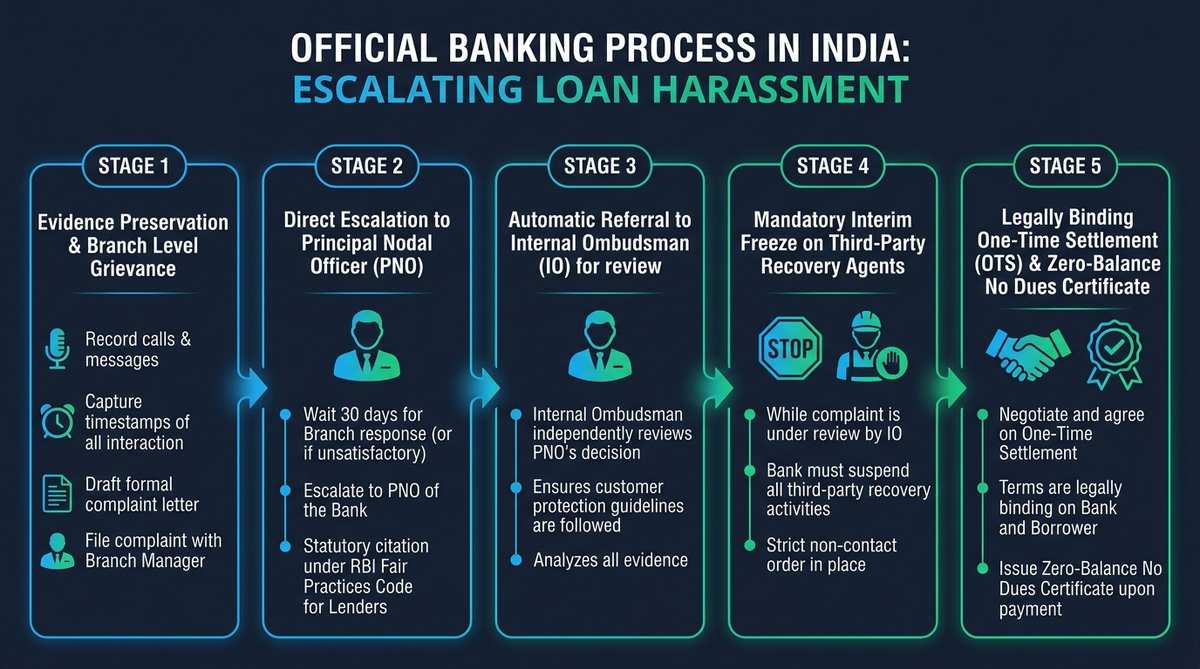
5. Institutional Escalation Roadmap
This visual chart outlines the 5 key stages of escalating harassment. It shows how cases move from gathering evidence to PNO intervention, collection freezing. And final settlement with a No Dues Certificate.
6. Step-by-Step PNO Escalation Protocol
Follow these 5 steps to file a complaint with the Principal Nodal Officer:
Send a written complaint by email or via the bank portal. Save your Ticket ID to prove you tried Level 1 first.
Look up the PNO name and email on the bank website or on the RBI grievance portal.
List your loan details, hardship reason, call records. And dates of agent abuse. Cite RBI recovery rules.
Email the signed letter to the PNO desk. Also send a copy by Speed Post for legal tracking proof.
Once received, the PNO office logs the issue. Bank rules require an immediate freeze on calls during the review.
7. The RBI Internal Ombudsman (IO) Mandatory Review
A key safeguard in banking is the RBI Internal Ombudsman (IO). The IO is an independent referee who reviews customer disputes. All large banks and NBFCs must run an active Internal Ombudsman desk.
The main rule is simple: The bank’s Principal Nodal Officer cannot reject a customer complaint without the written consent of the Internal Ombudsman. If the PNO wants to reject your case, the IO must review the whole file first.
How the Internal Ombudsman Protects You
The Internal Ombudsman reports straight to the RBI. This gives banks strong reason to resolve valid complaints quickly.
8. Strategic Debt Resolution
Stopping harassment brings quick relief. But clearing the loan brings lasting peace. When you talk to branch staff alone, they demand full payment plus extra fees.
However. When your case sits with the Principal Nodal Officer, the bank wants to avoid regulatory trouble. Experienced advocates use this opening to secure a fair settlement:
100% Waiver on Penal Fees
The bank cancels all late charges, extra interest. And notice fees.
50% to 70% Principal Waiver
The settlement desk approves a deep discount on the loan balance.
Official No Dues Certificate (NDC)
After payment, the bank issues a legal closure letter showing ₹0 balance.
Withdrawal of Legal Cases
The bank drops all cheque bounce notices and court actions.
This approach turns an abusive recovery situation into a clean and permanent exit from debt.
9. Bank Grievance Escalation
Here is a simple comparison of different ways to handle debt harassment and settle loans in India:
| Escalation Channel. | Governing Statutory Framework. | Average Resolution Speed. | Collection Freeze Authority. | Settlement Leverage Potential. |
|---|---|---|---|---|
| Branch Level Desk (Level-1). | Internal Bank Customer Service. | 15 to 30 Days (Often Ignored). | Zero (Frontline staff cannot stop agencies). | Low (Insists on full payment). |
| Principal Nodal Officer (Level-3). | RBI Integrated Ombudsman Scheme. | 48 Hours Freeze / 30 Days Final. | Immediate (Direct executive order to ops team). | High (Enables 50% to 70% OTS settlement). |
| RBI Integrated Ombudsman. | RBI CMS Scheme (Section 35A BRA 1949). | 30 to 90 Days. | High (Central bank regulatory action). | High (Forces bank compliance desk to resolve). |
| District Consumer Court (DCDRC). | Section 35 Consumer Protection Act 2019. | 6 to 18 Months. | Court order (Interim stay under Sec 38(8)). | High (Risk of heavy damages forces settlement). |
| Advocate-Led Strategic Resolution. | Legal Notice &. Direct Negotiation. | 15 to 45 Days. | Immediate (Full legal protection across all desks). | Highest (Fastest path to debt freedom &. NDC). |
10. SettleLoans Executive Legal Representation
Facing bank notices and dealing with recovery agents is stressful. At SettleLoans, our team of banking advocates and legal experts stands with you. We handle all talks with senior bank officers directly.
We draft formal petitions to the Principal Nodal Officer. We stop recovery calls fast and negotiate 50% to 70% settlements with official No Dues Certificates. We help you live debt-free with peace of mind.

Settle Loan is India's trusted debt relief and loan settlement platform. We help borrowers overcome financial distress by negotiating with banks and NBFCs to legally settle personal loans and credit card debts. With our transparent, performance-based approach, you can achieve debt freedom and regain your financial peace of mind.
COMPUTER