- Statutory 30-Day Resolution Ceiling: Credit Institutions (CIs) and Credit Information Companies (CICs) must resolve credit data discrepancies and update records within 30 calendar days of receiving a grievance.
- Automatic ₹100 Daily Monetary Penalty: If resolution extends beyond 30 calendar days, the defaulting institution must pay ₹100 per calendar day directly to the consumer without requiring proof of actual financial damages.
- Strict Time Allotment Breakdown: Banks are strictly allotted 21 calendar days to rectify internal records and transmit updated data tapes, while credit bureaus receive 9 calendar days to reflect the update.
- Direct Bank Transfer Mandate: Accrued compensation must be electronically credited via NEFT or RTGS to the borrower's bank account within 5 working days of resolving the underlying grievance.
- Dual-Tier Legal Escalation: Unpaid compensation or persistent refusal to update records can be escalated directly to the RBI Integrated Ombudsman for additional awards up to ₹20,000, or to the District Consumer Commission.
1. The RBI Compensation Directive: Statutory Architecture
For nearly two decades following the enactment of the Credit Information Companies (Regulation) Act, 2005 (CICRA 2005), retail borrowers across India endured systemic administrative apathy from institutional lenders and credit bureaus. When individuals settled distressed personal loans or credit card obligations through negotiated compromise agreements, banks routinely failed to transmit updated data tapes to Credit Information Companies (CICs) such as TransUnion CIBIL, Experian, Equifax, and CRIF High Mark. Consequently, settled accounts remained erroneously tagged as active non-performing assets, written-off facilities, or severe defaults spanning hundreds of days past due. This chronic negligence disabled commercial mobility, caused mortgage rejections, and depressed credit scores without administrative accountability.
To dismantle this institutional inertia, the Reserve Bank of India exercised its supervisory powers under Section 11(1) of CICRA 2005, read with Section 21 of the Reserve Bank of India Act, 1934, by issuing circular RBI/2023-24/73 (DoR.FIN.REC.48/20.16.056/2023-24) titled "Framework for compensation to customers for delayed updation/rectification of credit information." This landmark regulatory instrument transformed credit bureau rectification from an informal customer service request into a time-bound statutory obligation backed by automatic daily financial penalties.
The legislative philosophy underlying the RBI directive recognizes that inaccurate credit information directly infringes upon an individual's fundamental right to pursue lawful commerce and livelihood. Under modern underwriting practices, credit scoring algorithms dictate loan approvals, interest rates, employment background checks, and residential tenancy evaluations. By introducing a mandatory monetary liability of ₹100 per calendar day for delays exceeding 30 days, the central bank created an unyielding operational cost that forces institutional compliance committees to prioritize consumer dispute resolution over bureaucratic procrastination.
2. The 30-Day Resolution Clock: Bank and Bureau Liability
The centerpiece of the RBI compensation framework is an absolute 30-calendar-day resolution window that commences the moment a borrower formally registers a credit information grievance with either a lending institution or a credit bureau. To eliminate the historical practice wherein banks and credit bureaus deflected mutual blame for unrectified records, the Reserve Bank formulated precise institutional time budgets that delineate exact procedural responsibilities between Credit Institutions (CIs) and Credit Information Companies (CICs).
When a borrower submits a grievance directly to a Credit Information Company such as CIBIL, the bureau is legally obligated to forward the dispute details to the concerned credit institution within 7 calendar days. Upon receipt of this transmission, the lending bank or NBFC has exactly 15 calendar days to conduct an internal core banking system (CBS) verification, re-examine loan settlement sanction letters, confirm No Dues Certificate issuance, and furnish an updated, rectified data segment back to the bureau. Following receipt of the bank's confirmation, the bureau has 8 calendar days to ingest the tape, refresh the borrower's credit profile, and dispatch an automated SMS or email alert confirming the correction. The sum of these segments precisely equals the statutory 30-calendar-day deadline.
Alternatively, if the borrower lodges the dispute directly with the lending bank or NBFC, the lender is allotted 21 calendar days to investigate the discrepancy, correct its internal records, and transmit the revised ledger file to all four licensed credit bureaus. The credit bureaus then possess exactly 9 calendar days to update their proprietary score databases and inform the customer. If either institution exceeds its assigned window and the cumulative resolution time crosses 30 calendar days, legal liability crystallizes automatically, creating an immediate debt payable to the complainant.
Check Your Loan Settlement Options
Answer 2 quick questions to evaluate your settlement eligibility.
1. What type of loan do you want to settle?
3. Qualifying Grounds for Claiming ₹100 Daily Delay Penalty
The entitlement to ₹100 daily delay compensation is not restricted to clerical typographical errors; it extends across five primary operational scenarios where lenders and bureaus compromise a borrower's credit standing through administrative default or reporting failures. Recognizing these qualifying grounds ensures that aggrieved borrowers frame their initial legal grievances with precision, establishing an unassailable evidentiary audit trail.
A borrower executes a formal One-Time Settlement (OTS) with an authorized bank committee, satisfies the negotiated compromise payment in full, and receives a stamped No Dues Certificate. If the bank fails to report the account balance as zero and the status as "Settled" within 30 days of grievance receipt, continuing to reflect an outstanding overdue liability, statutory compensation accrues daily from Day 31.
Lenders frequently register false DPD marks (such as 30+, 60+, or 90+ days overdue) arising from internal clearing bottlenecks, NACH mandate switchover errors, or technical gateway failures, despite timely EMI debits from the borrower's salary account. Failure to expunge these derogatory payment history marks within the 30-day window triggers mandatory financial penalties.
Credit bureaus occasionally merge disparate credit profiles due to typographical similarities in borrower names, father's names, or regional addresses. When an individual discovers a completely unrelated third party's delinquent commercial loan or credit card attached to their PAN profile, lodging a formal dispute obligates the bureau and reporting bank to segregate the file within 30 days or face daily penalties.
Borrowers who execute full prepayment or complete scheduled amortizations of retail term loans frequently discover that the account remains "Open" on bureau reports with a nominal residual balance or uncancelled credit limit, impairing debt-to-income (DTI) calculations for new borrowing.
4. Bank Accounting, Provisioning, and NPA Recovery Dynamics
To understand why banks historically neglected credit updates—and why the RBI ₹100 daily penalty successfully forces prompt action—one must analyze the internal accounting mechanics of distressed asset resolution. Under the RBI Master Directions on Prudential Norms on Income Recognition, Asset Classification and Provisioning pertaining to Advances (IRACP), banks must maintain stringent capital reserves against non-performing loans. When an account defaults, it progresses from Sub-Standard (requiring a 15% provision) to Doubtful (requiring 25% to 100% provisioning), locking up high-cost Tier-1 capital that cannot be deployed for profitable lending.
When a borrower enters into a One-Time Settlement, the bank agrees to write off a portion of the contractual principal, accrued penal interest, and compounding ledger charges. The net cash recovered through the compromise payment immediately enters the bank's recovery realization ledger, enabling the release of locked capital provisions. However, because the operational units managing recovery settlements (such as Special Stressed Asset Management Branches or Stressed Assets Resolution Branches) operate separately from the central operations teams responsible for monthly bureau tape generation, completed settlements frequently languish in internal reconciliation buffers.
Where C_t represents estimated recoveries, r is the discount rate, and deductions account for 3–5 years of court friction and capital locked in NPA provisions.
The introduction of the ₹100 daily penalty recalibrates this institutional equation. While a single borrower's daily compensation of ₹100 may appear modest, systemic delays affecting hundreds of settled accounts expose the bank to cumulative multi-lakh penalties and immediate supervisory audits by the RBI Department of Supervision. Furthermore, under RBI consumer protection regulations, banks must disclose unrectified ombudsman complaints in their annual report notes on accounts. Consequently, when a borrower serves an advocate-backed notice invoking the 30-day compensation rule, the bank's legal and compliance officers mandate expedited bureau tape adjustments to avoid formal regulatory censure.
5. Visual Guide: 30-Day Resolution and Compensation Flow
The structural workflow below illustrates the statutory 30-calendar-day dispute resolution lifecycle governed by RBI Circular RBI/2023-24/73. It delineates the exact operational handoff between Credit Institutions (21-day verification ceiling) and Credit Information Companies (9-day ingestion limit), demonstrating how the ₹100 per day compensation meter activates automatically on Day 31.
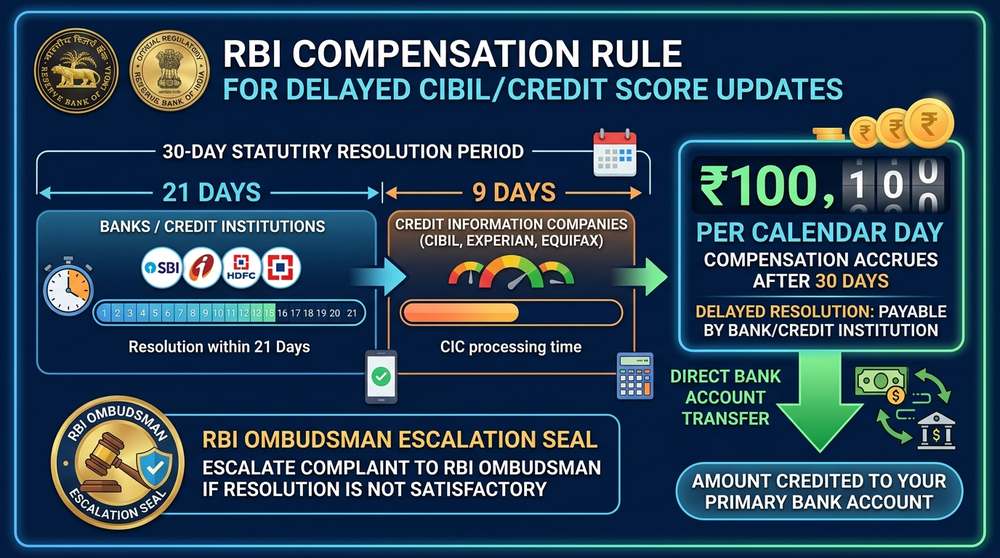
Statutory resolution path: From initial dispute filing through 21-day bank verification, 9-day bureau ingestion, automatic ₹100 daily compensation accrual, and RBI Ombudsman escalation.
6. Procedural Filing Protocol: Activating the Dispute Clock
To hold a bank or credit bureau strictly liable for ₹100 daily compensation, the borrower must establish an indisputable evidentiary audit trail complying with the legal standards of the Bharatiya Sakshya Adhiniyam, 2023 (BSA). Informal phone calls to call center executives or verbal discussions with local branch managers do not constitute statutory notice under the RBI circular. Borrowers must adhere to a rigorous four-stage filing protocol.
Obtain a fresh, official credit information report directly from the credit bureau (e.g., CIBIL, Experian) generated within the preceding 30 days. Identify the precise 9-digit or 10-digit Dispute Control Number (DCN) or Report Order Number. A statutory dispute cannot be adjudicated in the abstract; it must be anchored to a specific control index containing the exact account number and member code.
Lodge the dispute through the bureau's online dispute resolution portal, selecting the precise error category (e.g., "Account Settled but Showing Overdue" or "Wrong Balance Reported"). Simultaneously, serve a formal written grievance via registered email to the Principal Nodal Officer (PNO) and Chief Grievance Officer of the lending bank, attaching the bureau dispute acknowledgment receipt.
Attach certified copies of the bank's original settlement sanction letter, core banking payment receipts showing the transaction reference numbers (UTR/IMPS IDs), the official No Dues Certificate, and a copy of your bank account details (including a cancelled cheque) to remove any excuse regarding payment remittance bottlenecks.
Record the exact timestamp of acknowledgment from the bureau and the bank. The 30-calendar-day countdown begins on the date of receipt. If Day 31 arrives without a corrected credit report and formal confirmation dispatch, statutory liability is established as a matter of law.
7. Direct Account Credit Rules and Penalty Apportionment
The Reserve Bank of India established clear financial payout guidelines to ensure that compensation is not converted into arbitrary credit notes, fee waivers, or illusory administrative adjustments. The compensation must be credited as actual cash directly into the complainant's bank account through automated electronic fund transfers (NEFT, RTGS, or IMPS). Furthermore, the regulatory framework mandates that this remittance must be completed within 5 working days from the date the dispute is officially resolved.
Where T_resolution represents the total calendar days from formal grievance lodging to live bureau correction. If T_resolution exceeds 30 calendar days, automatic monetary penalty accrues daily until rectification.
To prevent inter-institutional litigation, the RBI circular defines a precise mathematical apportionment formula. Consider a case where a borrower files a grievance with the bank on Day 1. The bank is allotted 21 calendar days, and the bureau is allotted 9 days. If the bank takes 35 calendar days to transmit verified data tapes to CIBIL, and CIBIL completes the update within 3 calendar days, the total turnaround time is 38 days. The aggregate delay is 8 days beyond the 30-day statutory ceiling. Because CIBIL completed its obligation well within its 9-day allocation, the bank is solely liable for the entire 8-day delay and must transfer ₹800 (8 × ₹100) to the borrower's account.
Conversely, if the bank furnishes verified records in 15 days (6 days ahead of schedule), but the credit bureau takes 22 days to reflect the update (exceeding its 9-day limit by 13 days), total resolution takes 37 days. Here, the net delay beyond 30 days is 7 days, and the credit bureau is solely liable to pay ₹700 to the consumer. If both institutions exceed their respective limits—for example, if the bank takes 27 days (6 days late) and the bureau takes 14 days (5 days late), totaling 41 days—the bank must pay ₹600 and the credit bureau must pay ₹500, resulting in a total payment of ₹1,100 directly to the complainant.
8. Escalation Pathways: RBI Ombudsman and Consumer Forum
When a regulated entity fails to resolve a credit grievance within 30 calendar days, or executes the correction but refuses to disburse the accrued ₹100 daily penalty within the mandatory 5-working-day remittance window, the borrower possesses robust statutory escalation avenues under Indian banking and consumer protection jurisprudence.
The primary regulatory forum is the Reserve Bank - Integrated Ombudsman Scheme, 2021 (RB-IOS 2021). Under Clause 11 of the scheme, any non-observance of RBI directives or deficiency in service by a regulated entity constitutes actionable grounds for a complaint. Complainants can lodge an online petition via the RBI Complaint Management System (CMS) portal at cms.rbi.org.in. The Banking Ombudsman exercises statutory authority to order direct rectification, direct the immediate credit of accrued ₹100 daily penalties, and award consequential damages of up to ₹20,000 for mental agony, loss of time, and out-of-pocket expenses.
Where the credit reporting delay causes quantifiable economic harm—such as the rejection of a critical commercial credit facility, revocation of an employment offer, or loan underwriting at an exorbitant interest rate—the borrower can approach the District Consumer Disputes Redressal Commission under Section 35 of the Consumer Protection Act, 2019. The Supreme Court of India and National Consumer Disputes Redressal Commission (NCDRC) have repeatedly affirmed that credit bureaus and lending banks are joint service providers. Multiple consumer commissions have awarded damages ranging from ₹50,000 to ₹5,00,000 against banks for persistent credit bureau reporting negligence, establishing that the ₹100 daily penalty is merely an administrative minimum that does not preclude common-law civil damages.
9. Comparative Matrix: Regulatory Deadlines and Liabilities
The operational response times and supervisory oversight mechanisms differ significantly across institutional categories. The comparative matrix below outlines statutory turnaround times, liability thresholds, and primary redressal channels across the Indian banking ecosystem.
| Regulated Entity Category | Statutory Time Allocation | Daily Penalty Liability | Statutory Redressal Channel | Required Evidentiary Documentation |
|---|---|---|---|---|
| Public Sector Banks (e.g., SBI, PNB, BoB) | 21 calendar days (investigation & tape transmission) | ₹100/day for delays beyond 21 days (if total >30) | Principal Nodal Officer & RBI Integrated Ombudsman (CMS) | Stamped OTS letter, core banking payment receipts, NDC copy |
| Private Commercial Banks (e.g., HDFC, ICICI, Axis) | 21 calendar days (investigation & tape transmission) | ₹100/day for delays beyond 21 days (if total >30) | Executive Grievance Cell & RBI Integrated Ombudsman | Settlement approval email, UTR transaction proof, bureau DCN |
| Non-Banking Financial Companies (NBFCs) | 21 calendar days (internal verification & reporting) | ₹100/day for delays beyond 21 days (if total >30) | NBFC Nodal Desk & RBI Ombudsman for NBFCs | Loan account ledger, foreclosure receipt, settlement agreement |
| Credit Information Companies (CIBIL, Experian, etc.) | 9 calendar days (if filed with CI) / 15 total (if filed with CIC) | ₹100/day for delays beyond assigned window | CIC Grievance Redressal Desk & RBI DoR Supervision | Official credit report, Dispute ID, timestamped ticket logs |
| Fintech Lending Platforms & DLAs | Co-terminus with partner bank/NBFC (21 days) | Joint liability with regulated balance-sheet lender | RBI Digital Lending Directions & Sachet Portal | In-app settlement confirmation, payment gateway transaction ID |
As revealed by the matrix, non-banking financial companies and fintech lending partners frequently exhibit the highest incidence of reporting non-compliance. Fintech apps routinely operate through co-lending partnerships or digital lending agents (DLAs) where customer service desks lack direct access to the parent NBFC's core bureau tape generation system. Establishing formal legal contact with the principal regulated entity is crucial to initiating the 21-day timeline.
10. Institutional Legal Defense and Clean Credit Recovery
Successfully recovering from financial distress requires more than executing a settlement payment; it necessitates complete, legally enforceable rehabilitation of your credit profile. When negotiating a One-Time Settlement without professional legal advocacy, borrowers routinely fall victim to verbal representations made by outsourced recovery agents who promise credit score clearance but have no authority over banking records. Once the borrower pays, the bank records the account as a unilateral write-off, leaving an indelible negative mark on bureau files.
At SettleLoans, our experienced banking defense advocates structure One-Time Settlements with comprehensive protective covenants. We ensure that the formal compromise sanction letter explicitly obligates the lender to report the account as settled with zero outstanding balance, deliver an unconditional No Dues Certificate, and transmit revised data tapes to all four credit bureaus within 15 calendar days of final payment.
If an institutional lender or credit bureau attempts to delay credit rectification or withhold statutory compensation, our legal panel immediately deploys formal statutory notices under CICRA 2005 and initiates proceedings before the RBI Integrated Ombudsman. By anchoring debt resolution within established statutory rights, SettleLoans protects borrowers from unlawful recovery harassment, achieves 40% to 65% debt reductions, and restores financial dignity.

Settle Loan is India's trusted debt relief and loan settlement platform. We help borrowers overcome financial distress by negotiating with banks and NBFCs to legally settle personal loans and credit card debts. With our transparent, performance-based approach, you can achieve debt freedom and regain your financial peace of mind.
COMPUTER
11. Frequently Asked Questions
What is the RBI ₹100 daily compensation rule for CIBIL delay, and when did it become legally binding?
The Reserve Bank of India introduced a mandatory compensation framework under Circular RBI/2023-24/73 (DoR.FIN.REC.48/20.16.056/2023-24) issued on October 26, 2023. Under this regulatory directive, which became enforceable across India in April 2024, Credit Institutions (banks and NBFCs) and Credit Information Companies (CIBIL, Experian, Equifax, and CRIF High Mark) must resolve consumer credit information grievances within 30 calendar days. If they fail to rectify or update records within this statutory window, they must automatically pay the complainant ₹100 per calendar day until the correction is fully executed.
Does the 30-day statutory resolution timeline apply to both banks and credit bureaus like CIBIL and Experian?
Yes, the total composite timeline of 30 calendar days applies to both entities. If a consumer lodges a grievance with a Credit Information Company (CIC), the bureau has 7 days to forward it to the bank, the bank has 15 days to investigate, and the bureau has 8 days to implement the update and notify the borrower. If the dispute is submitted directly to the lending bank, the bank has 21 calendar days to provide updated records, and the CIC has 9 calendar days to reflect the changes. Any breach beyond the cumulative 30-day ceiling attracts daily monetary liability.
How is the ₹100 per day compensation apportioned between the lending bank and the credit bureau?
The RBI directive strictly allocates liability based on which entity exceeded its sub-allotment. When a dispute is filed with a bank, the bank is allotted 21 calendar days and the bureau 9 days. If the bank takes 30 days to send updated records and the bureau completes the update in 5 days, the bank is solely liable to pay ₹900 for the 9 days of delay beyond its 21-day limit. If both parties exceed their respective limits, each entity must separately pay ₹100 per day for the specific number of days it delayed beyond its statutory allotment.
How is the compensation amount credited to the borrower, and what is the payout deadline?
Under the RBI framework, the compensation must be credited directly to the complainant borrower's bank account via electronic transfer (NEFT, RTGS, or IMPS) within 5 working days from the date the grievance is officially resolved. To ensure seamless payout, borrowers are advised to include their bank account number, IFSC code, and a cancelled cheque copy when submitting their initial formal dispute.
What steps should I take if a settled loan continues to reflect as 'Written-Off' or 'Overdue' on CIBIL?
If you have completed a One-Time Settlement (OTS) and obtained a formal No Dues Certificate (NDC), obtain your latest credit report to extract the Dispute Control Number (DCN). Lodge a formal dispute on the CIBIL portal attaching the NDC, settlement sanction letter, and payment proofs. Simultaneously serve a registered email to the bank's Principal Nodal Officer. If the record is not rectified to 'Settled' with zero balance within 30 calendar days, the ₹100 daily compensation begins accruing automatically from Day 31.
Can I claim the ₹100 daily penalty if I did not provide my bank account details when filing the dispute?
While the failure to provide bank account details does not extinguish your legal entitlement to compensation, it provides the lender or credit bureau a procedural pretext to delay disbursement. Under RBI directives, if bank details are missing, the institution must contact the complainant to obtain payout information upon resolving the grievance. Providing complete banking credentials up front prevents avoidable administrative delays.
What legal remedy do I have if the bank or CIBIL refuses to pay the accrued ₹100 daily compensation?
If the 30-day resolution deadline passes or if the record is updated late but the bank or CIC refuses to remit the compensation within 5 working days, you can lodge an escalated complaint with the Reserve Bank - Integrated Ombudsman Scheme, 2021 via the CMS portal (cms.rbi.org.in). The Ombudsman can order immediate disbursement of the accrued statutory penalty along with additional compensation of up to ₹20,000 for mental harassment and loss of time.
Can I claim additional compensation beyond ₹100 per day in Consumer Court if a delayed CIBIL update led to a loan rejection?
Yes. The ₹100 daily penalty under the RBI circular is an automatic regulatory baseline that operates independently of common law and consumer remedies. If a bank's unlawful delay in reporting a loan settlement caused you tangible financial harm—such as the rejection of a home loan, loss of commercial property, or inflated interest charges—you can file a consumer complaint under Section 35 of the Consumer Protection Act, 2019 before the District Consumer Commission seeking exemplary damages for deficiency of service.