- Total Prohibition on Third-Party Contact: The RBI strictly bans calls to former employers. Agents cannot contact past bosses or college faculty about personal loans.
- Severe DPDP Act 2023 Non-Compliance: Scraping data from LinkedIn or alumni portals without consent is illegal. Lenders face DPDP Act fines up to ₹250 Crores.
- Criminal Stalking &. Defamation: Harassing past contacts causes public shame. It is Cyber Stalking under Section 78 BNS (Section 354D IPC) and Defamation under Section 356 BNS (Section 499 IPC).
- Doctrine of Privity of Contract: Past employers have no link to your loan. Lenders cannot demand money or help from them.
- Transforming Privacy Violations into 55% OTS: A legal notice to the bank DPO halts calls quickly. It opens talks for a 45% to 65% One-Time Settlement.
1. The Crisis of Digital Stalking
Debt collection in India faces rising cyber stalking. When loans default, rogue agencies ignore registered contacts. They crawl the web to find past bosses and college staff.
Agents often call managers from jobs left years ago. They also call old co-workers, past HR desks. And professors. These tactics aim to shame borrowers into paying quickly.
Collection agencies crawl LinkedIn and job boards. They track former bosses to put social pressure on borrowers.
Rogue callers search university lists and yearbooks. They collect phone numbers of teachers and classmates under false pretenses.
These actions break data privacy laws, RBI rules. And penal codes. Borrowers can take strong legal steps to hold lenders accountable.
2. Statutory Data Protection Violations
The Digital Personal Data Protection Act (DPDP Act), 2023 sets strict data rules. Banks and NBFCs act as Data Fiduciaries. Collection agencies act as Data Processors. The law limits how personal data is collected and used.
Scraping web pages or calling unlisted people breaks key DPDP rules:
- Section 5 (Notice &. Consent Mandate): Data needs clear consent from the borrower. Scraping third-party contacts has no consent.
- Section 6 (Purpose Limitation): Loan data cannot be used for stalking or third-party pressure.
- Section 8 (Data Fiduciary duties): Lenders stay liable for unlawful data use by their agencies.
- Section 33 &. Schedule (Monetary fines): The Data Protection Board of India (DPBI) can fine lenders up to ₹250 Crores.
Requires firms to pay damages if poor data security leads to wrongful loss.
Imposes up to 3 years in prison and ₹5 Lakhs in fines for leaking personal data without consent.
In Justice K.S. Puttaswamy (Retd.) v. Union of India (2017), the Supreme Court upheld privacy under Article 21 of the Constitution. Debt distress does not take away your personal dignity.
Check Your Loan Settlement Options
Answer 2 quick questions to evaluate your settlement eligibility.
1. What type of loan do you want to settle?
3. RBI Fair Practices Code Bans, Criminal Stalking (BNS/IPC)
The Reserve Bank of India bans abusive collection tactics. Under the RBI Master Direction on Fair Practices Code for Lenders and the Circular on Outsourcing of Financial Services, lenders cannot contact third parties, past employers, or friends who did not sign the loan.
Calling past bosses or teachers also triggers criminal laws under the Indian Penal Code (IPC) and Bharatiya Nyaya Sanhita (BNS), 2023:
Cyber Stalking (Section 354D IPC / Section 78 BNS 2023)
Tracking online profiles or calling peers to force contact is stalking. Section 78 BNS punishes this with up to 3 years in prison.
Criminal Defamation (Section 499 & 500 IPC / Section 356 BNS 2023)
Telling ex-bosses or professors about a debt harms reputation. It is punishable with up to 2 years in prison.
Doctrine of Privity of Contract (Indian Contract Act, 1872)
Under Section 2(h), a loan binds only the lender and borrower. Past employers have zero legal duty for your debt.
When lawyers cite these penal sections, banks act fast to rein in rogue agents.
4. Bank Accounting & Workplace Harassment Risks
To see why agents scrape data, check bank accounting rules. After 90 days of non-payment, RBI rules label a loan as a Non-Performing Asset (NPA). The bank must then set aside funds from profits to cover the loss:
| default Classification. | Overdue Aging Timeline. | Mandatory RBI Capital Provision. | Settlement / Haircut Scope. |
|---|---|---|---|
| SMA-1 / SMA-2. | 31 – 90 Days Overdue. | 5% General Capital Allocation. | Penal Interest &. Fee Waivers. |
| Substandard NPA. | 91 – 365 Days Overdue. | 25% Unsecured Capital Provision. | 35% – 45% Principal Haircut. |
| Doubtful NPA 1 (D1). | 12 – 24 Months Default. | 100% Unsecured Capital Provision. | 45% – 55% Principal Haircut. |
| Doubtful NPA 2 / Loss Asset. | 24+ Months / Written-Off. | 100% Full Balance Sheet Write-Off. | 55% – 65% Principal Haircut. |
Agencies earn 10% to 25% fees only if they collect debt quickly. That is why agents turn to scraping. When lawyers expose these acts, banks use the Net Present Value (NPV) Equation:
Here, C_t is estimated cash recovery. And r is the discount rate. Deductions include court costs, lawyer fees, DPBI fines. And locked NPA funds.
Facing privacy notices and RBI fines, banks know court fights lose money. Approving a 35% to 55% waiver becomes the bank's best financial choice.
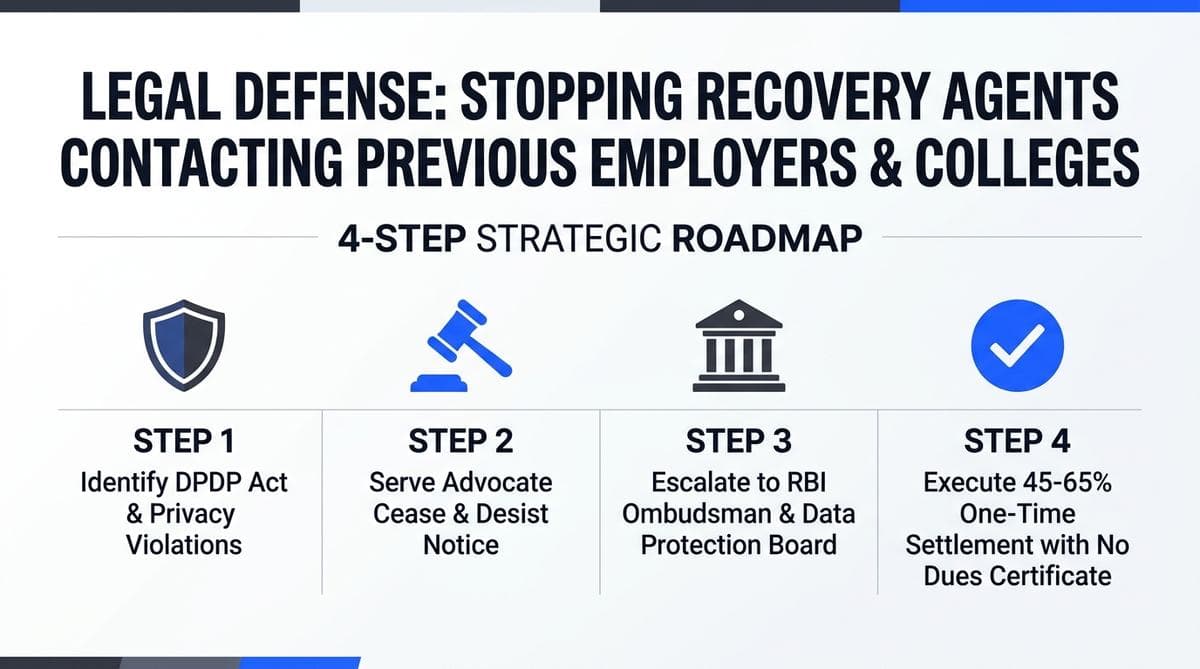
5. Employer Contact Defense Strategic Roadmap
The roadmap below outlines our 4-step process. It stops predatory scraping and secures a formal loan settlement.
6. The 5-Step Legal Counter-Offensive
When agents call past employers or teachers, panicking will not help. Rogue agents use fear to get fast cash. Follow this 5-step legal plan instead:
Step 1: Forensic Documentation & Third-Party Evidence Collection
Ask your former boss or HR team for call details. Collect phone numbers, names, timestamps. And audio clips. Build a solid evidence file.
Step 2: Issuing Protective Written Advisories to Third Parties
Send a polite note to your past workplace or college. Clarify that an illegal agency is scraping data in breach of RBI rules. State that your lawyer is acting on it.
Step 3: Serving Formal Advocate Cease-and-Desist & Defamation Notice
Your lawyer sends a legal notice to the bank MD, Nodal Officer, and Data Protection Officer. The notice cites the DPDP Act 2023, Section 78 and 356 BNS, and RBI rules.
Step 4: Escalation to RBI Ombudsman & Data Protection Board of India
File an urgent complaint on the RBI CMS portal (cms.rbi.org.in). Alert the Data Protection Board of India about unlawful data use.
Step 5: Filing Cyber Crime Portal & Police Stalking Complaints
If online stalking or threats continue, report it on the Cyber Crime Portal (cybercrime.gov.in). File an FIR under Section 78 BNS with cyber police.
This plan shifts legal risk onto the lender. It stops harassment and shields your work reputation.
7. Converting Data Privacy Breaches into Leverage
Workplace stalking is stressful. But it gives you strong legal leverage. Banks must follow strict privacy laws. When a bank faces clear proof of DPDP Act and RBI breaches, regulatory risks far exceed the loan amount.
Our legal team uses this misconduct to negotiate an affordable One-Time Settlement (OTS):
Show proof of financial hardship and illegal data scraping. This builds a clear case for an out-of-court settlement.
Wipe out all penal interest and late fees. Secure a 45% to 65% cut on your loan principal balance.
Add binding terms forcing the bank to recall agencies, delete scraped data. And stop third-party calls.
Pay the settled sum in 2 to 4 monthly parts. This clears your loan without hurting family savings.
8. Sanction Letter Forensics, Direct Bank Remittance
A debt settlement needs close legal checks. Rogue agents often send fake letters on chat apps or make false verbal promises. Never pay money until your lawyer reviews the official sanction letter.
- Official Institutional Letterhead: Must come from the bank's corporate email with a reference number and manager signature.
- Accurate Borrower &. Loan Credentials: Must state your full name, PAN. And exact 16-digit loan account number.
- Unconditional Debt closure Clause: Must state that all claims, interest. And legal disputes end once you pay.
- Direct Loan Account Remittance: Pay directly into your loan account through official bank channels. Never pay into third-party accounts.
Under RBI Circular RBI/2023-24/60, lenders must issue a No Dues Certificate (NDC) and update credit bureaus to a ₹0 balance within 30 calendar days of final payment. Missing this deadline costs the bank ₹5,000 per day paid to the borrower.
Credit Bureau Trajectory & CIBIL Score Rehabilitation
After settlement, the bank marks your credit report as "Settled" or "Post-Write-off Settled" with a ₹0 balance. Your score may drop by 70 to 120 points at first. However, it ends calls and stops fines. Using a secured card and paying on time will rebuild your score above 750 in 18 to 24 months.
9. Comparative Legal Defense Matrix
Compare your legal choices to find the best way to stop harassment and settle debt safely:
| Resolution Channel. | Governing Statutory Framework. | Privacy Protection Scope. | Resolution Timeline. | Final Legal Effect. |
|---|---|---|---|---|
| Rogue Collection Scraping. | Illegal stalking violating Privity of Contract. | Zero Protection (causes career and social harm). | Indefinite / Escalating. | Exposes lender to DPBI fines up to ₹250 Cr and police FIRs. |
| Data Protection Board Complaint. | DPDP Act 2023 (Sections 5, 6, 8 &. 33). | Probes illegal data scraping and vendor breaches. | 60 – 90 Days. | Heavy fines on lender. order to delete scraped data. |
| RBI Banking Ombudsman. | RBI Integrated Ombudsman Scheme 2021. | Orders immediate stop to third-party contact. | 30 – 45 Days. | Binding order forcing bank compliance and payout. |
| Advocate-Led 55% OTS. | Consensual Compromise Settlement Agreement. | 100% Workplace &. Network Ceasefire Guaranteed. | 15 – 30 Days. | Complete debt closure with official ₹0 NDC and file closure. |
10. SettleLoans Workplace Privacy Legal Defense
Stopping recovery agencies from scraping your networks requires skilled banking lawyers. Our team enforces the DPDP Act 2023 and sends strong legal notices. SettleLoans protects borrowers across India. We serve notices on bank Data Protection Officers, file RBI Ombudsman cases, protect your career. And negotiate directly with bank zonal heads to secure 45% to 65% principal waivers with official No Dues Certificates.

Settle Loan is India's trusted debt relief and loan settlement platform. We help borrowers overcome financial distress by negotiating with banks and NBFCs to legally settle personal loans and credit card debts. With our transparent, performance-based approach, you can achieve debt freedom and regain your financial peace of mind.
COMPUTER
11. FAQs: Recovery Agents Contacting Previous Employers
Direct answers to common questions about data scraping, third-party debt harassment, DPDP Act protections. And loan settlement in India.
Is it legal for recovery agents to contact my previous employer or former manager?
No. Under RBI Fair Practices Code and the DPDP Act 2023, contacting previous employers or ex-managers is illegal. Former employers are third parties to your loan. Sharing debt details with them violates data privacy laws and constitutes defamation.
How do recovery agencies find contact numbers of past colleagues or college professors?
Rogue collection agencies scrape public profiles on LinkedIn, old resumes on job sites. And college alumni directories. They harvest contact details of past managers and teachers to cause social shame and force payment.
What sections of the DPDP Act 2023 prohibit unauthorized scraping and third-party debt calls?
The DPDP Act 2023 limits data use under Section 6 and requires consent under Section 5. Scraping data and disclosing debt violates Section 8 duties. Under Section 33, the Data Protection Board can fine lenders up to ₹250 Crores for violations.
Can I claim damages or compensation from a bank for illegal scraping and workplace defamation?
Yes. You can claim damages under Section 43A and Section 72A of the IT Act 2000 for data leaks. You can also file a civil suit for defamation and seek relief through the RBI Integrated Ombudsman Scheme.
Does calling a former employer or college constitute criminal stalking under the new criminal laws?
Yes. Tracking or contacting associates of a borrower is Cyber Stalking under Section 78 BNS (Section 354D IPC). It also attracts criminal charges for Defamation under Section 356 BNS (Section 499/500 IPC) and Intimidation under Section 351 BNS (Section 503/506 IPC).
What immediate steps should I take if an ex-colleague informs me about a recovery call?
First, collect call logs, numbers. And recordings from your colleague. Second, send them a note clarifying that an illegal agency made the call. Third, hire a lawyer to send a notice to the bank's Nodal Officer and Data Protection Officer, then file an RBI Ombudsman complaint.
Can a bank legally use contact references provided on a 5-year-old loan application?
No. Under RBI rules, lenders can only call references to find your address if you are untraceable. Agents cannot disclose debt amounts or demand money from references once you are reachable.
How does exposing privacy violations help in negotiating a One-Time Settlement (OTS)?
Lenders face heavy fines and reputation loss for DPDP Act and RBI violations. To prevent fines from the Data Protection Board and RBI Ombudsman, banks often withdraw the agency and offer a 45% to 65% OTS waiver.
What timeline does the RBI mandate for issuing a No Dues Certificate after loan settlement?
Under RBI Circular RBI/2023-24/60, lenders must issue a No Dues Certificate (NDC) within 30 days of final settlement. They must also update credit bureaus to a ₹0 balance. Missing this deadline incurs a ₹5,000 daily penalty paid to the borrower.