- Total Freeze Illegality: Commercial banks cannot place a blanket operational debit freeze on an active salary account without a specific judicial attachment order or statutory decree.
- Section 60 CPC Statutory Exemption: Indian civil law strictly exempts the first ₹1,000 plus two-thirds of the remaining monthly salary from debt recovery attachment to protect basic human subsistence.
- Right of Set-Off Boundaries: The Banker's Right of Set-Off requires strict mutuality of accounts, matured debts, and mandatory prior written notice before any internal balance appropriation can occur.
- No Cross-Bank Freezing Power: A lender cannot administratively freeze your account in another bank unless authorized by a formal court decree, DRT attachment, or law enforcement requisition.
- Converting Account Holds to 55% OTS: Serving a statutory legal notice on the Principal Nodal Officer prompts banks to lift unlawful liens and negotiate a formal One-Time Settlement with substantial principal waivers.
1. Demystifying the Salary Account Freeze: Bankers Right of
Waking up on salary day to discover that your entire monthly earnings have been swept or that your debit card is declined due to an unexpected "Total Debit Freeze" represents an acute financial emergency. For salaried professionals across India who have defaulted on an unsecured personal loan or credit card, this sudden paralysis is frequently executed by the very bank hosting their corporate payroll account. Prominent private banking institutions—including ICICI Bank, HDFC Bank, Axis Bank, Kotak Mahindra Bank, and State Bank of India—routinely invoke internal banking clauses to seize incoming salary credits.
To mount an immediate and successful legal challenge, one must distinguish between the two primary legal doctrines banks cite to justify account restrictions:
Under Section 171 of the Indian Contract Act, 1872, a banker holds a general lien over physical goods, bonds, shares, and negotiable securities deposited in the bank's custody as a bailee. Crucially, established Indian jurisprudence confirms that money deposited in a current or savings account constitutes a debtor-creditor relationship, not a bailment. Therefore, Section 171 cannot be lawfully cited to freeze liquid cash deposits in a salary account.
The Right of Set-Off is an equitable and contractual doctrine permitting a commercial bank to combine a borrower's credit account balance with their debit account balance to extinguish a matured, crystalized debt. However, the exercise of this right is strictly governed by mandatory banking conditions: mutuality of parties, identical legal capacity, debt maturity, and the fundamental requirement of advance statutory notice.
When a commercial lender arbitrarily blocks an active salary account without adhering to statutory conditions precedent, the bank commits an actionable breach of contract and an unlawful deficiency of banking service. While loan contracts routinely contain standard set-off clauses buried in digital fine print, standard contract clauses cannot supersede mandatory statutory exemptions codified under Indian civil law.
2. Statutory Legal Grounding: Section 60 CPC, Article 21 & Landmark High Court Precedents
The most potent statutory shield shielding a salaried employee from predatory bank account sweeps is enacted in Section 60 of the Code of Civil Procedure, 1908 (CPC). Section 60 governs property liable to attachment and sale in the execution of court decrees. The legislative intent behind this statute is unambiguous: no creditor, institution, or judicial authority can reduce a citizen to complete destitution in the pursuit of civil monetary recovery.
Under Section 60(1)(clause i) of the CPC, in all civil recovery proceedings, the first ₹1,000 plus two-thirds of the remainder of a salary is strictly exempt from attachment. For example, if a borrower earns a net monthly salary of ₹61,000, the legally attachable portion in execution of a formal court decree cannot exceed ₹20,000, leaving ₹41,000 completely untouched for living sustenance.
The constitutional and judicial ramifications of Section 60 CPC are profound: if a formal Civil Court or District Judge executing a decree cannot lawfully attach more than one-third of a person's salary, a private commercial bank cannot exercise greater extra-judicial recovery powers than a sovereign court of law. By sweeping 100% of an employee's monthly salary credit under the unilateral guise of set-off, the bank commits an ultra vires act that violates both statutory law and fundamental constitutional protections.
The Supreme Court has consistently held that the Right to Life under Article 21 includes the right to live with human dignity and access basic livelihood. Freezing entire sustenance earnings constitutes an unconstitutional deprivation.
High Courts have repeatedly struck down arbitrary account freezes, ruling that banks cannot starve defaulting borrowers or seize welfare funds, pensions, or basic salaries without due process of law.
A bank cannot exercise a set-off against an account owned jointly with a spouse or parent. Debts owed in an individual capacity cannot be recovered from funds belonging in whole or part to a third party.
3. The Domino Effect of an Account Freeze: Cheque Bounces, Living Crisis & Legal Liabilities
An unannounced debit freeze or total balance sweep unleashes a catastrophic chain reaction across a borrower's financial ecosystem. When an account is placed on debit freeze, incoming salary credits remain locked, while all outbound automated clearing transactions (NACH, ECS, standing instructions, and post-dated cheques) are instantly rejected by the bank's central processing system.
This artificial paralysis causes collateral damage across four distinct legal and operational fronts:
Collateral Bounces & Section 138 NI Act Vulnerability
Legitimate outbound payments—such as home loan EMIs, rent cheques, and insurance premiums—bounce due to the account hold. Third-party lenders may initiate criminal complaints under Section 138 of the Negotiable Instruments Act or Section 25 of the Payment and Settlement Systems Act, unaware that the bounce was engineered by an internal freeze.
Severe Violation of RBI Fair Practices Code
Under the RBI Master Direction on Fair Practices Code for Lenders, regulated entities are strictly prohibited from resorting to coercive, abusive, or extra-judicial recovery mechanisms that deprive borrowers of basic livelihood funds without formal prior notice and grievance redressal opportunities.
Unwarranted CIBIL Score Destruction
Secondary loan defaults triggered by the primary account freeze lead to cascading 30+ and 60+ Days Past Due (DPD) entries across all credit bureaus, artificially destroying creditworthiness even when the borrower had ample funds to honor those obligations.
Because the freezing bank acted arbitrarily without a judicial decree, the borrower holds a legitimate cause of action to claim compensation for wrongful dishonor of cheques and deficiency of banking services before the Consumer Disputes Redressal Commission and the RBI Banking Ombudsman.
4. Bank Balance Sheet Accounting, NPA Provisioning & The Net Present Value (NPV) Equation
To understand why banks freeze salary accounts—and how advocates force them to release the hold and accept an affordable compromise settlement—one must examine the strict accounting rules governing commercial banks in India. Under Reserve Bank of India prudential provisioning guidelines, when an unsecured personal loan or credit card crosses 90 days of non-payment, it is classified as a Non-Performing Asset (NPA).
As overdue debts progress through delinquency buckets, the lender must lock up significant capital from its operating profits to create mandatory bad-debt provisions:
| Delinquency Classification | Overdue Aging Timeline | Mandatory RBI Capital Provision | Settlement / Haircut Scope |
|---|---|---|---|
| SMA-1 / SMA-2 | 31 – 90 Days Overdue | 5% General Capital Provision | Penal Interest & Late Fee Waivers |
| Substandard NPA | 91 – 365 Days Overdue | 25% Unsecured Provisioning | 35% – 45% Principal Haircut |
| Doubtful NPA 1 (D1) | 12 – 24 Months Default | 100% Unsecured Capital Provision | 45% – 55% Principal Haircut |
| Doubtful NPA 2 / Loss Asset | 24+ Months / Written-Off | 100% Full Balance Sheet Write-Off | 55% – 65% Principal Haircut |
When a bank locks 100% capital in an NPA provision, coercive recovery measures (such as account freezes) are frequently desperate tactics used by branch-level collection teams before the debt is transferred to the Stressed Asset Resolution Group. When evaluating whether to maintain an illegal account freeze or accept an immediate lump-sum settlement, bank credit committees calculate the Net Present Value (NPV) of Recovery:
Where C_t represents estimated recoverable cash flows over time, r is the discount rate, and deductions account for 3–5 years of court friction, advocate retainers, regulatory risk from Ombudsman complaints, and capital locked in NPA provisions.
Because pursuing protracted civil recovery or defending an unlawful account freeze before the RBI Ombudsman inflicts severe regulatory exposure and administrative friction, banks recognize that an upfront 35% to 55% cash recovery via a formal One-Time Settlement delivers superior financial certainty.
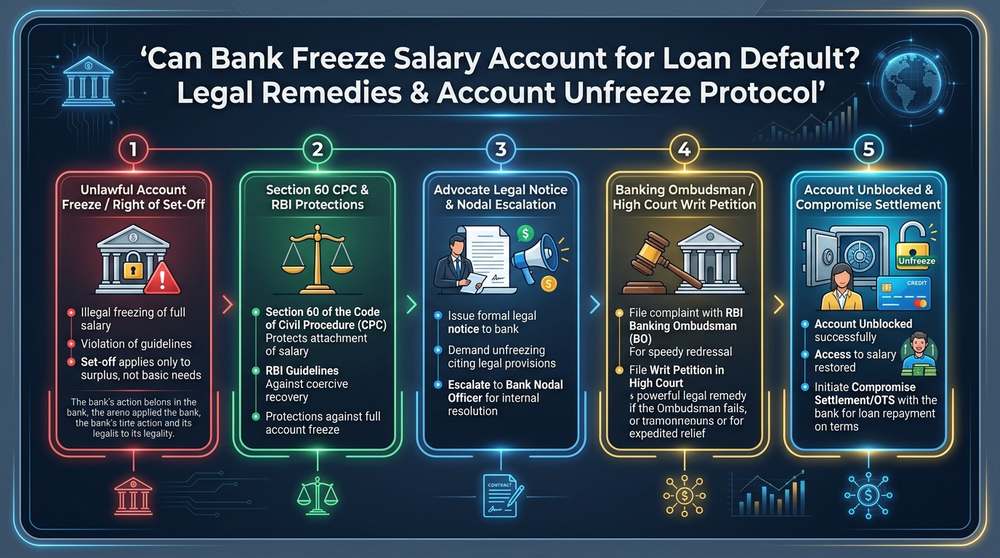
5. Salary Account Unfreezing & Debt Settlement Visual Roadmap
The visual roadmap below illustrates the structured 5-stage institutional progression from discovering an unlawful salary account freeze to advocate defense, Section 60 CPC invocation, Principal Nodal Officer escalation, and concluding an official compromise settlement with full debt discharge.
6. The Emergency 4-Stage Advocate Protocol to Unfreeze Salary Accounts
When confronting an active salary account freeze, time is of the essence. Begging branch personnel or arguing with collection agents will produce zero results, as local staff lack the authority to override automated debit liens. Instead, debt defense advocates execute an aggressive, legally calibrated 4-stage unfreezing protocol:
Stage 1: Immediate Payroll Diversion & Written Branch Objection
Within 24 hours of noticing the restriction, provide your employer's payroll department with an alternate bank account at an unaffected institution. Simultaneously, submit a formal written objection to the Branch Manager demanding immediate disclosure of the specific legal authority (court order or internal set-off) under which the debit freeze was placed.
Stage 2: Serving Advocate Statutory Legal Notice
Your legal counsel serves a formal demand notice on the bank's Managing Director, Zonal Head, and Principal Nodal Officer. The notice cites violations of Section 60(1)(i) CPC, Article 21, the lack of prior statutory notice, and warns of imminent proceedings before the High Court and Consumer Forum for consequential damages.
Stage 3: Escalation to RBI Integrated Ombudsman Scheme
If the bank fails to unfreeze the account within 48 to 72 hours, an expedited complaint is logged on the RBI CMS portal (cms.rbi.org.in) under the category of "Arbitrary Freezing of Accounts / Deficiency in Service". Commercial banks face severe scrutiny and penalties from the Banking Ombudsman for unauthorized debit holds.
Stage 4: High Court Writ Petition under Article 226 (Emergency Relief)
In cases involving Public Sector Banks (State Bank of India, Bank of Baroda, Punjab National Bank) or extreme financial hardship where basic survival funds are blocked, advocates file an urgent Writ Petition under Article 226 of the Constitution, obtaining interim court directions directing the immediate restoration of account operations.
This multi-tiered legal offensive removes the unilateral power advantage from the bank and establishes the legal groundwork for an amicable, heavily discounted debt settlement.
7. Converting an Account Freeze into an Affordable 45%–65% One-Time Settlement (OTS)
An account freeze is frequently the final coercive attempt by a bank to recover an unsecured loan before facing heavy NPA provisioning write-offs. By deploying advocate representation and exposing the bank's legal non-compliance, you transform a distressing account hold into your strongest bargaining chip to negotiate an institutional One-Time Settlement (OTS).
Rather than paying inflated late fees, penal interest, and recovery charges, our legal advocates guide the negotiation through structured phases:
Compile verifiable proof of genuine financial distress—such as medical emergencies, job loss letters, salary reduction slips, or business insolvency records—establishing bona fide inability to service the original EMI structure.
Demand 100% waiver of accumulated penal interest, overdue charges, and legal expenses, while securing a 45% to 65% reduction on the principal ledger balance based on the loan's NPA aging bucket.
Make the immediate removal of all account holds and debit freezes an explicit prerequisite before disbursing the first agreed settlement tranche.
Structure the compromised settlement sum into 2 to 4 manageable monthly installments, providing breathing room without triggering fresh delinquency notices.
8. Sanction Letter Forensics, Direct Remittance, RBI ₹0 NDC Mandate & CIBIL Bureau Trajectory
A critical danger during debt resolution is falling victim to unauthorized settlement promises made by external recovery agents. Unscrupulous tele-callers frequently issue fake WhatsApp approval slips to hit monthly recovery quotas. A borrower must never disburse funds until the settlement letter undergoes rigorous forensic verification.
- Official Bank Letterhead: Must bear registered bank letterhead, unique sanction reference numbers, and the digital or physical signature of an authorized Scale-IV/Zonal Manager.
- Exact Account & PAN Recital: Must clearly list your full legal name, permanent account number (PAN), and exact 16-digit loan account identifier.
- Unconditional Debt Extinguishment Clause: Must state that upon receipt of the agreed compromised sum, all remaining balances, interest, and legal claims stand completely extinguished.
- Formal Lien Release Commitment: Must contain an express covenant confirming that all debit freezes, liens, and holds on all borrower accounts will be formally vacated.
Under RBI Circular RBI/2023-24/60, regulated lenders are legally mandated to issue a formal No Dues Certificate (NDC) / Loan Closure Letter and update credit information companies (CIBIL, Experian, Equifax, CRIF High Mark) within 30 calendar days of receiving the final settlement tranche. Any unjustified delay beyond 30 days makes the bank liable to pay statutory compensation of ₹5,000 for each day of delay directly to the borrower.
Understanding CIBIL Bureau Reporting & Credit Score Rehabilitation
Following settlement, the bank updates credit bureau records with the status remark "Settled" or "Post-Write-off Settled" with a current outstanding balance of ₹0. While this causes a temporary credit score dip of 70 to 120 points, it halts compounding default accumulation and eliminates collection harassment. By securing a secured fixed-deposit credit card, keeping credit utilization below 30%, and ensuring timely utility payments, settled borrowers systematically rebuild their credit score back above 750 within 18 to 24 months.
9. Comparative Legal Matrix: Banker Right of Set-Off vs. Court Decree vs. Ombudsman vs. OTS
Evaluating the core legal mechanisms governing debt recovery and account freezes allows salaried borrowers to understand their strategic rights and choose the fastest path to financial recovery:
| Resolution Mechanism | Legal Basis & Limitations | Salary Protection Scope | Typical Resolution Time | Final Legal Effect |
|---|---|---|---|---|
| Unilateral Banker Set-Off | Section 171 Contract Act (Requires Mutuality & Notice) | Zero Protection (Unlawful total account sweep) | Instant / Unannounced | High risk of regulatory penalties via Ombudsman |
| Civil Court Execution (Order 21 CPC) | Section 60(1)(i) CPC Mandatory Statutory Protection | 1st ₹1,000 + 2/3rd of salary completely exempt | 2 – 4 Years | Judicial decree with strict statutory wage ceilings |
| RBI Banking Ombudsman | RBI Integrated Ombudsman Scheme 2021 (Deficiency) | Directs unfreezing of livelihood funds | 30 – 45 Days | Regulatory order forcing bank compliance & damages |
| Advocate-Led 55% OTS | Consensual Compromise Settlement Agreement | 100% Account Unfrozen & Future Payroll Safe | 15 – 30 Days | Absolute debt extinguishment with official ₹0 NDC |
10. SettleLoans Legal Defense & Emergency Account Unfreezing Advisory
Confronting an illegal bank account freeze requires seasoned banking litigation advocates who understand the nuances of the Code of Civil Procedure, RBI Master Directions, and institutional debt settlement frameworks. SettleLoans provides end-to-end legal defense for salaried borrowers across India: serving formal Section 60 CPC demand notices, halting unlawful recovery harassment, filing emergency escalations with the RBI Banking Ombudsman, and negotiating directly with bank zonal authorities to secure 45% to 65% principal haircuts backed by official, bank-stamped No Dues Certificates.

Settle Loan is India's trusted debt relief and loan settlement platform. We help borrowers overcome financial distress by negotiating with banks and NBFCs to legally settle personal loans and credit card debts. With our transparent, performance-based approach, you can achieve debt freedom and regain your financial peace of mind.
COMPUTER
11. Frequently Asked Questions: Salary Account Freezes & Legal Remedies
Direct, legally verified answers to critical questions regarding salary account freezes, Banker Right of Set-Off limitations, and debt settlement protocols in India.
Can a bank legally freeze my entire salary account for a loan or credit card default?
No. While a bank possesses the Banker's Right of Set-Off against matured debts in accounts held in the exact same capacity, placing a complete debit freeze on an active salary account without a judicial order or prior statutory notice is unlawful. Under Section 60(1)(i) of the Code of Civil Procedure (CPC) and Article 21 of the Constitution of India, a borrower's basic livelihood funds cannot be arbitrarily seized or frozen.
What is the difference between Banker's Right of General Lien and Right of Set-Off?
The Right of General Lien (Section 171 of the Indian Contract Act, 1872) applies to physical securities, goods, and negotiable instruments deposited with the bank in its ordinary course of business. Conversely, money deposited in a savings or salary account represents a debtor-creditor relationship, meaning the bank can only exercise a Right of Set-Off to combine credit balances against matured debts, strictly subject to strict legal mutuality and prior notice.
Can a bank freeze a salary account maintained in a completely different bank?
No. A lending bank or NBFC has zero administrative authority to freeze an account held at a different banking institution. An external bank account can only be frozen pursuant to a formal judicial attachment order from a competent Civil Court, a warrant from the Debt Recovery Tribunal (DRT), or a statutory attachment order from law enforcement or tax authorities.
How does Section 60 of the Code of Civil Procedure (CPC) protect my salary?
Section 60(1)(i) of the CPC establishes that in civil debt recovery executions, the first ₹1,000 plus two-thirds of the remainder of a salary is strictly exempt from attachment. Even a formal civil court decree cannot attach this exempt portion. Consequently, a commercial bank cannot unilaterally sweep 100% of a borrower's monthly salary under the guise of an internal set-off.
What should I do immediately if my bank freezes my salary account?
Immediately: (1) Instruct your employer's HR/payroll department to divert future salary credits to an alternate bank account; (2) Submit an urgent written objection letter to the Branch Manager citing lack of prior notice and Section 60 CPC; (3) Serve a formal advocate legal notice on the bank's Principal Nodal Officer; and (4) File an expedited complaint on the RBI CMS portal for deficiency in service.
Can a bank exercise Right of Set-Off on a joint salary account?
No. Under established banking jurisprudence, a fundamental prerequisite for exercising the Right of Set-Off is 'Mutuality of Debts'—the debts must exist between the exact same parties in the exact same legal capacity. A debt owed individually by one person cannot be set off against funds lying in a joint account owned jointly with a spouse or third party.
Can an illegal salary account freeze be converted into a One-Time Settlement (OTS)?
Yes. When legal advocates challenge an illegal account freeze before the bank's Zonal Nodal Desk and the RBI Banking Ombudsman, the bank faces regulatory penalties for deficiency of service. This legal leverage enables borrowers to negotiate a comprehensive One-Time Settlement (OTS) with 45% to 65% principal haircuts, culminating in account unfreezing and an official No Dues Certificate.
Does an account freeze affect my other scheduled loan EMIs and cheques?
Yes. A total debit freeze blocks all outbound transactions, causing third-party cheques, insurance premiums, and other critical loan EMIs to bounce. However, because the failure arose from an unlawful bank freeze rather than insufficient customer funds, the borrower can hold the freezing bank legally liable for consequential bounce damages and wrongful CIBIL score impairment.
How long does it take to unfreeze a bank account after serving a legal notice?
When an advocate serves a formal statutory notice highlighting Section 60 CPC violations and escalates the breach to the Principal Nodal Officer, commercial banks typically release the operational hold or unfreeze the account within 48 to 72 hours to avert RBI Ombudsman sanctions.
What are the RBI rules on issuing a No Dues Certificate after settlement?
Under RBI Circular RBI/2023-24/60, all commercial banks and NBFCs are legally mandated to deliver a formal No Dues Certificate (NDC) and update credit bureau records to zero balance within 30 days of settlement payment. Any unjustified delay incurs a mandatory statutory penalty of ₹5,000 per day payable directly to the borrower.