Bajaj Finance Algorithmic Credit & Recovery System
Bajaj Finance Limited (operating under the Bajaj Finserv brand) is India's largest consumer non-banking financial company (NBFC), dominating retail credit through unsecured personal loans, Flexi credit lines, and digital EMI cards. Unlike traditional commercial banks that rely on gradual branch-level follow-ups, Bajaj Finance deploys an automated, algorithm-driven recovery engine engineered to trigger immediate collection pressure upon a single missed installment.
When an equated monthly installment (EMI) dishonours, automated systems levy internal bounce penalties (₹450 to ₹1,000+ plus GST), penal interest of 24% to 36% annually, and multi-channel tele-calling within 24 to 48 hours. also, the lender frequently re-presents electronic National Automated Clearing House (NACH) mandates multiple times a month, multiplying destination bank return charges and causing severe financial strain for distressed borrowers.
For borrowers experiencing severe economic disruptions—such as job loss, business failure, or critical illness—these automated charges compound into an acute burden. Non-payment of an unsecured personal loan is strictly a civil contractual matter under the Indian Contract Act, 1872. Under Reserve Bank of India (RBI) regulations, distressed borrowers hold enforceable legal rights to halt collection harassment and seek compromise One-Time Settlements (OTS).
Bajaj Finance Delinquency Stages
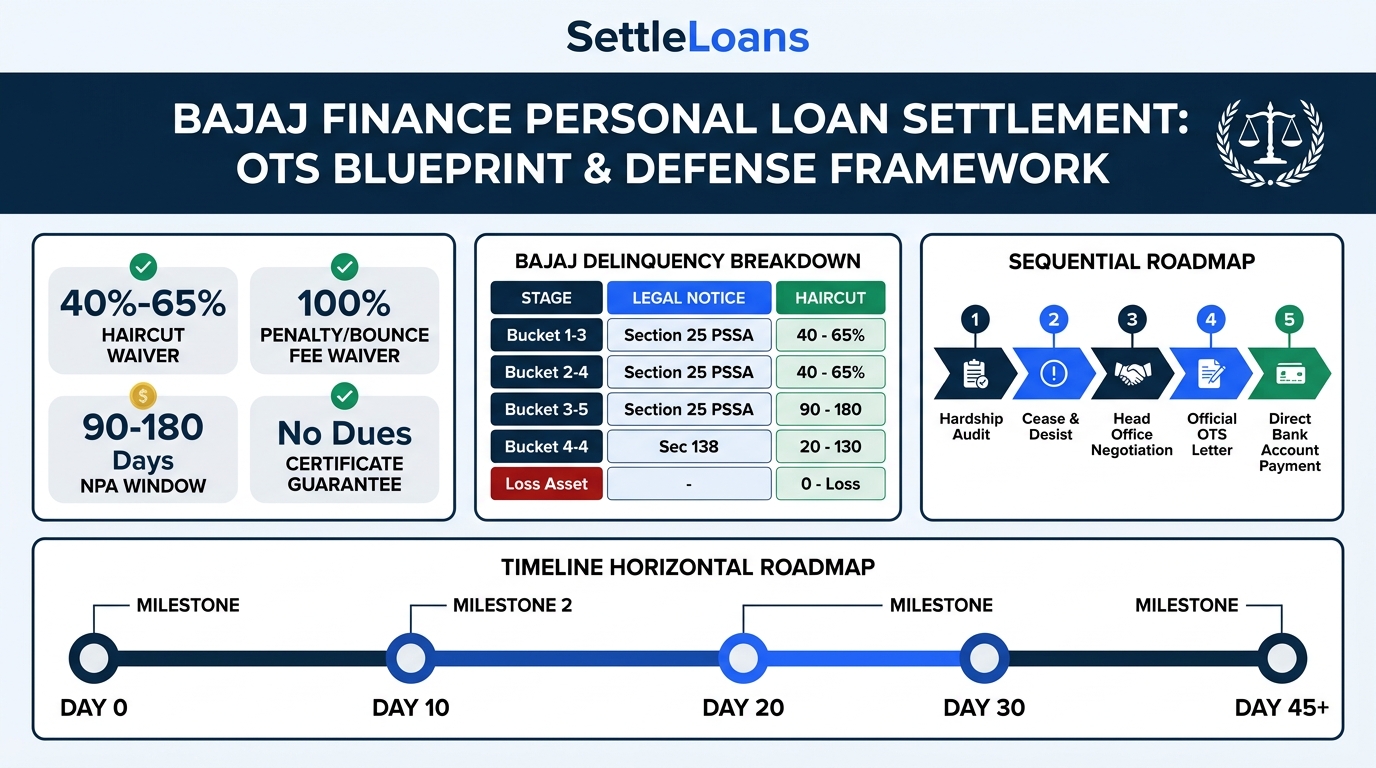
Bajaj Finance follows RBI Prudential Norms on Income Recognition, Asset Classification and Provisioning (IRACP). It also applies Expected Credit Loss (ECL) standards under Ind AS 109. Using these guidelines, Bajaj categorizes overdue retail loans into operational Days Past Due (DPD) buckets. Timing your settlement petition to match these stages is critical for maximizing debt waivers.
During the initial 60 days (Bucket 1 and 2), automated tele-callers push aggressively for overdue regularisation. Once default crosses 90 days, the account transitions into Non-Performing Asset (NPA) status. Bajaj Finance must then allocate balance-sheet capital provisioning, creating an institutional motivation to accept lump-sum compromise settlements that release locked reserves.
| Delinquency Bucket | Overdue Days (DPD) | Bajaj Recovery Action | Legal Exposure | Settlement Haircut Range |
|---|---|---|---|---|
| Bucket 1 (Early Stage) | 1 – 30 Days | Automated IVR calls, daily SMS alerts, NACH presentations. | Zero judicial risk; credit bureau overdue mark. | Very Low (NBFC demands regularizing EMI). |
| Bucket 2 (Mid Stage) | 31 – 60 Days | Intensive tele-calling, field visits, loan acceleration notices. | NACH bounce notices; CIBIL score drop begins. | Low (Restructuring or tenure extension possible). |
| Bucket 3 (Pre-NPA Alert) | 61 – 90 Days | Doorstep visits, demand for overdue clearance, recall warnings. | Statutory Section 25 PSSA / Section 138 notices sent. | Moderate (Penal fee waiver talks start). |
| NPA (Substandard Asset) | 91 – 180 Days | Account categorized as NPA; transferred to external agencies. | Magistrate court summons under Sec 25 PSSA. | High (35%–50% Haircut achievable). |
| Doubtful / Loss Asset | 181 – 365+ Days | Managed by National Stressed Assets Desk; provisioning absorbed. | Civil recovery suits, Lok Adalat referrals, write-off. | Maximum (50%–65% Haircut achievable). |
When an account enters Doubtful Asset or write-off status, Bajaj Finance has recognized the accounting loss. A structured cash settlement delivers an immediate write-back to operating profits, enabling senior credit committees to sanction deep concessions.
Check Your Loan Settlement Options
Answer 2 quick questions to evaluate your settlement eligibility.
1. What type of loan do you want to settle?
How to Stop Bajaj Finance Bounce Charges & NACH Hits
Compounding bounce penalties represent a severe hazard for delinquent Bajaj Finance borrowers. When an EMI mandate bounces, the destination bank deducts ₹250 to ₹500 plus GST, while Bajaj Finance levies an internal penalty of ₹450 to ₹1,000+. When the lender presents the debit mandate two or three times monthly, peripheral charges rapidly total thousands of rupees.
Under RBI's Fair Lending Practice directives on penal charges (2023), lenders cannot capitalize penal levies or charge compounding default interest. Distressed borrowers can halt this financial drain through two decisive steps:
First, borrowers have strong statutory rights under NPCI regulations and RBI consumer protection guidelines. You can instruct your destination bank in writing or through net banking to cancel or suspend the e-NACH mandate. This prevents recurring bounce penalties.
Second, during formal OTS talks, legal counsel must demand a 100% waiver of all accumulated bounce fees, late charges, and penal interest. In approved compromise settlements, Bajaj Finance completely wipes out these levies, focusing solely on the discounted core principal balance.
Bajaj Finance One-Time Settlement (OTS) & Haircut Valuation Matrix
Under the RBI Master Direction on Compromise Settlements (DOR.STR.REC.20/21.04.048/2023-24), Bajaj Finance maintains a board-approved compromise settlement framework. Rather than acting on arbitrary discretion, the NBFC evaluates proposals using a mathematical Net Present Value (NPV) recovery methodology.
Because unsecured personal and Flexi loans carry no attached collateral, Bajaj Finance balances an immediate cash settlement against the discounted future recovery of protracted litigation or arbitration, net of legal fees and overhead.
The NBFC Net Present Value (NPV) Settlement Equation
For Doubtful or Loss accounts with large ECL provisioning recognized, accepting a 40% to 55% settlement generates a direct positive cash write-back, making compromise settlements financially superior to prolonged litigation.
Realistic Bajaj Finance Settlement Haircut Slabs by Product & Aging
| Credit Product Category | Delinquency Aging | Bounce & Penal Waiver | Principal Haircut | Target Settlement Offer |
|---|---|---|---|---|
| Bajaj Unsecured Personal Loan | 90 – 180 Days (NPA) | 100% Waived | 30% – 45% Waiver | Offer 40% of Book Dues |
| Bajaj Unsecured Personal Loan | 181 – 365+ Days (Doubtful) | 100% Waived | 45% – 65% Waiver | Offer 30% – 35% of Book Dues |
| Bajaj Flexi Term / Dropline Loan | 90 – 180 Days | 100% Waived | 25% – 40% Waiver | Offer 45% of used Dues |
| Bajaj Insta EMI Card / Consumer Loan | 180+ Days (Written Off) | 100% All Penal Charges | 50% – 70% Waiver | Offer 25% – 35% of Dues |
Defending Against Aggressive Recovery Under RBI Directives
Bajaj Finance deploys extensive third-party Debt Recovery Agencies (DRAs) whose field personnel operate under commission incentives. In distress situations, these agents often overstep legal boundaries through persistent calling, unannounced workplace visits, and contacting non-guarantor relatives or colleagues whose numbers were collected during digital onboarding.
The RBI Master Direction on Recovery Agents and NBFC Fair Practices Code establish strict legal protections: (a) Agents may only contact borrowers between 08:00 AM and 07:00 PM. (b) Contacting employers, colleagues, neighbors, or family members is strictly unlawful. (c) Intimidation, abusive language, or public shaming is strictly prohibited. (d) Visiting personnel must produce an official Bajaj Finance ID and an IIBF DRA certification.
Borrowers encountering harassment should document all incidents and issue a formal legal cease-and-desist notice to Bajaj Finance's Principal Nodal Officer (PNO) in Pune. Escalating documented violations on the RBI Integrated Ombudsman portal (CMS) triggers immediate regulatory scrutiny and compels the NBFC to enforce professional conduct.
Step-by-Step Guide: Compromise Settlement with Bajaj Finance
Navigating a compromise settlement with Bajaj Finance requires structured financial preparation and firm legal representation:
1Financial Audit & Hardship Compilation
Assemble verifiable evidence of involuntary financial disruption, including severance letters, medical treatment records, or audited loss statements. Consecutive bank statements showing depleted liquidity prove default is non-wilful.
2Revoking NACH Mandates & Channeling notice
Stop NACH debit presentations at your bank to eliminate return charges. Direct all settlement discussions in writing to Bajaj Finance's Zonal Stressed Assets Desk.
3Submitting Formal Hardship Representation
Submit a structured OTS petition citing the RBI Master Direction on Compromise Settlements. Anchor an opening settlement offer at 25% to 35% of total ledger dues.
4Managing Counter-Demands & talks
Reiterate the absence of disposable income and show settlement funds are pooled from third-party relatives, steering the committee toward target 40% to 55% approvals.
5Rigorous Sanction Letter Audit
Verify an official OTS Sanction Letter on Bajaj Finance Limited letterhead containing loan account details, exact settlement figures, payment deadlines, and full debt extinguishment covenants.
6Direct Account Payment & Securing ₹0 NDC
Remit the settlement sum directly into your official Bajaj Finance loan account through RTGS/NEFT. Under RBI Circular RBI/2023-24/60, Bajaj Finance must issue a No Dues Certificate within 30 calendar days.
Section 25 PSSA Notices, Arbitration & Lok Adalat
When a personal loan crosses 60 to 90 days of default, Bajaj Finance issues statutory demand notices. These notices fall under Section 25 of the Payment and Settlement Systems Act, 2007 (PSSA) for dishonoured NACH mandates. The lender may also dispatch notices invoking private arbitration.
A Section 25 PSSA notice is a statutory precursor to a Magistrate Court complaint, not an arrest warrant. Responding through an advocate detailing genuine hardship and contesting improper mandate presentations protects your legal standing while establishing conciliation channels.
also, Bajaj Finance regularly participates in quarterly National Lok Adalats organized by District Legal Services Authorities (DLSA) under the Legal Services Authorities Act, 1987. In Lok Adalat sessions, NBFC agents carry pre-approved settlement mandates (often 45% to 65% haircuts). The resulting settlement award holds the power of a binding Civil Court Decree with non-appealable finality.
| Resolution Channel | Legal Mechanism | Haircut Potential | Speed | Legal Binding |
|---|---|---|---|---|
| Direct NBFC OTS | Compromise agreement under RBI Master Directions. | 40% – 65% Debt Haircut | 15 to 30 Days | Binding private contract with ₹0 NDC. |
| National Lok Adalat | Judicial conciliation before sitting judge and panel. | 45% – 65% Debt Haircut | Single-day session | Civil Court Decree (Zero appeal). |
| Arbitration Defense | Contesting unilateral arbitration in distant venues. | Variable (Transfers to OTS) | 3 to 9 Months | Subject to Section 34 challenge. |
| Section 25 / 138 Defense | Magistrate court compoundable cases defense. | 35% – 55% Debt Haircut | 2 to 6 Months | Formal withdrawal and case disposal. |
Authenticating Bajaj Settlement Letters & Enforcing NDC
A major hazard in retail debt recovery involves rogue collection agents issuing unverified settlement letters to collect partial payments. If funds are paid against an unauthorized letter, Bajaj Finance credits the money toward accumulated penal interest, leaving the core default open.
Borrowers must carefully verify the OTS sanction letter. Ensure it is printed on official Bajaj Finance Limited letterhead. The document must show the Corporate Identification Number (CIN) and the Pune registered office address. It must also feature a unique proposal reference number and the authorized officer's signature with employee ID.
The letter must explicitly declare that upon payment of the agreed sum, the account is fully discharged with zero further liability. Under RBI Circular RBI/2023-24/60, Bajaj Finance must deliver the No Dues Certificate (NDC) and cancel all security mandates within 30 days, or pay mandatory statutory relief of ₹5,000 per day of delay.
CIBIL Score Trajectory & 18-Month Recovery Plan
Completing a settlement with Bajaj Finance leads to the account being reported to all credit bureaus (CIBIL, Experian, Equifax, CRIF High Mark) as 'Settled' or 'Post-Write-off Settled' with an outstanding balance of exactly ₹0. This causes an initial credit score drop of 75 to 150 points.
Under RBI compromise directives, a mandatory 12-month cooling-off period applies before fresh unsecured loans can be granted. However, a 'Settled' record with ₹0 balance is far better than an active 'Default' status that degrades credit scores every month and attracts litigation.
Borrowers can restore their credit profile to 750+ within 18 to 24 months. You can start by acquiring a fixed-deposit-backed credit card (FD card). Maintain credit use strictly under 25%. In addition, ensure prompt payments on all living expenses and secured debts.
Why Distressed Bajaj Finance Borrowers Trust SettleLoans
Negotiating a debt settlement with an automated, aggressive lender like Bajaj Finance requires experienced legal defense. SettleLoans halts collection harassment through formal cease-and-desist notices, defends against Section 25 PSSA notices, and negotiates directly with Bajaj Finance's Zonal Stressed Assets Committees to achieve maximum lawful debt waivers.

Settle Loan is India's trusted debt relief and loan settlement platform. We help borrowers overcome financial distress by negotiating with banks and NBFCs to legally settle personal loans and credit card debts. With our transparent, performance-based approach, you can achieve debt freedom and regain your financial peace of mind.
COMPUTER
FAQs: Bajaj Finance Personal Loan Settlement
The Bajaj Finance personal loan settlement process is a formal compromise sanctioned under Reserve Bank of India Master Directions on Compromise Settlements. When an unsecured personal loan, Flexi loan, or EMI card defaults beyond 90 days into NPA status, the borrower submits a hardship petition to Bajaj Finance's Credit Committee. Upon evaluating the borrower's insolvency against the Net Present Value (NPV) of legal recovery, Bajaj issues an official OTS Sanction Letter. Paying the agreed amount directly into the loan account extinguishes the remaining debt, dismisses legal actions, and entitles the borrower to a ₹0 No Dues Certificate (NDC).
Bajaj Finance frequently presents electronic NACH mandates multiple times a month, multiplying return fees. To stop these charges: (1) Instruct your destination bank in writing or online to cancel or suspend the e-NACH mandate under NPCI guidelines. (2) Send a formal hardship notice to Bajaj requesting a pause on electronic debit sweeps. (3) Demand a 100% waiver of all accumulated bounce fees and penal interest under RBI penal charge directives during One-Time Settlement talks.
On unsecured personal loans and Flexi facilities, Bajaj Finance typically approves debt waivers between 40% and 65% of total book dues. The achievable haircut depends on delinquency aging and balance-sheet provisioning. Accounts overdue beyond 180 days (Doubtful or Loss status) qualify for maximum discounts (55% to 65%), along with 100% waiver of bounce penalties and penal interest.
Under RBI Master Directions on Recovery Agents and Fair Practices Code, borrowers have enforceable protections: (a) Agents can only call or visit between 08:00 AM and 07:00 PM. (b) Contacting employers, colleagues, or non-guarantor relatives is strictly illegal. (c) Abusive language, threats, or persistent calling is prohibited. To stop harassment, serve a formal cease-and-desist notice to the Bajaj Principal Nodal Officer and file an RBI CMS complaint.
No. Defaulting on an unsecured personal loan is strictly a civil contractual dispute under the Indian Contract Act, 1872. The police cannot register an FIR or arrest you for genuine financial insolvency. If NACH mandates bounce, Bajaj Finance may issue court summons under Section 25 PSSA or Section 138 NI Act, which are civil-court matters resolved through advocate representation and compromise settlement.
A Section 25 PSSA notice is a statutory 15-day demand letter sent after an electronic NACH mandate dishonours due to insufficient funds. It is not an arrest warrant. Borrowers should reply through counsel explaining hardship, contest unauthorized multiple presentations, and use the forum or National Lok Adalat to negotiate a binding OTS.
Under Bajaj Finance's Delegation of Financial Powers matrix, external tele-callers and field recovery agents have zero legal authority to approve debt waivers. Substantive principal haircuts (40% to 65%) must be approved by the Zonal Credit Committee, National Stressed Assets Desk, or Chief Risk Officer division, backed by a stamped sanction letter from corporate headquarters.
After the settlement amount is paid, Bajaj Finance updates credit bureaus (CIBIL, Experian, Equifax, CRIF High Mark) to 'Settled' with an outstanding balance of ₹0. This causes an initial credit score drop of 75 to 150 points and a 12-month cooling period. However, 'Settled' status permanently stops DPD compounding and legal flags, and scores can be rebuilt to 750+ within 18 to 24 months.
Follow five safety rules: (1) Never pay on verbal or WhatsApp promises. (2) Demand an authentic OTS Sanction Letter on Bajaj Finance Limited letterhead with employee code and seal. (3) Verify the full debt discharge clause. (4) Deposit funds solely into your official Bajaj loan account via NEFT/RTGS. (5) Retain bank payment receipts and secure the formal No Dues Certificate.
Under RBI Circular RBI/2023-24/60, Bajaj Finance is legally required to issue a formal No Dues Certificate (NDC) and update credit bureaus within 30 calendar days of receiving final payment. If the lender fails to issue the NDC within 30 days, it must pay statutory relief of ₹5,000 for each day of delay directly to the borrower.
Official Regulatory References & Statutory Circulars
- Reserve Bank of India (RBI): Master Direction on Compromise Settlements and Technical Write-offs (DOR.STR.REC.20/21.04.048/2023-24)
- RBI Master Circular: Fair Practices Code for Non-Banking Financial Companies (NBFCs) & Outsourcing of Financial Services
- Bajaj Finance Limited: Fair Practices Code & Grievance Redressal Mechanism / Principal Nodal Officer Matrix
- Reserve Bank - Integrated Ombudsman Scheme, 2021: Online Portal for Complaints on NBFC Harassment, Excessive Bounce Fees & NDC Delays
- National Legal Services Authority (NALSA): Legal Services Authorities Act, 1987 — National Lok Adalat Conciliation Framework