HDFC Bank Retail Loans & Default Dynamics
HDFC Bank Limited is the cornerstone of India's private retail credit market, managing an expansive loan book spanning unsecured personal loans, pre-approved InstaLoans, Jumbo loans linked to credit cards, and digital revolving credit facilities. These credit products are extended without any underlying physical security or mortgage backing. so, HDFC Bank safeguards its capital through algorithmic risk modeling, stringent credit bureau cutoffs, and automated NACH mandate sweeps.
The institutional collection mechanism of HDFC Bank is structured for rapid escalation upon the first instance of payment failure. When an equated monthly installment fails to clear on the designated cycle date, automated ledger triggers activate immediately. They start compounding late fees and penal interest of 24% to 36% annually. In addition, algorithmic risk flags restrict existing credit card limits across the borrower's entire CIF.
Borrowers facing severe personal disruptions—such as sudden corporate layoffs, catastrophic critical illness, business liquidation, or macroeconomic insolvencies—frequently experience an acute debt trap where compounding penal charges outpace their realistic debt servicing ability. Under Indian law and the governing Reserve Bank of India (RBI) directives, genuine financial failure is fundamentally recognized as a civil contractual dispute rather than a criminal dereliction.
HDFC's Default Timeline: From SMA-0 to NPA Classification
Understanding how HDFC Bank classifies delinquent retail debt under the Reserve Bank of India's Prudential Norms on Income Recognition, Asset Classification and Provisioning (IRACP) is vital for timing a compromise settlement. An overdue personal loan progresses through five administrative and regulatory tiers, each dictating the bank's internal recovery posture and legal authority to grant principal concessions.
During the initial Special Mention Account (SMA-0 and SMA-1) periods, covering the first 60 days of non-payment, the bank treats the overdue balance as an operational delinquency managed primarily by centralized tele-calling desks. When an account reaches SMA-2 status (61 to 90 days past due), HDFC Bank dispatches pre-NPA warnings and loan recall intimations. This signals the final opportunity for standard restructuring before the account is classified as a Non-Performing Asset.
| Delinquency Stage | Overdue Days (DPD) | HDFC Internal Action | Legal Exposure | OTS Viability |
|---|---|---|---|---|
| SMA-0 (Early Warning) | 1 – 30 Days | Automated SMS, WhatsApp reminders, soft IVR calls, late payment levy (₹500–₹1,000 + GST). | Zero legal risk. Contractual interest accumulation. | Very Low (Bank insists on regularizing EMI). |
| SMA-1 (Mid Delinquency) | 31 – 60 Days | Intensive tele-calling by HDFC internal collections team. Branch level loan follow-ups. | NACH bounce notices. Credit score starts dropping. | Low (Restructuring or tenure extension may be offered). |
| SMA-2 (Pre-NPA Alert) | 61 – 90 Days | Final pre-NPA warnings. Demands for immediate lump-sum payment of overdue tranches. | Formal loan recall notices dispatched via registered post / email. | Moderate (Interest waiver discussions possible). |
| NPA (Substandard Asset) | 91 – 180 Days | Account classified as Non-Performing Asset (NPA). Transferred to external Debt Recovery Agencies (DRAs). | Summons under Section 25 PSS Act (NACH) or Section 138 NI Act (Cheque bounce). | High (35%–50% Haircut achievable). |
| Doubtful-1 (D1) / Loss Asset | 181 – 365+ Days | Transferred to Stressed Assets Resolution Group (SARB). 100% balance-sheet provisioning absorbed. | Civil recovery suit / Arbitration clause invocation / Lok Adalat referral. | Maximum (50%–65% Haircut achievable). |
Once an account breaches the mandatory 90-day overdue threshold, HDFC Bank is legally required to classify the loan as an NPA and allocate capital provisioning against its balance sheet. In the Substandard and Doubtful-1 stages, the bank must set aside large provisioning reserves. This requirement creates a strong incentive for credit officers to accept upfront cash settlements. A settlement immediately releases locked capital back to operating profitability.
Check Your Loan Settlement Options
Answer 2 quick questions to evaluate your settlement eligibility.
1. What type of loan do you want to settle?
HDFC's Internal One-Time Settlement (OTS) & Haircut Policy
Under the regulatory framework mandated by the Reserve Bank of India Master Direction on Compromise Settlements and Technical Write-offs (DOR.STR.REC.20/21.04.048/2023-24), HDFC Bank operates a board-approved Compromise Settlement Policy. Rather than relying on arbitrary discretion, the bank's Credit Committees evaluate settlement proposals through a standardized mathematical Net Present Value (NPV) recovery methodology.
The core principle of the NPV formula compares the immediate, guaranteed lump-sum settlement sum against the present discounted value of uncertain recoveries achieved through protracted civil litigation over four to seven years. Because unsecured retail personal loans carry no attached immovable collateral, litigating through civil courts or arbitration yields low recovery ratios after accounting for senior advocate retainers, court processing charges, and the time value of money.
The Banking Net Present Value (NPV) Settlement Equation
When evaluating an OTS request, the HDFC Credit Committee calculates whether the immediate cash offer exceeds the discounted recovery probability:
When an account is in Doubtful or Loss Asset classification with full provisioning recognized, a 40% to 55% settlement yields an immediate cash write-back to HDFC's profit statement. This makes compromise settlements financially superior to prolonged legal battles.
The achievable haircut percentage is directly correlated with the verifiable severity of the borrower's hardship and the delinquency aging of the loan file. For unsecured personal loans and credit cards overdue beyond 180 days, HDFC Bank routinely waives 100% of accrued penal interest, late payment surcharges, and legal levies. It also approves a 40% to 65% reduction on the underlying principal balance.
Typical HDFC Settlement Haircut Slabs by Product & Aging
| Credit Facility Type | Overdue Aging | Penal Interest Waiver | Principal Haircut Slabs | Recommended Target Offer |
|---|---|---|---|---|
| HDFC Unsecured Personal Loan | 90 – 180 Days | 100% Waived | 25% – 40% Principal Waiver | Offer 35% of Total Book Dues |
| HDFC Unsecured Personal Loan | 181 – 365+ Days (D1/Loss) | 100% Waived | 40% – 65% Principal Waiver | Offer 30% – 40% of Total Book Dues |
| HDFC Credit Card / Jumbo Loan | 90 – 180 Days | 100% Late & Finance Charges | 30% – 50% Principal Waiver | Offer 35% of Total Statement Dues |
| HDFC Credit Card / InstaLoan | 181+ Days (Written Off) | 100% All Penal Surcharges | 50% – 70% Principal Waiver | Offer 25% – 35% of Total Statement Dues |
HDFC Recovery Agent Practices, Harassment Defense & RBI Compliance
When an HDFC Bank retail loan breaches 90 days of non-payment, the account is transferred from internal tele-calling executives to outsourced Debt Recovery Agencies (DRAs). Because external recovery personnel operate on recovery-linked commission incentives, aggressive and unauthorized tactics frequently occur, including relentless calling, unscheduled residential visits, and intimidating notices directed at relatives or employers.
The Reserve Bank of India has established comprehensive statutory regulations through its Master Direction on Recovery Agents and the Fair Practices Code. These binding guidelines protect borrowers against aggressive recovery tactics. Collection agents are strictly prohibited from calling before 08:00 AM or after 07:00 PM. They cannot share debt details with family members, visit workplaces to cause embarrassment, or use abusive language.
Borrowers must understand their legal remedies when dealing with overreaching collection agents. Every borrower holds the statutory right to demand the agent's physical Indian Institute of Banking & Finance (IIBF) DRA Certification and an official letter of authority issued by HDFC Bank. Any non-compliance can be immediately documented with call recordings and escalated directly to HDFC's Principal Nodal Officer and the Reserve Bank Integrated Ombudsman Scheme for swift corrective action and penalty cases against the lending institution.
Step-by-Step Guide: How to start & Negotiate Settlement with HDFC Bank
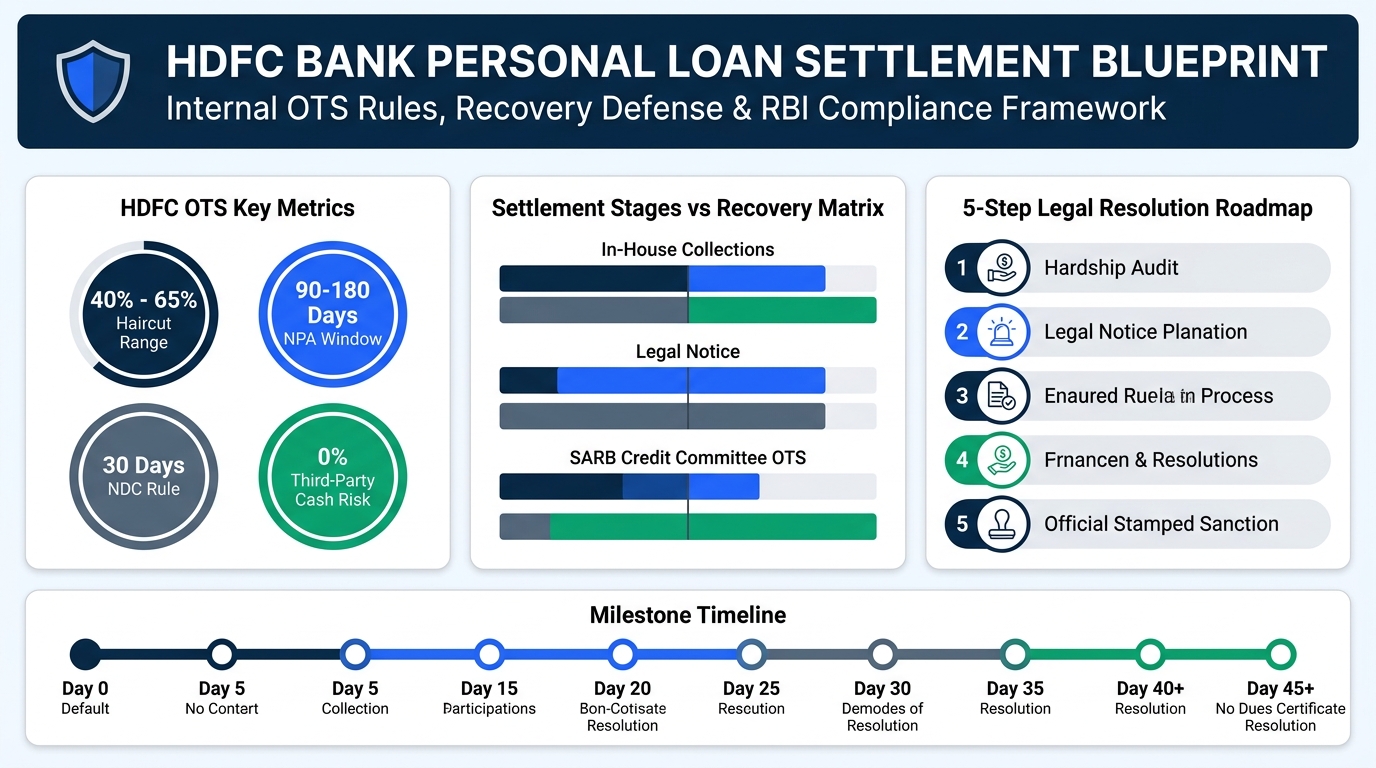
Navigating a high-stakes compromise settlement with HDFC Bank requires strategic legal coordination. Following this tested sequential roadmap ensures optimal financial relief while safeguarding your legal position at every milestone:
1Comprehensive Financial Audit & Hardship Evidence Compilation
HDFC Bank's Credit Committee will not consider informal or unsupported requests for debt forgiveness. You must assemble an indisputable evidentiary dossier establishing legitimate income destruction. This dossier includes corporate severance notices, termination letters, medical diagnosis certificates, catastrophic hospitalization invoices, or audited financial statements documenting complete commercial insolvency.
Coupling this with six months of bank statements illustrating negligible cash inflows clearly shows that default is involuntary, shielding the borrower from wilful default tagging.
2Neutralizing External Agencies & Establishing Direct Banking Jurisdiction
A frequent strategic mistake made by distressed borrowers is attempting to negotiate settlement numbers with outsourced collection agents. These agents lack legal authority to issue debt waivers and often promise verbal discounts to collect partial payments that are then applied to overdue interest.
Borrowers must immediately issue a formal notice directing all discussions to the Branch Manager and the Stressed Assets Resolution Group (SARB), effectively eliminating third-party commission markups from the talks table.
3Submitting the Formal Compromise Settlement Proposal
The formal OTS application must be formally addressed to the Competent Credit Authority, citing the Reserve Bank of India Master Direction on Compromise Settlements. The application should provide a detailed breakdown of historical repayments to establish good faith, articulate the specific hardship event, and present an opening settlement offer.
Strategically anchoring the opening offer at 25% to 35% of the total outstanding ledger balance creates necessary bargaining room to close talks within the target 40% to 55% settlement band.
4Managing Counter-Demands & Credit Committee talks
Upon receiving the proposal, HDFC's settlement desk will typically present a conservative counter-demand requiring 70% to 80% of book dues. This initial response is a standard institutional probe to test the debtor's liquidity.
Borrowers must maintain firm legal footing throughout talks. Reiterate the total absence of disposable income. Highlight that the proposed settlement capital is provided by third-party relatives exclusively for a one-time discharge. This guides the committee toward realistic haircut approvals.
5Rigorous Audit of the Stamped OTS Sanction Letter
Before releasing a single rupee, the borrower must receive and meticulously audit an official OTS Sanction Letter printed on HDFC Bank letterhead. The document must explicitly stipulate the exact compromise figure, precise remittance deadlines, and an unconditional covenant confirming that all residual principal, penal interest, and incidental legal fees will be permanently extinguished upon payment.
The sanction letter must also include an explicit undertaking from HDFC Bank to withdraw any pending litigation or statutory cheque bounce cases.
6Direct Account Remittance & Securing the ₹0 No Dues Certificate
The sanctioned settlement amount must be remitted strictly through verifiable banking channels (RTGS, NEFT, or Account Payee draft) directly into the designated HDFC loan account number. Third-party intermediary or collection agency accounts must never be used under any situations.
Under Reserve Bank of India Circular RBI/2023-24/60, HDFC Bank is legally mandated to complete full account closure and issue an official No Dues Certificate (NDC) within 30 calendar days of receiving full payment.
HDFC OTS vs Loan Restructuring vs National Lok Adalat
Distressed borrowers often face the dilemma of choosing between a One-Time Settlement, formal loan restructuring, or participating in judicial conciliation through the National Lok Adalat. Each mechanism carries distinct legal consequences, financial requirements, and credit bureau reporting outcomes that must be evaluated against the debtor's realistic earning trajectory.
Loan restructuring is designed primarily for borrowers experiencing temporary liquidity disruptions who retain reliable future earning capacity. Under restructuring, HDFC Bank extends the overall repayment tenure or converts accumulated unpaid interest into a funded interest term loan. However, restructuring provides zero reduction on the underlying principal debt, and the total lifetime interest burden frequently increases significantly.
Conversely, the National Lok Adalat represents a statutory dispute resolution forum organized under the Legal Services Authorities Act, 1987. During Lok Adalat sessions, HDFC Bank empowers legal officers with pre-approved settlement discount mandates (often 45% to 65% haircuts) to dispose of non-performing retail portfolios. An award passed by the Lok Adalat holds the status of a binding Civil Court decree with absolute finality, prohibiting any future appeal or claim by the lender.
| Key Parameter | One-Time Settlement (OTS) | Loan Restructuring | National Lok Adalat |
|---|---|---|---|
| Core Objective | Permanent debt cancellation via negotiated lump-sum payment. | Modifying repayment tenure / EMI to keep account standard. | Judicial conciliation and settlement before court panel. |
| Principal Haircut | 40% – 65% Principal Waiver achievable. | 0% Principal Waiver (Full principal remains payable). | 45% – 65% Haircut on standardized bank slabs. |
| Upfront Capital Needed | Moderate to High (Lump-sum within 15–30 days). | Low (Resumes regular monthly installments). | Moderate (Payable in 1 to 3 judicial tranches). |
| Legal Status | Private contract under RBI Compromise Directives. | Contract amendment under regular banking norms. | Binding Civil Court Decree with zero appeal right. |
| CIBIL Reporting | Reported as 'Settled' with ₹0 balance. | Reported as 'Restructured'. | Reported as 'Settled via Lok Adalat' with ₹0 balance. |
| Best Suited For | Borrowers with permanent income loss / severe hardship. | Borrowers facing temporary cash crunch with stable future jobs. | Borrowers already facing Section 138/25 legal notices. |
Critical Checklist for HDFC Settlement Sanction Letters & ₹0 NDC Verification
A recurring hazard in retail debt recovery involves rogue collection agents issuing fraudulent or unauthorized settlement letters to induce token payments. If a payment is remitted against an invalid letter, HDFC Bank will credit the sum as a standard part-payment toward accumulated penal charges, leaving the loan open and litigation active.
To guarantee complete legal validity, every borrower must verify that the sanction letter is printed on official HDFC Bank stationery featuring the bank's corporate watermark, the physical address of the sanctioning retail asset branch. also, the explicit physical or digital signature of an authorized officer accompanied by their official employee code.
Crucially, the body of the letter must contain unambiguous legal covenants. It must state that the agreed settlement sum constitutes full and final satisfaction of all claims, permanently extinguishing all residual liabilities. also, under RBI Circular RBI/2023-24/60, HDFC Bank must release all closure certificates within 30 calendar days. The bank is liable for statutory penalties of ₹5,000 per day payable to the borrower for operational delays attributable to the bank.
Impact on CIBIL Score & Long-Term Credit recovery Post-HDFC Settlement
Distressed borrowers often worry about the long-term credit bureau consequences of a settlement. Following receipt of the final settlement tranche, HDFC Bank must update all four authorized credit bureaus: TransUnion CIBIL, Experian, Equifax, and CRIF High Mark. The bank modifies the account status from 'Default' or 'Suit Filed' to 'Settled' or 'Post-Write-off Settled' with an outstanding balance of exactly ₹0.
A 'Settled' remark lowers your CIBIL score by 75 to 150 points. It also triggers a 12-month cooling period under RBI guidelines before fresh credit can be obtained. However, it permanently halts month-on-month credit degradation caused by compounding Days Past Due (DPD) counters. Eliminating active default tags is the foundational first step toward regaining financial freedom.
Rebuilding a credit profile post-settlement is a systematic process achievable within 18 to 24 months. Borrowers can systematically rebuild credit post-settlement. Obtain a secured credit card backed by a modest fixed deposit. Maintain credit use strictly below 25%, and service utility bills punctually. This steady payment history elevates your credit score back to the 750+ threshold.
Why Distressed HDFC Borrowers Choose SettleLoans
Negotiating an equitable compromise settlement with a major financial institution like HDFC Bank requires experienced banking litigation counsel. The legal strategists at SettleLoans provide comprehensive debt defense. We halt third-party harassment through formal cease-and-desist notices and audit NPA provisioning allocations. also, we directly engage HDFC's Zonal Settlement Committees to secure the maximum legally permissible debt waiver.
Direct access to HDFC Stressed Assets Resolution Branches in Mumbai, Delhi, Bengaluru, and Chennai, bypassing third-party collection agencies for accounts exceeding ₹5 Lakhs.
Custom compromise formulas for HDFC credit card Jumbo loans and SmartDraft overdraft lines, ensuring principal-focused haircuts under RBI Master Directions.
Enforcing Indian Banks' Association (IBA) code of conduct against HDFC empanelled recovery agents, halting calling outside 8 AM - 7 PM and workplace visit violations.

Settle Loan is India's trusted debt relief and loan settlement platform. We help borrowers overcome financial distress by negotiating with banks and NBFCs to legally settle personal loans and credit card debts. With our transparent, performance-based approach, you can achieve debt freedom and regain your financial peace of mind.
COMPUTER
Frequently Asked Questions About HDFC Personal Loan Settlement
The HDFC Bank personal loan settlement process is a formal legal compromise agreement between HDFC Bank Limited and a distressed borrower who is genuinely unable to repay their outstanding unsecured loan. When a loan crosses 90 to 180 days of non-payment, it transitions into Non-Performing Asset (NPA) status. At this stage, the borrower can submit a formal One-Time Settlement (OTS) proposal. The proposal must be supported by verifiable hardship proof, such as job loss, medical catastrophe, or business failure. HDFC's internal Stressed Assets Resolution Group (SARB) or Competent Credit Committee evaluates the account's recovery potential using a Net Present Value (NPV) formula. If approved, HDFC issues an official stamped OTS Sanction Letter. Upon direct payment of the agreed settlement amount into the loan account, the bank extinguishes the residual debt, closes all legal cases, and issues a ₹0 No Dues Certificate (NDC).
On unsecured personal loans, Jumbo loans, and credit cards, HDFC Bank typically approves debt haircuts ranging between 40% and 65% of the total ledger balance. The exact waiver percentage depends on: (1) Delinquency Aging: Accounts in deep default (over 180 to 365 days) where HDFC has already absorbed 50% to 100% balance-sheet provisioning qualify for higher discounts. (2) Hardship Verifiability: Rock-solid records proving total loss of livelihood or severe medical disability. (3) Direct Credit Committee talks: Eliminating third-party recovery commissions to negotiate directly with authorized bank managers. In virtually all approved settlements, 100% of penal interest, late fees, and bounce charges are completely waived alongside a large principal discount.
HDFC Bank operates a structured collection mechanism. It uses internal tele-calling teams for early delinquencies (1–60 days). Once an account enters NPA territory (90+ days), it assigns recovery to third-party Debt Recovery Agencies (DRAs). While HDFC maintains codes of conduct, third-party agents sometimes overstep legal boundaries. Under the RBI Master Directions on Recovery Agents (2022) and the RBI Fair Practices Code, borrowers have clear statutory rights. First, agents can only contact you between 08:00 AM and 07:00 PM. Second, abusive language and public shaming are strictly illegal. Third, agents cannot contact references, colleagues, or neighbors. Finally, they must present their bank authorization letter and DRA identity card upon visiting. Any breach can be reported to HDFC's Principal Nodal Officer (PNO) and the RBI Ombudsman.
No. Defaulting on an unsecured personal loan or credit card in India is strictly a civil dispute. It is governed by the Law of Contract (Indian Contract Act, 1872). It is not a criminal offence. The police have zero legal authority to register an FIR, arrest you, or summon you to a station for genuine insolvency. However, if your repayment cheques bounce or an automated NACH/ECS mandate fails, HDFC Bank can start legal cases. The bank has the statutory right to invoke Section 138 of the Negotiable Instruments Act, 1881, or Section 25 of the Payment and Settlement Systems Act, 2007. These cases originate from a Magistrate Court, not a police station, and can be resolved through counsel or settlement.
Under Section 171 of the Indian Contract Act, 1872 (Banker's Right of General Lien and Set-Off), HDFC Bank holds set-off powers. The bank is legally entitled to debit funds from any savings account, current account, or fixed deposit held with HDFC Bank under the same CIF or PAN to offset delinquent loan dues. However, HDFC Bank cannot legally freeze, access, or deduct funds from accounts held with other independent banks (such as SBI, ICICI Bank, Axis Bank, or Kotak Mahindra Bank). Doing so requires a specific attachment decree issued by a competent Civil Court or Debt Recovery Tribunal (DRT).
Under HDFC Bank's internal Delegation of Financial Powers (DoFP) matrix, collection agents and branch executives possess zero authority to grant loan waivers. Minor interest waivers (up to ₹25,000–₹50,000) on standard accounts may be handled at the Branch Manager level. However, substantive principal haircuts (40%–65%) on retail NPA portfolios are sanctioned exclusively by authorized verticals. These include the Stressed Assets Resolution Group (SARB), Regional Settlement Committees, or Zonal Credit Committees chaired by AVPs and Senior Credit Officers.
Following full remittance of the agreed OTS amount, HDFC Bank updates the account status across all four credit bureaus (CIBIL, Experian, Equifax, CRIF High Mark). The account is reported as 'Settled' or 'Post-Write-off Settled' with an outstanding balance of ₹0. This closure results in an initial CIBIL score reduction of about 75 to 150 points. also, under RBI directives, the borrower enters a 12-month cooling period before applying for fresh credit. Even so, a 'Settled' status with ₹0 dues is far better than an open, compounding default or 'Suit Filed' tag. Borrowers can steadily rebuild their CIBIL score back to 750+ within 18 to 24 months through secured credit cards and disciplined repayments.
Distressed borrowers must observe five strict safety rules: (1) Zero Verbal Agreements: Never pay a single rupee based on telephone calls, WhatsApp messages, or handwritten notes from collection executives. (2) Official Bank Letterhead: Demand an authentic OTS Sanction Letter printed on official HDFC Bank letterhead with bank seal and officer signature. (3) Direct Account Remittance: Pay only directly into your official HDFC Loan Account Number via RTGS/NEFT or account payee cheque—never into any third-party agency or person account. (4) Full Debt Extinguishment Clause: Confirm the letter explicitly states that upon receipt of the settlement sum, the loan account stands fully discharged with no further liability. (5) Instant Acknowledgment: Secure an official bank stamped receipt immediately upon payment.
Yes. HDFC Bank is one of the most active institutional participants in the National Lok Adalat, organized quarterly across India by District Legal Services Authorities (DLSA) under the Legal Services Authorities Act, 1987. During Lok Adalat sessions, HDFC Bank sends designated officers empowered with pre-approved settlement discount mandates (often 45% to 65% haircut). Settling via Lok Adalat offers large advantages: (a) The settlement award holds the status of a Civil Court Decree with absolute finality. (b) No appeal lies against the settlement in any court. (c) Any ongoing civil litigation or Section 138 complaint is formally disposed of on the spot.
under RBI Circular RBI/2023-24/60, HDFC Bank must adhere to strict post-settlement timelines. The bank is legally obligated to issue a formal No Dues Certificate (NDC) / Loan Closure Certificate. It must also update all credit bureaus within 30 calendar days of receiving the final settlement tranche. If HDFC Bank fails to complete the closure within 30 days due to internal delays, it faces penalties. The bank is legally required to pay statutory relief of ₹5,000 for each day of delay directly to the borrower.
Official Regulatory References & Statutory Circulars
- Reserve Bank of India (RBI): Master Direction on Compromise Settlements and Technical Write-offs (DOR.STR.REC.20/21.04.048/2023-24)
- RBI Master Circular: Fair Practices Code for Regulated Lending Entities & Engagement of Recovery Agents
- HDFC Bank Limited: Grievance Redressal Policy & Principal Nodal Officer (PNO) Escalation Matrix
- Reserve Bank - Integrated Ombudsman Scheme, 2021: Dispute Redressal Portal for OTS Non-Compliance, Coercive Recovery & NDC Delays
- National Legal Services Authority (NALSA): Legal Services Authorities Act, 1987 — National Lok Adalat Conciliation Framework