- Pure Civil Jurisdiction: Loan default is a contractual dispute. Local police stations cannot issue summons, register criminal FIRs, or assist private bank recovery agents.
- Statutory Account Shields: Section 60(1) CPC and Section 171 Contract Act prevent creditor institutions from executing unauthorized liens across external bank accounts.
- Hasthampatti Court Defense: Advocate replies to Section 138 NI Act and Section 25 PSSA notices neutralize arrest risks and shift disputes into Lok Adalat benches.
- Substantial OTS Haircuts (40% to 70%): Direct advocacy before Zonal Credit Committees achieves 40% to 70% principal waivers with 100% elimination of penal interest.
- Enforceable 30-Day NDC Delivery: Lenders must issue stamped No Dues Certificates within 30 days under RBI Circular RBI/2023-24/60 or incur a daily penalty of ₹5,000.
Western Tamil Nadu Manufacturing Hub & MSME Debt Realities
Salem is the industrial anchor of Western Tamil Nadu, powering vital manufacturing clusters: sago and starch merchants centered around SAGOSERVE in Shevapet, steel fabricators and foundry vendors supplying the Salem Steel Plant (SAIL) in Omalur, and powerloom weaving units in Gugai, Ammapet, and Elampillai. Connected closely with Namakkal poultry and truck logistics and Erode textile processing, this corridor operates on intricate trade credit cycles. When wholesale markets across Leigh Bazaar and Shevapet experience buyer delays, the entire supply chain absorbs intense liquidity pressure.
Recent disruptions in raw material pricing for cotton yarn and tapioca tubers, paired with delayed payments from major buyers, created intense liquidity shortages. To sustain operations, business owners and supervisors turned to unsecured personal loans, credit cards, and digital fintech lines. Compounding interest, penal charges, and bounce fees quickly turned temporary cash flow deficits into heavy debt burdens. Many entrepreneurs found themselves servicing multiple retail EMIs alongside commercial working capital facilities.
Third-party collection agencies operating around Meyyanur, Swarnapuri, and Five Roads often deploy unlawful pressure, including workplace visits and calls to commercial contacts. Borrowers must know that retail debt default due to genuine commercial distress is purely a civil matter under Indian contract law, entitling them to complete statutory protection against harassment.
Delinquency Lifecycle & Madras High Court Borrower Safeguards
Under the Reserve Bank of India framework, an unpaid personal loan progresses through Special Mention Account stages: SMA-0 (1 to 30 days overdue), SMA-1 (31 to 60 days), and SMA-2 (61 to 90 days). Beyond 90 days of non-payment, the loan is classified as a Non-Performing Asset (NPA) under the RBI Master Direction on Prudential Norms on Income Recognition, Asset Classification and Provisioning pertaining to Advances (IRACP). This transition directly impacts branch performance metrics and triggers mandatory recovery protocols.
Banks must set aside mandatory capital provisions: 15% for Substandard assets, rising to 25% to 40% for Doubtful debts, and 100% for Loss assets. To free trapped capital and improve balance sheet performance, banks establish One-Time Settlement (OTS) policies. This institutional requirement provides defaulting borrowers with substantial bargaining strength to secure negotiated haircuts. As provisioning percentages escalate, lender credit committees face heightened economic incentives to close delinquent accounts via compromise.
The Madras High Court has established definitive precedents regarding debt recovery in Tamil Nadu. The Court consistently ruled that lenders cannot employ muscular recovery tactics or publicly humiliate debtors. Lawful recovery must follow due judicial process, upholding the borrower constitutional right to dignity and privacy under Article 21.
Check Your Loan Settlement Options
Answer 2 quick questions to evaluate your settlement eligibility.
1. What type of loan do you want to settle?
Hasthampatti District Court Summons & Section 138/25 Defense
Following NPA classification, lenders frequently issue statutory demand notices through empanelled lawyers at the Combined District Court Complex in Hasthampatti, Salem. Creditors rely on Section 138 of the Negotiable Instruments Act, 1881 for dishonored cheques and Section 25 of the Payment and Settlement Systems Act, 2007 (PSSA) for failed NACH auto-debits.
Both statutes provide a mandatory 15-day cure window from notice receipt. Leaving notices unanswered risks criminal complaint filings before Judicial Magistrates at Hasthampatti, leading to summons or bailable warrants. In contrast, serving a formal advocate reply within 15 days establishes bona fide financial distress, challenges unlawful fees, and negates criminal intent.
Recovery agents often threaten arrest through police stations such as Hasthampatti, Shevapet, or Suramangalam. Under the Supreme Court ruling in Arnesh Kumar v. State of Bihar, police cannot detain citizens over commercial defaults. An advocate response protects against harassment and redirects the creditor toward compromise settlement.
Banker Lien Under Section 171 & Salary Account Protections
Creditor banks often invoke Section 171 of the Indian Contract Act, 1872 (Banker General Lien) to freeze or debit savings, fixed deposits, or current accounts to offset overdue personal loans. However, this lien is legally restricted to accounts held within the same banking network under the identical Customer Information File (CIF).
A lending bank has no statutory authority to attach or freeze accounts held at independent institutions such as Indian Bank, Canara Bank, or SBI without a court decree from a civil court or the DRT in Coimbatore. Furthermore, Section 60(1)(i) of the Code of Civil Procedure (CPC) expressly protects two-thirds of disposable salary from court attachment. SettleLoans assists borrowers in shielding their operational accounts and preserving living expenses.
Salem Loan Settlement Blueprint & Resolution Architecture
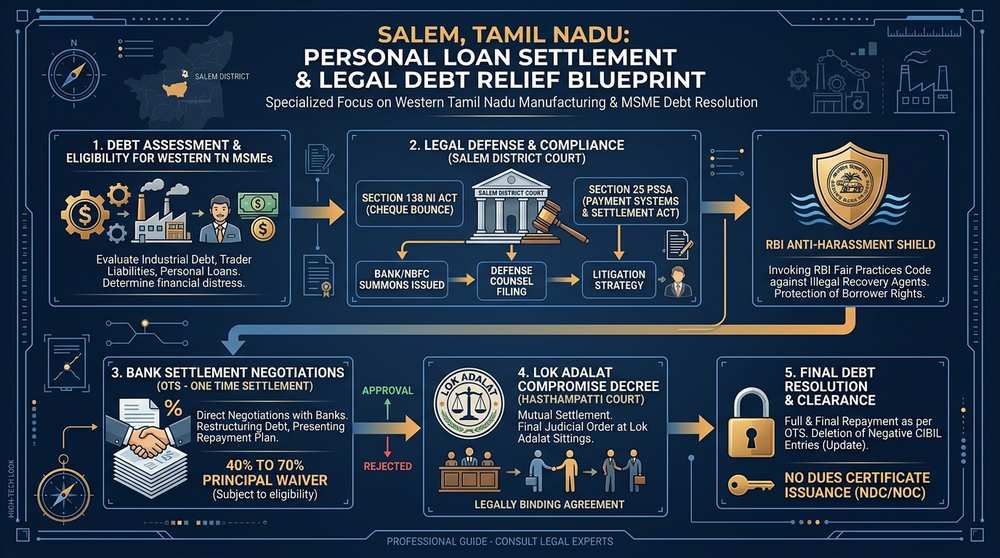
Bank OTS Policies & Net Present Value (NPV) Recovery Formula
Every commercial bank operates a Board-approved Compromise Settlement Policy governed by RBI guidelines. When evaluating an OTS proposal, Credit Committees use the Net Present Value (NPV) Recovery Valuation to measure immediate compromise cash against protracted litigation outcomes.
Where C_t represents estimated recoveries over time, r is the discount rate, and deductions account for 3–5 years of court friction in Salem courts, advocate fees, and locked capital provisioning.
Because clean personal loans carry no mortgage security under SARFAESI, banks face lengthy civil recovery proceedings that erode real financial returns. For major regional institutions like Indian Bank, Canara Bank, and Western Tamil Nadu NBFCs including Shriram Finance and Cholamandalam, recovery litigation involves significant legal overheads. Demonstrating this negative NPV allows SettleLoans advocates to secure 40% to 70% principal waivers and total write-offs of penal charges.
National Lok Adalat Conciliation at Salem Court Complex
Organized quarterly by the District Legal Services Authority (DLSA) Salem at the Combined Court Complex in Hasthampatti, National Lok Adalat benches provide statutory dispute resolution under the Legal Services Authorities Act, 1987. Banks frequently place distressed portfolios before these benches to clean balance sheets before regulatory audits.
Under Section 21 of the Legal Services Authorities Act, 1987, a Lok Adalat award is deemed a final Decree of a Civil Court. Under Section 21(2), no appeal lies against this award in any court. Once the agreed settlement sum is remitted, the lender is legally prohibited from reopening the debt, transferring balances to ARCs, or continuing court complaints.
Sanction Letter Forensics, 30-Day NDC & Credit Rehabilitation
A debt settlement must be supported by authentic documentation. Borrowers must never rely on verbal promises or informal messages from collection agents. An authentic OTS sanction letter must appear on official bank letterhead with branch seals, reference numbers, explicit debt extinguishment clauses, and written commitments to withdraw court cases.
Under RBI Circular RBI/2023-24/60, lenders are legally mandated to issue a No Dues Certificate (NDC) within 30 calendar days of final payment. Failure to do so incurs statutory compensation of ₹5,000 per day of delay. Credit bureaus update the record to 'Settled' with ₹0 balance, stopping overdue compounding. Borrowers can restore credit scores to 750+ within 18 to 24 months through disciplined secured credit management.
Comparative Matrix: Self-Negotiation vs. Legal Representation
The strategy chosen by a distressed borrower determines whether they attain complete financial closure or face persistent legal claims. The table below details the differences across common resolution pathways:
| Resolution Parameter | Unassisted Debtor | Third-Party Recovery Agent | SettleLoans Legal Advocacy |
|---|---|---|---|
| Negotiation Authority | Local Branch Desk (Minimal powers) | Commission Agent (Zero authority) | Zonal Committee / SAMB Desks |
| Average Principal Haircut | 10% to 20% (Interest waiver only) | 0% to 15% (Often misquoted) | 40% to 70% Principal & Charge Waiver |
| Protection from Harassment | None; persistent calls continue | Coercive field visits to workplace | Statutory Cease-and-Desist Notice |
| Court Notice Defense | Unrepresented; default risk | Ignored; causes bailable warrants | Formal Advocate Reply in 15 Days |
| Sanction Letter Authenticity | Unverified informal letter | High fraud risk via email drafts | Forensically Verified Bank Letterhead |
| NDC & Credit Bureau Closure | Frequent administrative delays | No post-payment tracking | Enforced 30-Day RBI NDC Delivery |
Empanelled Advocate Representation for Western Tamil Nadu Debt
Successfully resolving defaulted loans across Salem, Namakkal, and Erode requires a nuanced understanding of Western Tamil Nadu commercial dynamics, local court hierarchies, and RBI regulatory mandates. SettleLoans delivers specialized legal defense and financial representation, shielding your commercial reputation from aggressive recovery personnel and securing legally binding, stamped One-Time Settlements.

Settle Loan is India's trusted debt relief and loan settlement platform. We help borrowers overcome financial distress by negotiating with banks and NBFCs to legally settle personal loans and credit card debts. With our transparent, performance-based approach, you can achieve debt freedom and regain your financial peace of mind.
COMPUTER
Frequently Asked Questions on Salem Loan Settlement
Why do sago merchants and textile traders in Salem require specialized debt settlement advocates?
Wholesale merchants in Shevapet and powerloom operators in Gugai operate on elongated credit cycles. When buyer remittances lag, borrowers often take high-interest unsecured loans. Unregulated collection agencies exploit local trade standing through doorstep visits. Empanelled advocates enforce RBI Fair Practices codes, defend Section 138 notices in Hasthampatti courts, and negotiate formal OTS terms directly with bank Zonal Committees.
Can private banks or NBFCs freeze my business current account under Section 171 Banker Lien in Salem?
Under Section 171 of the Indian Contract Act, 1872, a lending institution has a general lien only on accounts held internally within its own branch network. A creditor bank cannot attach, debit, or freeze funds maintained at an external financial institution without an explicit attachment order from a competent Civil Court or the Debt Recovery Tribunal in Coimbatore.
Can recovery agents visit industrial units in Omalur or residential premises in Fairlands?
Under RBI Master Directions on Recovery Agents, lenders are strictly forbidden from visiting a borrower workplace or manufacturing facility without prior consent. Residential visits in areas like Fairlands or Alagapuram are restricted strictly between 08:00 and 19:00 hours. Agents must display authenticated bank credentials, and verbal intimidation warrants immediate regulatory complaints.
How should borrowers respond to Section 138 NI Act or Section 25 PSSA summons from Salem courts?
Borrowers must file a formal legal reply drafted by an advocate within 15 days of receiving statutory notice. The reply documents financial hardship, disputes arbitrary penalty compounding, and refutes fraudulent intent under Section 138 NI Act or Section 25 PSSA. Timely legal response avoids non-bailable warrants and routes disputes to Lok Adalat.
How does the National Lok Adalat at the Combined Court Complex in Hasthampatti settle debts?
Organized under the District Legal Services Authority (DLSA) Salem, Lok Adalat sittings facilitate compromise settlements between lenders and borrowers. Under Section 21 of the Legal Services Authorities Act, 1987, a Lok Adalat award operates as a non-appealable Civil Court Decree that permanently closes all litigation and extinguishes remaining balances.
What percentage of debt haircut is typically negotiated through an OTS in Salem?
Depending on loan delinquency age, bank provisioning classifications (Substandard, Doubtful, or Loss), and verified business loss documentation, advocates achieve 40% to 70% principal write-offs. Furthermore, 100% of accumulated penal interest, compounding overdue charges, and bounce fees are completely eliminated.
Can Salem City Police or Hasthampatti Police Station arrest borrowers for personal loan default?
No. Involuntary loan default is strictly a civil breach of contract under Indian jurisprudence. Police stations across Salem, such as Hasthampatti, Shevapet, and Suramangalam, have no legal authority to intervene, summon debtors, or register FIRs for unpaid civil debts, as affirmed by the Supreme Court in Arnesh Kumar v. State of Bihar.
How does SettleLoans utilize the Net Present Value (NPV) recovery formula during bank negotiations?
Lender Credit Committees assess settlements by comparing upfront settlement offers against the Net Present Value of litigation: NPV = ∑ [ C_t / (1 + r)^t ] minus legal costs and provisioning drag. SettleLoans proves that 3 to 5 years of trial friction in local courts diminishes real recovery, making immediate compromise cash economically superior for the bank.
What is the mandatory timeline for banks to issue a No Dues Certificate under RBI directives?
Under RBI Circular RBI/2023-24/60, all regulated lenders must issue an official stamped No Dues Certificate (NDC) and release original records within 30 calendar days of final settlement payment. Any unjustified delay obligates the lender to pay the borrower statutory compensation of ₹5,000 per day of delay.
How does personal loan settlement affect credit history and what is the CIBIL repair timeline?
Upon clearance of the agreed settlement sum, lenders report the loan status as 'Settled' with a zero balance to CIBIL and other bureaus. This ends compounding delinquency marks. Borrowers experience an initial score adjustment of 75 to 150 points, but can rebuild their score to 750+ within 18 to 24 months through disciplined secured credit usage.