- Quasi-Criminal Statutory Origin: Section 138 of the Negotiable Instruments Act, 1881 is a regulatory penal provision where warrants are issued to secure attendance, not to inflict pre-trial punishment for pure financial distress.
- Statutory Recall via Section 70(2) CrPC / BNSS: Borrowers can prevent police arrest by having an advocate file an immediate application for warrant recall and bail bond submission before the executing police station takes physical custody.
- Supreme Court Arrest Safeguards: Under binding precedents like Inder Mohan Goswami, Magistrates must exhaust summons and bailable warrants before issuing non-bailable warrants, protecting unserved borrowers from arbitrary detention.
- Absolute Right to Compound under Section 147: All Section 138 complaints are compoundable by law at any stage, empowering borrowers to settle the underlying loan out of court and secure complete criminal case quashing.
- Complete Debt Extinguishment & ₹0 CIBIL Update: Remitting an advocate-negotiated One-Time Settlement results in a formal court acquittal order, permanent withdrawal of warrants, and mandatory RBI ₹0 credit bureau clearance.
1. Anatomy of Cheque Bounce Escalation: From Missed EMI to
Discovering that a Judicial Magistrate or Metropolitan Magistrate court has issued an active Bailable Warrant (BW) or Non-Bailable Warrant (NBW) against you for a defaulted loan EMI or bounced security cheque triggers intense psychological panic. Borrowers across India who defaulted on personal loans, credit cards, business credit lines, or SME overdrafts with major commercial banks and NBFCs—including State Bank of India, HDFC Bank, ICICI Bank, Axis Bank, Kotak Mahindra Bank, and Bajaj Finance—often find themselves suddenly contacted by local police officers or recovery agents brandishing arrest threats.
To mount an effective legal defense, it is critical to understand the precise chronological and statutory chain of events that leads from an unpaid monthly instalment to a judicial warrant. Commercial lenders routinely collect post-dated cheques (PDCs), security cheques, or Electronic Clearing Service (NACH) mandates during the initial loan disbursal. When a borrower suffers severe financial hardship—such as business insolvency, job termination, or catastrophic medical emergencies—and the monthly debit fails, the lending institution deposits the physical cheque into clearing. When the cheque returns dishonoured with reasons such as "Funds Insufficient" or "Account Closed", the statutory machinery of the Negotiable Instruments Act, 1881 is activated.
Under Section 138 of the NI Act, the creditor must first serve a mandatory statutory demand notice within 30 days of receiving the cheque return memo, granting the borrower an unextendable 15-day grace period to make payment. If the liability remains unsatisfied upon the expiry of this 15-day window, a formal criminal complaint is lodged before the competent Judicial Magistrate of First Class (JMFC) or Metropolitan Magistrate (MM) within 30 days under Section 142 of the Act.
Upon examining the preliminary evidence, the Magistrate takes cognizance of the complaint and issues a Summons commanding the accused borrower to appear on a specified date. However, because borrowers frequently relocate for employment, vacate leased premises, or because recovery agencies furnish outdated addresses, these summonses often go unserved or are returned with postal remarks like "Not Known" or "Left Without Address". When the court records continuous non-appearance across two or more consecutive hearings, the Magistrate presumes deliberate evasion and escalates the process by issuing a warrant of arrest to compel physical attendance.
2. Bailable (BW) vs. Non-Bailable Warrant (NBW): Statutory Distinction Under CrPC & Bharatiya Nagarik Suraksha Sanhita (BNSS)
The issuance and execution of arrest warrants in Section 138 proceedings are governed by procedural criminal law codified under the Code of Criminal Procedure, 1973 (CrPC) and the newly enacted Bharatiya Nagarik Suraksha Sanhita, 2023 (BNSS). Understanding the legal difference between a Bailable Warrant and a Non-Bailable Warrant is vital to determining the urgency and nature of the required advocate intervention.
A Bailable Warrant is a conditional judicial directive issued by the Magistrate with an explicit statutory endorsement on the face of the warrant. It authorizes the executing police officer to release the accused immediately upon the execution of a personal recognizance bond and solvent surety bond, without taking the individual into physical police custody or lockup detention.
A Non-Bailable Warrant is an unconditioned judicial command commanding law enforcement authorities to arrest the named accused person and produce them physically before the issuing Magistrate. The police station has zero statutory authority to grant bail on an NBW; bail, stay of execution, or cancellation can be granted solely by the issuing judicial magistrate.
Under procedural law, an arrest warrant remains valid and executable indefinitely until it is either formally executed by the police through arrest or expressly cancelled and recalled by the court that issued it. Simply waiting or letting court dates pass will never cause a warrant to expire.
If an NBW remains unexecuted because the accused is evading, the court can initiate Section 82 proceedings declaring the borrower a "Proclaimed Person" (PO) and issue Section 83 orders attaching moveable bank accounts and immovable properties. Immediate legal intervention prevents this severe escalation.
The Supreme Court of India has repeatedly held that an offense under Section 138 of the Negotiable Instruments Act is primarily a civil wrong clothed in criminal apparel. The penal sanction of imprisonment exists solely to enforce commercial credibility and ensure debt recovery. Consequently, when an arrest warrant is issued, its purpose is never punitive incarceration, but solely to compel the borrower's legal appearance and facilitate financial resolution.
Check Your Loan Settlement Options
Answer 2 quick questions to evaluate your settlement eligibility.
1. What type of loan do you want to settle?
3. Judicial Protocols & Supreme Court Precedents on 138 Warrants: Curbing Arbitrary Arrests
The issuance of Non-Bailable Warrants by subordinate magistrates in routine commercial cheque bounce cases has been heavily scrutinized and restrained by the Supreme Court of India. The apex court has laid down binding constitutional and procedural guidelines to prevent the misuse of criminal warrants by banking institutions seeking coercive recovery leverage.
Key landmark judgments that every defaulting borrower and defense advocate must rely upon include:
Inder Mohan Goswami & Another v. State of Uttaranchal (2007) 12 SCC 1
The Supreme Court established unequivocal rules regarding personal liberty under Article 21 of the Constitution. The Court ruled that Non-Bailable Warrants must not be issued mechanically in the first instance. Courts must strictly follow a graded hierarchy: first issuing a summons, followed by a Bailable Warrant if the summons is ignored, and reserving Non-Bailable Warrants solely as a last resort when the court is fully satisfied that the accused is deliberately evading the judicial process.
Damodar S. Prabhu v. Sayed Babalal H. (2010) 5 SCC 663
The Supreme Court held that the primary objective of Section 138 is the recovery of money and compensatory settlement rather than punitive incarceration. The bench framed comprehensive guidelines encouraging early compounding of offences under Section 147, establishing that compounding can take place at any stage of litigation, including trial, appeal, or revision, without requiring custodial detention.
In Re: Expeditious Trial of Cases Under Section 138 of N.I. Act, 2021 SCC OnLine SC 325
A 5-judge Constitution Bench of the Supreme Court mandated that trial courts must carefully scrutinize postal tracking reports and delivery certificates before treating summons as validly served. Issuing warrants without verified evidence of proper service or without recording written judicial satisfaction violates procedural mandates, rendering such warrants immediately liable to be recalled upon application.
Armed with these authoritative precedents, experienced debt defense advocates routinely approach Magistrate courts to secure immediate stays on coercive execution and have arrest warrants recalled without the borrower spending a single minute in police custody.
4. Bank Balance Sheet Economics, NPA Provisioning & The Stressed Asset NPV Recovery Equation
While a Section 138 proceeding feels like an existential criminal crisis to a borrower, from the commercial bank's institutional perspective, it is merely an expensive, slow recovery mechanism. Commercial banks and NBFCs file thousands of bulk Section 138 complaints across specialized court complexes (such as Patiala House Courts in Delhi, Metropolitan Magistrate Courts in Mumbai, or Egmore Courts in Chennai) not out of criminal vengeance, but to exert maximum pressure to force a financial settlement.
Under Reserve Bank of India (RBI) Prudential Norms on Income Recognition, Asset Classification and Provisioning (IRACP), once a defaulted loan crosses 90 days past due (DPD), it is classified as a Non-Performing Asset (NPA). Banks are statutorily required to lock away 15% to 100% of the loan value in loss provisioning on their balance sheets. Continuous criminal litigation ties down bank capital, incurs recurring advocate retainers, requires bank officials to attend witness examinations, and yields zero immediate liquidity.
Consider the actual recovery realities faced by commercial lenders managing Section 138 litigation:
| Loan Facility Type | Gross Cheque Face Value | Estimated Litigation Horizon | Target Compounded OTS Range |
|---|---|---|---|
| Unsecured Personal Loan Default | ₹5.0 Lakhs – ₹15.0 Lakhs | 3 to 5 Years Trial Time | ₹2.0 Lakhs – ₹5.5 Lakhs (50%–65% Haircut) |
| Credit Card Outstanding Balance | ₹2.0 Lakhs – ₹8.0 Lakhs | 2 to 4 Years Trial Time | ₹70,000 – ₹2.8 Lakhs (60%–70% Haircut) |
| Business Loan / SME Working Capital | ₹25.0 Lakhs – ₹1.0 Crore | 4 to 7 Years Trial Time | ₹10.0 Lakhs – ₹38.0 Lakhs (55%–65% Haircut) |
| Fintech Digital App Micro-Loan | ₹50,000 – ₹2.5 Lakhs | 2 to 3 Years Trial Time | ₹20,000 – ₹1.0 Lakh (50%–60% Haircut) |
When evaluating an out-of-court One-Time Settlement (OTS) proposal submitted by an advocate on behalf of a distressed borrower facing an arrest warrant, the bank's Stressed Asset Committee applies the Net Present Value (NPV) Recovery Valuation Benchmark:
Where C_t represents estimated recoveries realized from prolonged judicial proceedings, r is the bank's cost of capital discount rate, and deductions account for 3 to 5 years of court friction, advocate fees, evidence recording overhead, and regulatory capital locked in 100% NPA provisioning reserves.
Because prosecuting a Section 138 trial to its absolute conclusion yields zero guaranteed cash if the borrower is genuinely insolvent, the discounted Net Present Value of an immediate, advocate-negotiated cash settlement is mathematically far superior for the bank. This financial reality gives seasoned debt defense advocates immense leverage to negotiate substantial 40% to 70% principal waivers while simultaneously securing the full withdrawal of criminal complaints.
5. Visual Roadmap for Warrant Recall & Section 138 Compounding
The visual guide below illustrates the 5-stage institutional and legal journey: from missed court summons and Magistrate warrant issuance to emergency Section 70(2) recall petition filing, judicial stay of coercive arrest, advocate-led out-of-court Section 147 compounding, and final case disposal with RBI No Dues Certificate delivery.
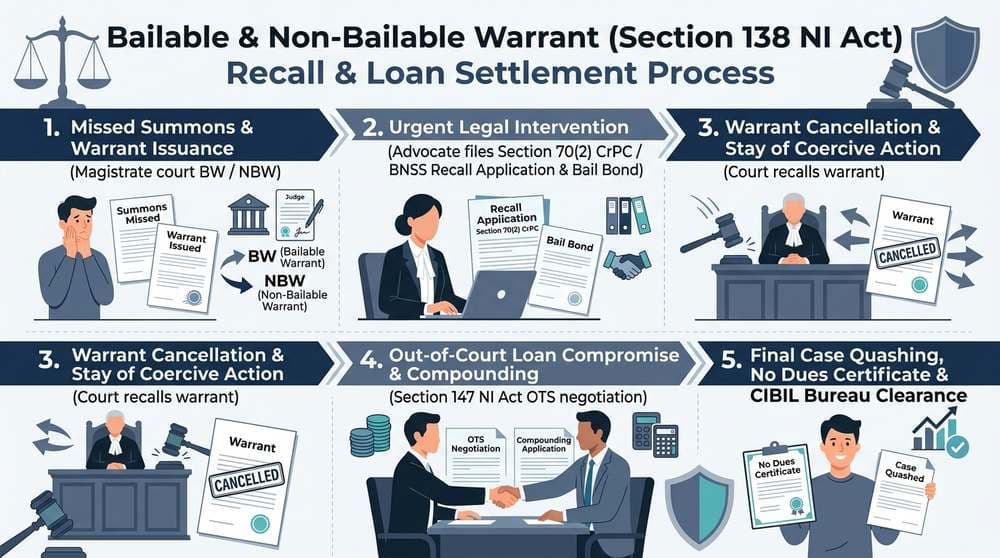
6. Strategic Legal Defense: How Advocates File Section 70(2) CrPC / BNSS Petitions to Recall Warrants & Secure Bail
When an arrest warrant has been issued by a Judicial Magistrate, attempting to evade the police or ignoring the situation is the most dangerous course of action. Evading active warrants risks sudden arrest at your residence or place of employment, overnight detention in police custody, and severe social humiliation. Instead, an experienced criminal defense advocate must be engaged immediately to execute a structured 4-step judicial intervention:
Step 1: Case Inspection, Vakalatnama Execution & Certified Order Copies
The defense advocate files a formal Memo of Appearance or Vakalatnama before the concerned trial court and conducts an immediate court diary and case file inspection. Counsel examines the summons service report, verifies whether postal acknowledgement cards were forged or unserved, obtains certified copies of the order sheets directing warrant issuance, and checks the exact warrant execution return date given to the local police station.
Step 2: Drafting the Section 70(2) CrPC / BNSS Recall & Cancellation Petition
Advocates draft an exhaustive, verified Application under Section 70(2) of the CrPC (or Section 72(2) of BNSS) for Recall and Cancellation of the Bailable or Non-Bailable Warrant. The application sets forth legitimate, bonafide reasons for previous non-appearances—supported by medical discharge summaries, address relocation proof, out-of-station employment affidavits, or non-receipt of summons. Counsel explicitly invokes Inder Mohan Goswami to demonstrate that the absence was neither intentional nor contumacious.
Step 3: Court Appearance, Bail Application & Surety Bond Submission
On the designated morning, the advocate presents the recall application before the presiding Magistrate. Because Section 138 is a bailable offense, the borrower is entitled to bail as a matter of legal right under Section 436 CrPC / Section 478 BNSS. Counsel submits a regular Bail Application along with a Personal Bond and introduces a solvent local surety (or requests cash bail in lieu of surety). Upon examining the grounds, the Magistrate cancels the warrant, admits the borrower to bail, and directs the police station to withdraw the arrest mandate immediately.
Step 4: Securing Judicial Stay & Intimating Local Station House Officer (SHO)
Immediately upon obtaining the signed court order cancelling the warrant, the advocate secures a certified dasti copy of the order. Counsel serves a formal intimation letter along with the court order upon the Station House Officer (SHO) of the jurisdictional police station, instantly terminating all pending police visits, arrest threats, and verification calls.
By proactively submitting to court jurisdiction through legal counsel, the threat of physical arrest is completely extinguished, establishing a secure legal environment to negotiate an out-of-court loan compromise.
7. Section 147 NI Act Compounding & Out-of-Court Settlement Negotiation: Securing 40%–70% OTS Waivers
Once the arrest warrant is recalled and bail is secured, the borrower holds immense strategic leverage to resolve the dispute permanently. Under Section 147 of the Negotiable Instruments Act, 1881, every offense punishable under the Act is non-cognizable and expressly compoundable by law. Unlike general Indian Penal Code / Bharatiya Nyaya Sanhita offenses that require high court quashing, a Section 138 complaint can be compounded and dismissed directly before the trial Magistrate with mutual consent of the parties.
Experienced debt resolution advocates bypass low-level recovery tele-callers and open formal negotiations directly with the bank's Zonal Legal Manager, Stressed Asset Resolution Branch (SARB), or internal One-Time Settlement (OTS) Committee. The negotiation strategy incorporates four essential pillars:
Advocates submit documentary proof demonstrating genuine economic distress—such as audited business loss statements, bank account debit freezes, termination letters, or medical diagnostic bills—substantiating a permanent reduction in repayment capability.
Counsel demonstrates to the bank's credit committee that continuing 4+ years of contested criminal trial will cost the bank more in legal fees and provisioning drag than accepting an immediate lump-sum settlement of 30% to 60% of the principal sum.
Before a single rupee is transferred, advocates verify that the bank issues an official OTS sanction letter on corporate letterhead, explicitly naming the Section 138 court case number, citing the agreed settlement sum, and agreeing to withdraw the criminal complaint.
Whenever feasible, advocates refer the settlement to the National Lok Adalat. An award passed by Lok Adalat holds the status of a final civil court decree, ensuring zero court fees, immediate case closure, and no future appeal or revival rights for the bank.
Never remit money based on verbal promises or WhatsApp messages from recovery agents claiming they will "cancel the warrant" after receiving a partial payment. Banks routinely appropriate unverified token deposits as partial interest credits while proceeding aggressively with the Section 138 court case. Settlement remittances must occur solely against a signed, authorized bank sanction letter.
8. Case Disposal, RBI No Dues Certificate Delivery & CIBIL Bureau Clean-Up
Remitting the compromised settlement amount is only the financial milestone of debt resolution. Achieving total legal immunity and restoring creditworthiness requires completing three essential post-settlement legal steps:
1. Formal Compounding Application & Judicial Acquittal Order
Upon receipt of full settlement funds, the bank's authorized representative and the defense advocate jointly file a Compounding Application under Section 147 of the NI Act read with Section 320 CrPC / Section 359 BNSS. The complainant bank records its statement confirming full satisfaction of claims. The Magistrate passes a final judicial order recording the compounding of the offense. Under Section 320(8) CrPC / Section 359(8) BNSS, the compounding of an offense has the statutory effect of an absolute acquittal of the accused, permanently erasing any criminal taint.
2. Delivery of RBI No Dues Certificate (NDC) Within Mandatory 30 Days
Under RBI Master Circular RBI/2023-24/60 (Responsible Lending Conduct), all commercial banks and NBFCs are statutorily mandated to issue an official No Dues Certificate (NDC) / Loan Closure Certificate and return all original security cheques or property title deeds within 30 calendar days of receiving settlement funds. Failure to adhere to this timeline renders the lender liable to pay statutory compensation of ₹5,000 per day of delay directly to the borrower.
3. Credit Bureau (CIBIL, Experian, CRIF) Record Rectification
Under the Credit Information Companies (Regulation) Act, 2005, the bank is legally required to update all four credit bureaus (TransUnion CIBIL, Experian, Equifax, CRIF High Mark) within 30 days. The loan status is updated from "Written Off / Default / Active Suit Filed" to "Settled", with the outstanding ledger balance reduced to strictly ₹0.
While a "Settled" status reflects that the account was resolved for less than the total claim, it completely halts negative monthly DPD compounding and eliminates all risk of secondary debt sale to recovery agencies. By obtaining a secured credit card backed by a fixed deposit (FD), maintaining low 20% credit utilization, and establishing a 100% spotless track record of on-time utility payments, borrowers consistently rebuild their credit score back to 750+ within 18 to 24 months.
9. Criminal Trial Contest vs. Out-of-Court Compounding Strategic Matrix
When an arrest warrant is recalled, borrowers must choose between contesting the Section 138 trial on merits or negotiating an out-of-court compromise under Section 147. Comparing both strategic pathways highlights why out-of-court compounding provides superior certainty:
| Strategic Parameter | Full Criminal Trial Defense | Out-of-Court Compounding Settlement (OTS) |
|---|---|---|
| Resolution Horizon | 3 to 6 Years across Trial & Appellate Courts | 30 to 90 Days from Recall Application to Case Dismissal |
| Financial Exposure | Risk of sentence: 2x Cheque Amount fine + up to 2 Years jail | Fixed compromised amount: 40%–70% principal waiver |
| Court Attendance | Mandatory personal appearance for all hearings and evidence | Single joint appearance or Lok Adalat bench disposal |
| Legal Risk Profile | High risk under statutory presumptions (Sec 118 & 139 NI Act) | Zero legal risk; binding mutual compromise and acquittal |
| Credit Bureau Impact | Continuous "Suit Filed / Default" monthly negative reporting | Permanent status update to "Settled" with ₹0 balance |
| Final Outcome | Judicial verdict (Conviction or Contested Acquittal) | Complete statutory acquittal, NDC issuance, and total peace of mind |
10. SettleLoans Criminal Defense & Loan Settlement Advisory
Facing a Bailable or Non-Bailable Warrant for a cheque bounce loan default demands rapid, seasoned criminal defense counsel combined with master debt settlement negotiators. SettleLoans provides end-to-end legal protection for distressed borrowers across India: conducting emergency court file inspections, filing urgent Section 70(2) recall petitions to stay police arrest, securing court bail, and negotiating directly with bank senior credit authorities to achieve deep 40% to 70% One-Time Settlements backed by official No Dues Certificates and formal court acquittal orders.

Settle Loan is India's trusted debt relief and loan settlement platform. We help borrowers overcome financial distress by negotiating with banks and NBFCs to legally settle personal loans and credit card debts. With our transparent, performance-based approach, you can achieve debt freedom and regain your financial peace of mind.
COMPUTER
11. Frequently Asked Questions: Cheque Bounce Warrants & Loan Settlement
Direct, legally verified answers to critical questions regarding bailable and non-bailable warrants, Section 138 NI Act proceedings, warrant recall petitions, and out-of-court loan compounding in India.
Why did the Magistrate court issue a warrant for a bounced loan EMI cheque?
When a loan repayment or security cheque bounces due to insufficient funds, the lender serves a 15-day statutory legal notice. If unpaid, the bank files a criminal complaint under Section 138 of the Negotiable Instruments Act. The Judicial Magistrate initially issues a court summons commanding the borrower's appearance. If the summons is ignored, unserved due to address changes, or deliberately avoided, the court is legally empowered to issue a Bailable Warrant (BW) or Non-Bailable Warrant (NBW) under the Code of Criminal Procedure (CrPC) / Bharatiya Nagarik Suraksha Sanhita (BNSS) to compel attendance.
What is the legal difference between a Bailable Warrant (BW) and a Non-Bailable Warrant (NBW)?
A Bailable Warrant (under Section 71 CrPC / Section 73 BNSS) contains an endorsement directing the executing police officer to release the accused immediately upon furnishing a bail bond with or without sureties. In contrast, a Non-Bailable Warrant (under Section 70 CrPC / Section 72 BNSS) is an unconditioned judicial command directing law enforcement to arrest the accused and produce them directly before the issuing Magistrate. An NBW does not allow police station bail; bail or warrant recall must be sought directly from the court.
Can the local police arrest me immediately if an NBW is issued in a Section 138 case?
Yes, legally a police officer possessing an active Non-Bailable Warrant has the statutory power to execute the arrest and produce you before the nearest Magistrate within 24 hours. However, under landmark Supreme Court guidelines (such as Inder Mohan Goswami v. State of Uttaranchal), courts are instructed not to issue NBWs indiscriminately in quasi-criminal commercial complaints. An experienced advocate can file an urgent recall application under Section 70(2) CrPC before the police execute the warrant, preventing physical custody.
How does an advocate file an application for cancellation or recall of a warrant?
An advocate drafts and files an urgent Application for Recall/Cancellation of Warrant under Section 70(2) of the Code of Criminal Procedure (or Section 72(2) of BNSS). The application is supported by an affidavit explaining genuine, non-deliberate reasons for the previous non-appearance (such as non-service of summons, medical illness, address relocation, or lack of knowledge). The advocate undertakes that the borrower will submit to court jurisdiction, furnishes a personal or surety bond, and requests the Magistrate to recall the warrant and grant regular bail.
Can I settle the underlying loan and close the criminal case after a warrant has been issued?
Yes, absolutely. Under Section 147 of the Negotiable Instruments Act, all offences under Section 138 are expressly compoundable by law at any stage of the proceedings, even after warrants have been issued. Borrowers can engage legal counsel to negotiate an out-of-court One-Time Settlement (OTS) with the bank. Once the agreed settlement sum is remitted, the lender files an application for compounding or withdrawal of the complaint, leading to immediate acquittal and case dismissal.
What happens if I never received the original court summons before the warrant was issued?
Non-service or improper service of summons is the most common reason warrants are issued in loan default cases. Banks frequently send summons to outdated residential addresses or addresses listed in old loan application forms. Under procedural law, a warrant issued without verified proof of personal service or refusal can be challenged. Your advocate can present address proof (such as rental agreements or utility bills) showing you resided elsewhere, which provides robust legal grounds for the Magistrate to recall the warrant instantly without punitive costs.
Is Section 138 cheque bounce a cognizable crime, and will it show on my criminal record?
Section 138 of the NI Act is a non-cognizable, bailable, and compoundable quasi-criminal offense. It is primarily a regulatory mechanism designed to maintain trust in commercial transactions rather than a heinous moral crime. If the warrant is recalled, bail is obtained, and the matter is compounded under Section 147 through loan settlement, the court passes an order of acquittal. An acquittal or compounded settlement does not create a permanent criminal conviction record or disqualify you from government employment or passport renewals.
What are the compounding costs mandated by the Supreme Court in Damodar S. Prabhu?
In the landmark judgment Damodar S. Prabhu v. Sayed Babalal H. (2010), the Supreme Court framed graded cost guidelines to encourage early settlement: 0% to minimal costs if compounded at early trial stages, 10% of the cheque amount if compounded before the Magistrate at subsequent stages, 15% before Sessions Court, and 20% before the High Court or Supreme Court. However, Magistrates retain judicial discretion to waive or reduce compounding costs if genuine economic hardship and mutual lender consent are established.
How does resolving a Section 138 warrant and compounding the loan impact my CIBIL score?
While the criminal court quashes the Section 138 complaint upon compounding, the financial settlement requires the bank to issue a formal No Dues Certificate (NDC) and report the loan as 'Settled' with a ₹0 balance to CIBIL, Experian, Equifax, and CRIF High Mark within 30 days under RBI mandates. This stops monthly default reporting and allows the borrower to systematically rebuild their credit score back to 750+ over 18 to 24 months.