- Zero Direct Seizure Power: Unsecured personal loans carry no mortgage or charge. Banks have zero legal right to confiscate your house, car, or furniture without a formal civil court decree.
- SARFAESI Act Is Inapplicable: The SARFAESI Act, 2002 applies exclusively to secured loans where collateral was pledged. It cannot be used to seize assets for personal loans or credit cards.
- Statutory Shield under Section 60 CPC: The Code of Civil Procedure, 1908 guarantees absolute immunity for residential houses, essential belongings, tools of trade, and salary subsistence portions.
- Recovery Agent Threats Constitute Crimes: Agents claiming they will lock your home, tow your car, or bring police commit criminal intimidation and extortion under Indian penal laws.
- OTS Debt Settlement Eliminates Exposure: A structured One-Time Settlement (OTS) negotiated via SettleLoans closes the debt permanently at a 40%–70% waiver with a binding No Dues Certificate (NDC).
1. Can a Bank Attach Property for an Unsecured Personal Loan?
When unexpected financial turmoil strikes—whether due to sudden job termination, severe medical emergencies, or enterprise insolvency—defaulting on a personal loan is one of the most stressful life events a borrower can endure. In this vulnerable state, third-party recovery agents frequently exploit borrowers' lack of legal knowledge. They make terrifying claims that the bank will arrive with police. They often threaten to seal the borrower's residential apartment, auction ancestral land, or tow away their family vehicle.
"An unsecured creditor has no proprietary interest or charge over any specific asset of the borrower. The relationship is purely that of a debtor and creditor governed by the Indian Contract Act, 1872. In the absence of an enforceable mortgage or registered charge, no summary recovery or extra-judicial possession of property can be started."
— Principles of Commercial Jurisprudence & Indian Contract Act, 1872
Let us state the foundational legal reality unequivocally: A bank or NBFC cannot seize, attach, or auction your immovable or movable property simply because you defaulted on an unsecured personal loan. Unlike home loans or auto loans, personal loans are extended solely on the basis of your creditworthiness, income verification, and personal promise to repay. You never signed a mortgage deed, never handed over property title deeds, and never hypothecated your vehicle or household assets to the lender.
Under the Indian legal framework, commercial lenders account for the risk of default by charging greatly higher interest rates on unsecured personal loans—ranging from 12% to 36% per annum. This elevated pricing model reflects the reality that the lender has zero security backing the facility. so, if a borrower defaults due to genuine financial distress, the bank cannot take the law into its own hands. Any attachment of property requires an exhaustive, multi-year civil court litigation ending in an enforceable money decree.
2. Secured vs Unsecured Debt: Why SARFAESI Does Not Apply
To understand why your property is legally safe, it is essential to examine the statutory framework governing loan recovery in India. When recovery agents threaten property attachment, they often quote the SARFAESI Act (Securitisation and Reconstruction of Financial Assets and Enforcement of Security Interest Act, 2002). However, this statute applies exclusively to secured credit facilities.
| Legal Dimension | Secured Loans (Home / Auto / LAP) | Unsecured Personal Loans (Your Scenario) |
|---|---|---|
| Underlying Collateral | Registered equitable mortgage on real estate, or hypothecation on vehicles / machinery. | Zero collateral. Issued purely on borrower creditworthiness and promissory note. |
| SARFAESI Act, 2002 Applicability | 100% Applicable under Section 13(2) and Section 13(4). | 0% Applicable. Inoperative because no "security interest" was ever created. |
| Direct Asset Seizure Power | Bank can take possession via District Magistrate (DM) order under Section 14. | Zero extra-judicial seizure power. Bank cannot touch any asset directly. |
| Governing Substantive Law | Transfer of Property Act, 1882 & SARFAESI Act, 2002 | Indian Contract Act, 1872 & Code of Civil Procedure (CPC), 1908 |
| Legal Recourse for Bank | Statutory 60-day demand notice followed by physical auction of mortgaged asset. | Civil summary suit for money recovery (Order 37 CPC) or Lok Adalat OTS settlement. |
| Typical Dispute Resolution | Debt Recovery Tribunal (DRT) under Securitisation Appeals. | Direct One-Time Settlement (OTS) or Lok Adalat mutual compromise. |
The Statutory Definition of "Security Interest" under SARFAESI
Under Section 2(1)(zf) of the SARFAESI Act, a "security interest" has a specific definition. It means any right, title, or interest upon property created in favour of a secured creditor. This includes any mortgage, charge, hypothecation, or assignment. Section 13(2) explicitly mandates that enforcement notices can only be served where a security interest exists.
Personal loan contracts do not establish any security interest over your flat, residential house, agricultural land, or motor vehicle. Therefore, any recovery agent or collection officer claiming to invoke SARFAESI against your property is making a fraudulent and legally baseless misrepresentation.
Check Your Loan Settlement Options
Answer 2 quick questions to evaluate your settlement eligibility.
1. What type of loan do you want to settle?
3. Dismantling Recovery Agent Extortion
Third-party collection agencies rely almost exclusively on psychological pressure and manufactured panic to coerce payments. Unregulated collection agents often send fake legal notices formatted to look like court warrants, threatening that "court bailiffs accompanied by police officers will seize movable inventory within 48 hours."
It is crucial to recognize these notices as illegal extortion tactics. In the landmark Supreme Court ruling in ICICI Bank Ltd. v. Prakash Kaur (2007), the apex court condemned the use of strong-arm tactics and musclemen by financial institutions, ruling that banks are vicariously liable for the illegal conduct of their outsourced recovery agents.
Threatening to seize a borrower's home without a court order constitutes Criminal Intimidation (Section 506 IPC / Section 351 BNS). Forcibly entering premises or attempting to take movable goods constitutes Criminal Trespass (Section 441 IPC / Section 329 BNS) and Extortion (Section 384 IPC / Section 308 BNS).
A recovery agent might arrive at your home or workplace claiming the right to inspect personal belongings. When this happens, you have the absolute legal right to demand their credentials. Ask for their official Direct Recovery Agent (DRA) accreditation, bank authorization letter, and government identity card. You are under no obligation to allow them inside your residential premises.
4. The Legitimate Legal Attachment Procedure
While extra-judicial property seizure is completely prohibited, does a lending bank possess any lawful mechanism to attach a borrower's property? Yes, but only through a rigorous, multi-stage civil judicial trial governed by the Code of Civil Procedure (CPC), 1908. Understanding this judicial process shows why banks rarely attempt property attachment for retail personal loans.
To execute any attachment, the bank must first institute a formal civil suit for recovery (typically under Order 37 CPC for Summary Suits). The civil court serves formal judicial summons upon the borrower. The borrower, represented by legal counsel, enters appearance and files an Application for Leave to Defend, challenging compound interest calculations, unadjusted charges, and documenting genuine financial hardship.
The High Evidentiary Threshold of Order 38 Rule 5 (Attachment Before Judgment)
During a civil recovery suit, a bank may file an interim application under Order 38 Rule 5 CPC for "Attachment Before Judgment." However, the Supreme Court of India in Raman Tech. & Process Engg. Co. v. Solanki Traders (2008) laid down clear boundaries. The Court ruled that Order 38 Rule 5 is a drastic power and cannot be exercised casually.
The bank must prove with concrete, unassailable evidence that the borrower is actively attempting to dispose of their entire property with the fraudulent intent of obstructing the execution of any decree. Mere inability to pay or normal living asset ownership does NOT justify attachment before judgment.
If the civil suit proceeds through trial, arguments, and evidence, obtaining a final money decree takes an average of 3 to 7 years in Indian civil courts. Even after securing a decree, the bank must file separate Execution cases under Order 21 of the CPC. This extensive duration and procedural complexity explain why commercial lenders overwhelmingly prefer negotiated debt settlements over litigation.
5. Legal Defense & Asset Protection Blueprint
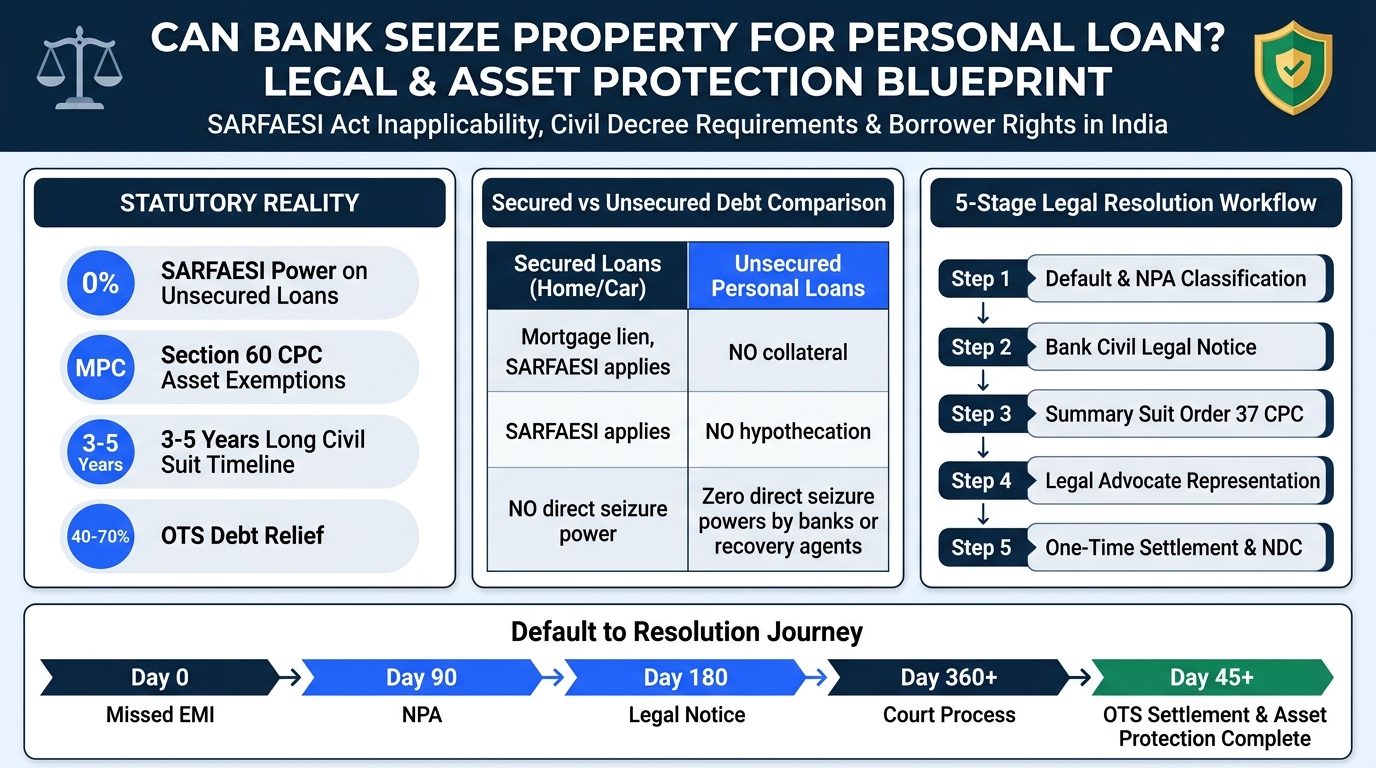
The visual blueprint below synthesizes the statutory realities, secured versus unsecured legal comparisons, the 5-stage formal court progression, and the typical default-to-resolution timeline under Indian law:
Can Bank Seize Property for Personal Loan Summary & Process Overview
6. Statutory Immunity: Protected Assets Under Section 60 CPC
Suppose a bank pursues a civil suit to completion and obtains an execution decree under Order 21 CPC. Even in this rare scenario, Indian law establishes powerful statutory safeguards. These protections ensure that debtors and their families are never deprived of their fundamental means of survival.
Section 60(1) of the Code of Civil Procedure, 1908 contains a comprehensive list of properties that are explicitly exempt from attachment or sale in the execution of any civil court decree:
Necessary wearing apparel, cooking vessels, beds, bedding of the judgment-debtor and their family, and personal ornaments that religious usage requires a woman to retain cannot be attached.
Tools of artisans, agricultural applies, cattle necessary for tillage, and seed-grain required to earn a livelihood are entirely immune from attachment.
In civil execution, the first ₹1,000 of monthly salary plus two-thirds of the remaining salary is completely exempt from attachment, ensuring subsistence cash flows remain intact.
Moneys payable under the Employees' Provident Funds (EPF) Act, 1952, statutory gratuity, and life insurance policies taken for the benefit of family cannot be attached by any creditor.
These constitutional and statutory provisions reflect the enlightened jurisprudence affirmed by the Supreme Court in Jolly George Varghese v. Bank of Cochin (1980): Indian law prioritizes human dignity and basic survival under Article 21 over commercial debt recovery.
7. Banking Accounting Rules & NPV Recovery Economics
Borrowers often wonder: If banks technically possess the right to file civil suits, why do they almost never proceed with asset attachment against salaried personal loan defaulters? The answer lies in institutional banking accounting rules mandated by the Reserve Bank of India (RBI) and Net Present Value (NPV) recovery mathematics.
Under the RBI's Prudential Norms on Income Recognition, Asset Classification, and Provisioning pertaining to Advances (IRAC), when a retail loan account remains overdue past 90 days, it is classified as a Non-Performing Asset (NPA). For unsecured loans, banks must immediately allocate capital provisions out of their operating profits—scaling from 15% in the Sub-Standard stage up to 100% in the Doubtful/Loss asset category.
Why Banks Financially Prefer OTS Over Long Litigation
When evaluating whether to litigate or settle, a bank's credit risk committee applies a Net Present Value (NPV) recovery analysis:
Where r is the bank's cost of capital (10%–12%), t is the litigation timeline (4–7 years), and upfront ad-valorem court fees require an immediate cash outflow of 5% to 8% of the loan amount. After discounting for time and legal friction, litigating a ₹10 Lakh personal loan yields an NPV of barely ₹2.5 to ₹3 Lakhs. By accepting an immediate One-Time Settlement (OTS) of ₹4 to ₹5 Lakhs in cash, the bank maximizes its recovery, releases blocked capital provisions, and strengthens its balance sheet.
This fundamental banking economics is the primary reason banks maintain formal, board-approved One-Time Settlement policies. Settlement is not a favor granted by the bank; it is an economically rational balance sheet optimization strategy.
8. Enforcing RBI Mandates & Silencing Harassment
If recovery agents are subjecting you or your family to threats of property seizure, police action, or public humiliation, you do not have to suffer in silence. The Reserve Bank of India has established robust regulatory mechanisms under its Master Direction on Fair Practices Code for Lenders and Master Circular on Recovery Agents.
Strict Time Window Mandates
Recovery agents are strictly prohibited from contacting borrowers before 8:00 AM or after 7:00 PM. Calls outside this regulatory window violate RBI directives.
Total Ban on Third-Party & Workplace Harassment
Lenders cannot contact your employer, HR department, colleagues, friends, or extended family members. They cannot disclose your debt status to any unauthorized third party.
Prohibition of False Legal Assertions
Threatening immediate police arrest, claiming court warrants exist without judicial records, or threatening illegal property confiscation is strictly actionable under banking regulations.
When SettleLoans intervenes on behalf of a distressed borrower, our empaneled advocates issue a formal Legal Cease & Desist Notice to the lending institution's Principal Nodal Officer. This notice documents every statutory breach, places the bank on notice of regulatory liability, and halts unlawful collection activities within 24 to 48 hours. If harassment persists, complaints are escalated directly to the RBI Integrated Ombudsman on the CMS Portal.
9. One-Time Settlement: Permanent Legally Binding Resolution
Understanding that your property cannot be seized eliminates immediate fear. However, leaving an unpaid loan in indefinite default causes severe long-term damage to your credit profile. Your CIBIL score drops, and you remain exposed to periodic collection escalations. The definitive, legally binding exit is a structured One-Time Settlement (OTS).
How SettleLoans Protects Your Assets & Negotiates Clean Exits
We scrutinize your loan agreement, audit unadjusted compound interest and illegal penalties, and structure authentic financial hardship dossiers.
Our empaneled advocates issue registered legal replies to bank demand notices, stopping recovery harassment and asserting your statutory rights.
We negotiate directly with the bank's senior credit committee to secure large waivers on penal interest, late fees, and principal balance.
We ensure settlement payments are remitted strictly against an authentic bank compromise sanction letter, securing an official No Dues Certificate (NDC).

Settle Loan is India's trusted debt relief and loan settlement platform. We help borrowers overcome financial distress by negotiating with banks and NBFCs to legally settle personal loans and credit card debts. With our transparent, performance-based approach, you can achieve debt freedom and regain your financial peace of mind.
COMPUTER
Frequently Asked Questions
Authoritative, legally verified answers regarding property attachment, SARFAESI applicability, recovery agent intimidation, and debt settlement in India.
No. Personal loans are 100% unsecured debts where no property, house, or land is pledged as collateral or mortgaged. The SARFAESI Act, 2002 does NOT apply to unsecured personal credit. A lending bank or NBFC has zero legal authority to enter your property or seal your premises. They cannot change door locks or conduct an auction without a court order. They must first obtain a formal money recovery decree from a civil court through a multi-year judicial trial.
The SARFAESI Act empowers commercial lenders to enforce security interests and take physical possession of assets without court intervention. However, this applies only when an underlying security interest has been legally created (such as an equitable mortgage or registered hypothecation charge under Section 2(1)(zf)). Personal loan agreements do not create any charge or mortgage over any specific asset. Therefore, SARFAESI provisions are completely inapplicable under Indian law.
No, absolutely not. Third-party collection agents have zero judicial power to seize your vehicle, furniture, electronics, or personal belongings. Recovery agents cannot forcefully enter your residence or tow away a vehicle for an unsecured loan default. Doing so constitutes serious criminal offences under Indian law. These offences include Criminal Trespass (Section 441 IPC / Section 329 BNS), Theft (Section 378 IPC / Section 303 BNS), and Extortion (Section 384 IPC / Section 308 BNS).
Under Order 38 Rule 5 of the Code of Civil Procedure, 1908, a creditor can apply for conditional property attachment during a civil suit. However, they must prove their claim with concrete documentary evidence. They must establish that the defendant is actively attempting to dispose of or fraudulently remove assets outside court jurisdiction to defeat the decree. Indian civil courts apply strict scrutiny and rarely grant Order 38 attachment for routine personal loan defaults.
Section 60 of the Code of Civil Procedure, 1908 grants absolute statutory exemption from court attachment for essential assets, including: 1) Necessary wearing apparel, cooking vessels, and bedding. 2) Tools of artisans and agricultural applies. 3) Sole residential house of an agriculturist or laborer. 4) Mandatory portions of salary (the first ₹1,000 plus two-thirds of the remainder are completely exempt). 5) Statutory Employee Provident Fund (EPF), Gratuity, and life insurance policy proceeds.
A bank cannot arbitrarily freeze your salary account maintained in another independent financial institution without a formal court decree. If the default occurs with the exact same bank where your salary is deposited, the bank may attempt to exercise a Banker's Right of Set-Off under Section 171 of the Indian Contract Act. However, in court-directed execution cases, Section 60 CPC strictly caps salary attachment, ensuring that the majority of income remains protected for living subsistence.
For personal loans, banks can: 1) Report the default to credit information companies (CIBIL, Experian, Equifax), lowering your credit score. 2) Issue formal statutory demand notices. 3) File a Civil Summary Suit under Order 37 of the Code of Civil Procedure, 1908. 4) start Section 138 NI Act or Section 25 PSSA cases if cheques or NACH auto-debits bounced. 5) Refer the dispute to National Lok Adalat for an amicable compromise settlement.
Filing a civil recovery suit in Indian civil courts is burdensome for banks. They must pay upfront ad-valorem court fees (5% to 8% of the claim). They also incur heavy advocate retainers and must endure 3 to 7 years of contested litigation with uncertain recovery outcomes. Through Net Present Value (NPV) recovery calculations, banks achieve vastly superior financial recovery by granting a 40% to 70% OTS waiver to recover immediate liquid cash rather than pursuing long civil execution suits.
Never make a panic payment. Indian civil courts never serve attachment orders or auction notices over informal WhatsApp chats. Preserve all evidence, including screenshots, agent phone numbers, and call recordings. Next, engage SettleLoans advocates to issue a formal Cease & Desist legal notice to the bank's Principal Nodal Officer. We also lodge a formal complaint on the RBI CMS Portal to protect your rights.
Authoritative Legal & Regulatory Sources
- Ministry of Law & Justice — The Code of Civil Procedure, 1908 (Section 60 Statutory Asset Exemptions)
- Supreme Court of India — Landmark Rulings on Order 38 Rule 5 CPC & Article 21 Debtor Protection (Raman Tech & Jolly George Varghese)
- Reserve Bank of India (RBI) — Master Direction on Fair Practices Code for Lenders & Recovery Directives
- Ministry of Law & Justice — The SARFAESI Act, 2002 (Section 2(1)(zf) Security Interest Provisions)
- RBI Integrated Ombudsman Scheme (CMS Portal) — Redressal of Unlawful Bank & Recovery Agent Harassment