1. ₹12 Lakh Crisis: MSME Revenue Drop & Default
In October 2023, Vikram Verma, a 41-year-old proprietor managing a precision engineering and auto-ancillary unit in Pune, secured an unsecured term loan facility of ₹12,00,000 from State Bank of India (SBI) to finance capital tooling and raw material inventories. The credit agreement stipulated a repayment tenure of 48 months at an interest rate of 12.85% per annum, translating into a fixed equated monthly installment (EMI) of ₹32,150. For nearly two years, Vikram maintained a flawless repayment track record, servicing twenty-one consecutive EMIs through an automated National Automated Clearing House (NACH) mandate linked to his primary current account.
In late 2025, Vikram's principal institutional buyer—an electric vehicle component manufacturer accounting for over 60% of his annual revenues—filed for corporate insolvency under the Insolvency and Bankruptcy Code (IBC). This sudden operational shock led to an immediate ₹28 Lakh unpaid receivables freeze. Deprived of operational working capital, Vikram was forced to shut down two manufacturing lines, exhaust his personal contingency savings, and prioritize statutory payroll commitments over bank debt servicing.
When the November 2025 EMI debit failed due to insufficient account balance, the loan entered delinquency. Over the subsequent 90 days, as consecutive NACH presentations bounced, SBI reclassified the facility from Special Mention Account stages (SMA-0, SMA-1, and SMA-2) to a formal Non-Performing Asset (NPA). Compounding penal interest at 2.0% per month, late fees, and processing levies rapidly inflated SBI's gross ledger claim from the principal balance of ₹12,00,000 to ₹13,40,000 by early 2026.
MSME supply-chain shocks and involuntary revenue destruction represent the leading cause of retail and small-business loan defaults in India. While PSU lenders possess rigid automated recovery escalations, their institutional provisioning frameworks create powerful statutory incentives to settle bad loans once classified as NPAs.
2. Overcoming Legal Fear: Deconstructing the SBI Lok Adalat Summons
In February 2026, Vikram received a formal registered notice bearing the official judicial seal of the District Legal Services Authority (DLSA), titled 'Pre-Litigation Notice for National Lok Adalat Conciliation — State Bank of India vs. Vikram Verma'. The notice demanded his physical appearance before the Lok Adalat bench on an upcoming Saturday, warning that failure to attend would prompt SBI to initiate regular recovery litigation.
For an unrepresented borrower, receiving an official document adorned with court emblems and judicial terminology triggers immense psychological panic. Vikram feared that the Lok Adalat was a criminal tribunal where police officers would arrest him on the spot, or where judicial magistrates would order the immediate auction of his family residence and personal assets. These fears were exacerbated by aggressive calls from SBI-empaneled third-party collection agents who falsely claimed that ignoring the notice constituted contempt of court punishable by imprisonment.
When Vikram approached SettleLoans, our legal team immediately dispelled these misconceptions by clarifying the foundational legal reality governed by the Legal Services Authorities Act, 1987:
First, Lok Adalat is an Alternative Dispute Resolution (ADR) statutory body designed exclusively for amicable, consensual settlement. It is not a trial court, criminal tribunal, or enforcement agency. Second, Lok Adalat conciliators and presiding judges hold zero legal authority to issue arrest warrants, impose criminal penalties, or order unilateral asset attachments. Third, appearance at Lok Adalat is entirely voluntary; no order can ever be passed without the explicit, written consent of both the borrower and the bank. Fourth, and most crucially, Lok Adalat represents the most borrower-friendly statutory forum in India, where PSU banks operate under mandate to grant deep financial haircuts to clear non-performing balance sheet assets.
Check Your Loan Settlement Options
Answer 2 quick questions to evaluate your settlement eligibility.
1. What type of loan do you want to settle?
3. Inside SBI's Ledger: Stressed Assets Management & Provisioning Burden
To understand why State Bank of India agreed to surrender ₹6.6 Lakhs of core principal and 100% of accumulated interest, one must examine the internal regulatory mechanics of SBI's Stressed Assets Resolution Centres (SARC) and Stressed Assets Management Branches (SAMB) under Reserve Bank of India prudential accounting mandates.
Under the RBI Master Directions on Income Recognition and Asset Classification (IRAC), commercial banks cannot treat defaulted unsecured credit as normal receivables. Unlike secured mortgages backed by physical real estate, unsecured personal and business loans lack collateral that can be attached under the SARFAESI Act, 2002. Consequently, the bank must set aside substantial hard capital out of its quarterly operating profits as provisioning coverage:
| Default Category | Overdue Duration (DPD) | SBI Internal Classification | Mandatory RBI Provisioning |
|---|---|---|---|
| SMA-0 / SMA-1 / SMA-2 | 1 – 89 Days | Standard (Stressed Asset) | 0.40% – 5.00% General Capital Buffer |
| NPA Stage 1 | 90 – 365 Days | Substandard (Unsecured) | 25.00% Specific Profit Provision |
| NPA Stage 2 (D1/D2) | 12 – 36 Months | Doubtful Stressed Asset | 100.00% of Unsecured Outstanding |
| AUCA / Loss Ledger | 36+ Months | Loss Asset (Written-Off Ledger) | 100.00% Balance Sheet Write-off |
When an unsecured loan defaults beyond 180 days, SBI's Return on Assets (ROA) and Capital to Risk-Weighted Assets Ratio (CRAR) are heavily penalized. Every quarter, the Department of Financial Services (DFS) and the RBI mandate that public sector banks reduce gross NPAs. Recovering an upfront lump-sum cash amount through a Lok Adalat compromise allows SBI to write back locked provisioning reserves straight into operational profit, providing immense institutional motivation for high-level approvals.
4. The Hardship Resolution Dossier & SBI Recovery Valuation (NPV)
Public sector banks operate under stringent scrutiny from the Central Vigilance Commission (CVC) and statutory auditors. To grant a 55% haircut without inviting vigilance inquiries, SBI's Assistant General Manager (AGM) and Credit Committee must establish that the borrower suffers from genuine, verifiable financial distress and is not a 'willful defaulter' hiding assets.
SettleLoans compiled a comprehensive, multi-layered Financial Hardship Resolution Dossier on Vikram's behalf, structured into five evidentiary components:
First, certified Goods and Services Tax (GST) returns for the preceding twelve months, demonstrating an 82% decline in gross business turnover following the primary buyer's insolvency. Second, certified six-month bank statements across all current and savings accounts verifying negligible residual balances and zero incoming trade payments. Third, the official corporate insolvency public announcement (Form G) of his buyer from the Insolvency and Bankruptcy Board of India (IBBI), validating the frozen receivables. Fourth, an itemized household subsistence and dependent healthcare expense schedule confirming that Vikram had zero monthly disposable surplus. Fifth, an unencumbered property affidavit affirming that he owned no commercial real estate, mutual funds, or secondary liquid assets.
With the hardship dossier verified, SettleLoans modeled the recovery economics using SBI's internal Net Present Value (NPV) Valuation Formula:
Where C_t represents estimated future court recovery cash flows, r is SBI's cost of funds (8.5%), and deductions account for 4–6 years of contested civil litigation expenses, advocate retainers, and ongoing NPA provisioning burdens.
Our mathematical analysis proved that pursuing civil litigation against Vikram in a crowded commercial court would consume over ₹1.8 Lakhs in litigation costs and 54 months of judicial delays, yielding an estimated net recovery of less than ₹4.1 Lakhs in present value. Conversely, an immediate Lok Adalat compromise of ₹5.4 Lakhs delivered superior real-time cash realization to SBI with zero execution risk.
5. Cease-and-Desist Defense: Neutralizing Recovery Harassment & Demand Notices
Prior to the Lok Adalat session, SBI's empanelled collection agencies subjected Vikram to persistent harassment. Field recovery personnel visited his residential housing society, spoke to neighbors regarding his debt, and issued unauthorized WhatsApp messages threatening immediate police action under Section 420 (cheating) of the Indian Penal Code.
Simultaneously, SBI's legal panel served a formal notice under Section 25 of the Payment and Settlement Systems Act, 2007 (PSSA) for the electronic NACH mandate failure, alongside a demand notice under Section 138 of the Negotiable Instruments Act, 1881.
SettleLoans advocates executed a rapid, decisive two-pronged legal intervention:
First, our legal team drafted and served an urgent Cease-and-Desist Legal Notice to the Regional Manager and Principal Nodal Officer (PNO) of State Bank of India. The notice cited specific violations of the RBI Master Directions on Recovery Agents (2022), including unlawful third-party disclosures, harassment outside statutory hours (08:00 AM – 07:00 PM), and misleading threats of criminal prosecution for civil debt defaults. Within 72 hours, SBI acknowledged receipt, ordered the immediate withdrawal of external field agents, and redirected all communication exclusively to our legal desk.
Second, our advocates drafted a formal statutory reply to the Section 25 PSSA and Section 138 NI Act notices within the mandatory 15-day window. The reply established the complete absence of fraudulent intent, recorded the documented MSME business disruption, and placed on record Vikram's proactive willingness to appear at the upcoming National Lok Adalat for an amicable, court-sanctioned compromise.
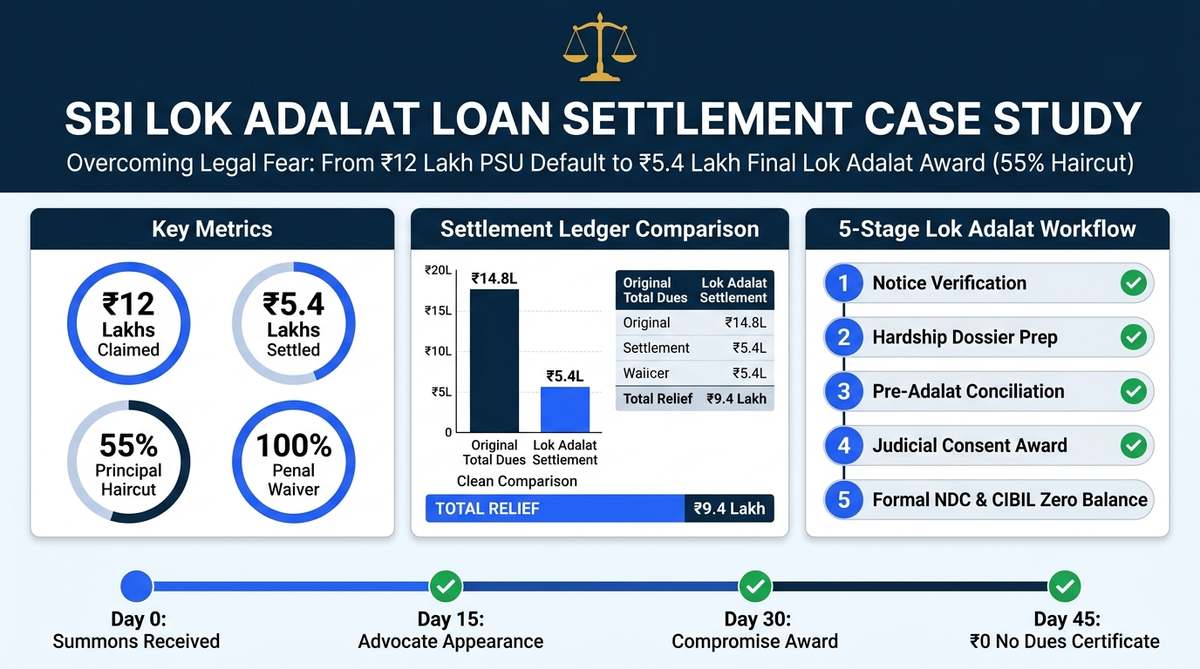
6. The Lok Adalat Hearing: Negotiating the 55% Haircut Before the Judicial Bench
On the designated National Lok Adalat date, SettleLoans senior advocates appeared alongside Vikram before the judicial conciliation bench at the District Court complex. The Lok Adalat bench was presided over by a sitting Senior Civil Judge accompanied by a seasoned advocate conciliator appointed by the DLSA. State Bank of India was represented by an Assistant General Manager (AGM) from the regional SARC division along with SBI's standing counsel.
The conciliation proceeded through three structured negotiation phases:
In Phase 1, SBI's legal counsel presented the bank's initial opening demand: full principal recovery of ₹12,00,000 with a partial waiver of accumulated penal interest, offering a settlement figure of ₹10,20,000. In Phase 2, SettleLoans advocates submitted the audited Hardship Dossier and empirical NPV valuation model directly to the presiding judge. Our advocates demonstrated that Vikram's business had suffered genuine involuntary catastrophe, that he had zero unencumbered assets, and that his immediate family was willing to pool exactly ₹5,00,000 in borrowed emergency funds for a single-bullet closure.
In Phase 3, after examining the evidentiary records, the presiding judge recommended that SBI exercise its discretionary authority under the RBI Compromise Settlement Framework. The SBI AGM agreed to a final, binding compromise amount of ₹5,40,000, representing a net 55.0% principal haircut (₹6,60,000 forgiven) and a total waiver of ₹8,00,000 across all ledger components.
| Financial Ledger Item | Claimed Bank Dues | Approved Lok Adalat Award | Total Haircut / Relief |
|---|---|---|---|
| Core Principal Balance | ₹12,00,000 | ₹5,40,000 | ₹6,60,000 (55.0% Haircut) |
| Accrued Regular Interest | ₹86,400 | ₹0 | ₹86,400 (100% Waived) |
| Penal Interest & Overdue Fees | ₹38,600 | ₹0 | ₹38,600 (100% Waived) |
| NACH Bounce & Legal Charges | ₹15,000 | ₹0 | ₹15,000 (100% Waived) |
| Total Outstanding Claim | ₹13,40,000 | ₹5,40,000 Payable | ₹8,00,000 Total Relief (59.7%) |
7. Anatomy of a Lok Adalat Consent Award: 6 Essential Statutory Protections
Before signing the formal settlement award (Samjhauta Patra), SettleLoans advocates conducted a meticulous clause-by-clause audit of the drafted document. A flawed settlement memo can leave borrowers vulnerable to residual recovery or future litigation if mandatory legal safeguards are omitted.
Our advocates ensured that the final Lok Adalat Award incorporated six non-negotiable statutory provisions:
First, an unequivocal declaration that the payment of ₹5,40,000 represents full, final, and absolute satisfaction of all financial claims arising from the loan account. Second, a debt extinguishment clause mandating that the residual balance of ₹8,00,000 is irrevocably written off by SBI with zero future recourse. Third, a mandatory litigation withdrawal directive requiring SBI to withdraw all pending Section 138 NI Act notices and Section 25 PSSA proceedings with immediate effect. Fourth, an enforceable 30-day timeline for SBI to issue the formal, physical and digital No Dues Certificate (NDC). Fifth, a direct banking channel remittance mandate specifying payment via RTGS directly into Vikram's loan account, prohibiting any cash or third-party handling. Sixth, invoking Section 21 of the Legal Services Authorities Act, 1987, which confers the status of a final, unappealable Civil Court Decree on the award.
8. Securing the ₹0 No Dues Certificate & 24-Month CIBIL Reconstruction
Following the Lok Adalat session, Vikram remitted the sanctioned amount of ₹5,40,000 via a single RTGS transaction directly into his designated SBI loan account. SettleLoans advocates submitted the transaction confirmation alongside the certified Lok Adalat Award to SBI's SARC operations branch.
Under RBI Circular RBI/2023-24/60 (Directions on Release of Property Documents and Issuance of No Dues Certificate), regulated commercial banks are legally mandated to issue the formal No Dues Certificate and update credit bureaus within 30 calendar days of settlement receipt. On Day 21 following payment, State Bank of India issued the official stamped No Dues Certificate (NDC), confirming zero outstanding dues and full loan account closure.
In compliance with credit reporting standards, SBI updated TransUnion CIBIL, Experian, Equifax, and CRIF High Mark with the status 'Settled' and an outstanding balance of ₹0. Vikram's credit score, which had plummeted to 572 during default, stabilized at 605 upon settlement reflection.
SettleLoans provided Vikram with a customized 24-month credit rehabilitation roadmap:
First, opening a fixed-deposit-backed secured credit card with a ₹40,000 limit, maintaining monthly credit utilization strictly below 20%. Second, establishing flawless automated payments across all ongoing utility and trade accounts. Third, refraining from applying for any fresh unsecured credit during the 12-month cooling period stipulated under RBI compromise norms. Within twenty months of structured credit discipline, Vikram successfully elevated his CIBIL score to 762, restoring his creditworthiness and enabling him to obtain fresh working capital lines for his revived enterprise.
9. Comparative Resolution Analysis: Lok Adalat vs. Direct OTS vs. Civil Courts
Distressed borrowers facing PSU bank loan defaults must evaluate the comparative advantages of available institutional resolution mechanisms in India:
| Resolution Channel | Average Timeline | Typical Haircut Scope | Legal Finality & Immunity | Judicial Oversight |
|---|---|---|---|---|
| National Lok Adalat Conciliation | 30 – 45 Days | 45% – 65% Waiver | Civil Court Decree (No Appeals) | Sitting District Judge & DLSA |
| Direct Branch / SARC One-Time Settlement | 45 – 90 Days | 40% – 60% Waiver | Contractual Sanction Letter | Internal Bank Credit Committee |
| Contested Civil Court / DRT Suit | 3 – 6 Years | 0% – Court Discretion | Subject to Appeals & Execution | Adversarial Judicial Trial |
| Informal Debt Restructuring | 15 – 30 Days | 0% (Extended EMI Tenure) | Ongoing Active Debt Liability | None (Internal Restructure) |
As proven in Vikram's case study, National Lok Adalat conciliation backed by experienced legal advocates provides the ultimate combination of maximum principal haircut, rapid closure, and absolute judicial finality without the cost or stress of protracted court litigation.

Settle Loan is India's trusted debt relief and loan settlement platform. We help borrowers overcome financial distress by negotiating with banks and NBFCs to legally settle personal loans and credit card debts. With our transparent, performance-based approach, you can achieve debt freedom and regain your financial peace of mind.
COMPUTER
Everything You Need to Know About SBI Lok Adalat Settlements
Clear, authoritative legal answers regarding State Bank of India debt settlements, Lok Adalat summons rights, haircuts, and credit score rehabilitation.
No. A Lok Adalat notice issued under the Legal Services Authorities Act, 1987, is strictly an invitation for voluntary pre-litigation conciliation. It is neither a police summons nor a criminal warrant. Lok Adalats operate as Alternative Dispute Resolution (ADR) bodies aimed at amicable compromise, and non-attendance does not constitute a criminal offense or contempt of court.
The borrower suffered severe MSME business revenue collapse, leading to 5 consecutive missed EMIs on an unsecured SBI facility. SettleLoans advocates compiled an unassailable financial hardship dossier proving complete liquidity loss, appeared before the Lok Adalat judicial bench, and demonstrated that SBI's Net Present Value (NPV) recovery was maximized via an upfront cash settlement of ₹5.4 Lakhs (a 55% principal haircut) and 100% waiver of penal interest and legal costs.
Depending on asset classification (NPA Substandard, Doubtful D1/D2, or Loss Asset AUCA) and verifiable borrower hardship, State Bank of India regularly sanctions haircuts ranging from 40% to 65% on unsecured personal loans and credit cards during National Lok Adalat sessions. Accrued penal interest, late payment levies, and NACH bounce charges are typically waived 100%.
Yes. Under Section 21 of the Legal Services Authorities Act, 1987, every award made by a Lok Adalat is deemed to be a decree of a Civil Court. It is final and binding on both the borrower and State Bank of India. No appeal lies to any court against a Lok Adalat consent award, meaning SBI can never reopen the loan account or demand residual balances in the future.
If a borrower ignores a Lok Adalat notice, the Lok Adalat bench simply closes the pre-litigation file and refers the matter back to the bank. While there is no immediate penalty or arrest, the borrower loses an invaluable opportunity to negotiate a high-haircut settlement in a neutral judicial forum, and SBI may subsequently initiate regular civil recovery suits or proceedings under Section 138 NI Act.
No. For unsecured personal loans, banks cannot invoke summary property seizure under the SARFAESI Act, 2002, because there is no mortgaged collateral. Lok Adalat conciliators possess zero statutory power to order coercive attachment or salary garnishment. Any settlement at Lok Adalat must be purely consensual between the borrower and SBI.
To approve substantial principal waivers, the SBI Credit Committee requires verifiable documentation proving inability to pay, including: (1) Certified bank statements showing depleted liquidity; (2) Business closure or audited P&L loss statements; (3) Employment termination letters or severance proofs; (4) Medical emergency hospital discharge summaries; and (5) Non-encumbrance asset affidavits.
Following full payment under the Lok Adalat award, SBI reports the loan account to credit bureaus as 'Settled' with an outstanding balance of ₹0. While the settlement remark initially lowers the CIBIL score by 75-120 points, the borrower stops accumulating active default penalties. By using a secured credit card and maintaining disciplined repayments, borrowers routinely rebuild their score back to 750+ within 18 to 24 months.
Under RBI Circular RBI/2023-24/60, commercial banks including SBI are mandated to issue the formal No Dues Certificate (NDC) / Loan Closure Certificate within 30 calendar days of receiving full settlement funds. If the bank fails to issue the NDC within 30 days, it is liable to pay statutory compensation of ₹5,000 per day of delay to the borrower.
Official Statutory Authorities & Regulatory Frameworks
- National Legal Services Authority (NALSA): Legal Services Authorities Act, 1987 — National Lok Adalat Conciliation Mandates
- Reserve Bank of India (RBI): Prudential Framework for Resolution of Stressed Assets & Compromise Settlements
- RBI Master Direction: Fair Practices Code & Mandatory Guidelines on Outsourced Recovery Agents
- State Bank of India (SBI): Customer Grievance Redressal Policy & Stressed Assets Resolution Centre (SARC) Framework
- Reserve Bank - Integrated Ombudsman Scheme, 2021: Dispute Redressal Portal for Coercive Recovery & NDC Issuance Delays