- Regulated NBFC Framework: Navi personal loans are funded by Navi Finserv Limited (an RBI-registered NBFC-ND-SI), making them legally distinct from illegal 7-day APK scam apps and strictly bound by RBI Fair Practices Codes.
- 100% Unsecured Exposure: Navi loans up to ₹20 Lakhs are completely unsecured with no physical collateral or asset mortgage, restricting the lender's legal recovery remedies to civil court proceedings and Lok Adalat conciliation.
- Halting NACH Bounce Penalties: Repetitive automated mandate presentations can be stopped by serving written stop-payment and revocation notices under RBI NACH Procedural Guidelines to prevent compounding bank charges.
- Section 25 PSSA Defense: Statutory digital notices for failed auto-debits require a formal advocate-drafted 15-day response establishing financial hardship and absence of fraudulent intent to prevent magistrate court escalation.
- Substantial OTS Haircuts: Escalating stressed files to Navi Finserv's Credit Committee unlocks 50% to 65% principal write-downs, complete penalty waivers, and a statutory ₹0 No Dues Certificate under RBI Circular RBI/2023-24/60.
2. Automated Calling Bots, Recovery Tele-calling Harassment & The NACH Bounce Penalty Spiral
The most acute crisis faced by borrowers defaulting on a Navi app loan is the relentless bombardment of automated collection systems. Navi's tech-heavy recovery framework utilizes automated Interactive Voice Response (IVR) dialers that can trigger dozens of automated calls per day from rotating virtual numbers. Concurrently, outsourced collection agencies frequently deploy aggressive tele-callers who cross statutory boundaries by calling outside permitted hours, contacting references whose details were extracted during initial app permission granting, and making unlawful threats of police action or workplace visits.
Simultaneously, borrowers are trapped in a debilitating financial spiral known as the NACH Bounce Penalty Cascade. When availing a loan on the Navi app, borrowers authorize an electronic National Automated Clearing House (e-NACH) mandate. When funds are insufficient on the EMI due date, the mandate bounces, triggering dual financial penalties:
- Home Bank Penalty: Your savings bank debits ₹295 to ₹590 per failed NACH mandate presentation as an unpaid return fee.
- Navi Late Fee & Penal Charge: Navi Finserv adds ₹250 to ₹500 plus 24% to 36% annualized penal interest on overdue balances.
- Repetitive Presentations: Automated systems re-present the mandate 2 to 4 times a month, wiping out small incoming credits.
- Legal Liability: Each failed NACH instruction generates technical grounds under Section 25 of the PSSA, 2007.
- RBI Fair Practices Code: Agents cannot call before 08:00 AM or after 07:00 PM, nor contact workplace colleagues.
- Mandate Revocation Right: Borrowers can submit a written stop-payment or NACH revocation letter to their bank.
- RBI Digital Lending Directives: Lenders cannot harass family members or use unauthorized contact scraping.
- Integrated Ombudsman Escalation: Violations can be reported directly to cms.rbi.org.in with call logs and recordings.
To break this punitive cycle, distressed borrowers should not borrow from other high-cost predatory apps to service bounce charges. Instead, formal legal representation should be engaged to issue a formal representation to Navi Finserv, revoke the electronic debit mandate through official banking channels, and transition the conversation into structured One-Time Settlement negotiations.
Check Your Loan Settlement Options
Answer 2 quick questions to evaluate your settlement eligibility.
1. What type of loan do you want to settle?
3. Statutory Legal Notices, Section 25 PSSA, Section 138 NI Act & Digital Summons Defense
As a loan default crosses 60 to 90 days, Navi Finserv's legal panel issues formal statutory demand notices. In modern digital lending, these notices are dispatched via registered speed post, email, and automated WhatsApp delivery. Borrowers frequently receive notices invoking Section 25 of the Payment and Settlement Systems Act, 2007 (PSSA), Section 138 of the Negotiable Instruments Act, 1881 (if repayment cheques were collected), and Section 430/406 of the Indian Contract Act and Bharatiya Nyaya Sanhita (BNS).
Distressed borrowers must distinguish between authentic statutory legal notices and fraudulent intimidation tactics deployed by rogue recovery tele-callers:
Crucial Distinctions: Genuine Statutory Notice vs. Fake Agent Threat
Authentic Section 25 PSSA Notice:
Issued on the letterhead of an enrolled Advocate representing Navi Finserv Limited. Contains specific loan account numbers, exact transaction dates of the bounced NACH mandate, demands payment within 15 statutory days, and provides verifiable contact and bar council enrollment details.
Fake Recovery Agent WhatsApp Threat:
Sent from unverified personal mobile numbers containing dramatic headers like "POLICE SUMMONS," "ARREST WARRANT WITHIN 2 HOURS," "CBI CYBER ATTACHMENT," or demands to transfer money to personal UPI handles. Forging law enforcement insignia is a severe non-bailable criminal offense.
When an authentic Section 25 PSSA notice is received, never ignore it. The 15-day statutory response window is your most critical legal defense window. An experienced debt settlement advocate must draft a comprehensive legal reply that: (1) Formally establishes bona fide financial catastrophe resulting in involuntary default; (2) Disproves any fraudulent intent or mens rea; (3) Challenges unlawful penal interest capitalization; and (4) Formally offers to resolve the entire account through an amicable, pre-litigation One-Time Settlement. Serving this reply on record legally disarms magistrate court proceedings and compels Navi's Stressed Asset Desks to table realistic settlement terms.
5. Visual Resolution Blueprint: Navi App Personal Loan Settlement Lifecycle
The comprehensive visual roadmap below details the strategic progression of a defaulted Navi personal loan—from initial automated tele-calling pressure and NACH bounce escalation to advocate-led hardship negotiation, formal credit committee sanction, and final zero-balance credit bureau rehabilitation:
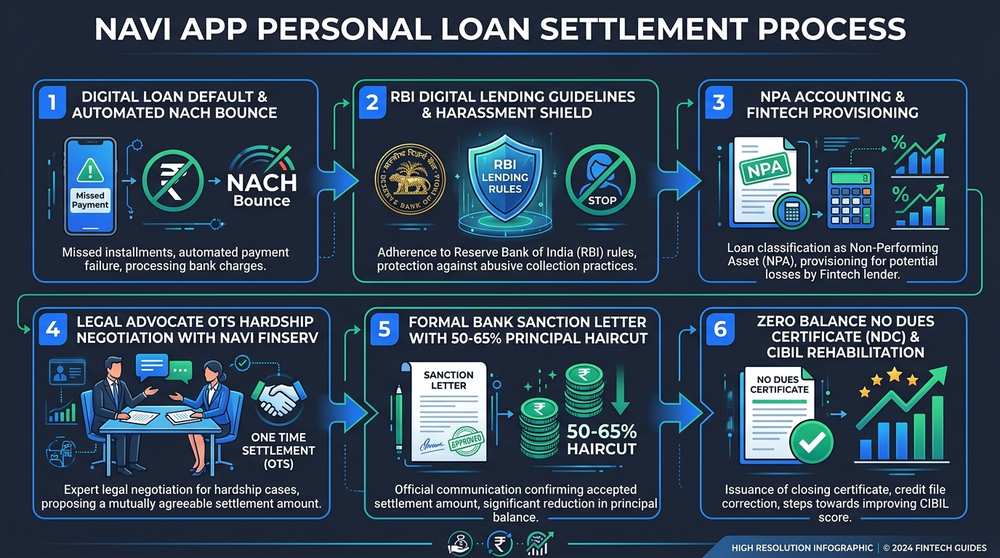
By understanding this multi-stage lifecycle, borrowers can avoid panic-driven mistakes—such as making partial token payments to third-party tele-callers without sanction letters—and systematically execute a legally protected compromise settlement that delivers a full and final discharge.
6. Step-by-Step Strategic Roadmap: How Advocates Negotiate Navi Loan Settlements
Securing a 50% to 65% principal haircut from Navi Finserv requires a disciplined, legally rigorous methodology. SettleLoans executes a proven 5-phase strategic framework designed to disarm automated recovery systems and engage directly with authorized decision-makers:
Advocates serve a formal Representation and Cease-and-Desist Notice to Navi Finserv Limited and its empanelled recovery agencies. The notice asserts borrower representation, invokes the RBI Fair Practices Code, mandates that all future communication occur strictly via authorized legal counsel in writing, and warns against unlawful third-party reference calling.
A comprehensive insolvency dossier is compiled, including medical records, termination notices, income reduction certificates, GST cancellation records, and bank statements. This evidence proves that default is caused by bona fide economic catastrophe rather than wilful evasion, which is mandatory under RBI Compromise Settlement Directives.
Legal advocates bypass low-level tele-calling queues and digital chatbot portals to submit a formal One-Time Settlement Petition directly to Navi Finserv's Zonal Stressed Assets Manager and Principal Nodal Officer, proposing a structured 35% to 50% principal compromise payment.
Using the NPV recovery equation, advocates negotiate aggressively with Navi's Credit Committee, eliminating 100% of accumulated late fines, penal interest, and NACH bounce fees, while securing a 50% to 65% principal haircut structured in 1 to 3 manageable tranches.
Advocates conduct forensic verification of the stamped OTS Sanction Letter issued by Navi Finserv Limited. The compromised amount is deposited directly into the borrower's official Navi loan account via RTGS/NEFT. SettleLoans monitors post-settlement compliance until the zero-balance No Dues Certificate is delivered.
7. Navi OTS Sanction Letter Forensics & Settlement Trap Avoidance
The most dangerous hazard in digital loan settlement is paying funds based on verbal tele-caller promises or forged PDF receipts. Unscrupulous collection agents frequently tell borrowers: "Deposit ₹25,000 today on this UPI link and your Navi loan will be closed." In reality, such verbal deposits are booked as regular overdue part-payments, leaving the remaining principal active while the agent collects their recovery commission.
Before remitting a single rupee, verify that your settlement letter satisfies all five mandatory forensic criteria:
8. Loan Remittance, RBI ₹0 No Dues Certificate Mandate & CIBIL Credit Score Repair
Once the agreed compromise sum is transferred directly into your Navi loan account, the final legal phase begins: securing your No Dues Certificate (NDC) / Loan Closure Letter and managing your credit bureau profile. Under Reserve Bank of India Circular RBI/2023-24/60 (Release of Movable/Immovable Property Documents & Loan Account Closure), regulated NBFCs like Navi Finserv Limited are statutorily mandated to issue the formal closure letter and update all four Credit Information Companies (TransUnion CIBIL, Experian, Equifax, and CRIF High Mark) within 30 calendar days.
If Navi Finserv fails to deliver the NDC within 30 days without valid statutory justification, the RBI framework entitles the borrower to mandatory compensation of ₹5,000 per day of delay, directly payable by the lender.
Following loan settlement, Navi reports the account to CIBIL with the remark "Settled" or "Post-Write-off Settled" with an Outstanding Balance of ₹0. While this entry reflects an agreed compromise and triggers a temporary credit score drop of 75 to 130 points, it halts negative compounding overdue reporting and eliminates active legal liability. Distressed borrowers can systematically rebuild their CIBIL score above 750 within 18 to 24 months through a disciplined 4-step credit rehabilitation protocol:
Open a fixed-deposit backed credit card (e.g., IDFC WOW, Kotak 811 DreamDifferent) with a ₹25,000–₹50,000 deposit. Use 15% to 25% of the limit and settle 100% of the bill on time every month.
Pull official CIBIL and Experian reports 45 days post-settlement to confirm the Navi loan outstanding balance reflects precisely ₹0 with zero active days-past-due (DPD) accumulation.
Maintain an aggregate Credit Utilization Ratio (CUR) below 30% across all active credit lines, demonstrating responsible leverage and cash flow discipline to bureau algorithms.
Avoid applying for multiple unsecured digital loan apps during the 12-month cooling period, establishing an unblemished 24-month repayment record that elevates your score above 750+.
10. SettleLoans: India's Leading Legal Defense & Debt Settlement Advisory
Navigating an institutional dispute against a tech-driven digital lender like Navi Finserv requires seasoned legal advocates who understand both digital lending regulations and RBI compromise settlement frameworks. SettleLoans provides comprehensive legal defense for distressed borrowers across India—stopping unlawful collection bot harassment, drafting formal replies to Section 25 PSSA summons, and negotiating directly with Navi Finserv's Stressed Asset Desks to achieve the deepest possible debt haircuts backed by authentic, bank-stamped No Dues Certificates.

Settle Loan is India's trusted debt relief and loan settlement platform. We help borrowers overcome financial distress by negotiating with banks and NBFCs to legally settle personal loans and credit card debts. With our transparent, performance-based approach, you can achieve debt freedom and regain your financial peace of mind.
COMPUTER
11. Frequently Asked Questions: Navi App Loan Settlement
Clear, legally verified answers to essential questions regarding Navi app personal loan default, NACH bounce penalties, recovery agent harassment rules, and credit score rehabilitation.
What is the Navi app personal loan settlement process and how does it operate?
The Navi app personal loan settlement is a formal, legally recognized compromise resolution executed between a financially distressed borrower and Navi Finserv Limited (the RBI-registered NBFC that finances Navi loans). When an unsecured digital loan defaults past 90 days and enters Non-Performing Asset (NPA) classification, recovery operations shift from front-line tele-callers to the Stressed Asset Resolution Committee. The borrower submits a structured One-Time Settlement (OTS) petition supported by verified insolvency records (such as medical discharge summaries, termination letters, or audited balance sheet losses). Upon formal evaluation, Navi approves a stamped OTS Sanction Letter providing 50% to 65% principal write-downs and complete penalty waivers, followed by a ₹0 No Dues Certificate upon receipt of the compromised sum.
Is Navi a regulated NBFC or an unauthorized predatory 7-day loan app?
Navi is a legitimate, Reserve Bank of India-regulated digital lending institution. All personal loans originated through the Navi application are underwritten, booked, and managed by Navi Finserv Limited (an RBI-registered Systemically Important Non-Deposit Accepting NBFC). Unlike illegal 7-day APK scam apps that blackmail borrowers through unauthorized contact book harvesting, Navi operates under the RBI Digital Lending Directions (2022/2023), reports directly to credit bureaus (CIBIL, Experian, Equifax, CRIF High Mark), offers formal loan terms up to 72 months, and is legally required to adhere to the statutory RBI Fair Practices Code.
How can borrowers halt repetitive calling bots and recovery agent harassment?
Under the RBI Master Directions on Recovery Agents and Conduct and the Digital Lending Framework, Navi and its third-party collection vendors are strictly prohibited from deploying aggressive automated IVR bots, making repetitive phone calls, using intimidating or profane language, calling outside 08:00 AM to 07:00 PM, or contacting third-party references, friends, or employers. Distressed borrowers can immediately stop harassment by serving a formal legal representation through debt advocates, revoking unnecessary device permissions, and escalating violations to Navi Finserv's Principal Nodal Grievance Officer and the RBI Integrated Ombudsman (cms.rbi.org.in).
What should you do when Navi NACH auto-debit bounces repeatedly?
When an electronic NACH auto-debit instruction fails, both the borrower's depository bank and Navi levy punitive bounce charges ranging from ₹250 to ₹590 per event. Navi's automated collection systems frequently trigger multiple automated re-presentations every month, depleting savings balances. Under Section 25 of the Payment and Settlement Systems Act, 2007 (PSSA), an electronic mandate bounce is treated similarly to a cheque bounce. Borrowers facing severe financial distress can submit a written mandate cancellation or stop-payment instruction directly to their home bank branch citing financial hardship, halting repetitive bounce deductions while legal counsel initiates OTS negotiations.
Can Navi file a criminal FIR or send police officers to your residence for personal loan default?
No. Under established Indian jurisprudence, the inability to repay an unsecured retail digital loan constitutes a civil breach of contract, not a criminal offence. Police officers possess zero legal authority to act as debt collection enforcers for private fintech apps or NBFCs. Recovery agents who send forged police summons, fake arrest warrants, or fraudulent court notices on WhatsApp are engaging in criminal extortion and forgery under the Bharatiya Nyaya Sanhita (BNS) and the Information Technology Act, 2000.
What percentage of debt waiver or haircut can you realistically negotiate on a defaulted Navi loan?
On unsecured digital personal loans disbursed by Navi Finserv that have aged past 90 to 180+ days into Substandard or Doubtful NPA categories, borrowers with verified economic distress can negotiate a 50% to 65% principal haircut. In addition, 100% of accumulated penal interest, late payment fines, compounding overdue charges, and NACH bounce fees are waived entirely under standard RBI compromise settlement protocols.
How should you respond to a Section 25 PSSA legal notice from Navi Finserv advocates?
When Navi Finserv's empanelled advocates serve a statutory demand notice under Section 25 of the Payment and Settlement Systems Act, 2007, you must never disregard it. Borrowers have a mandatory 15-day statutory window to respond. A formal legal reply drafted by experienced debt defense advocates must be served, establishing bona fide financial catastrophe, challenging unlawful penalty compounding, demonstrating lack of mens rea (criminal intent), and formally inviting the lender to resolve the dispute through an amicable One-Time Settlement.
Can Navi Finserv freeze or debit funds from your savings account in other banks?
No. While Section 171 of the Indian Contract Act, 1872 gives deposit-taking banks a Right of General Banker's Lien over accounts within the same institution, Navi Finserv is a non-deposit-taking NBFC. It has zero legal authority to freeze, set off, or attach balances in accounts maintained with independent commercial banks (such as State Bank of India, HDFC Bank, ICICI Bank, or Punjab National Bank) without first obtaining a formal execution decree and attachment warrant from a competent Civil Court.
What is the statutory timeline for Navi Finserv to issue a No Dues Certificate under RBI rules?
Under Reserve Bank of India Circular RBI/2023-24/60, Navi Finserv Limited is legally obligated to release all loan closure documents, issue an official stamped No Dues Certificate (NDC), and update credit bureau records across CIBIL, Experian, Equifax, and CRIF High Mark within 30 calendar days of receiving full settlement payment. If the lender delays issuing the NDC beyond 30 days without valid justification, it must pay mandatory statutory compensation of ₹5,000 per day of delay directly to the borrower.
How does a Navi app loan settlement impact your CIBIL score and how can you rebuild it?
Upon completion of the settlement, Navi reports the loan account status as 'Settled' or 'Post-Write-off Settled' with an outstanding balance of ₹0. While this entry leads to an immediate credit score contraction of 75 to 130 points and initiates a 12 to 24 month institutional cooling period, it permanently stops compounding default remarks. Borrowers can successfully rebuild their credit score back above 750 within 18 to 24 months by maintaining disciplined repayment on secured fixed-deposit credit cards and small consumer lines.