- SARB Escalation Window: Once defaults cross 90–120 days, retail branches transfer files to the Stressed Asset Resolution Branch (SARB), where formal compromise settlements with large haircuts are sanctioned.
- Haircut Benchmark (40%–65%): Distressed borrowers with verifiable hardship can secure 40% to 65% waivers on principal outstanding, with 100% elimination of penal interest and late fees.
- Section 171 Banker's Lien Defense: Axis Bank can auto-debit accounts within Axis Bank under Section 171 of the Indian Contract Act, requiring borrowers to safeguard external banking arrangements.
- Statutory Notice Response: Prompt legal replies to Section 25 PSSA and Section 138 NI Act notices halt magistrate escalation and direct the bank toward judicial conciliation.
- Mandatory ₹0 NDC within 30 Days: Under RBI Circular RBI/2023-24/60, Axis Bank must issue the No Dues Certificate within 30 days of settlement or pay ₹5,000 daily delay relief.
Axis Bank Retail Loans & Risk Framework
Axis Bank Limited stands as one of India's largest private sector financial institutions. It commands a massive retail credit footprint, including unsecured personal loans, 24x7 digital loans, Burgundy credit facilities, and revolving credit lines. Because these credit products are extended without mortgage collateral or tangible hypothecation, Axis Bank manages its institutional risk through automated credit underwriting, algorithmic bureau monitoring, and tight National Automated Clearing House (NACH) mandate sweeps.
When an unexpected economic disruption strikes—such as sudden corporate downsizing, catastrophic medical emergencies, business liquidation, or macroeconomic insolvencies—the borrower's cash flow fractures. When a scheduled monthly installment fails to clear on time, Axis Bank's automated risk systems react. They trigger compounding late fees and penal charges of 24% to 36% per annum. also, algorithmic risk flags restrict credit card limits across the borrower's entire CIF.
Under Indian jurisprudence and the binding directives of the Reserve Bank of India (RBI), financial distress resulting from legitimate economic misfortune is fundamentally recognized as a civil contractual dispute. The law draws a clear distinction between a dishonest wilful defaulter who possesses liquid assets but deliberately diverts sanctioned capital, and an involuntary distressed borrower whose debt-servicing capacity has been dismantled by genuine financial calamity. Involuntary borrowers possess the legal right to seek debt resolution under board-approved compromise settlement frameworks.
Axis Bank's Delinquency Lifecycle: From SMA-0 to SARB Handover
Navigating a compromise settlement with Axis Bank requires a clear understanding of the Reserve Bank of India's Prudential Norms on Income Recognition, Asset Classification and Provisioning (IRACP). An overdue personal loan progresses through standardized regulatory and administrative stages that determine the bank's internal provisioning burden and its legal willingness to grant principal haircuts.
During the initial Special Mention Account (SMA-0 and SMA-1) stages spanning the first 60 days of default, collection efforts remain centralized with automated digital reminders and tele-calling teams. When delinquency enters SMA-2 status (61 to 90 days past due), the risk vertical issues pre-NPA warnings and loan acceleration notices. Once the account crosses the 90-day threshold without payment, it is officially classified as a Non-Performing Asset (NPA) and reassigned to the Stressed Asset Resolution Branch (SARB).
| Delinquency Stage | Overdue Timeline | Regulatory Asset Category | Institutional Action & Settlement Viability |
|---|---|---|---|
| SMA-0 | 1 – 30 Days Past Due | Standard Performing Asset | Automated SMS reminders, NACH re-presentment fees, standard tele-collection calls. Zero haircut viability. |
| SMA-1 | 31 – 60 Days Past Due | Standard Monitored Asset | Escalated tele-calling, initial credit limit freeze on Burgundy cards. Standard restructuring possible. |
| SMA-2 | 61 – 90 Days Past Due | High-Risk Watchlist | Pre-NPA demand notices dispatched, field verification started. Settlement discussions strictly non-discounted. |
| Substandard NPA | 91 – 365 Days Past Due | Non-Performing Asset (NPA) | Account transferred to SARB. Bank absorbs 15%–25% provisioning. 35%–50% principal haircut becomes negotiable. |
| Doubtful (D1/D2) | 12 – 36 Months Past Due | Doubtful Impaired Asset | Provisioning escalates to 50%–100%. SARB prioritizes cash realization. 50%–65% principal haircut achievable. |
| Loss Asset | 36+ Months Past Due | Fully Written-off Asset | 100% written off on bank ledger. Lok Adalat conciliation or deep OTS (up to 70% haircut) actively pursued. |
The critical strategic inflection point occurs when the account transfers to SARB after 90 days. While local branches are evaluated on EMI collection targets, SARB desks are judged on bad-debt recoveries and NPA portfolio reduction. SARB officers hold delegated financial powers to evaluate compromise settlements based on commercial recovery benchmarks.
Check Your Loan Settlement Options
Answer 2 quick questions to evaluate your settlement eligibility.
1. What type of loan do you want to settle?
Banker's Right of Set-Off (Section 171) & Safeguarding Liquid Assets
Borrowers defaulting on an Axis Bank personal loan or Burgundy credit card must understand the legal power of the Banker's Right of General Lien and Set-Off under Section 171 of the Indian Contract Act, 1872. This statutory provision grants Axis Bank authority to appropriate internal funds. It can debit any savings account, current account, salary credit, or fixed deposit maintained with Axis Bank under the same PAN or CIF to offset delinquent loan dues.
High-net-worth borrowers and salaried professionals maintaining Burgundy banking relationships are particularly vulnerable to sudden automated ledger sweeps. When an equated monthly installment or card balance defaults, Axis Bank algorithms automatically freeze or sweep incoming funds to satisfy arrears without requiring prior judicial notice.
However, this right of set-off has defined statutory boundaries. Axis Bank cannot legally debit or attach accounts maintained with other independent commercial banks (such as SBI, HDFC Bank, or ICICI Bank). Doing so requires a specific decree or attachment order from a competent Civil Court or Debt Recovery Tribunal (DRT). Borrowers facing default must immediately ring-fence their monthly subsistence by opening an operational salary or savings account with an independent bank where they hold no existing loan exposure.
Defending Against Section 25 PSSA & Section 138 Cheque Bounce Notices
When automated NACH mandates bounce or physical repayment cheques dishonour, Axis Bank takes legal steps. Its legal panel dispatches statutory notices under Section 25 of the Payment and Settlement Systems Act, 2007 (PSSA) or Section 138 of the Negotiable Instruments Act, 1881. These statutory notices grant a mandatory 15-day window to respond before criminal complaint cases can be instituted in a Magistrate Court.
Receiving a Section 25 PSSA or Section 138 legal notice requires immediate formal legal action rather than panic. Under the guidance of seasoned debt defense advocates, borrowers should serve an exhaustive legal reply within the 15-day statutory window. The reply establishes the genuine absence of fraudulent intent, sets out verifiable economic distress, challenges inflated penal charges and compounding interest calculations, and places on record a formal offer for compromise settlement.
Serving a structured legal reply effectively neutralizes the bank's litigation momentum. Magistrate cases require large legal costs, dedicated counsel appearances, and multi-year timelines. For this reason, Axis Bank legal officers routinely prefer resolving accounts with active legal replies. They channel these matters into the SARB or National Lok Adalat for immediate compromise resolution.
Axis Bank Loan Settlement Roadmap & Haircut Architecture
The visual framework below outlines Axis Bank's complete resolution pathway—from initial default and Special Mention Account classification to SARB committee evaluation, haircut determination, and final debt extinguishment with a zero-balance No Dues Certificate.
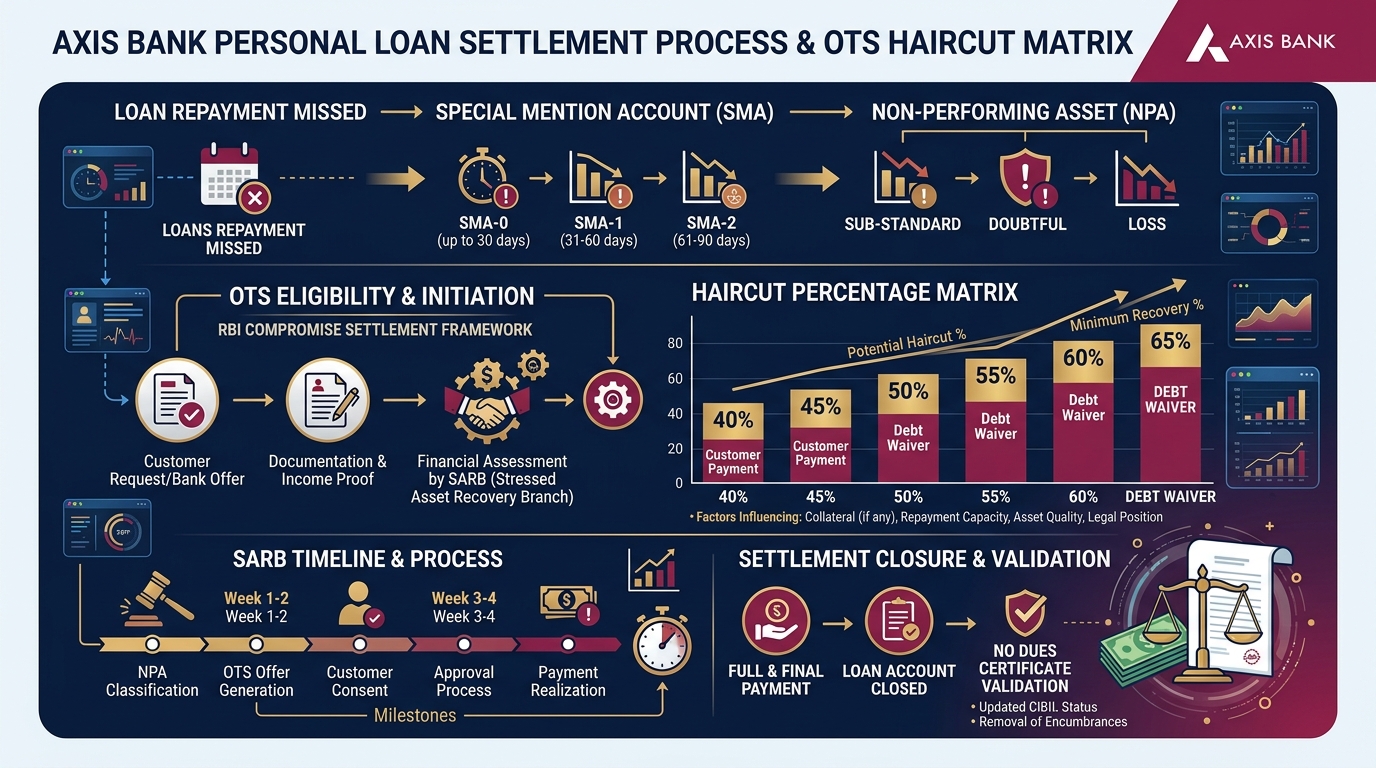
Figure 1.0: End-to-End Axis Bank Personal Loan Settlement Lifecycle, SARB Escalation Milestones & Compromise Haircut Matrix.
Axis Bank's OTS Haircut Mechanics & Recovery Valuation Formula
Under the Reserve Bank of India's Prudential Framework for Resolution of Stressed Assets and board-approved compromise settlement policies, Axis Bank evaluates One-Time Settlement offers using rigorous financial modeling. Unlike front-line recovery agents who claim that loans cannot be discounted, the Stressed Asset Resolution Branch evaluates every default through a Net Present Value (NPV) Recovery Valuation Benchmark.
When a loan transitions into an NPA, Axis Bank is legally mandated to set aside regulatory capital provisions. On unsecured credit lines, this provisioning burden reaches 25% within 12 months, 40%–50% within 24 months, and 100% for Loss Assets. If Axis Bank pursues civil recovery through Order 37 summary suits or DRT cases, it faces major hurdles. It must pay court fees (typically 1% to 3% of claim value) and senior advocate retainers. It also endures 4 to 7 years of litigation with zero guarantee of asset discovery against an unsecured borrower.
Where C_t represents estimated recoveries, r is the discount rate, and deductions account for 3–5 years of court friction and capital locked in NPA provisions.
An immediate cash settlement under OTS releases 100% of locked regulatory provisioning and eliminates legal overheads. so, the bank's Credit Committee routinely approves settlements offering 40% to 65% debt waivers on principal debt. In addition, it approves a 100% waiver of unaccrued interest, penal levies, and late fees.
5-Step Protocol for Negotiating Axis Bank Personal Loan Settlement
Successfully executing a compromise settlement with Axis Bank requires adhering to a disciplined, legally backed five-step roadmap that bypasses third-party recovery agents and engages directly with authorized decision-makers:
Dossier Compilation & Insolvency Audit
Assemble comprehensive records establishing genuine financial hardship, including termination letters, income tax returns showing collapsed revenue, hospital discharge summaries, or bank statements reflecting insolvency.
Cease-and-Desist & Agent Insulation
Serve a formal legal notice under the RBI Master Directions on Recovery Agents to Axis Bank and its collection agencies, stopping unlawful contact with workplace colleagues, friends, and relatives.
Formal OTS Submission to SARB Desks
Bypass third-party recovery tele-callers and submit a formal compromise petition directly to the Stressed Asset Resolution Branch or Central Settlement Committee, offering a structured settlement tranche.
Credit Committee Sanction & Letter Verification
Negotiate haircut terms before the Zonal Credit Committee to secure an authentic, stamped OTS Sanction Letter on official Axis Bank letterhead with explicit debt extinguishment terms.
Remittance & Mandatory ₹0 NDC Issuance
Pay the agreed sum directly into the loan account via RTGS/NEFT, obtain an immediate stamped bank receipt, and secure the No Dues Certificate within the statutory 30-day window under RBI directives.
Sanction Letter Forensics & Mandatory ₹0 NDC Protocol
The single most dangerous error in debt settlement is remitting money based on verbal promises or informal messages from collection personnel. Unauthorized agents frequently deceive borrowers by claiming that an ad-hoc token payment will settle the account, only for the funds to be absorbed into accumulated penal charges while the loan remains active and compounding.
Before releasing a single rupee, borrowers must verify that the Axis Bank OTS Sanction Letter satisfies five mandatory forensic criteria: (1) Printed on official Axis Bank letterhead with authentic bank insignia. (2) Issued with a unique reference number and signed by an authorized Assistant Vice President (AVP) or Zonal Credit Manager with employee code. (3) Explicitly lists the exact settlement amount, payment due dates, and specific loan account number. (4) Contains an unambiguous debt discharge clause confirming that upon payment, all residual balance is fully waived and legal cases withdrawn. (5) Mandates the issuance of a formal No Dues Certificate.
Under RBI Circular RBI/2023-24/60, Axis Bank is legally obligated to release the final No Dues Certificate (NDC) / Loan Closure Letter. It must also update credit bureau records within 30 calendar days of receiving the agreed settlement amount. If the bank fails to issue the certificate within 30 days due to operational lapses, it faces penalties. It must pay mandatory statutory relief of ₹5,000 per day of delay directly to the borrower.
CIBIL Trajectory, RBI Cooling Period & 24-Month Score Rebuilding
Following full payment of the settlement amount, Axis Bank updates the account status across all four credit bureaus (CIBIL, Experian, Equifax, CRIF High Mark). The account status becomes 'Settled' or 'Post-Write-off Settled' with an outstanding balance of ₹0. While this causes an initial CIBIL score drop of 75 to 150 points, it halts monthly default compounding and allows systematic credit score rebuilding.
While a 'Settled' status reflects a past concession, it is infinitely superior to an open, compounding 'Default' or 'Suit Filed' tag that triggers ongoing legal notices. Once the debt is extinguished with a ₹0 balance, borrowers can rebuild their credit profile back to 750+ within 18 to 24 months. You can use secured credit cards backed by fixed deposits, make punctual utility payments, and maintain credit use below 30%.
| Resolution Avenue | Principal Haircut Range | Legal Finality | CIBIL Reporting Status | Resolution Timeline |
|---|---|---|---|---|
| Direct SARB Settlement | 40% – 65% Principal Haircut | Complete (Bank NDC Issued) | 'Settled' / ₹0 Balance | 3 to 6 Weeks |
| National Lok Adalat | 45% – 65% Principal Haircut | Absolute (Civil Court Decree) | 'Settled' / ₹0 Balance | Quarterly Lok Adalat Cycles |
| Standard Restructuring | 0% Haircut (Tenure Extension) | Conditional on EMI Service | 'Restructured' / Active Debt | 2 to 4 Weeks |
| Civil Court Litigation | Uncertain (Judicial Discretion) | Subject to Multi-Year Appeal | 'Suit Filed' / Open Default | 4 to 7 Years |
Professional Legal Representation for Axis Bank Debt Settlement
Navigating an Axis Bank loan default requires expert advocacy. Professional representation shields your family from aggressive collection tactics. It also ensures timely replies to statutory Section 25 PSSA and Section 138 notices, securing maximum debt relief from SARB credit committees. SettleLoans provides end-to-end legal and financial representation to help distressed borrowers achieve financial freedom.

Settle Loan is India's trusted debt relief and loan settlement platform. We help borrowers overcome financial distress by negotiating with banks and NBFCs to legally settle personal loans and credit card debts. With our transparent, performance-based approach, you can achieve debt freedom and regain your financial peace of mind.
COMPUTER
Frequently Asked Questions on Axis Bank Personal Loan Settlement
The Axis Bank loan settlement process is a formal legal compromise agreement between Axis Bank Limited and an unsecured borrower. When an unsecured personal loan or Burgundy credit card defaults beyond 90 days, it is classified as a Non-Performing Asset (NPA). At this stage, the account is transferred from retail branches to the Stressed Asset Resolution Branch (SARB). The borrower submits a detailed OTS proposal supported by legitimate hardship records, such as termination letters, medical bills, or business winding-up filings. Axis Bank's Credit Committee evaluates the recovery potential against Net Present Value (NPV) benchmarks. Upon sanction, Axis Bank issues an official stamped OTS Sanction Letter. Once the compromised sum is remitted, the bank extinguishes all residual debt and issues a ₹0 No Dues Certificate (NDC).
On unsecured personal loans, 24x7 instant credit lines, and Burgundy credit cards, Axis Bank typically approves debt haircuts between 40% and 65%. The exact waiver percentage depends on three key criteria. First is the NPA Aging Bucket. Loans classified as Doubtful (D1/D2) or Loss Assets qualify for the deepest haircuts, as Axis Bank has provisioned 50% to 100% of the balance. Second is Hardship Verifiability, backed by concrete records of insolvency. Third is SARB Channel talks, engaging directly with senior zonal credit managers rather than agencies. In all approved settlements, 100% of accrued penal charges, overdue interest, and bounce fees are completely eliminated.
The Stressed Asset Resolution Branch (SARB) is Axis Bank's specialized asset recovery division created to manage and resolve non-performing retail and corporate debt portfolios. Once a personal loan defaults past 90 to 120 days, retail branch managers lose discretionary authority to offer repayment concessions, and the file is reassigned to SARB. SARB officers operate under delegated financial authorities, possessing the institutional power to waive large principal balances, evaluate litigation costs versus immediate cash recovery, and execute binding compromise settlement agreements.
Yes. Under Section 171 of the Indian Contract Act, 1872 (Banker's Right of General Lien and Set-Off), Axis Bank holds statutory set-off authority. It is legally empowered to debit funds or freeze balances in any savings account, salary account, current account, or fixed deposit maintained with Axis Bank under the same CIF or PAN. However, Axis Bank cannot legally attach, freeze, or withdraw money from accounts held with other independent banking institutions (such as HDFC Bank, ICICI Bank, or SBI). Doing so requires a formal attachment warrant from a competent Civil Court or Debt Recovery Tribunal.
When an electronic NACH auto-debit mandate fails or a repayment cheque dishonours due to insufficient funds, Axis Bank acts quickly. Its empanelled law firms issue statutory legal notices under Section 25 of the Payment and Settlement Systems Act, 2007 (PSSA) or Section 138 of the Negotiable Instruments Act, 1881. Borrowers must never ignore these notices. A formal legal reply drafted by experienced debt defense advocates must be served within the mandatory 15-day window. The reply sets out genuine financial hardship, disputes unlawful penalties, and proposes a structured One-Time Settlement to avert court escalation.
Axis Bank deploys internal recovery desks during early delinquency (1–60 days) and assigns empanelled third-party Debt Recovery Agencies (DRAs) once accounts enter NPA status. Under the RBI Master Directions on Recovery Agents (2022) and the Fair Practices Code, borrowers possess enforceable statutory rights: (a) Agents may only call between 08:00 AM and 07:00 PM. (b) Abusive language, intimidation, and public humiliation are strictly prohibited. (c) Agents are barred from contacting employers, colleagues, or relatives. (d) Visiting agents must display an official bank authorization letter and DRA ID card. Violations can be reported to Axis Bank's Principal Nodal Officer and the RBI Integrated Ombudsman.
Yes. Axis Bank regularly participates in the quarterly National Lok Adalat conducted across India under the Legal Services Authorities Act, 1987. Delinquent personal loan and credit card accounts referred to Lok Adalat are evaluated by a judicial conciliation panel where authorized Axis Bank officers attend with pre-approved settlement mandates (often offering 45% to 65% haircuts). An award passed in Lok Adalat has the legal force of a Civil Court Decree with absolute finality, permanently extinguishing all civil claims and Section 138/Section 25 cases with no right of appeal.
Upon completion of the settlement, Axis Bank reports the loan account status to credit information companies (CIBIL, Experian, Equifax, CRIF High Mark) as 'Settled' or 'Post-Write-off Settled' with an outstanding balance of ₹0. This closes the delinquent account but causes an immediate credit score drop of about 75 to 150 points. In addition, RBI compromise guidelines mandate a 12-month cooling period before applying for fresh credit. However, a 'Settled' tag with ₹0 balance halts open compounding defaults and enables borrowers to restore their CIBIL score back to 750+ within 18 to 24 months through disciplined credit rebuilding.
Borrowers must follow five non-negotiable security protocols: (1) Zero Verbal Commitments: Never pay based on phone calls, SMS, or WhatsApp messages from recovery agents. (2) Authentic Bank Letterhead: Demand an official OTS Sanction Letter printed on Axis Bank letterhead with bank seal and officer employee code. (3) Direct Loan Account Remittance: Deposit funds strictly into your designated Axis Bank loan account number via RTGS/NEFT or account payee cheque—never into personal accounts. (4) Full Extinguishment Clause: Confirm the letter explicitly states that the payment constitutes full and final satisfaction with complete waiver of balance dues. (5) Instant Stamped Receipt: Secure an immediate bank-stamped payment receipt upon transfer.
Under RBI Circular RBI/2023-24/60, Axis Bank must adhere to strict post-settlement timelines. The bank is legally required to issue a formal No Dues Certificate (NDC) / Loan Closure Certificate. It must also update credit bureau databases within 30 calendar days of receiving the agreed settlement amount. If Axis Bank fails to issue the certificate within 30 days without lawful justification, it faces statutory penalties. The bank is statutorily liable to pay mandatory relief of ₹5,000 for each day of delay directly to the borrower.