1. The ₹10 Lakh Debt Reality: Bank Exposure & Risk Thresholds
Defaulting on a ₹10 Lakh unsecured personal loan places a borrower into a uniquely intense operational zone within Indian banking institutions. Unlike retail micro-loans below ₹2 Lakhs, which credit institutions write off swiftly with minimal individual scrutiny, an exposure of ₹10,00,000 commands active monitoring from zonal asset recovery branches and senior credit managers. Lenders like HDFC Bank, ICICI Bank, State Bank of India, Axis Bank, Kotak Mahindra Bank, and major NBFCs such as Bajaj Finance or Tata Capital treat this ticket size with heightened urgency because it impacts branch-level Non-Performing Asset (NPA) ratios.
When a borrower defaults on a ₹10 Lakh personal loan, financial institutions initiate a synchronized escalation protocol. This strategy combines automated digital reminders, outsourced collection agency deployment, and the formal dispatch of statutory legal notices by empaneled advocates. However, borrowers frequently experience profound psychological distress because recovery agents deliberately exaggerate the bank's legal powers, threatening immediate police intervention, property attachment, or workplace defamation.
Understanding the structural limitations of the bank's legal arsenal is essential to maintaining composure and executing a strategic resolution. In India, genuine loan default is strictly a civil contract breach governed by the Indian Contract Act, 1872. Furthermore, under the Recovery of Debts and Bankruptcy Act (RDB Act), 1993, the minimum pecuniary threshold required for a financial institution to approach the Debt Recovery Tribunal (DRT) is ₹20 Lakhs. Consequently, banks are legally barred from initiating DRT summary attachment proceedings against a ₹10 Lakh personal loan. While lenders retain the right to file a regular summary civil suit under Order XXXVII of the Civil Procedure Code (CPC), doing so requires significant non-refundable state court fees (typically 4% to 7% of the claim value) and commits the bank to a judicial process lasting 4 to 8 years.
2. Delinquency Aging, NPA Provisioning & NPV Mechanics
To secure an optimal settlement haircut of 40% to 50% on a ₹10 Lakh personal loan, one must analyze the institutional accounting incentives governing commercial lenders. In compliance with the Reserve Bank of India's Prudential Framework on Resolution of Stressed Assets, every overdue loan transitions through strictly regulated classification stages based on Days Past Due (DPD). The account is categorized as Special Mention Account-0 (SMA-0) for 1 to 30 days overdue, SMA-1 for 31 to 60 days, and SMA-2 for 61 to 90 days.
Upon crossing the critical 90-day threshold of continuous non-payment, the loan is formally classified as a Non-Performing Asset (NPA) under the Substandard category. At this junction, the RBI Master Circular on Income Recognition, Asset Classification and Provisioning (IRACP) mandates that the lender set aside an immediate 15% provisioning allocation against their operating profits for unsecured debt. If the default continues past 12 months, the account slips into Doubtful Asset Stage 1 (D1), triggering a mandatory 25% to 40% provisioning requirement, which eventually climbs to 100% for Doubtful D2 and Loss Asset categories.
This mandatory balance-sheet provisioning creates an economic imperative for the bank. Locked provisioning capital impairs the bank's Return on Capital Employed (ROCE) and restricts its lending capacity. When evaluating a settlement proposal, the bank's Credit Committee does not operate on emotional hostility; instead, they execute a Net Present Value (NPV) recovery analysis. The committee compares the guaranteed cash received today via a One-Time Settlement against the discounted present value of potential recoveries achieved through 5 to 7 years of civil court litigation, factoring in 10% annual inflation, legal retainer expenses, and administrative overhead.
| Delinquency Stage | Days Past Due (DPD) | RBI Mandatory Provisioning | Bank Settlement Leverage |
|---|---|---|---|
| SMA-0 / SMA-1 | 1 – 60 Days | Standard Provisioning (0.4%) | Zero Haircut; Focus on EMI Restructuring |
| SMA-2 | 61 – 90 Days | Pre-NPA Alert Stage | Waiver of Late Fees & Bounce Penalties Only |
| Substandard NPA | 91 – 180 Days | 15% Capital Provisioning | 25% – 35% Principal Haircut Window Opens |
| Doubtful D1 NPA | 181 – 365 Days | 25% – 40% Capital Provisioning | 40% – 55% Principal Haircut Sweet Spot |
| Doubtful D2 / Loss | 365+ Days | 100% Capital Written-Off | 55% – 70% Maximum Hardship Haircut |
Check Your Loan Settlement Options
Answer 2 quick questions to evaluate your settlement eligibility.
1. What type of loan do you want to settle?
3. Legal Notice Escalation: Section 25 PSSA & Section 138
At a ₹10 Lakh outstanding principal, lending institutions routinely issue statutory legal notices following automated banking mandate failures. When the electronic National Automated Clearing House (e-NACH) or standing instruction bounces due to insufficient funds, the lender dispatches a legal notice under Section 25 of the Payment and Settlement Systems Act, 2007 (PSSA). Similarly, if physical post-dated security cheques deposited by the borrower dishonor, the bank issues a demand notice under Section 138 of the Negotiable Instruments Act, 1881 (NI Act).
Receiving these legal notices generates severe panic, but understanding their procedural framework dispels unnecessary fear. Both Section 25 of the PSSA and Section 138 of the NI Act are quasi-criminal, bailable offenses created to ensure the commercial integrity of payment instruments. Under the law, the lender must provide the borrower with a mandatory 30-day statutory demand period from the date of notice receipt to resolve the financial claim before any formal complaint can be filed before a Judicial Magistrate First Class (JMFC) or Metropolitan Magistrate (MM).
Engaging an experienced debt settlement advocate to draft a comprehensive, point-by-point legal response within this 30-day window is critical. The advocate's reply achieves three vital legal objectives: first, it establishes that the non-payment arises strictly from genuine, documented financial hardship (such as catastrophic medical emergencies, job loss, or commercial bankruptcy) rather than fraudulent intent or willful default (rebutting criminal mens rea); second, it places on record that the disputed instrument was executed solely as collateral security rather than against a crystallized, undisputed liability; and third, it formally invites the financial institution to resolve the outstanding balance through bilateral conciliation or a compromise One-Time Settlement.
4. Sole Arbitration Notices & Civil Money Suit Realities
In addition to banking mandate notices, private banks and NBFCs frequently initiate unilateral arbitration proceedings for ₹10 Lakh loan defaults by invoking boiler-plate dispute resolution clauses embedded in standard loan agreements. Borrowers often receive letters from institutional arbitration councils or sole arbitrators located in metropolitan hubs like Mumbai, Delhi, or Chennai, demanding appearance or threatening an ex-parte arbitral award.
However, unilateral appointment of a sole arbitrator by a lending institution without the express, post-dispute written consent of the borrower is legally impermissible. In the landmark judgment Perkins Eastman Architects DPC v. HSCC (India) Ltd., followed by numerous High Court rulings, the Supreme Court of India established that a party interested in the dispute outcome cannot unilaterally appoint an arbitrator. An advocate can immediately challenge such proceedings by raising statutory objections under Section 12(5) and Section 14 of the Arbitration and Conciliation Act, 1996, effectively stalling unilateral arbitral pressure.
When lenders consider filing a summary civil suit under Order XXXVII of the CPC, they encounter daunting operational friction. Beyond payment of hefty state ad-valorem court fees, serving summons, framing issues, conducting cross-examination of bank officers, and obtaining a final decree typically consumes half a decade. Even after securing a money decree, executing it against an unsecured individual with no unencumbered commercial assets requires additional execution petitions under Order XXI CPC. Recognizing this protracted attrition, bank legal departments overwhelmingly prefer executing a compromise OTS that recovers liquid cash within 30 to 90 days.
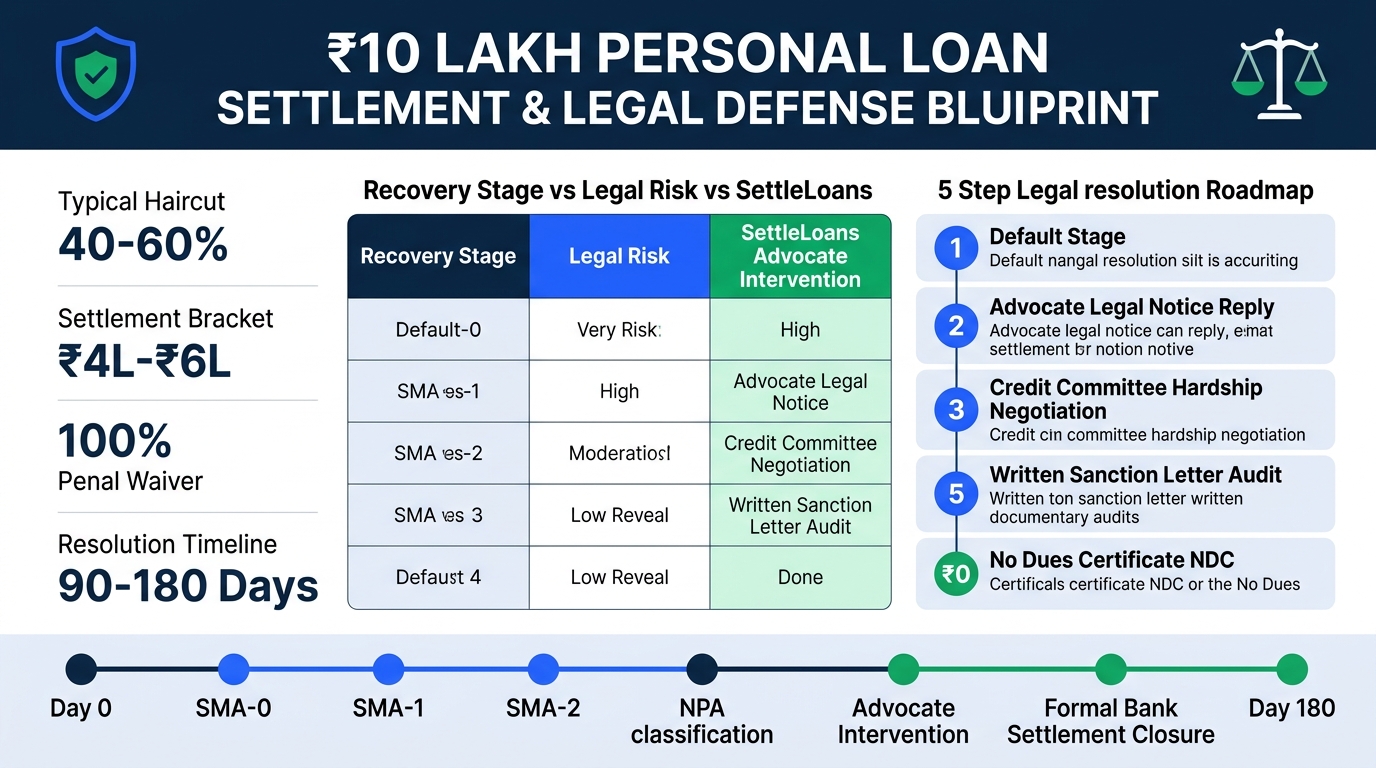
6. Realistic OTS Haircut Formula: Settling ₹10 Lakhs for ₹4L–₹5.5L
When calculating the settlement figure for a defaulted ₹10 Lakh personal loan, borrowers must never accept the inflated total claim presented on bank collection notices. Over 6 to 12 months of default, financial institutions compound exorbitant penal interest (often 24% to 36% annually), bounce charges, and administrative recovery levies, swelling an original ₹10 Lakh principal into an artificial ledger liability of ₹13 Lakhs to ₹15 Lakhs.
A legitimate One-Time Settlement executed under RBI Compromise Settlement frameworks follows a two-tier haircut calculation:
Tier 1: Complete 100% Penal Fee Waiver. Under RBI regulations and fair lending practices, all penal charges, bounce fees, legal notices costs, and post-default compound interest are completely eliminated from the negotiation table before assessing the underlying principal.
Tier 2: Principal Debt Haircut (40% to 60%). The negotiation focuses exclusively on the remaining core principal balance of ₹10,00,000. Depending on the delinquency vintage (120 to 360+ days) and the strength of the documented financial hardship, the bank's Credit Committee sanctions a final settlement between ₹4,00,000 and ₹5,50,000. If the borrower can remit the funds in a single bullet payment, banks frequently approve the deeper end of the haircut spectrum (₹4.0L to ₹4.5L). If the settlement is structured over 2 to 3 monthly installments, the approved figure typically ranges between ₹4.8L and ₹5.5L.
| Settlement Component | Bank Ledger Claim | Negotiated OTS Treatment | Final Settlement Payable |
|---|---|---|---|
| Core Principal Outstanding | ₹10,00,000 | 40% – 55% Hardship Haircut | ₹4,50,000 – ₹5,50,000 |
| Accrued Normal Interest | ₹1,80,000 | 100% Complete Waiver | ₹0 (Waived) |
| Compounded Penal Interest | ₹1,45,000 | 100% Complete Waiver | ₹0 (Waived) |
| NACH / Cheque Bounce Fees | ₹35,000 | 100% Complete Waiver | ₹0 (Waived) |
| Total Liability Comparison | ₹13,60,000 | Overall Debt Relief: ~63% | ₹4,50,000 – ₹5,50,000 |
7. Recovery Agent Harassment Defense & Workplace Protection
Because a ₹10 Lakh exposure represents an attractive recovery commission for third-party Debt Recovery Agencies (DRAs), borrowers often face intense collection misconduct. Unethical recovery agents frequently resort to abusive calling at odd hours, sending threatening messages via WhatsApp, contacting distant relatives whose numbers were never provided as references, and staging unauthorized visits to the borrower's workplace or residential society to cause social embarrassment.
Every borrower in India possesses robust, enforceable legal protections against recovery harassment under the RBI Master Directions on Recovery Agents (August 2022) and the Charter of Customer Rights. Key statutory mandates include:
• Time & Frequency Restrictions: Recovery calls and home visits are strictly restricted between 8:00 AM and 7:00 PM. Repeated calling or calling late at night constitutes an actionable regulatory violation.
• Strict Prohibition of Third-Party Disclosure: Lenders and collection agents are legally forbidden from contacting neighbors, colleagues, relatives, or employers who are not co-borrowers or legal guarantors. Disclosing debt details to third parties violates constitutional privacy rights upheld in the Puttaswamy ruling.
• Mandatory Agent Identity Disclosure: Recovery personnel must carry valid identity cards, Indian Institute of Banking & Finance (IIBF) DRA certifications, and an official authorization letter from the principal lending bank.
When recovery agents violate these guidelines, SettleLoans advocates issue formal cease-and-desist legal notices directly to the bank's Managing Director and Principal Nodal Officer (PNO). If harassment persists, complaints are lodged on the RBI Integrated Ombudsman portal (cms.rbi.org.in) and local police complaints are filed for criminal intimidation under Section 351/352 of the Bharatiya Nyaya Sanhita (BNS). In practice, formal legal intervention compels banks to immediately withdraw rogue recovery agents and re-route negotiations to their central settlement desk.
8. Comparative Resolution Avenues: OTS vs Lok Adalat vs Restructuring
Borrowers facing an unmanageable ₹10 Lakh personal loan have four distinct institutional avenues to consider. Evaluating their legal enforceability, cash requirements, and timeline ensures that you choose the most advantageous path for your financial situation.
| Resolution Channel | Typical Haircut / Discount | Resolution Timeframe | Legal Finality & Status | Cash Outflow Requirement |
|---|---|---|---|---|
| Bilateral One-Time Settlement (OTS) | 40% – 60% Principal Haircut + 100% Penal Waiver | 45 – 90 Days | Bank Sanction Letter + Official ₹0 No Dues Certificate | Lump-sum or 2–3 Structured Monthly Tranches |
| National Lok Adalat Settlement | 35% – 50% Principal Haircut + 100% Penal Waiver | Quarterly Sittings | Final, Non-Appealable Civil Court Decree (DLSA) | Immediate Lump-sum on Lok Adalat Award Date |
| Loan Restructuring / Rescheduling | 0% Haircut (Tenure Extended; Interest Capitalized) | 30 – 60 Days | Revised Loan Agreement with Higher Total Interest | Continuing Monthly EMI Outflow over 5–7 Years |
| Bank Civil Summary Suit (Order 37) | 0% Discount; 100% Claim + Court Interest & Legal Costs | 4 – 8 Years | Contested Civil Court Judgment & Execution Decree | Ongoing Advocate Fees & Court Appearance Costs |
9. The 5-Step Strategic Legal Settlement Roadmap
Executing a legally binding, deep-discount settlement on a ₹10 Lakh personal loan requires disciplined execution through five distinct strategic phases:
Phase 1: Forensic Loan Ledger Audit. SettleLoans legal associates inspect your comprehensive loan account statement to isolate the actual principal disbursed from inflated penal surcharges, late fees, GST levies, and automated mandate bounce penalties.
Phase 2: Financial Hardship Dossier Compilation. A compelling legal settlement must be supported by verifiable evidence of genuine insolvency. Counsel assists in assembling a robust hardship dossier containing termination letters, salary reduction slips, audited business P&L dips, ITR filings, or hospital discharge summaries.
Phase 3: Formal Legal Representation & Communication Channelling. A formal Letter of Representation and advocate notice reply is served to the bank, notifying them that all future communications must be directed exclusively to legal counsel. This instantly halts unauthorized telephonic harassment and home visits.
Phase 4: Direct Credit Committee Negotiation. Once the loan enters the 120+ day NPA provisioning window, our senior advocates negotiate directly with the bank's Zonal Settlement Authority, leveraging NPV calculations and hardship evidence to secure an approved 40% to 50% haircut.
Phase 5: Stamped Sanction Letter Vetting & ₹0 NDC Issuance. Before any payment is transferred, advocates rigorously audit the bank's official settlement sanction letter to ensure complete extinguishment of all residual claims. Following payment, we track and secure the stamped No Dues Certificate (NDC) within 21 to 30 days.
10. Credit Bureau Trajectory & Rebuilding a 750+ CIBIL Score
A critical question for every borrower settling a ₹10 Lakh loan is the long-term impact on creditworthiness. Following full payment of the agreed settlement sum, the lending bank is legally required under the Credit Information Companies (Regulation) Act (CICRA), 2005, to update all four credit bureaus (CIBIL, Experian, Equifax, CRIF High Mark) within 30 to 45 days. The loan status transitions from 'Overdue / Default / NPA' to 'Settled', and the current balance is reduced to ₹0.
While a 'Settled' status results in an immediate credit score contraction of 75 to 150 points, it provides an invaluable operational reset: it permanently stops the compounding default markers ('90+', '120+', 'Loss') that destroy creditworthiness month after month. Under RBI guidelines, a 12-month cooling-off period applies before mainstream unsecured personal loans can be sanctioned.
Borrowers can systematically restore their CIBIL score back to 750+ within 18 to 24 months by adopting a proven credit rehabilitation strategy:
1. Open a Fixed Deposit-Backed Secured Credit Card: Obtain a secured credit card (such as IDFC WOW, OneCard, or SBI Unnati) against a fixed deposit of ₹30,000 to ₹50,000.
2. Maintain Strict 20%–30% Credit Utilization: Restrict monthly card utilization to under 30% of the allocated credit limit.
3. 100% Punctual Total Payment: Set up automated total bill debits to maintain a spotless 24-month repayment track record, signaling restored credit discipline to future lenders.

Settle Loan is India's trusted debt relief and loan settlement platform. We help borrowers overcome financial distress by negotiating with banks and NBFCs to legally settle personal loans and credit card debts. With our transparent, performance-based approach, you can achieve debt freedom and regain your financial peace of mind.
COMPUTER
Frequently Asked Questions: ₹10 Lakh Personal Loan Settlement
For an unsecured ₹10 Lakh personal loan past 120 to 180 days of default, realistic One-Time Settlement (OTS) amounts typically settle between ₹4.0 Lakhs and ₹5.5 Lakhs. This corresponds to an effective 45% to 60% debt haircut on the principal ledger. In all RBI-compliant compromise settlements, 100% of accumulated penal interest, overdue late charges, and bounce fees are completely waived before discounting the core principal balance based on verified insolvency.
A ₹10 Lakh exposure represents a critical balance-sheet line item for a lending branch. Unlike micro-debts that are written off quickly, banks assign senior collection managers, retain law firms to dispatch statutory legal notices, and allocate higher recovery incentives (15% to 20%) to collection agencies. However, because ₹10 Lakhs falls below the ₹20 Lakh Debt Recovery Tribunal (DRT) statutory threshold, lenders face high court fees and 4 to 7 years of civil court delays, making a negotiated compromise settlement their most profitable resolution.
You must never ignore a Section 25 Payment and Settlement Systems Act (PSSA) notice. You have a 30-day statutory window to respond. A specialized debt settlement advocate will draft a formal legal reply establishing genuine financial incapacity (such as business closure or job loss), proving the absence of criminal intent (mens rea), and formally proposing a structured compromise settlement to resolve the dispute amicably.
No. Under the Recovery of Debts and Bankruptcy Act (RDB Act), 1993, the minimum pecuniary jurisdiction for a bank to approach the Debt Recovery Tribunal is ₹20 Lakhs. For a ₹10 Lakh unsecured default, the lender cannot file a DRT application and is legally restricted to civil summary suits, institutional arbitration, or Lok Adalat conciliation.
No. Genuine loan default is strictly a civil dispute governed by the Indian Contract Act, 1872. The police have no legal power to register an FIR, arrest you, or summon you for non-repayment. While cheque bounces (Section 138 NI Act) or NACH mandate failures (Section 25 PSSA) carry quasi-criminal provisions, they are bailable compoundable matters where court appearance through counsel and financial settlement extinguish all proceedings immediately.
A lending bank can only exercise a Banker's Right of General Lien and Set-Off (Section 171 of the Indian Contract Act) over deposit or savings accounts held within their own banking institution under the same PAN/CIF. They have no legal authority to attach, freeze, or auto-debit your salary accounts held at other independent commercial banks without securing a formal execution decree from a competent civil court.
An advocate audits your loan statement to eliminate compounded penal surcharges, compiles an irrefutable hardship dossier (tax returns, termination slips, medical bills), and initiates formal representation before the bank's Zonal Settlement Committee during the NPA provisioning window. By demonstrating Net Present Value (NPV) cash recovery advantages over protracted multi-year litigation, counsel secures an authorized 40% to 50% principal haircut.
A typical ₹10 Lakh settlement requires 3 to 6 months from the first missed EMI. The account moves through SMA-0, SMA-1, and SMA-2 before being declared a Non-Performing Asset (NPA) at 90 days. The optimum negotiation window opens between Day 120 and Day 180, when the lender has absorbed regulatory provisioning hits and the credit committee is authorized to grant maximum debt write-offs.
You must verify that the letter is issued on official bank letterhead with an authorized signatory stamp, specifies your exact loan account number and name, reflects the negotiated settlement amount and payment tranches, contains an explicit clause extinguishing all balance claims, and commits to issuing a stamped zero-balance No Dues Certificate (NDC) within 30 days. Never pay based on oral assurances or collection agent WhatsApp messages.
Post-settlement, the lender reports the loan status to credit bureaus as 'Settled' with a ₹0 balance. While this causes an immediate score reduction of 75 to 150 points, it halts continuous default degradation. By securing a secured credit card against a fixed deposit and maintaining disciplined 25% utilization, you can rebuild your CIBIL score to 750+ within 18 to 24 months.
- RBI Master Circular – Prudential Framework on Resolution of Stressed Assets & Compromise Settlements
- RBI Master Directions on Recovery Agents & Fair Practices Code (August 2022)
- Section 25 of the Payment and Settlement Systems Act, 2007 (PSSA e-Mandate Bounce Laws)
- Section 138 & Section 147 of the Negotiable Instruments Act, 1881 (Cheque Dishonor & Compounding)
- Legal Services Authorities Act, 1987 – National Lok Adalat Dispute Settlement Provisions