Predatory 7-Day Loan Apps vs RBI Regulated Platforms
The Indian digital lending ecosystem is divided into two distinct operating models. The first includes legitimate Digital Lending Apps (DLAs) partnered with RBI-registered NBFCs or banks. The second encompasses unauthorized, predatory instant loan apps operating illicit extortion syndicates. Identifying which category your lender belongs to is the essential first step in determining your legal defense strategy.
Predatory instant loan apps are often distributed through sideloaded APKs or rogue social media ads. They lure cash-strapped individuals by offering instant credit without standard underwriting. Upon disbursement, they immediately deduct 40% to 50% of the loan amount as arbitrary "processing fees". For instance, they may disburse only ₹3,300 on an approved ₹6,000 loan, demanding full repayment within 7 days. This results in effective annualized interest rates exceeding 3,000%.
Conversely, RBI-regulated digital lenders (such as KreditBee, Navi, MoneyView, Cashe, and Kissht) operate under strict rules. They are legally bound by the Banking Regulation Act, 1949 and RBI Digital Lending Directions. Under these frameworks, retail borrowing is strictly a civil contractual relationship. Operating an unauthorized lending scheme without valid registration violates Section 45-IA of the RBI Act, 1934.
Anatomy of Blackmail: Scraping & Fabricated Threats
When a borrower downloads an unauthorized instant loan APK, the application covertly exploits device access permissions to scrape the entire contact address book, SMS repository, call history, media gallery, and device identifiers. If the borrower defaults or resists exorbitant 7-day renewal penalties, the operating syndicate deploys weaponized psychological harassment and cyber extortion tactics designed to induce panic and social humiliation.
The primary weapon of these rogue collection rings involves downloading the borrower's personal photographs (or social media profile pictures) and utilizing digital editing tools to create sexually explicit, vulgar, or defamatory morphed graphics. Recovery operatives transmit these fabricated images directly to the borrower alongside aggressive countdown timers, threatening to circulate the defamatory media to parents, spouses, workplace supervisors, and school alumni groups via WhatsApp and Telegram.
In addition to visual blackmail, tele-callers frequently impersonate high-ranking police officers, Central Bureau of Investigation (CBI) sleuths, or judicial magistrates. They circulate forged legal summonses, counterfeit arrest warrants, and fake FIR documents bearing official state emblems to coerce instant money transfers. Borrowers must understand that authentic law enforcement agencies never serve arrest warrants via instant messaging applications or act as recovery agents for commercial digital applications. Fabricating official seals is a non-bailable offense under the Bharatiya Nyaya Sanhita, 2023.
Enforcing Legal Rights: IT Act & RBI Master Directions
Victims of predatory digital lending apps enjoy robust legal protections under Indian penal statutes, cyber law, and central banking directives. When recovery agents resort to photo morphing, abusive tele-calling, or contact harassment, their actions cross from commercial default into cognizable criminal offenses that carry severe imprisonment terms for the perpetrators.
Under the Information Technology Act, 2000, Section 66E criminalizes transmitting private images without consent, prescribing imprisonment up to three years. In addition, Section 67 penalizes transmitting obscene material with imprisonment up to five years. Section 43A mandates corporate liability and compensation for unauthorized data breaches.
Under the Bharatiya Nyaya Sanhita (BNS), 2023, extortion triggers prosecution under Section 308(2) and Section 351 (Criminal Intimidation). It also triggers Section 79 (Insulting the modesty of a woman) and Section 336 (Forgery). Simultaneously, RBI Digital Lending Directions strictly prohibit accessing phone storage, media files, or contact lists. All disbursements and collections must route through verified bank accounts.
| Lending Parameter | RBI-Regulated Digital Lenders (DLAs) | Illegal 7-Day Predatory Loan Apps | Applicable Legal Violation / Protection |
|---|---|---|---|
| Mobile Permissions | Restricted to camera/location for KYC; zero contact or gallery access. | Harvests entire contact book, media gallery, SMS, and device logs. | Sec 66E IT Act & RBI Master Direction on Digital Lending. |
| Loan Tenure & APR | Minimum 60 to 365+ days with transparent annualized APR in KFS. | 6 to 7 days tenure with 3,000%+ effective annualized interest. | Usurious Loans Act & Section 45-IA of the RBI Act, 1934. |
| Recovery Practices | Regulated calls between 08:00 AM – 07:00 PM; no third-party contact. | Abusive 24/7 calls, morphed photos, blackmail, contact harassment. | Sec 308(2) & Sec 351 BNS (Extortion & Intimidation). |
| Disbursal Mechanism | Direct NEFT/RTGS between Bank/NBFC and borrower account. | Untraceable UPI handles, mule accounts, third-party payment gateways. | RBI Circular on Disintermediation of Pool Accounts. |
| Credit Bureau Access | Mandatory monthly reporting to CIBIL, Experian, Equifax, CRIF. | Zero access to Credit Information Companies; cannot report default. | Credit Information Companies (Regulation) Act, 2005 (CICRA). |
Filing Complaints on Cyber Crime Portal (1930)
When facing active cyber blackmail or contact harassment, prompt reporting creates an evidentiary shield. The Ministry of Home Affairs, through the I4C, manages the National Cyber Crime Reporting Portal. Victims can call the emergency helpline 1930, which is equipped to handle digital lending fraud and financial extortion.
The moment extortion threats or morphed media emerge, dial 1930 immediately. The citizen financial cyber fraud reporting system logs your incident and triggers an automated alert across participating banking networks and UPI gateways to freeze the illicit mule accounts utilized by the extortion syndicate.
Simultaneously, log onto cybercrime.gov.in and lodge a comprehensive formal complaint under the category "Report Cyber Crime Related to Women/Child" (if morphed imagery or harassment of female contacts is involved) or "Report Other Cyber Crime". Ensure you upload complete digital evidence: raw screenshots of WhatsApp chats showing phone numbers, payment QR codes, transaction reference numbers (UTR), and the installation APK file name. Securing a formal Cyber Crime Acknowledgement Number establishes absolute legal immunity against fraudulent civil claims.
Neutralizing Blackmail: Emergency Contact Shielding
Extortion syndicates rely entirely on isolation, shame, and social panic. The moment a victim capitulates to fear and transfers money to stop a photo leak, the syndicate flags the profile as "paying" and escalates extortion demands through secondary and tertiary rogue numbers. Neutralizing their leverage requires executing an immediate, proactive narrative takeover before the extortionists initiate mass calling.
Execute the proven Broadcast Shielding Protocol. Send a broadcast message across WhatsApp, SMS, and social media alerting your contacts that your phone was infected by malware that cloned your address book. Clarify that cyber criminals are circulating fraudulent spam and morphed imagery from virtual numbers to extort money. Request your contacts to block and report unsolicited calls immediately.
Once this proactive disclosure is distributed, the extortionists lose 100% of their psychological leverage. Family members and colleagues who receive rogue calls are already forewarned and will dismiss the callers as cyber scammers. Combine this with a strict policy of zero communication: block all unknown numbers using call-screening tools, delete suspicious APKs, and refuse to engage in WhatsApp arguments with tele-callers.
Resolving Digital Debt: Illegal APKs vs NBFC Apps
Resolving digital lending debt requires applying a strict dual-track methodology based on the institutional legitimacy of the underlying lender. Attempting to negotiate a compromise settlement with an illegal extortion ring is futile and counterproductive, whereas failing to formally settle with an RBI-regulated NBFC will lead to compounding default penalties and credit score destruction.
Track A: Unauthorized 7-Day Predatory Apps: These operations are criminal enterprises with zero corporate registration, no RBI licensing, and no legal standing. The only lawful strategy is complete non-cooperation and legal isolation. Never pay extortion demands or renewal charges. Secure your Cyber Crime complaint acknowledgement, block their communications, and report their payment UPI handles to the National Payments Corporation of India (NPCI) and cyber police. These entities cannot initiate civil suits, issue legal notices, or access Lok Adalat.
Track B: RBI-Regulated Digital Lending Apps (Partnered NBFCs): When default occurs on legitimate platforms (like KreditBee, Navi, or MoneyView), resolution follows the RBI Master Direction on Compromise Settlements (2023). Once an unsecured loan crosses 90 days and enters NPA status, the NBFC must allocate provisioning. Borrowers can submit a hardship petition to the Stressed Assets Committee to secure a 40% to 65% principal haircut and full cancellation of penal fees.
Settlement Strategy Matrix: Regulated NBFCs vs Rogue APK Syndicates
| Resolution Factor | RBI-Regulated NBFC Digital Loans | Illegal 7-Day Chinese / Predatory APKs |
|---|---|---|
| Recommended Action | Structured One-Time Settlement (OTS) Negotiation. | Zero Payment; Immediate Cyber Crime FIR & Blocking. |
| Haircut / Waiver Potential | 40% – 65% Principal Reduction + 100% Penal Fee Waiver. | 100% Extinction (Unlawful debt is void ab initio). |
| Documentation Required | Formal Stamped OTS Letter from NBFC Letterhead. | Cyber Crime Acknowledgement & Police Diary Entry. |
| Payment Remittance | Direct NEFT/RTGS into verified NBFC loan account. | Never pay; all private UPI handles are fraudulent. |
| Closure Deliverable | Authentic ₹0 No Dues Certificate (NDC) within 30 days. | App uninstallation, device reset, cyber closure. |
CIBIL Realities: Debunking Threats & Removing Inquiries
A widespread tactic employed by rogue collection agents is threatening to "permanently ruin your CIBIL score" or place you on a "national defaulter blacklist". Under the Credit Information Companies (Regulation) Act, 2005 (CICRA), access to credit reporting bureaus (TransUnion CIBIL, Experian, Equifax, and CRIF High Mark) is strictly restricted to RBI-licensed credit institutions. Illegal, unregistered loan apps possess zero technical or legal capability to report defaults, submit payment history, or alter your credit score.
However, when applying for loans across multiple digital aggregator platforms, fraudulent apps sometimes trigger unauthorized "hard inquiries" by misusing borrower PAN credentials through obscure third-party NBFC tie-ups. A cluster of multiple hard inquiries within a short timeframe depresses credit scores and signals financial distress to future institutional lenders.
Borrowers have the statutory right under CICRA to audit their credit bureau files and initiate formal dispute resolution. By submitting your Cyber Crime complaint acknowledgement alongside a formal dispute petition to TransUnion CIBIL and the concerned NBFC, unauthorized inquiries and fraudulent trade lines must be scrubbed within 30 days. Under RBI Circular RBI/2023-24/60, credit institutions that fail to resolve erroneous bureau entries within 30 days must pay compensation of ₹100 per day directly to the affected consumer.
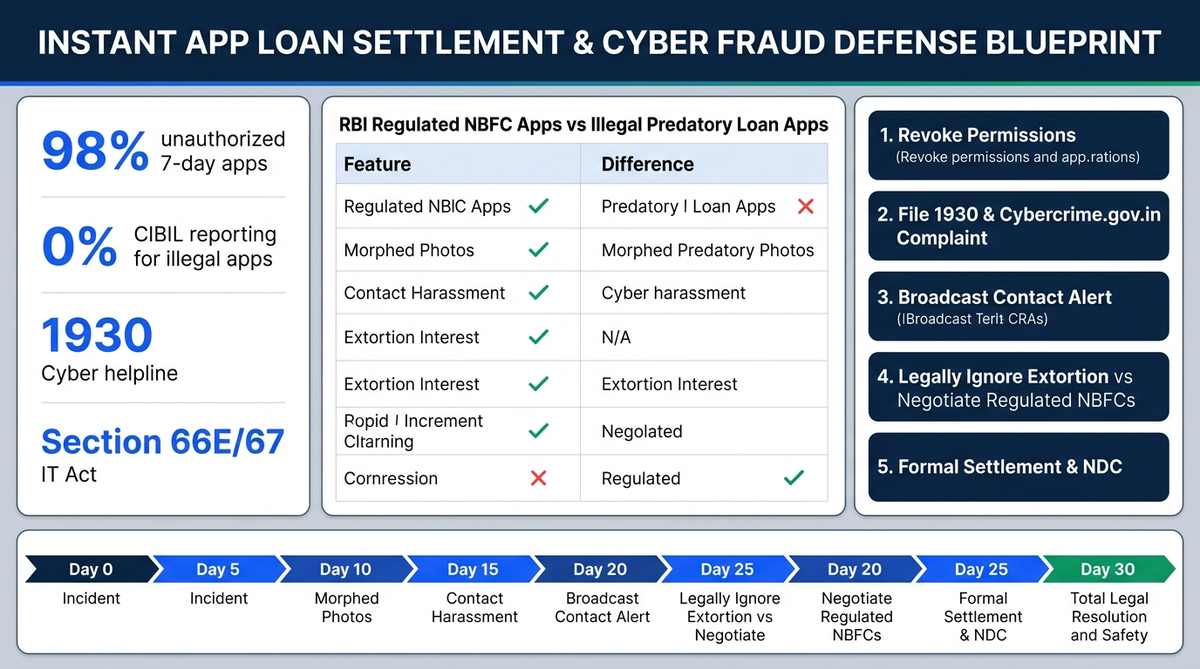
The 5-Stage Legal Action Roadmap to Eliminate Digital Loan Harassment
Navigating digital lending distress requires executing a disciplined, multi-stage protocol that seals digital vulnerabilities, builds an ironclad legal defense, and permanently extinguishes outstanding debt obligations without exposing your family to cyber extortion.
Stage 1: Digital Containment & Data Revocation: Immediately access your mobile device settings, revoke all permissions (Contacts, Storage, Camera, Location, SMS) granted to the loan applications, and uninstall the APK files. For severe malware infections, back up critical documents and perform a factory reset of the operating system to purge background data-harvesting daemons.
Stage 2: Digital Evidence Preservation: Before deleting communication channels, take high-resolution screenshots of all threatening WhatsApp messages, call logs with timestamps, forged legal notices, and UPI payment requests. Export WhatsApp chat logs with media attachments into a secure cloud folder. This evidentiary repository forms the foundation of your police filing.
Stage 3: Statutory Cyber Portal & Police Lodgment: Dial helpline 1930 to register the financial extortion threat and immediately lodge a formal complaint on cybercrime.gov.in. Retain the generated 14-digit Acknowledgement Number, which serves as your legal protection shield against fraudulent claims and third-party inquiries.
Stage 4: Social Shielding & Legal Intervention: Dispatch your pre-drafted family and contact broadcast message across WhatsApp and social media, informing your network of the cyber scam. Engage legal defense counsel to serve formal cease-and-desist notices to recovery agencies and redirect all tele-calling communications to your legal representatives.
Stage 5: Regulated NBFC Settlement & No Dues Certification: For legitimate balance-sheet NBFC loans, mandate your legal counsel to submit a formal hardship petition to the lender's Zonal Stressed Assets Committee. Negotiate a 40% to 60% principal reduction, obtain an official stamped OTS sanction letter on corporate letterhead, remit payment directly into your NBFC loan account, and secure your final ₹0 No Dues Certificate.
Why Distressed Digital Borrowers Trust SettleLoans
Overcoming digital loan harassment and navigating complex fintech debt structures requires seasoned legal defense and cyber expertise. SettleLoans provides complete anti-harassment protection, assists victims with emergency cyber crime filings, and negotiates directly with the senior credit committees of RBI-regulated NBFCs to achieve lawful compromise settlements with maximum debt waivers.

Settle Loan is India's trusted debt relief and loan settlement platform. We help borrowers overcome financial distress by negotiating with banks and NBFCs to legally settle personal loans and credit card debts. With our transparent, performance-based approach, you can achieve debt freedom and regain your financial peace of mind.
COMPUTER
FAQs: Instant App Loan Settlement & Harassment Defense
Settling an instant app loan requires first verifying whether the lender is an RBI-regulated entity (Bank/NBFC) or an unauthorized predatory app. For RBI-regulated digital lending apps (DLAs), borrowers submit a formal hardship petition to the lender's Stressed Assets desk seeking a One-Time Settlement (OTS) with a complete waiver of penal charges and a 40%–60% principal reduction. For illegal or unauthorized 7-day APK apps operating extortion rackets, borrowers must not pay extortion demands and should immediately file an emergency cyber crime complaint via the 1930 helpline and cybercrime.gov.in.
If an instant loan app harvests your contact list and threatens morphed media: (1) Immediately revoke all mobile permissions and uninstall the application. (2) Dial 1930 and register a formal cyber extortion FIR on cybercrime.gov.in under Sections 66E/67 of the IT Act and Section 308(2) of the Bharatiya Nyaya Sanhita (BNS). (3) Issue a proactive broadcast message to your family, friends, and colleagues warning that your phone was compromised by a cyber fraud syndicate. (4) Cease all monetary transfers, as sending token payments only fuels further extortion cycles.
No. Unauthorized 7-day loan apps have zero access to Reserve Bank of India-licensed Credit Information Companies (TransUnion CIBIL, Experian, Equifax, CRIF High Mark). Only RBI-registered Regulated Entities possess credit reporting authority. Illegal apps cannot legally report defaults, register negative remarks, or damage your credit score.
No. Retail loan default is strictly a civil matter under Indian contract law, not a criminal offense. Instant loan recovery agents operate under fictitious identities and routinely forge fake police notices, court warrants, or CBI summons on WhatsApp. Real police officers never act as debt collectors for mobile applications. Forging law enforcement documents is a non-bailable criminal offense under Section 336 of the BNS.
Under the RBI Master Directions on Digital Lending: (1) All loan disbursals and repayments must execute strictly between the borrower's bank account and the Regulated Entity's bank account without passing through third-party pool accounts. (2) Digital Lending Apps cannot access mobile phone storage, media, files, or contact lists. (3) All fees must be disclosed in a standardized Key Fact Statement (KFS). (4) Regulated entities must maintain a dedicated Principal Nodal Grievance Officer.
A genuine lending app clearly discloses its partner RBI-registered NBFC or Bank on its website, Play Store listing, and Key Fact Statement (KFS), which can be cross-verified on the official RBI website. Legitimate apps offer tenures exceeding 60 to 90 days with transparent APRs. In contrast, illegal predatory apps offer short 7-day or 15-day tenures, deduct 40% to 50% upfront as processing fees, demand full contact and gallery access, and operate through sideloaded APK downloads.
On defaulted loans with RBI-regulated digital lenders crossed 90+ days overdue (NPA status), borrowers can negotiate comprehensive settlements. You can secure a 40% to 65% principal haircut, along with a 100% complete waiver of late penalties, penal interest, and bounce charges.
Victims can lodge complaints across three statutory forums: (1) National Cyber Crime Reporting Portal (cybercrime.gov.in) or Helpline 1930 for extortion, photo morphing, and contact harassment. (2) RBI Complaint Management System (cms.rbi.org.in) against RBI-regulated NBFCs or their digital lending partners for Fair Practices Code violations. (3) Local Cyber Crime Police Stations by filing a physical complaint under the IT Act, 2000 and criminal extortion sections.
Unsolicited disbursals are a classic tactic used by predatory APK syndicates. If unsolicited funds land in your bank account: (1) Do not spend or transfer the money. (2) Report the unsolicited credit transaction to your bank branch immediately. (3) File an emergency cyber crime incident report on cybercrime.gov.in documenting the forced transfer. (4) If contacted by recovery agents, refuse extortion charges and instruct them in writing to reverse the transaction through official banking channels only.
SettleLoans provides comprehensive legal protection: (1) Immediate cyber fraud filing and legal cease-and-desist representation to halt contact harassment. (2) Strategic legal isolation of illegal extortion syndicates. (3) Formal OTS negotiations directly with the Stressed Assets Committees of RBI-registered NBFCs for maximum lawful debt waivers. (4) Verification of stamped settlement letters, No Dues Certificates, and credit bureau report rectification.
Official Regulatory References & Statutory Circulars
- Reserve Bank of India (RBI): Master Direction on Digital Lending (Guidelines on Default Loss Guarantee & Fair Practices Code)
- Ministry of Home Affairs (MHA): National Cyber Crime Reporting Portal & Citizen Financial Cyber Fraud Helpline (1930)
- Ministry of Electronics & Information Technology (MeitY): Information Technology Act, 2000 (Sections 66E, 67 & 43A Privacy Safeguards)
- Reserve Bank - Integrated Ombudsman Scheme, 2021: Online Grievance Redressal Portal for Unfair Digital Recovery & DLA Violations
- National Legal Services Authority (NALSA): Legal Services Authorities Act, 1987 — Pre-Litigation Conciliation & Lok Adalat