- RBI Regulatory Accountability: Kissht and Ring loans are disbursed through Si Creva Capital Services Private Limited and partner NBFCs, making them strictly accountable to RBI Digital Lending Directives and Fair Practices Codes.
- Zero Harassment Mandate: Contacting third-party phone contacts, issuing automated IVR threats, and sending intimidating WhatsApp messages are severe statutory offenses subject to RBI Ombudsman complaints.
- Revoking e-NACH Mandates: Borrowers can lawfully cancel auto-debit mandates through their banks under NPCI rules to stop recurring bounce deductions and demand 100% penal fee waivers during OTS talks.
- Achievable 40%–60% Haircut: Once an account crosses 90 days past due (NPA classification), Si Creva Capital evaluates Net Present Value (NPV) recovery economics, enabling substantial principal write-offs.
- Binding ₹0 No Dues Certificate: Under RBI Circular RBI/2023-24/60, the NBFC must deliver a formal stamped No Dues Certificate within 30 calendar days of settlement, backed by a ₹5,000/day statutory penalty for delay.
Understanding Kissht, Ring App the Si Creva Capital Lending
The digital lending landscape in India has witnessed rapid expansion through fintech platforms such as Kissht and its sister product, the Ring app, both managed under Onemi Technology Solutions Private Limited. While retail borrowers interact with sleek smartphone interfaces offering instant revolving credit lines, merchant checkout finance, and personal loans, the actual underwriting and capital disbursement operate through Reserve Bank of India (RBI) registered Non-Banking Financial Companies (NBFCs). The principal balance sheet lender for Kissht is Si Creva Capital Services Private Limited, frequently supported by co-lending institutional syndicates including MAS Financial Services Limited and Northern Arc Capital.
Because Kissht functions as a Digital Lending App (DLA) and Loan Service Provider (LSP) tied to regulated NBFCs, every rupee extended to a consumer is governed by the comprehensive regulatory architecture of the Reserve Bank of India. When unexpected financial setbacks strike—such as sudden medical emergencies, layoffs in the corporate sector, or business revenue contractions—borrowers often discover that the algorithmic speed of digital disbursement is matched by an aggressive, automated recovery framework engineered to extract repayments at high velocity.
Many distressed borrowers erroneously assume that digital app loans operate outside the formal legal system or that defaulting leads to immediate criminal penalties. Under Indian jurisprudence, an unsecured personal loan or digital credit line default is purely a civil contractual dispute governed by the Indian Contract Act, 1872. Borrowers retain statutory rights under the RBI Master Direction on Compromise Settlements and Technical Write-offs, enabling them to halt illegal recovery harassment, revoke unauthorized bank sweeps, and negotiate an equitable One-Time Settlement (OTS).
Kissht Delinquency Lifecycle: From DPD 1-30 to Non-Performing Asset (NPA)
Under the Reserve Bank of India's Prudential Norms on Income Recognition, Asset Classification and Provisioning (IRACP) alongside Expected Credit Loss (ECL) standards under Ind AS 109, Si Creva Capital Services classifies overdue accounts into distinct Days Past Due (DPD) buckets. Understanding these institutional stages is crucial for borrowers seeking to time their settlement negotiations for maximum financial relief.
During the initial 30 to 60 days of non-payment, collections are handled by automated telephonic dialers and external tele-calling agencies focused entirely on curing the default. However, once an account crosses the critical 90-day overdue mark, it is statutorily classified as a Non-Performing Asset (NPA). At this stage, the NBFC must allocate capital provisioning from its own balance sheet, altering its institutional strategy from aggressive installment pursuit to balance-sheet cleanup via compromise settlements.
| Delinquency Stage | Overdue Days (DPD) | Kissht / Si Creva Collection Tactics | Legal & Judicial Exposure | Settlement Haircut Potential |
|---|---|---|---|---|
| SMA-0 (Early Delinquency) | 1 – 30 Days | Automated IVR calls, daily SMS alerts, repeated e-NACH presentation sweeps. | Zero legal risk; early DPD reporting to credit bureaus begins. | Negligible (NBFC demands 100% full EMI clearance). |
| SMA-1 (Mid Delinquency) | 31 – 60 Days | Assigned to third-party tele-calling agencies; high-frequency WhatsApp reminders. | Formal loan acceleration warning letters issued via email. | Low (Tenure extensions or partial interest waivers discussed). |
| SMA-2 (Pre-NPA Escalation) | 61 – 90 Days | Intensive recovery pressure, threats of legal action, field agent tracing. | Statutory demand notices under Section 25 PSSA issued. | Moderate (Discussions for penal fee waivers can commence). |
| NPA (Substandard Asset) | 91 – 180 Days | Transferred to Stressed Asset Desks; balance-sheet provisioning absorbed. | Digital arbitration summons; Section 25 PSSA court filings. | High (35%–50% Haircut achievable). |
| Doubtful / Written-Off | 181 – 365+ Days | Technical write-off evaluated; third-party bad debt portfolio pooling. | Conciliation via National Lok Adalat; civil recovery suits. | Maximum (50%–60% Haircut achievable). |
Once a loan is classified as a Doubtful Asset or subjected to technical write-off, Si Creva Capital has already absorbed 100% provisioning on its quarterly profit-and-loss statements. Under these accounting realities, receiving an upfront lump-sum payment represents an immediate cash write-back to the NBFC, providing risk officers with the regulatory and financial room to approve substantial debt haircuts.
Check Your Loan Settlement Options
Answer 2 quick questions to evaluate your settlement eligibility.
1. What type of loan do you want to settle?
Defending Against Aggressive Recovery Tactics Under RBI Digital Lending Rules
The most severe challenge encountered by defaulted Kissht and Ring app borrowers is aggressive recovery harassment orchestrated by outsourced collection agencies. Tele-callers frequently engage in non-stop WhatsApp messaging, send unauthorized notices containing fake police logos or counterfeit court stamps, contact non-guarantor family members and colleagues, and deploy auto-dialers that ring multiple times per hour from untraceable virtual numbers.
These coercive tactics represent explicit violations of the Reserve Bank of India Guidelines on Digital Lending (2022) and the Master Direction on Recovery Agents. The statutory framework clearly prescribes:
- Prohibition on Contact List Harvesting: DLAs and LSPs are strictly prohibited from accessing, storing, or utilizing borrower mobile address books, contact lists, or private media galleries.
- Time and Communication Boundaries: Recovery personnel are legally prohibited from calling before 08:00 AM or after 07:00 PM, and cannot contact third parties, employers, or relatives who are not co-borrowers or legal guarantors.
- Ban on Intimidation and Public Shaming: Threatening criminal arrest, using defamatory language, or creating WhatsApp groups with relatives constitutes illegal extortion under the Indian Penal Code and Bharatiya Nyaya Sanhita.
When borrowers face persistent harassment, they must systematically document call audio logs, WhatsApp message transcripts, and caller phone numbers. Serving a formal legal cease-and-desist notice to Si Creva Capital's Principal Nodal Officer and filing a complaint on the RBI Integrated Ombudsman portal (CMS) immediately halts third-party collection activities and forces the NBFC to engage through formal legal channels.
How to Stop Kissht NACH Bounce Charges & Eliminate Unfair Penal Levies
During onboarding, Kissht sets up automated electronic National Automated Clearing House (e-NACH) mandates or UPI auto-pay instructions on the borrower's primary bank account. In defaulted loans, automated systems repeatedly present these mandates—often multiple times within a single billing cycle. Each failed transaction triggers a return penalty of ₹250 to ₹500 from the borrower's bank, while Kissht simultaneously tacks on internal bounce fees ranging from ₹400 to ₹1,000 plus GST.
Over a span of four to six months, these compounding charges can artificially inflate a ₹50,000 loan balance beyond ₹85,000. Under the Reserve Bank of India's Fair Lending Practice directives on penal charges (2023), regulated entities are expressly prohibited from capitalizing penal interest or compounding late fees.
Distressed borrowers can protect their bank accounts through two vital measures:
First, under National Payments Corporation of India (NPCI) circulars and RBI consumer protection rules, every account holder holds the unconditional right to cancel or revoke an e-NACH mandate directly through their bank's internet banking portal or by submitting a written mandate stop-request at their branch.
Second, when initiating formal One-Time Settlement discussions, legal counsel conducts a forensic audit of the loan ledger and insists on an absolute 100% waiver of all accumulated bounce fees, penal interest, and processing charges, anchoring the settlement calculation strictly on the authentic outstanding principal.
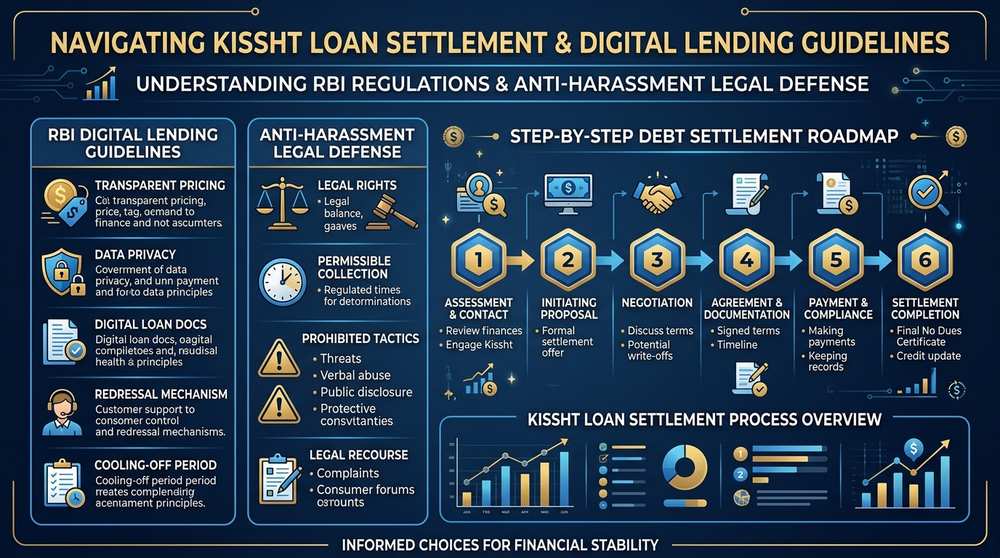
Kissht Loan Settlement & Digital Lending Defense Blueprint
Kissht & Si Creva Capital OTS Haircut Matrix & Recovery Valuation
Compromise settlements with digital lending NBFCs are governed by the RBI Master Direction on Compromise Settlements and Technical Write-offs (2023). Under this framework, Si Creva Capital evaluates settlement proposals using a mathematical Net Present Value (NPV) recovery methodology rather than informal agent discretion.
Because digital micro-loans carry no collateral backing, the NBFC must mathematically evaluate whether an immediate lump-sum settlement delivers higher economic recovery than pursuing protracted litigation through Magistrate Courts or arbitration tribunals, after deducting legal retainers, court processing fees, and asset management overheads.
Where C_t represents estimated recoveries, r is the discount rate, and deductions account for 2–4 years of judicial delays and regulatory capital locked in non-performing assets.
Realistic Kissht & Ring App Settlement Haircut Slabs by Aging
| Product Facility | Delinquency Aging | Penal & Bounce Waiver | Principal Haircut Range | Recommended Target Settlement |
|---|---|---|---|---|
| Kissht Personal Credit Line | 90 – 180 Days (NPA) | 100% Full Waiver | 30% – 45% Principal Waiver | Offer 45%–55% of Principal |
| Kissht Personal Credit Line | 181 – 365+ Days (Doubtful) | 100% Full Waiver | 45% – 60% Principal Waiver | Offer 35%–40% of Principal |
| Ring App Merchant / QR Line | 90 – 180 Days (NPA) | 100% Full Waiver | 30% – 40% Principal Waiver | Offer 50%–55% of Principal |
| Ring App Merchant / QR Line | 180+ Days (Written Off) | 100% All Penal Fees | 50% – 65% Principal Waiver | Offer 30%–35% of Principal |
Step-by-Step Guide: How to Negotiate a Legally Binding Kissht Settlement
Executing a legally secure, discounted compromise settlement with Kissht and Si Creva Capital requires a methodical, evidence-backed strategy:
1Hardship Documentation & Financial Ledger Audit
Compile verifiable documentary evidence substantiating involuntary financial incapacity. Crucial records include salary termination letters, medical treatment records, bank statements showing depleted liquidity, or business loss statements. This documentation establishes that the default is bona fide and non-wilful.
2Revoking e-NACH Mandates & Establishing Legal Representation
Instruct your bank to cancel the e-NACH auto-debit mandate to halt recurring return fees. Issue a formal legal notice directing Kissht and Si Creva Capital to route all future communications strictly to your designated legal counsel, stopping abusive third-party tele-calling.
3Submitting Formal Compromise Proposal to Si Creva Nodal Desk
Submit a structured compromise petition addressed to Si Creva Capital's Stressed Assets Division and Principal Nodal Officer. Cite the RBI Master Direction on Compromise Settlements and anchor the opening settlement offer at 25% to 35% of the authentic principal balance.
4Managing Counter-Offers & Securing Credit Committee Approval
The NBFC will initially counter with modest discounts (10%–20%). Your advocate demonstrates that funds are being pooled from third-party family assistance solely for a full and final settlement, guiding the Credit Committee toward an authorized 40% to 60% debt waiver.
5Rigorous Forensic Audit of the OTS Sanction Letter
Before paying any funds, verify that Si Creva Capital issues an official OTS Sanction Letter on corporate letterhead containing your exact loan account number, sanctioned settlement figure, payment deadlines, and unambiguous covenants confirming complete debt discharge and withdrawal of all legal actions.
6Direct Account Payment & Enforcing ₹0 NDC Issuance
Remit the agreed settlement sum directly into your designated loan account through official banking channels. Under RBI Circular RBI/2023-24/60, the lender must issue a formal No Dues Certificate and update credit bureaus within 30 calendar days.
Defending Against Section 25 PSSA Notices, Digital Arbitration & Lok Adalat
When a digital loan remains in default beyond 60 to 90 days, Si Creva Capital frequently issues statutory demand notices under Section 25 of the Payment and Settlement Systems Act, 2007 (PSSA) for dishonoured NACH mandates, along with notices initiating digital arbitration.
A Section 25 PSSA notice is a statutory precursor to a Magistrate Court complaint, not an immediate arrest warrant. Responding through legal counsel within the 15-day window detailing bona fide financial distress and challenging multiple unauthorized presentation attempts preserves your legal standing while steering the lender toward a compromise settlement.
Regarding digital arbitration proceedings, landmark Supreme Court rulings (including Perkins Eastman Architects DVM v. HSCC (India) Ltd. and TRF Ltd. v. Energo Engineering Projects Ltd.) establish that unilateral arbitrator appointments without mutual written consent are legally invalid. Legal counsel can challenge unilateral appointments under Section 12 and Section 14 of the Arbitration and Conciliation Act, 1996, effectively halting ex-parte proceedings.
Additionally, Si Creva Capital regularly participates in quarterly National Lok Adalats organized by District Legal Services Authorities (DLSA). Lok Adalat sessions offer an excellent conciliation forum where NBFC representatives hold pre-approved authority to grant 45% to 60% debt haircuts. The resulting settlement award holds the legal force of a binding Civil Court Decree with complete finality and zero appeal.
| Resolution Channel | Legal Mechanism | Haircut Potential | Typical Timeline | Judicial Finality |
|---|---|---|---|---|
| Direct NBFC Compromise (OTS) | Settlement under RBI Master Directions. | 40% – 60% Debt Haircut | 15 to 30 Days | Binding private contract with ₹0 NDC. |
| National Lok Adalat | Judicial conciliation before DLSA panel. | 45% – 60% Debt Haircut | Single-day session | Civil Court Decree (Non-appealable). |
| Arbitration Defense | Contesting unilateral digital arbitrator appointments. | Variable (Converts to OTS) | 2 to 6 Months | Subject to Section 34 challenge. |
| Section 25 PSSA Defense | Magistrate court compoundable defense. | 35% – 50% Debt Haircut | 2 to 4 Months | Formal complaint withdrawal and closure. |
Authenticating Kissht Settlement Letters & Enforcing the ₹0 NDC Mandate
A significant hazard in digital loan recovery involves rogue recovery agents issuing fake settlement letters via WhatsApp to collect partial payments into personal accounts. If a borrower remits money against an unverified offer, the NBFC credits the funds toward overdue penal charges, leaving the default active and compounding.
Borrowers must verify that their OTS sanction letter is printed on official corporate letterhead of Si Creva Capital Services Private Limited (or its co-lending NBFC partner), featuring the Corporate Identification Number (CIN: U65923MH2015PTC266425), official registered office address in Mumbai, unique settlement reference number, authorized signatory name, and corporate seal.
The letter must explicitly declare that upon payment of the agreed settlement sum, the loan account is fully discharged with zero remaining balance. Under RBI Circular RBI/2023-24/60, the NBFC must issue the formal No Dues Certificate (NDC) and cancel all security mandates within 30 calendar days, or pay mandatory statutory compensation of ₹5,000 per day of delay directly to the borrower.
CIBIL Score Impact Post-Settlement & 18-Month Credit Restoration Plan
Completing a One-Time Settlement with Kissht results in Si Creva Capital reporting the account to all four credit bureaus (TransUnion CIBIL, Experian, Equifax, CRIF High Mark) with the status 'Settled' or 'Post-Write-off Settled' with an outstanding balance of exactly ₹0. This causes an initial credit score drop of 75 to 150 points.
Under RBI compromise directives, a mandatory 12-month cooling-off period applies before fresh unsecured loans can be sanctioned. However, a 'Settled' status with ₹0 balance permanently terminates compounding overdue DPD entries and eliminates the threat of ongoing litigation.
Borrowers can systematically restore their credit score back to 750+ within 18 to 24 months by obtaining a secured fixed-deposit credit card (FD card), maintaining credit utilization strictly below 25%, and maintaining a flawless 100% on-time repayment history across all household utilities and active credit facilities.
Why Distressed Kissht Borrowers Trust SettleLoans for Legal Protection
Resolving digital app debt and stopping recovery harassment requires seasoned banking advocates and legal strategists. SettleLoans halts aggressive tele-calling through immediate cease-and-desist notices, defends Section 25 PSSA summons, challenges unilateral digital arbitration, and negotiates directly with Si Creva Capital's Stressed Assets Desks to secure maximum debt waivers and certified ₹0 No Dues Certificates.

Settle Loan is India's trusted debt relief and loan settlement platform. We help borrowers overcome financial distress by negotiating with banks and NBFCs to legally settle personal loans and credit card debts. With our transparent, performance-based approach, you can achieve debt freedom and regain your financial peace of mind.
COMPUTER
Frequently Asked Questions About Kissht App Loan Settlement
Is Kissht a legal loan app in India and who is the underlying NBFC lender?
Yes, Kissht is a regulated digital lending application operated by Onemi Technology Solutions Private Limited. The loans are disbursed through its primary Reserve Bank of India (RBI) registered Non-Banking Financial Company (NBFC) partner, Si Creva Capital Services Private Limited, alongside co-lending institutional partners such as MAS Financial Services and Northern Arc Capital. Because Kissht operates under RBI regulatory oversight, it is legally bound by the RBI Digital Lending Guidelines (2022/2023) and Fair Practices Code.
Can I legally settle my Kissht or Ring app loan through a One-Time Settlement (OTS)?
Yes. When a borrower faces genuine financial distress (such as job loss, medical emergency, or severe income drop) and the loan remains unpaid past 90 days (NPA status), Si Creva Capital Services allows a One-Time Settlement (OTS). Under the RBI Master Direction on Compromise Settlements (2023), regulated NBFCs maintain board-approved compromise frameworks to resolve non-performing assets by granting substantial debt waivers.
How can I stop aggressive recovery agent harassment and WhatsApp threats from Kissht callers?
Under the RBI Digital Lending Guidelines and Master Directions on Recovery Agents, lenders and their outsourced recovery agencies are strictly prohibited from contacting your phone contacts, sending threatening WhatsApp messages, using abusive language, or calling outside the permitted hours of 08:00 AM to 07:00 PM. You can stop harassment by: (1) Preserving all message screenshots and call recordings as evidence; (2) Serving a formal legal cease-and-desist notice through an advocate to Si Creva Capital's Principal Nodal Officer; (3) Filing an online grievance on the RBI Integrated Ombudsman portal (CMS) and National Cyber Crime portal if threats persist.
What percentage of debt waiver can I negotiate on a defaulted Kissht loan?
Borrowers typically achieve a 40% to 60% waiver on total outstanding ledger dues. The exact settlement haircut depends on loan aging, delinquency bucket (90 to 180+ DPD), and documented financial hardship. In approved OTS agreements, 100% of accumulated bounce penalties, late payment charges, and penal interest are waived, with significant reductions negotiated on the core principal balance.
Can Kissht or Si Creva Capital file a police case or have me arrested for loan default?
No. Loan default is purely a civil contractual dispute under the Indian Contract Act, 1872. Police authorities cannot register a criminal FIR or make arrests for non-payment of an unsecured digital personal loan. While lenders may issue statutory notices under Section 25 of the Payment and Settlement Systems Act (PSSA) for dishonoured NACH mandates, these are compoundable civil/quasi-criminal proceedings handled in Magistrate Courts that are routinely resolved through advocate representation and compromise settlements.
How do I stop repeated NACH auto-debit bounce charges from Kissht in my bank account?
Under National Payments Corporation of India (NPCI) procedural guidelines, you have the statutory right to instruct your bank (via NetBanking or written branch application) to cancel or suspend the e-NACH mandate issued to Kissht/Si Creva Capital. This halts recurring debit presentations and stops destination bank return penalties. During OTS negotiations, your advocate will demand a 100% complete waiver of all internal NBFC bounce charges.
How do I verify if a Kissht settlement letter is authentic and not a recovery agent scam?
Never pay against WhatsApp messages, unofficial emails, or verbal assurances. An authentic OTS Sanction Letter must be issued directly on the official corporate letterhead of Si Creva Capital Services Private Limited (or its co-lending NBFC partner), featuring the Corporate Identification Number (CIN), official company seal, authorized signatory details, explicit settlement amount, payment deadline, and covenants confirming full debt extinguishment with ₹0 balance. Payment must only be remitted directly into your official loan account number or via the verified in-app repayment gateway.
What happens to my CIBIL score after settling a Kissht loan and how can I rebuild it?
Upon receiving the settlement amount, Si Creva Capital updates credit information companies (CIBIL, Experian, Equifax, CRIF High Mark) with the status 'Settled' or 'Post-Write-off Settled' with an outstanding balance of ₹0. While this temporarily lowers your credit score by 75 to 150 points, it halts compounding DPD arrears and legal flags. Borrowers can rebuild their score back above 750 within 18 to 24 months using secured fixed-deposit credit cards and disciplined repayment habits.
How long does it take for Kissht to issue the No Dues Certificate (NDC) post-settlement?
Under RBI Circular RBI/2023-24/60, regulated financial entities must issue a formal No Dues Certificate (NDC) and update credit bureau records within 30 calendar days of receiving full settlement payment. If the lender fails to deliver the NDC within 30 days without lawful justification, it is statutorily liable to pay compensation of ₹5,000 per day of delay to the borrower.
Official Regulatory References & Statutory Circulars
- Reserve Bank of India (RBI): Guidelines on Digital Lending (DOR.CRE.REC.66/21.07.001/2022-23)
- RBI Master Direction: Compromise Settlements and Technical Write-offs (DOR.STR.REC.20/21.04.048/2023-24)
- Si Creva Capital Services Pvt Ltd: Fair Practices Code, Grievance Redressal Policy & Nodal Officer Details
- Reserve Bank - Integrated Ombudsman Scheme, 2021: Online Portal for Complaints on Recovery Harassment & DLA Violations
- National Legal Services Authority (NALSA): Legal Services Authorities Act, 1987 — National Lok Adalat Conciliation Framework