- Lending Entity Identification: MoneyView operates as a Lending Service Provider (LSP). Formal compromise settlements must be executed directly with the underlying RBI-registered NBFC (such as Whizdm Finance, DMI Finance, or Clix Capital) named in the loan agreement.
- Halting Automated NACH Bounces: Revoking electronic mandates under NPCI rules stops repetitive ₹250–₹590 return penalties. Legal settlement petitions mandate 100% waiver of accumulated bounce and penal charges under RBI fair practices.
- Realistic 50%–60% Haircut: When an account reaches 90+ Days Past Due (NPA Stage 3 under Ind AS 109), NBFC credit committees evaluate recovery Net Present Value (NPV), approving substantial debt haircuts against uncollectible principal.
- Legal Defense Against Harassment: Unsecured loan default is strictly a civil dispute under the Indian Contract Act, 1872. RBI directives prohibit calling third-party contacts, abusive language, or threatening fake police arrests.
- Mandatory 30-Day ₹0 NDC: Under RBI Circular RBI/2023-24/60, the lending NBFC must issue a stamped No Dues Certificate and update credit bureaus within 30 days of full settlement payment, backed by a ₹5,000/day delay penalty.
Understanding MoneyViews Digital Lending Architecture
MoneyView, managed by Whizdm Innovations Private Limited, is one of India's largest digital financial platforms offering unsecured personal loans ranging from ₹5,000 to ₹10,00,000 with flexible repayment tenures spanning 3 to 60 months. To navigate a debt default effectively, borrowers must first understand how MoneyView operates from a legal and regulatory perspective. MoneyView is not a standalone scheduled bank; rather, it functions as a regulated Digital Lending App (DLA) and Lending Service Provider (LSP) governed by the Reserve Bank of India (RBI) Digital Lending Guidelines.
When a borrower submits an online application through the MoneyView mobile interface or web portal, credit underwriting and capital disbursement are handled through a diverse network of Regulated Entities (REs). The principal in-house financing vehicle is Whizdm Finance Private Limited, an RBI-registered Non-Banking Financial Company (NBFC-ND-SI). In addition to Whizdm Finance, MoneyView maintains institutional co-lending partnerships with premier Non-Banking Financial Companies and private scheduled commercial banks, including DMI Finance Private Limited, Clix Capital Services Private Limited, Aditya Birla Finance Limited, Vivriti Capital Limited, Northern Arc Capital Limited, Fullerton India (SMFG India Credit Co. Ltd.), and IDFC FIRST Bank.
Under the RBI Master Directions on Digital Lending, every loan disbursed through an LSP must clearly specify the exact balance-sheet lender in the Key Fact Statement (KFS) and sanction letter. When a financial emergency strikes—such as sudden corporate retrenchment, severe health emergencies, or small business income disruption—the default is recorded not merely on an app dashboard, but on the balance sheet of the specific NBFC partner. Understanding which institutional NBFC holds your debt contract is the critical foundation for structuring an authentic One-Time Settlement (OTS) and extinguishing personal liability permanently.
Automated Calling Bots, Third-Party Harassment & Halting the NACH Bounce Spiral
The immediate aftermath of defaulting on a MoneyView personal loan installment involves algorithmic collection pressure. In the first 1 to 30 days past due (DPD), automated interactive voice response (IVR) dialers initiate dozens of calls daily. As the delinquency matures past 60 days, loan accounts are assigned to external third-party recovery agencies. These outsourced tele-calling operations frequently resort to coercive tactics: contacting secondary phone numbers, threatening to message workplace colleagues, sending unauthorized WhatsApp notices, or making calls during irregular evening hours.
These aggressive practices represent direct violations of statutory banking regulations. Under the Reserve Bank of India (RBI) Master Direction on Recovery Agents and Outsourcing of Financial Services, lenders and their appointed collection agencies are strictly forbidden from contacting borrowers before 08:00 AM or after 07:00 PM, using abusive or threatening language, reaching out to non-guarantor relatives or employers, or making false representations regarding legal proceedings. Furthermore, under the RBI Digital Lending Guidelines, DLAs and LSPs are explicitly barred from scraping mobile phone contact lists or accessing personal device media.
Compounding this distress is the automated NACH mandate presentation cycle. MoneyView's automated payment gateway repeatedly presents electronic debit instructions to the borrower's savings bank account. Each failed NACH auto-debit triggers return penalty charges ranging from ₹250 to ₹590 at the destination bank, while the NBFC levies internal late payment fines of ₹500 to ₹1,000 plus penal interest of 24% to 36% per annum. Within four months of delinquency, these compounding fees can inflate the ledger liability by ₹30,000 to ₹60,000 over the genuine principal amount.
Three-Step Legal Strategy to Halt the NACH Return Drain
- 1. Written e-Mandate Revocation: Under National Payments Corporation of India (NPCI) circulars, every banking customer has the absolute right to instruct their home branch in writing to cancel or suspend an electronic NACH mandate due to acute financial hardship.
- 2. Formal Legal Cease-and-Desist Notice: Serving a structured legal notice to Whizdm Finance and its co-lenders asserting financial hardship and demanding immediate suspension of automated payment sweeps.
- 3. 100% Bounce Fee Waiver Clause: When executing a formal compromise settlement, skilled debt advocates ensure that all accumulated NACH bounce charges and compounding late penalties are entirely waived by the NBFC credit committee.
Check Your Loan Settlement Options
Answer 2 quick questions to evaluate your settlement eligibility.
1. What type of loan do you want to settle?
Statutory Civil Rights, Section 25 PSSA Notices & Debunking Police Threats
A primary source of anxiety for defaulted borrowers is the barrage of legal threats sent via SMS, email, and WhatsApp. Unscrupulous recovery agents frequently circulate fabricated draft notices featuring official-looking emblems, threatening instant police arrest, registration of criminal First Information Reports (FIRs), or immediate attachment of ancestral household properties. It is vital to state the legal reality clearly: under Indian jurisprudence and the Indian Contract Act, 1872, default on an unsecured digital personal loan is strictly a civil dispute arising from commercial breach of contract.
Police authorities possess zero statutory authority under the Bharatiya Nagarik Suraksha Sanhita (BNSS) or the Code of Criminal Procedure (CrPC) to intervene in civil loan recovery, visit borrower homes for collection, or summon citizens to police stations on behalf of private NBFCs. Collection agents who masquerade as police officers or court bailiffs commit severe cognizable criminal offenses under the Bharatiya Nyaya Sanhita (BNS) for extortion, criminal intimidation, and impersonation of public servants, alongside violations under Section 66D of the Information Technology Act, 2000.
Lending NBFCs such as Whizdm Finance and DMI Finance do possess legitimate statutory recourse through formal legal demand notices under Section 25 of the Payment and Settlement Systems Act, 2007 (PSSA). Similar in legal structure to Section 138 of the Negotiable Instruments Act, 1881 for cheque dishonour, Section 25 PSSA applies to dishonoured electronic NACH mandates. When an NBFC's empanelled advocate serves a 15-day statutory demand notice under Section 25 PSSA, borrowers must never ignore it. A formal legal reply drafted by experienced debt defense counsel must be served within the statutory timeframe, demonstrating lack of fraudulent intent (mens rea), documenting involuntary financial insolvency, and initiating formal conciliation channels.
Threatening immediate police arrest, home seizure without civil court warrants, public shaming of employer contacts, or demanding payment into private individual UPI handles. All such actions violate the RBI Fair Practices Code.
Formal 15-day Section 25 PSSA demand notices, Civil Recovery Suits under Order 37 CPC in local territorial courts, and Lok Adalat conciliation summonses aimed at executing mutually agreed compromise settlements.
NBFC NPA Accounting, Provisioning Burden & Net Present Value (NPV) Equation
To negotiate a 50% to 60% haircut successfully, borrowers must comprehend the institutional mathematics governing NBFC balance sheets. Under the Reserve Bank of India's Prudential Framework for Stressed Assets and Indian Accounting Standards (Ind AS 109), financial institutions must classify loans into three distinct asset stages based on delinquency aging:
- Stage 1 (0–30 DPD):Standard Performing Asset requiring nominal Expected Credit Loss (ECL) provisioning (0.5% to 2%).
- Stage 2 (31–89 DPD):Special Mention Account (SMA-1 and SMA-2) reflecting significant increase in credit risk; provisioning increases to 10%–20%.
- Stage 3 (90+ DPD):Non-Performing Asset (NPA) status. The NBFC must suspend income recognition (cease booking unrealized interest as profit) and allocate 40% to 100% capital provisioning against its statutory capital reserves.
Once a loan enters Stage 3 NPA classification, continuing litigation in civil courts requires high upfront advocate fees, filing charges, court process delays of 3 to 6 years, and severe capital lock-in. When evaluating whether to accept a compromise One-Time Settlement, the NBFC's Credit Committee utilizes a Net Present Value (NPV) recovery valuation model:
Where C_t represents estimated recoveries across future periods t, r represents the NBFC's internal discount rate (cost of capital), and subtractions account for court filing fees, advocate honorariums, and capital adequacy reserves locked in NPA provisioning.
Because an immediate, lump-sum OTS payment yields a significantly higher guaranteed cash-in-hand Net Present Value compared to prolonged, uncertain recovery litigation against an insolvent individual, NBFCs are financially incentivized under RBI Master Direction DOR.STR.REC.20/21.04.048/2023-24 to approve substantive debt write-downs of 50% to 60%.
MoneyView Loan Settlement Roadmap: Step-by-Step Resolution Architecture
The visual infographic below details the complete legal and financial trajectory of resolving defaulted MoneyView personal loans. From initial delinquency classification and automated mandate revocation to direct NBFC Credit Committee escalation, structured OTS sanction letter verification, and final ₹0 No Dues Certificate delivery:
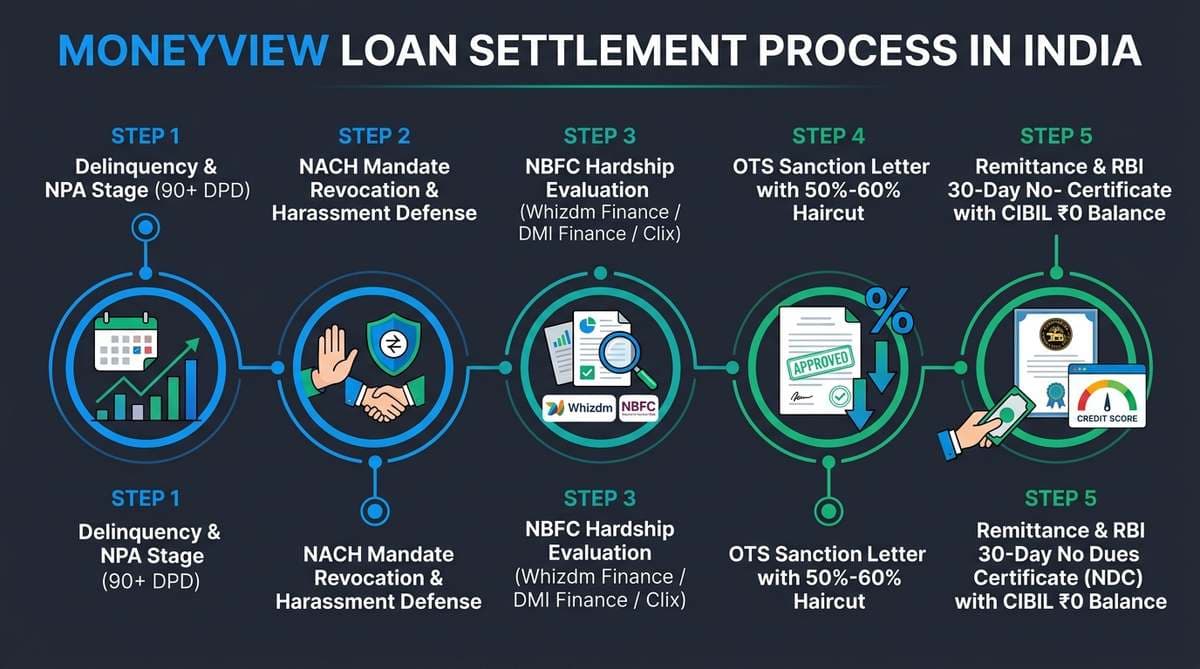
Step-by-Step Advocate OTS Roadmap: Direct NBFC Stressed Asset Escalation
Securing an authorized 50% to 60% settlement from MoneyView's financing partners requires a disciplined legal procedure rather than casual phone conversations with tele-callers. Tele-calling agents are compensated strictly on gross collections; they possess zero delegated financial authority to sanction debt waivers. SettleLoans executes an institutional 5-step roadmap:
1Loan Forensic Audit & Balance-Sheet Lender Identification
Our banking advocates inspect the original Key Fact Statement (KFS), loan sanction document, and current repayment ledger. We identify the exact registered balance-sheet lender (Whizdm Finance, DMI Finance, Clix Capital, etc.), calculate the exact disbursed principal, and segregate all uncollected penal interest, processing markups, and unlawful NACH return fines.
2Harassment Shield & Cease-and-Desist Escalation
We serve formal legal notices to the Principal Nodal Officer and Compliance Head of the lending NBFC under the RBI Master Circular on Recovery Conduct. This establishes legal representation, halts aggressive automated calling bots, prohibits third-party contact, and redirects all communications through authorized legal counsel.
3Financial Hardship Dossier Compilation
Under RBI compromise settlement frameworks, debt waivers must be substantiated by bona fide economic distress. We compile a comprehensive hardship dossier comprising medical discharge records, termination notices, business income reductions, bank statements evidencing zero disposable surplus, and sworn hardship affidavits.
4Credit Committee Presentation & NPV Negotiation
Our senior advocates present the hardship petition directly to the NBFC's Zonal Stressed Assets Division and Credit Committee. By framing the borrower's payment capacity against the NBFC's Net Present Value (NPV) benchmark, we negotiate a 50% to 60% principal write-down and 100% waiver of accrued penalties.
5Sanction Verification, Remittance & ₹0 NDC Delivery
Before any funds are released, we conduct a forensic audit of the formal OTS Sanction Letter. Once verified, remittance is made directly to the NBFC's official virtual loan account. We then enforce statutory delivery of the stamped No Dues Certificate within the mandatory 30-day RBI window.
Sanction Letter Forensics: Authenticity Verification & Trap Avoidance
The fintech debt ecosystem is rife with collection scams where unscrupulous recovery agents issue fraudulent settlement letters on manipulated PDFs or WhatsApp templates. Once a desperate borrower transfers money to a third-party UPI ID or generic account, the agent pockets the funds, and the NBFC's core banking ledger continues to show the loan as fully active and defaulting.
To guarantee that a settlement is legally irrevocable and binding upon Whizdm Finance or its co-lenders, every sanction letter must satisfy the following forensic checklist:
Mandatory OTS Sanction Letter Verification Checklist
Remittance Protocols, RBI 30-Day ₹0 NDC Mandate & CIBIL Rehabilitation
Once the authentic OTS sanction letter is secured, the agreed compromised sum must be remitted strictly within the validity timeline specified in the sanction letter. Payment should be executed via direct Real Time Gross Settlement (RTGS), National Electronic Funds Transfer (NEFT), or through the official MoneyView payment portal directly credited to the lending NBFC's virtual account. Never hand over cash or transfer funds into individual UPI IDs.
Following full remittance, Reserve Bank of India Circular RBI/2023-24/60 (Responsible Lending Conduct – Release of Movable / Immovable Property Documents on Repayment / Settlement of Personal Loans) establishes strict statutory obligations for all Regulated Entities. Whizdm Finance and its co-lenders must issue an official stamped No Dues Certificate (NDC) / Closure Letter within 30 calendar days of receiving the settlement remittance. If the lender fails to deliver the NDC within 30 days without valid justification, it must pay mandatory statutory compensation of ₹5,000 per day of delay directly to the borrower.
Simultaneously, the NBFC is required to report the loan account to all four statutory Credit Information Companies (CIBIL, Experian, Equifax, and CRIF High Mark) with the status updated to "Settled" or "Post-Write-off Settled" and the outstanding ledger balance reflected as ₹0. While a "Settled" status causes an initial credit score drop of 70 to 120 points and triggers an institutional cooling-off window of 12 to 24 months, it permanently extinguishes the toxic monthly default reporting. Borrowers can systematically rebuild their CIBIL score back above 750 within 18 to 24 months by maintaining disciplined repayment on secured fixed-deposit credit cards and keeping overall credit utilization below 30%.
MoneyView Debt Resolution Matrix: Financial & Legal Comparison
To evaluate the tangible financial advantages of executing an advocate-led One-Time Settlement versus prolonged default or unassisted negotiation, examine the comparative benchmark matrix below:
| Resolution Parameter | Unassisted Individual Default | Third-Party Recovery Agency | SettleLoans Advocate OTS |
|---|---|---|---|
| Principal Debt Haircut | 0% (Full Dues Demanded) | 10% – 20% (Unverified) | 50% – 60% Principal Waiver |
| Penal Interest & Bounce Fees | 100% Compounding Addition | Partial Informal Reductions | 100% Complete Waiver |
| Calling Bots & Harassment | Severe (50+ Calls Daily & Threats) | Relentless Tele-calling | Legally Halted via Cease & Desist |
| NACH Return Bank Charges | Recurring ₹250–₹590 Debits | Continuous Monthly Sweeps | Revoked via NPCI Mandate Halt |
| Section 25 PSSA Defense | Ignored (High Legal Risk) | No Legal Representation | Formal Legal Reply & Conciliation |
| Sanction Letter Verification | None | High Risk of Fake PDF Scams | 100% Stamped NBFC Audit |
| No Dues Certificate (NDC) | Delayed or Denied | Uncertain Delivery | Statutory Delivery within 30 Days |

Settle Loan is India's trusted debt relief and loan settlement platform. We help borrowers overcome financial distress by negotiating with banks and NBFCs to legally settle personal loans and credit card debts. With our transparent, performance-based approach, you can achieve debt freedom and regain your financial peace of mind.
COMPUTER
Frequently Asked Questions: MoneyView Loan Settlement
What is the MoneyView loan settlement process and how does an app loan OTS work?
Who actually finances MoneyView loans: Whizdm Finance or co-lending partner banks?
How can borrowers stop automated calling bots, WhatsApp threats, and reference harassment from MoneyView?
How do you stop recurring MoneyView NACH auto-debit bounce fees and bank return charges?
Can MoneyView file a police FIR, send police officers, or have a borrower arrested for loan default?
What percentage of debt waiver or haircut can you realistically negotiate on a defaulted MoneyView loan?
What is a Section 25 PSSA legal notice from MoneyView and how should you respond?
Can Whizdm Finance or MoneyView freeze savings accounts in other banks under Section 171 Banker's Lien?
What is the statutory deadline for MoneyView and its partner NBFC to deliver the No Dues Certificate (NDC)?
How does settling a MoneyView loan impact your CIBIL score and how can you rebuild it?
Official Regulatory References & Statutory Circulars
- Reserve Bank of India (RBI): Master Direction on Compromise Settlements and Technical Write-offs (DOR.STR.REC.20/21.04.048/2023-24)
- RBI Guidelines on Digital Lending: Regulatory Framework for Digital Lending Apps (DLAs) & Lending Service Providers (LSPs)
- RBI Master Circular: Fair Practices Code for Non-Banking Financial Companies (NBFCs) & Outsourcing of Financial Services
- Reserve Bank - Integrated Ombudsman Scheme, 2021: Complaint Filing Portal for Fintech Harassment & Excessive NACH Penalties
- National Legal Services Authority (NALSA): Legal Services Authorities Act, 1987 — National Lok Adalat Conciliation Framework