1. The ₹2 Lakh Multi-App Debt Trap: Genesis of Cyber Loan
In November 2024, Rahul Sharma, a 28-year-old digital marketing executive based in Bengaluru, encountered an acute short-term cash shortfall following delayed client retainers and rising medical expenses for his diabetic mother. Attracted by instant digital disbursals requiring minimal documentation, Rahul availed an initial micro-credit line of ₹50,000 from Navi Finserv. To manage routine household outlays and service initial interest charges over the ensuing months, he subsequently downloaded and secured additional instant loans from KreditBee (₹45,000), MoneyView (₹40,000), SmartCoin (₹35,000), and mPokket (₹30,000). Within four months, his cumulative unsecured digital loan liability reached exactly ₹2,00,000 across five separate mobile lending applications.
The compounding structure of high nominal interest rates (ranging from 28% to 36% per annum) combined with front-loaded processing fees rapidly created an unsustainable monthly debt servicing burden. By March 2026, Rahul's aggregate monthly Equated Monthly Installments (EMIs) exceeded ₹24,800, representing nearly 75% of his net take-home salary. When a primary consulting client terminated their marketing contract unexpectedly, Rahul suffered a severe income shock, rendering him completely unable to maintain the automated National Automated Clearing House (NACH) mandates debited across his salary accounts.
Within 72 hours of the first round of NACH bounces, algorithmic delinquency management software deployed by the five digital lending applications initiated aggressive automated collection protocols. The synchronized default triggered heavy return bounce penalties, compounded daily interest surcharges, and immediate handover of his account profiles to third-party recovery vendors, initiating a catastrophic cycle of psychological intimidation.
Fintech debt stacking occurs when borrowers take concurrent micro-loans across multiple digital lending applications to service prior interest obligations. When cash flow fails, automated algorithmic recovery systems coordinate aggressive telecalling campaigns that systematically violate Reserve Bank of India Fair Practices Codes.
2. Algorithmic Delinquency & The Ground Reality of 50+ Daily Harassment Calls
As the overdue horizon crossed 30 days past due (DPD) across all five lenders in April 2026, Rahul was subjected to relentless cyber-harassment orchestrated through automated predictive dialers and outsourced third-party Lending Service Providers (LSPs). Operating through multiple virtual private branch exchange (PBX) numbers and rotating GSM SIMs, collection agents initiated over 50 to 60 harassing telephone calls per day, commencing as early as 06:30 AM and continuing past 10:30 PM.
The intimidation tactics quickly escalated beyond telephonic demands. Collection telecallers began transmitting threatening WhatsApp messages displaying counterfeit legal notices, fabricated police summons, and threatening voice notes alleging imminent arrest under non-bailable warrants. Most distressingly, recovery personnel illegally accessed contact numbers provided during initial application onboarding, calling Rahul's elderly parents and professional colleagues to disclose his private debt delinquency and issue defamatory threats of public shaming.
The continuous psychological barrage induced severe panic attacks, acute sleep deprivation, and extreme workplace anxiety, pushing Rahul to the brink of complete emotional collapse. Trapped in a state of terror, he attempted to negotiate piecemeal with individual telecallers, only to be deceived into making small token payments that were entirely absorbed into non-statutory penal charges without reducing his core outstanding principal debt.
Check Your Loan Settlement Options
Answer 2 quick questions to evaluate your settlement eligibility.
1. What type of loan do you want to settle?
3. Regulatory Red Lines: RBI Digital Lending Guidelines vs. Illegal App Practices
To eradicate exploitative fintech collection practices, the Reserve Bank of India promulgated the landmark Guidelines on Digital Lending (DOR.CRE.REC.66/21.07.001/2022-23) alongside the Master Direction on Recovery Agents Engaged by Regulated Entities. These statutory regulations establish absolute legal boundaries governing how Regulated Entities (REs) and their appointed Lending Service Providers (LSPs) interact with distressed borrowers.
Under Paragraph 6 of the RBI Digital Lending Guidelines, regulated NBFCs are explicitly barred from accessing mobile device data, including contact books, call history, media galleries, and precise real-time geolocation. Furthermore, RBI Master Directions categorically prohibit calling borrowers outside the statutory window of 08:00 AM to 07:00 PM, contacting unauthorized third parties or references, deploying deceptive or forged legal notices, and using threatening or abusive verbal language.
The following comparative table illustrates the profound statutory violations committed by the recovery vendors of the five digital apps in Rahul's case:
| Operational Parameter | Mandatory RBI Regulation | Ground Harassment Encountered | Statutory Legal Remedy |
|---|---|---|---|
| Contact List & Data Access | Strict prohibition on accessing phone contacts & gallery | Calling family & workplace contacts | Section 72A IT Act & RBI PNO Filing |
| Calling Hours & Frequency | Restricted between 08:00 AM and 07:00 PM only | 50+ daily automated calls from 6 AM to 11 PM | Statutory Cease-and-Desist Notice |
| Legal Notice Authenticity | Mandatory dispatch via registered post/advocate | Counterfeit court summons sent on WhatsApp | Section 463/468 IPC Forgery Claim |
| Third-Party Disclosure | Absolute confidentiality of debtor financial records | Disclosing default to employer and friends | Article 21 Privacy & Defamation Action |
4. Statutory Legal Violations: Information Technology Act & Criminal Intimidation
The coercive collection methods deployed in multi-app debt scenarios constitute clear actionable offenses under Indian civil and criminal jurisprudence. Under the landmark nine-judge Constitution Bench ruling in Justice K.S. Puttaswamy (Retd.) v. Union of India (2017), the Supreme Court of India declared informational privacy and personal dignity as fundamental rights guaranteed under Article 21. Commercial financial defaults under unsecured loan contracts do not grant digital lenders the license to breach constitutional protections.
Under the Information Technology Act, 2000, extracting and disseminating private subscriber data without lawful authority violates Section 66E (violation of privacy) and Section 72A (punishment for disclosure of information in breach of lawful contract), attracting substantial penal fines and imprisonment. Furthermore, issuing fabricated court summons and non-bailable arrest threats fulfills the statutory ingredients of Criminal Intimidation under Section 503 and 506 of the Indian Penal Code (IPC), Extortion under Section 384 IPC, and Criminal Defamation under Section 499 IPC.
In ICICI Bank Ltd. v. Prakash Kaur (2007), the Supreme Court unequivocally held that financial institutions cannot utilize extra-judicial coercion or muscle power to effect loan recovery. When collection agencies cross these statutory thresholds, the principal NBFC incurs direct vicarious liability for the illegal conduct of its outsourced vendors.
5. SettleLoans Emergency Protocol: Consolidating 5 Creditors & Serving Statutory Notices
Recognizing the escalating cyber-panic, SettleLoans onboarded Rahul into an immediate emergency debt defense workflow. The first objective was the complete consolidation and neutralization of all creditor touchpoints. SettleLoans advocates audited Rahul's call logs, archived audio recordings of abusive telecallers, gathered timestamped WhatsApp threats, and mapped each consumer-facing app to its underlying Reserve Bank of India-registered Non-Banking Financial Company (NBFC): Navi Finserv Limited, Krazybee Services Private Limited, Whizdm Finance Private Limited, SmartCoin Financials, and mPokket Financial Services.
Within four hours of onboarding, SettleLoans drafted and served comprehensive Statutory Cease-and-Desist Legal Notices concurrently to the Managing Directors, Principal Nodal Officers (PNOs), and Chief Grievance Redressal Officers of all five registered NBFCs. The legal notices established four decisive mandates:
First, they formally recorded the empirical evidence of regulatory violations, citing specific timestamped breaches of the RBI Digital Lending Guidelines and IT Act data privacy provisions. Second, they formally exercised the borrower's statutory right to legal representation, directing each lender to immediately suppress automated predictive dialers and cease all direct communication with the borrower and his family. Third, they instructed that all future communication regarding loan resolution be routed exclusively to SettleLoans' designated legal desk. Fourth, they warned that continued harassment would result in immediate escalation to the RBI Integrated Ombudsman and the Cyber Crime Cell.
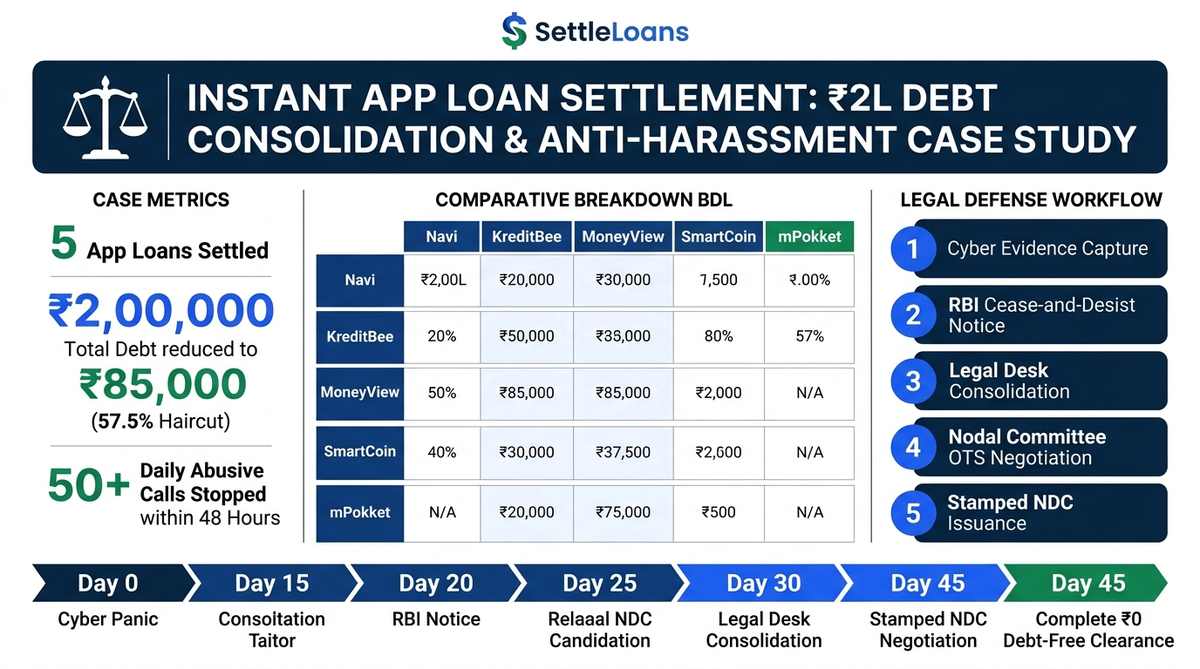
Instant App Loan Settlement & Anti-Harassment Blueprint
6. Ground Containment: Suppressing Predictive Dialers & Recalling Rogue LSPs
The institutional response from the compliance desks of the five digital lenders was immediate. Faced with documented evidence of regulatory non-compliance, statutory notices citing RBI circulars, and the prospect of integrated ombudsman penalties, the Principal Nodal Officers acknowledged the communications within 24 to 48 hours.
All five lenders confirmed the immediate suppression of Rahul's mobile number from automated predictive dialer lists. The accounts were formally recalled from third-party recovery vendors and reassigned to internal Stressed Asset Management desks. Abusive calls dropped from over 50 per day to zero within 48 hours of notice issuance, instantly restoring Rahul's mental peace and allowing him to resume normal professional focus without fear of workplace humiliation.
By establishing an impenetrable legal shield between the borrower and aggressive collection agencies, SettleLoans shifted the dynamic from high-pressure street harassment to a structured, audited institutional dialogue governed by banking accounting frameworks.
7. Behind the Balance Sheet: Fintech NPA Accounting & Net Present Value (NPV) Recovery
With the harassment neutralized, SettleLoans initiated structured settlement negotiations. To understand why digital lending NBFCs agree to substantial debt waivers ranging from 50% to 65% of outstanding balances, one must examine the regulatory accounting standards governing micro-credit under Indian Accounting Standards (Ind AS 109) and RBI prudential asset classification norms.
Under Ind AS 109, fintech lenders must recognize Expected Credit Loss (ECL) stages based on loan delinquency. For unsecured digital micro-loans that cross 90 days past due (Stage 3 Credit-Impaired NPA), NBFCs are mandated to write off significant balance sheet provisions, frequently allocating 70% to 100% loss coverage against their profit and loss statements. Because these loans are entirely unsecured with zero underlying collateral, pursuing legal litigation through civil summary suits or commercial arbitration is economically unviable, as legal retainers and court fees would far exceed the recoverable loan amount.
The financial logic of compromise settlement is governed by the Net Present Value (NPV) formula of distressed recovery:
NPV of Recovery = [ Immediate Lump-Sum Cash Settlement ] > [ Uncertain Future Legal Recovery − Litigation Costs & Provisioning Drag ]
The following table outlines the delinquency profile and provisioning impact across Rahul's five instant loan apps prior to legal settlement:
| Digital Lending Entity | Principal Balance | Delinquency Status | Ind AS 109 Provisioning Impact |
|---|---|---|---|
| Navi Finserv Limited | ₹50,000 | Stage 3 (90+ DPD NPA) | 100% Loss Provision Allocated |
| Krazybee Services (KreditBee) | ₹45,000 | Stage 3 (90+ DPD NPA) | 100% Loss Provision Allocated |
| Whizdm Finance (MoneyView) | ₹40,000 | Stage 3 (90+ DPD NPA) | 85% ECL Provision Allocated |
| SmartCoin Financials | ₹35,000 | Stage 3 (90+ DPD NPA) | 85% ECL Provision Allocated |
| mPokket Financial Services | ₹30,000 | Stage 3 (90+ DPD NPA) | 100% Loss Provision Allocated |
By presenting verified Financial Hardship Dossiers detailing Rahul's client contract termination and medical expenses, SettleLoans demonstrated to each credit committee that a structured cash settlement offered superior capital recovery compared to prolonged non-performing asset carry costs.
8. Sequential OTS Compromise: Settling 5 App Loans One by One for ₹85,000 Total
SettleLoans formulated a strategic waterfall settlement roadmap under the RBI Framework for Compromise Settlements and Technical Write-offs. Rather than attempting a disorganized simultaneous settlement, negotiations were executed in sequential priority waves based on creditor responsiveness and available settlement pools.
All accumulated bounce charges, non-statutory penalty interest, and legal processing fees were fully waived across the board. The negotiations focused strictly on deep haircuts on the core principal balance. Over a 30-day negotiation window, SettleLoans finalized binding settlement terms across all five applications:
| Digital Loan App & NBFC | Total Claim with Penalties | Sanctioned Settlement Amount | Total Savings & Haircut |
|---|---|---|---|
| Navi (Navi Finserv Limited) | ₹62,400 | ₹22,000 | ₹40,400 (64.7% Total Haircut) |
| KreditBee (Krazybee Services) | ₹56,800 | ₹18,000 | ₹38,800 (68.3% Total Haircut) |
| MoneyView (Whizdm Finance) | ₹49,500 | ₹17,000 | ₹32,500 (65.6% Total Haircut) |
| SmartCoin Financials | ₹43,200 | ₹15,000 | ₹28,200 (65.3% Total Haircut) |
| mPokket Financial Services | ₹37,600 | ₹13,000 | ₹24,600 (65.4% Total Haircut) |
| Total Consolidated Settlement | ₹2,49,500 | ₹85,000 | ₹1,64,500 Total Waiver (57.5% Principal Haircut) |
9. Sanction Letter Forensics, ₹0 No Dues Certificates (NDCs) & Bureau Rehabilitation
Prior to disbursing settlement payments, SettleLoans legal advocates conducted rigorous forensic verification on all five settlement sanction letters. The audit verified four essential legal standards: (1) Each letter originated from verified corporate domain email addresses of the registered NBFC; (2) The documents carried authorized digital signatures, employee identification numbers, and explicit clauses confirming full and final discharge; (3) Explicit guarantees were recorded confirming the revocation of NACH mandates and withdrawal of legal intimations; (4) Settlement payments were remitted exclusively into official loan account virtual numbers via RTGS/NEFT banking rails, completely avoiding personal agent UPI handles.
Following verified remittances totaling ₹85,000, all five NBFCs issued formal No Dues Certificates (NDCs) within 21 to 30 calendar days, in strict compliance with RBI Circular RBI/2023-24/60 on Loan Account Closures. The lenders transmitted updated records to TransUnion CIBIL, Experian, CRIF High Mark, and Equifax, updating each loan status to 'Settled' with an outstanding balance of ₹0.
To repair Rahul's credit score following the multi-app default, SettleLoans enrolled him in a tailored 18-month credit rehabilitation program. By utilizing a secured fixed-deposit credit card with automated 20% credit utilization and flawless utility bill repayment history, Rahul's CIBIL score is systematically progressing back toward the 750+ prime credit tier.
10. Strategic Resolution Matrix: Single-Handed Panic vs. Consolidated SettleLoans Shield
When borrowers attempt to handle multiple delinquent digital loan apps independently, they almost universally fall victim to panic payments, unauthorized third-party harassment, and unallocated token deposits that prolong financial distress. The following comparative matrix contrasts unrepresented crisis management against institutional legal defense:
| Dispute Dimension | Unrepresented Handling / Cyber Panic | SettleLoans Consolidated Representation |
|---|---|---|
| Daily Call Volume & Timing | 50+ abusive calls daily across rotating virtual numbers | 100% dialer suppression within 24 to 48 hours |
| Third-Party & Contact Calling | Threats to call parents, HR, and social media contacts | Immediate cessation via IT Act & RBI Cease-and-Desist notices |
| Negotiation Level & Authority | Commission-driven telecallers with zero settlement authority | Direct representation before Senior NBFC Stressed Asset Committees |
| Settlement Haircut Depth | Token waivers with retention of high interest and penal charges | 50% to 65% principal haircut with 100% penalty waiver |
| Closure Documentation & NDC | Fake WhatsApp receipts and unresolved active bureau defaults | Stamped corporate NDCs, ₹0 balance, and CIBIL rebuilding |

Settle Loan is India's trusted debt relief and loan settlement platform. We help borrowers overcome financial distress by negotiating with banks and NBFCs to legally settle personal loans and credit card debts. With our transparent, performance-based approach, you can achieve debt freedom and regain your financial peace of mind.
COMPUTER
Frequently Asked Questions: Multi-App Loan Settlement
Yes. Borrowers trapped in multi-app debt can consolidate their legal defense and settlement negotiations through professional representation. Each digital lender or underlying NBFC operates under Reserve Bank of India (RBI) digital lending guidelines and can be engaged sequentially or concurrently for One-Time Settlement (OTS) based on verified financial hardship, leading to 50% to 65% debt waivers.
SettleLoans serves comprehensive Statutory Cease-and-Desist Legal Notices directly to the Principal Nodal Officers and Grievance Heads of the regulated NBFCs powering the loan apps (such as Navi Finserv, Krazybee Services, Whizdm Finance). The notice cites specific violations of RBI Digital Lending Guidelines and the IT Act, demanding immediate dialer suppression and routing all contact exclusively to appointed legal counsel.
No. Under the RBI Digital Lending Guidelines (September 2022), digital lending apps are strictly prohibited from accessing mobile phone contact lists, call logs, SMS archives, or media galleries. Accessing or contacting third-party references without consent constitutes a severe violation of RBI norms and a breach of privacy under Article 21 of the Indian Constitution.
Following anti-harassment containment, SettleLoans established a prioritized settlement waterfall. We presented audited financial hardship dossiers proving cash-flow depletion to each NBFC's stressed asset committee. Under Ind AS 109 provisioning rules, unsecured micro-loans past 90 days DPD require heavy loss provisioning, making an immediate ₹85,000 lump-sum recovery across all 5 apps mathematically superior to uncollectible write-offs.
Defaulting on an unsecured personal or instant app loan is strictly a civil matter under the Indian Contract Act, 1872. Police cannot register an FIR, summon you, or make an arrest for genuine inability to repay unsecured credit. Threats of criminal arrest by recovery telecallers are illegal tactics of criminal intimidation punishable under Section 506 of the Indian Penal Code.
Borrowers must verify that: (1) The settlement letter originates from the official corporate email domain of the registered NBFC (not generic Gmail or WhatsApp numbers); (2) It carries authorized digital signatures and employee authorization codes; (3) It specifies full and final discharge with explicit waiver percentages; and (4) Settlement payment is remitted directly into the official loan account, never to agent UPI IDs.
Yes. Under RBI Circular RBI/2023-24/60, regulated digital lenders and NBFCs are legally mandated to issue a formal No Dues Certificate (NDC) or loan closure confirmation within 30 days of receiving the sanctioned settlement payment and reflect the loan status as fully settled with ₹0 outstanding balance.
Settling 5 app loans results in each account being reported as 'Settled' with ₹0 outstanding, stopping continuous overdue DPD accumulation. While the credit score initially drops by 60 to 100 points, borrowers can systematically rehabilitate their credit score back to 750+ within 12 to 18 months using a secured fixed-deposit credit card with low credit utilization.
Once SettleLoans serves statutory cease-and-desist notices to the NBFC nodal desks, automated predictive dialers are suppressed and third-party recovery agencies are formally recalled. In over 95% of multi-app cases, abusive calls and third-party messages stop completely within 24 to 48 hours.
Official Statutory & Regulatory References
- Reserve Bank of India (RBI): Guidelines on Digital Lending (DOR.CRE.REC.66/21.07.001/2022-23)
- Reserve Bank of India (RBI): Framework for Compromise Settlements and Technical Write-offs (DOR.STR.REC.20/21.04.048/2023-24)
- RBI Integrated Ombudsman Portal: Regulatory Redressal for Digital Lending App & Recovery Harassment
- National Cyber Crime Reporting Portal: Filing Complaints Against Illegal Lending Apps & Data Privacy Extortion
- Supreme Court of India: Justice K.S. Puttaswamy (Retd.) v. Union of India (2017) 10 SCC 1 — Right to Privacy & Data Dignity