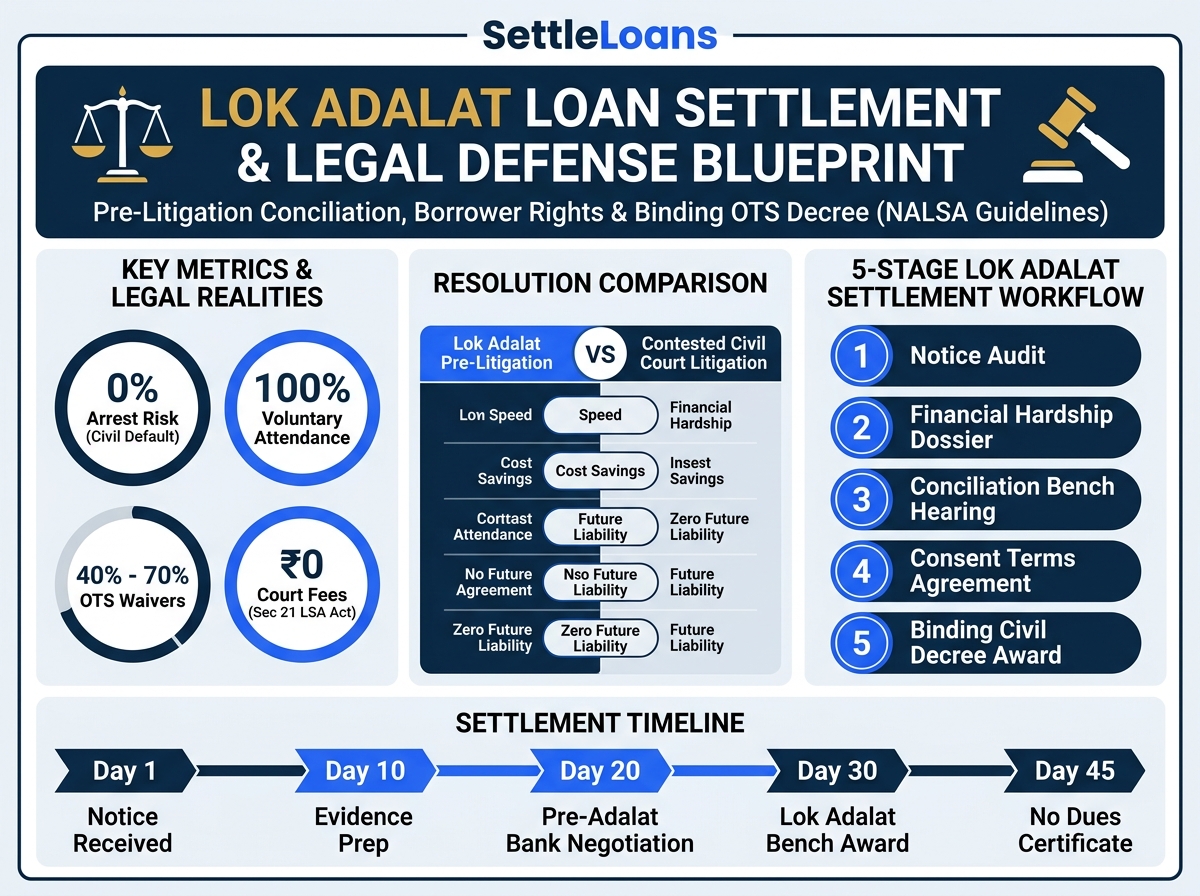
- 100% Voluntary Attendance: Lok Adalat is an alternative dispute resolution (ADR) conciliation forum established under the Legal Services Authorities Act, 1987. Non-attendance is neither a crime nor contempt of court.
- Zero Arrest or Police Powers: A Lok Adalat bench cannot issue arrest warrants, order police detention, or impose fines. It acts strictly as a neutral mediator between you and the bank.
- Unmatched Settlement Discounts (40%–75%): Because banks avoid litigation expenses and save on provisioning, they are authorized to waive 100% of penal interest and up to 50% of the core principal.
- Deemed Civil Court Decree (Section 21): A Lok Adalat settlement award has the full legal force of a civil court decree with zero appeal rights under Section 96(3) CPC, permanently extinguishing the debt.
- Zero Court Fees: No court fees are levied on either party. If a court suit was already pending, any court fees previously paid by the bank are fully refunded under Section 21(1) of the Act.
1. What is a Lok Adalat Notice for Personal Loan Default?
Finding a formal notice stamped with the seal of the District Legal Services Authority (DLSA) or receiving a message headed "NATIONAL LOK ADALAT PRE-LITIGATION SUMMONS" triggers intense anxiety for any borrower struggling with personal loan defaults. The immediate fear is that the judicial machinery has initiated criminal proceedings and police arrest is imminent.
"Under the Legal Services Authorities Act, 1987, a Lok Adalat (literally 'People's Court') is a statutory Alternative Dispute Resolution (ADR) mechanism designed to facilitate voluntary, non-adversarial compromise between disputing parties. A pre-litigation Lok Adalat notice is not a criminal summons or a decree of liability; it is an official invitation to resolve outstanding loan dues amicably before formal court litigation commences."
— National Legal Services Authority (NALSA) Statutory Framework & Section 19 of LSA Act, 1987
In India, retail personal loans are unsecured credit facilities governed by the Indian Contract Act, 1872. When a borrower misses three consecutive monthly installments (90 days past due), the loan is categorized as a Non-Performing Asset (NPA) under Reserve Bank of India (RBI) prudential norms.
Rather than immediately spending significant funds on court litigation, advocate retainers, and process fees to file civil recovery suits (Summary Suits under Order XXXVII of the CPC) or Section 138 / Section 25 criminal complaints, banks and Non-Banking Financial Companies (NBFCs) utilize the National Lok Adalat platform organized quarterly across all district court complexes in India.
There are two distinct types of Lok Adalat referrals in personal loan matters:
1. Pre-Litigation Lok Adalat Reference (Most Common)
The bank submits a list of defaulted loan accounts to the District Legal Services Authority (DLSA) before any lawsuit or court complaint is filed. The DLSA issues a pre-litigation notice assigning a Pre-Litigation Case (PLC) number, inviting both the borrower and bank officials to meet on the designated Lok Adalat Saturday to reach an amicable One-Time Settlement (OTS).
2. Post-Filing / Pending Litigation Lok Adalat Reference
If the bank has already filed a Section 138 Negotiable Instruments Act cheque bounce case, a Section 25 PSS Act NACH bounce case, or a civil recovery suit, the presiding Magistrate or Civil Judge may refer the pending case to the upcoming Lok Adalat bench if both parties indicate a willingness to explore compromise terms.
Notice Classification Matrix: Lok Adalat vs. Court Summons vs. Fake Recovery Notice
| Notice Type | Issuing Authority | Attendance Requirement | Arrest / Warrant Powers? | Legal Objective |
|---|---|---|---|---|
| Pre-Litigation Lok Adalat Notice | District Legal Services Authority (DLSA) | 100% Voluntary | ZERO (No warrants) | Mutual compromise & One-Time Settlement |
| Regular Civil Court Summons | Civil Judge / Senior Civil Court | Mandatory (via Advocate) | Ex-parte Money Decree | Adjudication of debt & execution order |
| Section 138 / 25 Court Summons | Judicial / Metropolitan Magistrate | Mandatory (Bailable) | Bailable Warrant if skipped | Summary quasi-criminal trial for bounce |
| Fake Recovery Notice (WhatsApp) | Unregulated Collection Agency | Illegal / Disregard | ZERO (Criminal Forgery) | Psychological extortion & coercion |
2. Is Lok Adalat Attendance Mandatory? Arrest Myths Debunked
The most pervasive tactic deployed by rogue debt collection agents is misrepresenting a Lok Adalat notice as a non-bailable judicial arrest warrant. Borrowers frequently receive threatening phone calls stating: "The Lok Adalat Judge has issued an order to arrest you if you do not report to court with cash by 10:00 AM."
This is completely false and unlawful. Under Indian constitutional and statutory jurisprudence, Lok Adalat benches operate under strict legal boundaries:
1. Supreme Court Precedent on Non-Coercive Nature
In landmark decisions including State of Punjab v. Jalour Singh (2008 2 SCC 660) and B.P. Moideen Sevamandir v. A.M. Kutty Hassan (2009 2 SCC 198), the Supreme Court of India held that Lok Adalats have no adjudicatory or judicial power. Their role is solely to persuade parties to reach a compromise. A Lok Adalat cannot pass an order on merits, cannot punish any party, and cannot compel attendance against a citizen's will.
2. Complete Absence of Warrant & Contempt Powers
A Lok Adalat bench has zero statutory power under the Code of Criminal Procedure (CrPC / BNSS) to issue warrants of arrest, issue property attachment notices, or initiate contempt of court proceedings. If a borrower fails to appear on the scheduled Saturday, the bench simply marks the pre-litigation matter as "Unsettled / Disposed of as Not Settled".
3. Distinction from Section 138 Cheque Bounce Summons
If the bank previously filed a formal Section 138 NI Act or Section 25 PSS Act complaint in a regular Magistrate Court and that specific criminal court referred the matter to Lok Adalat, skipping the Lok Adalat session will return the file back to the regular Magistrate Court. In that scenario, your advocate must appear on the regular court hearing date to secure bail—not because of the Lok Adalat notice, but due to the underlying Section 138 summons.
Check Your Loan Settlement Options
Answer 2 quick questions to evaluate your settlement eligibility.
1. What type of loan do you want to settle?
3. Why Banks and NBFCs Rely on Lok Adalat for Personal Loan Recoveries
Understanding why institutional lenders (such as HDFC Bank, ICICI Bank, SBI, Axis Bank, Kotak Mahindra, Bajaj Finance, and digital fintech NBFCs) aggressively push personal loan defaults to Lok Adalat gives you significant negotiating leverage:
100% Court Fee Exemption
Under Section 21(1) of the Legal Services Authorities Act, 1987, no court fee is payable in Lok Adalat. Furthermore, if the bank had already filed a civil suit and paid ad-valorem court fees (often 5% to 8% of the loan amount), the entire court fee is refunded in full to the bank once the matter is settled at Lok Adalat.
NPA Provisioning Relief
Under RBI Master Directions, commercial banks must set aside capital provisions (ranging from 15% to 100%) against non-performing unsecured personal loans. Settling the account via a Lok Adalat award allows the bank to write off the loss and immediately clean its balance sheet for the financial quarter.
Zero Appeal Delays
Civil litigation in India takes an average of 4 to 7 years. Because Lok Adalat awards are non-appealable by law, the bank eliminates the risk of endless appellate litigation in the District Court or High Court, locking in guaranteed recovery cash flows.
Senior Settlement Mandates
On National Lok Adalat days, banks empanel their Senior Vice Presidents, Cluster Heads, and Stressed Asset Managers on the bench. Unlike low-level call-center recovery agents who have zero authority to discount loans, these senior executives carry authorized corporate power to approve immediate 50%+ waivers on the spot.
4. Realistic Settlement Discounts in Lok Adalat (40%–75%)
How much debt relief can a borrower realistically achieve when negotiating a personal loan at Lok Adalat? Because personal loans are completely unsecured (with no property, gold, or vehicle pledged as collateral), the bank's recovery probability in contested litigation is extremely low.
The settlement mathematics at Lok Adalat is structured across three layers:
Banks inflate defaulted loan statements with 36% compound interest, monthly penal charges, bounce fees, and legal notice costs. In Lok Adalat, 100% of these auxiliary charges are routinely eliminated at the very first step of negotiation.
The conciliation bench encourages lenders to roll back accumulated interest to the date of default or charge simple interest at RBI repo rates, reducing the contractual interest burden by 50% to 80%.
If the borrower presents verifiable hardship evidence (such as job termination, critical illness diagnosis, severe business insolvency, or family bereavement), senior bank officials frequently approve a 20% to 50% waiver directly on the remaining principal balance.
National Lok Adalat Settlement Matrix: Realistic Discount Benchmarks
| Default Vintage (Months Past Due) | Borrower Hardship Profile | Penal Interest Waiver | Principal Haircut Range | Total Overall Settlement Waiver |
|---|---|---|---|---|
| 3 to 6 Months (Early NPA) | Temporary salary delay / liquidity squeeze | 100% Waiver | 0% to 15% Principal Haircut | 35% – 45% Waiver |
| 6 to 12 Months (Substandard NPA) | Job loss, salary reduction, business slump | 100% Waiver | 20% to 35% Principal Haircut | 45% – 60% Waiver |
| 12 to 24+ Months (Doubtful NPA) | Prolonged unemployment, medical crisis | 100% Waiver | 35% to 50% Principal Haircut | 60% – 75% Waiver |
| 24+ Months / Written-Off Asset | Complete business shutdown / permanent crisis | 100% Waiver | 40% to 60% Principal Haircut | 70% – 85% Waiver |
6. Action Plan: How to Prepare, Attend & Settle at Lok Adalat
Approaching Lok Adalat unprepared can result in settling on unfavorable terms. Following a structured, strategic protocol ensures maximum debt reduction and ironclad legal protection:
Step 1: Verify Notice Authenticity & Pre-Litigation Case (PLC) Number
Examine the physical notice received. Confirm that it carries a legitimate District Legal Services Authority (DLSA) seal, a valid PLC Number, and details of the specific court room/hall. You can verify the case on the state legal services portal or by visiting the DLSA office at your district court.
Step 2: Assemble Your Financial Hardship Dossier
Lok Adalat conciliation judges are deeply sympathetic to documented distress. Prepare a clean folder containing: termination letters, pink slip notices, salary slips showing steep pay cuts, medical diagnosis reports, hospital billing receipts, GST/ITR returns reflecting business downturn, and bank statements showing low average balances.
Step 3: Conduct Pre-Adalat Informal Bargaining with Bank Officers
In the 7 to 10 days leading up to Lok Adalat Saturday, contact the bank's Stressed Asset Resolution Branch (SARB) or have your debt settlement advocate initiate preliminary discussions. Agreeing on tentative settlement numbers in advance ensures that Lok Adalat day is merely used to record formal consent terms before the bench.
Step 4: Present Your Case Before the Lok Adalat Bench
On hearing day, attend the designated court room with your advocate. Explain your bona fide intention to resolve the debt despite genuine economic hardship. Emphasize that you are not a willful defaulter. The conciliation judge will actively counsel the bank officers to grant maximum principal haircuts and realistic installment timelines.
Step 5: Scrutinize the Award Text Before Signing Consent Terms
Before affixing your signature to the settlement agreement, ensure the written Award explicitly states: 1) The exact settlement amount and payment due dates; 2) That upon final payment, the entire debt is deemed fully discharged; 3) That the bank shall issue an unconditional No Dues Certificate (NDC) within 30 days; 4) That all pending Section 138, Section 25, or civil recovery proceedings stand permanently withdrawn.
Lok Adalat Settlement Award vs. Private Bank OTS Sanction Letter
| Resolution Parameter | Lok Adalat Settlement Award | Private Bank OTS Sanction Letter |
|---|---|---|
| Legal Standing | Deemed Civil Court Decree (Sec 21 LSA Act) | Private Commercial Contract |
| Appeal & Challenge Rights | ZERO Appeal (Sec 96(3) CPC) — 100% Final | Can be revoked by bank if terms disputed |
| Execution & Enforcement | Directly executable under Order XXI CPC | Requires fresh civil lawsuit to enforce |
| Protection from Future Lawsuits | Absolute judicial immunity for settled debt | High, subject to valid No Dues Certificate |
| Court Fee Implications | ₹0 Court Fee / 100% Refund to Bank | Bank absorbs or passes legal expenses |
7. Legal Finality of Lok Adalat Awards Under Section 21
The single most powerful advantage of settling a personal loan through Lok Adalat is its unshakeable legal finality. Under Section 21 of the Legal Services Authorities Act, 1987, every award passed by a Lok Adalat bench has the legal character and enforceability of a formal decree passed by a competent Civil Court.
Statutory Rule on Non-Appealable Consent Decrees:
"Under Section 96(3) of the Code of Civil Procedure, 1908, no appeal shall lie from a decree passed by the court with the consent of parties. Because a Lok Adalat award is founded on mutual consent, neither the borrower nor the bank can appeal against the award before any District Court, High Court, or the Supreme Court."
— Supreme Court of India in P.T. Thomas v. Thomas Job (2005 6 SCC 478)
Once the Lok Adalat Award is stamped by the bench and you honor the settlement tranches, the bank is permanently barred from:
- Re-calculating interest or claiming residual balances in the future.
- Assigning or selling the residual debt to third-party Asset Reconstruction Companies (ARCs).
- Initiating fresh Section 138 NI Act or Section 25 PSS Act criminal proceedings.
- Deploying recovery agents to contact or visit you regarding the settled loan.
8. What Happens If You Do Not Attend Lok Adalat?
Many borrowers ask: "What if I simply do not show up on Lok Adalat Saturday? Will a judgment be passed against me in my absence?"
The short answer is No. Unlike a regular civil court where failing to appear can lead to an ex-parte decree, a Lok Adalat bench has zero power to pass an ex-parte order against an absent party.
What Actually Happens at the Bench:
The bench calls the case. If the borrower is absent, the judge notes: "Borrower absent. Matter unsettled. Returned to referring bank." The pre-litigation file is permanently closed without cost or penalty.
What the Bank May Do Next:
With the pre-litigation attempt failed, the bank evaluates three choices: 1) Send regular advocate demand notices; 2) File a formal civil recovery suit or Section 138/25 complaint in court; 3) Re-list the matter in the next quarterly National Lok Adalat session (3 months later) with better settlement terms.
Strategic Assessment: When to Attend vs. When to Skip:
If you have access to some settlement funds (even 30% to 40% of the loan value) via family assistance or savings, attending is strongly recommended because you will never get a better discount forum. If you are in total financial destitution with zero funds to offer, skipping is harmless; you can wait until your financial situation stabilizes.
9. Post-Settlement Compliance: Securing NDC & CIBIL Update
Securing a favorable Lok Adalat award is only half the battle; ensuring meticulous post-settlement execution is essential to protect your credit profile and financial standing:
4-Point Post-Lok Adalat Checklist:
- Execute Payments Strictly via Verifiable Banking Channels: Never pay cash to collection agents. Remit settlement tranches directly to your loan account via RTGS, NEFT, or Demand Draft, quoting the Lok Adalat Case Number in the transaction remarks.
- Obtain Certified Copy of the Lok Adalat Award: Collect the signed and sealed Lok Adalat Award directly from the DLSA registry at the district court. This serves as your permanent judicial record.
- Demand Official No Dues Certificate (NDC / NOC): Within 15 to 30 days of the final settlement tranche, the lender is legally required under RBI Fair Practices Code to issue a formal No Dues Certificate confirming zero outstanding liability.
- Monitor Credit Bureau Updates (CIBIL / Experian): After 45 to 60 days, verify your CIBIL report. The loan account balance must reflect ₹0 with status "Settled". If discrepancies exist, submit a CIBIL online dispute attaching the Lok Adalat Award and bank NDC.

Settle Loan is India's trusted debt relief and loan settlement platform. We help borrowers overcome financial distress by negotiating with banks and NBFCs to legally settle personal loans and credit card debts. With our transparent, performance-based approach, you can achieve debt freedom and regain your financial peace of mind.
COMPUTER
10. Frequently Asked Questions (FAQ)
Authoritative legal answers to the most common questions surrounding Lok Adalat notices, attendance rules, arrest fears, and loan settlement negotiations in India.
No, attending a Lok Adalat session is strictly voluntary under Indian law. Under the Legal Services Authorities Act, 1987, Lok Adalat is an alternative dispute resolution (ADR) conciliation platform designed to promote mutual, amicable compromise—not an adversarial court of trial. You cannot be penalized, arrested, or prosecuted for choosing not to attend. However, attending is widely considered one of the single most advantageous opportunities for distressed borrowers because senior bank decision-makers are present with discretionary mandates to approve deep 40% to 70% One-Time Settlement (OTS) waivers that are legally binding and permanent.
Absolutely not. Lok Adalat possesses zero judicial or criminal authority to issue bailable or non-bailable arrest warrants, impose fines, or direct police officers to detain you. A Lok Adalat bench consists of a sitting or retired judicial officer and a legal/social conciliation member who act purely as impartial mediators. If you do not attend, the bench simply endorses the file as "Disposed of as Not Settled / Pre-Litigation Failed" and remits the matter back to the lender. No adverse order, monetary penalty, or arrest warrant can ever be issued by a Lok Adalat bench.
A Pre-Litigation Lok Adalat Notice is issued by the District Legal Services Authority (DLSA) or Taluk Legal Services Committee before any formal lawsuit, summary suit (Order XXXVII CPC), or criminal complaint has been filed in court. It represents a friendly, cost-free invitation to settle the debt outside formal litigation. In contrast, a Regular Court Summons is issued by a Metropolitan Magistrate (for Section 138 cheque bounce or Section 25 PSS Act NACH failure) or a Civil Judge after a formal judicial case has been instituted. While ignoring a court summons can lead to bailable warrants or ex-parte decrees, ignoring a Lok Adalat notice carries zero immediate judicial penalty.
If you skip a Lok Adalat session, nothing happens immediately in terms of court penalties. The matter is closed as unsettled, and the lender retains the legal right to decide their next course of action—such as filing a civil recovery suit, initiating arbitration, issuing statutory Section 138/25 notices, or assigning the file to third-party recovery channels. While skipping does not create immediate legal jeopardy, it forfeits a unique window of opportunity where the bank was officially prepared to offer deep debt write-offs with zero court fees.
Settlement discounts in National Lok Adalat for unsecured personal loans and credit cards typically range from 40% to 75% of the total outstanding demand. Banks and NBFCs routinely grant a 100% waiver on accumulated penal interest, compounding late fees, and legal charges. For loans defaulted over 12 to 24 months with documented financial distress (such as job loss, medical emergency, or business failure), banks are often willing to take a 20% to 50% haircut on the core principal balance as well, provided the agreed sum is paid in a single bullet payment or 2 to 3 structured monthly tranches.
Yes, absolutely. Under Section 21 of the Legal Services Authorities Act, 1987, a Lok Adalat award is deemed to be a decree of a Civil Court. Once both you and the bank representative sign the joint compromise terms and the Lok Adalat bench passes the award, it becomes absolute, final, and non-appealable under Section 96(3) of the Code of Civil Procedure (CPC). The bank can never reopen the account, demand additional funds, or file a future lawsuit for the settled debt. The dispute is permanently terminated under Indian law.
While legal representation is not mandatory by statute, having an experienced debt settlement advocate accompany you to the Lok Adalat session is strongly advised. A dedicated advocate will structure your financial hardship dossier, shield you from aggressive bank recovery officers attempting to extract high repayment commitments, calculate the optimal mathematical settlement floor, and scrutinize the final written Award to ensure that an unconditional No Dues Certificate (NDC) and full withdrawal of pending complaints are explicitly mandated.
If you execute a Lok Adalat settlement award and subsequently default on the agreed payment schedule, the legal protection dissolves. Because a Lok Adalat award has the legal standing of a final Civil Court Decree, the bank can directly initiate execution proceedings under Order XXI of the Code of Civil Procedure to attach assets or bank accounts without having to prove the debt again in a full civil trial. Therefore, you should only agree to a settlement figure and installment schedule that you have the immediate financial means to honor.
When you settle a loan at Lok Adalat for less than the contractual balance, the lender updates your credit bureau record (CIBIL, Experian, CRIF High Mark) with the status "Settled" or "Post-Lok Adalat Settled" and marks the outstanding overdue balance as ₹0. While a "Settled" remark causes an immediate score reduction of 50 to 100 points, it halts ongoing negative DPD (Days Past Due) reporting. With disciplined credit behavior, secured credit card usage, and zero future defaults, your CIBIL score can be rebuilt above 750 within 18 to 24 months.
A genuine Lok Adalat notice is issued under the seal of the District Legal Services Authority (DLSA) or Taluk Legal Services Committee, contains a verifiable Pre-Litigation Case (PLC) Number, lists the specific bench and court complex hall, and is formally dispatched via Speed Post or official court process servers. Fake notices sent by unscrupulous collection agencies lack a PLC number, feature fabricated police emblems or "Immediate Arrest Warrant" stamps, demand payment to personal UPI QR codes, and threaten police raids within 24 hours.
Official Regulatory Sources & Statutory Authorities
- National Legal Services Authority (NALSA) — National Lok Adalat Guidelines & Pre-Litigation Framework
- Supreme Court of India — Landmark Rulings on Lok Adalat Award Finality (Jalour Singh & Thomas Job)
- Reserve Bank of India (RBI) — Master Directions on Compromise Settlements & Recovery Norms
- eCourts Services — National Judicial Data Grid & District Legal Services Case Tracking
- TransUnion CIBIL — Credit Information Companies (Regulation) Act Rules on Settled Accounts