- Legal Authority & Standing: A formal written settlement letter submitted to the Branch Manager and Nodal Officer creates an official legal record under the RBI Master Direction on Compromise Settlements (June 2023), eliminating unofficial recovery agent exploitation.
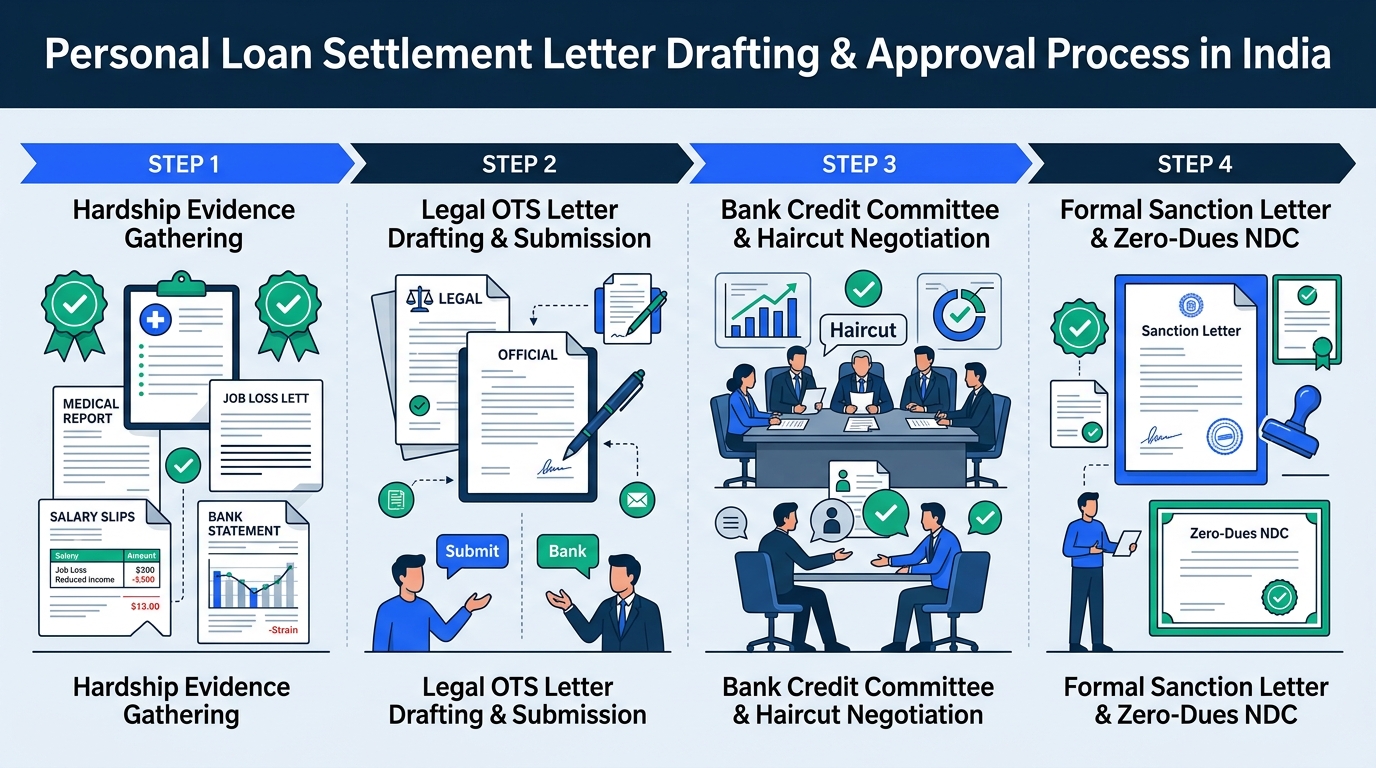
- Hardship records: Letters supported by verifiable proof (hospital discharge summaries, termination letters, bank statements) receive 80% higher approval rates from bank credit committees.
- Realistic Settlement Band: Starting offers of 25%–40% of outstanding dues enable realistic talks, typically closing between 35% and 60% with 100% waiver of penal interest.
- Non-Negotiable Safeguards: Never pay any settlement sum until you hold an official OTS Sanction Letter on bank letterhead and a written guarantee of a final No Dues Certificate (NDC).
1. Why a Written Settlement Letter is Crucial for Banks
When personal loan borrowers face unexpected financial catastrophe—such as catastrophic illness, job loss, or commercial business failure—they often make the critical mistake of negotiating verbally over phone calls with third-party recovery agents.
In the Indian banking system, verbal talks carry zero legal or evidentiary weight. Recovery agents operate on commission targets and lack the statutory authority to waive loan principal, stop penal interest, or issue binding debt discharges. The only lawful, recognized method to start a One-Time Settlement (OTS) is by submitting a formal, written settlement proposal letter directly to the bank's authorized management.
How Banks Evaluate Your Settlement Proposal Letter:
1. NPA Aging & Provisioning
Once a loan crosses 90 days past due (NPA), banks must set aside mandatory provisioning capital (15% to 100%). A compromise settlement unlocks this locked provisioning capital on the bank's balance sheet.
2. NPV vs. Litigation Cost
The credit committee calculates the Net Present Value (NPV) of an immediate cash recovery against the 3–5 year legal cost of dragging unsecured debt through Civil Courts or Section 25 PSS Act cases.
3. Verifiable Insolvency
The committee scrutinizes your hardship documents to ensure default was involuntary and bona fide, rather than intentional or willful financial diversion.
A meticulously structured settlement letter bridges the gap between your insolvency and the bank's risk-mitigation objectives, transforming an adversarial recovery dispute into an orderly, board-approved commercial compromise.
2. The 9 Essential Pillars of an Ironclad Settlement Letter
To withstand legal scrutiny and speed up sanction by the Stressed Assets Recovery Committee, your personal loan settlement letter must contain these nine mandatory anatomical components:
Precise Identification & Loan Coordinates
Your full legal name (matching PAN card), registered residential address, permanent mobile number, official email, loan account number, loan sanction date, and the specific disbursing branch name.
Track Record of Prior Prompt Repayments
Highlight the exact number of consecutive monthly EMIs successfully paid before the crisis, along with the total cumulative amount remitted. This establishes your bona fide character and negates any allegation of fraudulent intent.
Factual, Substantiated Hardship Statement
A clear, objective narrative detailing the specific unforeseen catastrophe (e.g., hospitalization, diagnosis of chronic disease, company layoffs, bankruptcy of key buyers) that disrupted your debt servicing capability.
Statement of Current Asset & Income Insolvency
show that your current monthly disposable income is insufficient to cover contractual EMIs after meeting bare family sustenance, and that you possess no unencumbered liquid assets to pledge.
Concrete One-Time Settlement (OTS) Offer Amount
State the specific lump-sum settlement sum offered in both figures (e.g., INR 3,50,000) and words (Rupees Three Lakhs Fifty Thousand Only), indicating the source of funds (e.g., borrowed from family/relatives).
Defined Execution & Payment Horizon
Specify the payment window (typically 15 to 30 calendar days from receipt of written sanction) or propose a maximum of 2–3 structured monthly tranches if liquidity is constrained.
100% Waiver of Accrued Penalties & Interest
Explicitly request complete cancellation and write-off of compounding penal interest, overdue charges, cheque bounce levies, and legal notice expenses accumulated on the ledger.
Mandatory Pre-Conditions: Official Sanction Letter & NDC
State unequivocally that remittance will only occur upon receipt of a formal, stamped OTS Sanction Letter on official bank stationery, followed by issuance of a ₹0 No Dues Certificate (NDC) within 30 days.
Exhaustive List of Verified Enclosures
An enumerated appendix of attached identity cards, 6-month bank statements, medical records, or termination letters showing complete transparency.
Check Your Loan Settlement Options
Answer 2 quick questions to evaluate your settlement eligibility.
1. What type of loan do you want to settle?
3. Comparison Table: Different Types of Formal Debt Relief Letters
Depending on your financial horizon and repayment capability, a One-Time Settlement letter may not be the only correspondence format. The table below compares the 4 major formal representation letters submitted to banks in India:
| Formal Letter Type | Borrower Financial State | Typical Haircut / Concession | CIBIL Bureau Tag | Legal Impact & Outcome |
|---|---|---|---|---|
| One-Time Settlement (OTS) Proposal | Permanent / Severe Insolvency (NPA 90+ DPD) | 40% – 65% Waiver | Reported as "Settled" | Full release of debt liability; ₹0 balance NDC issued; litigation halted. |
| Loan Restructuring / Tenor Extension | Temporary cash crunch; ongoing regular salary | 0% Haircut (Tenor extended) | Reported as "Restructured" | EMIs reduced by 30%–50%; interest continues; account remains regular. |
| Penal Interest & Charges Waiver Letter | Ready to repay full principal & basic interest | 100% Waiver of Penalties | Reported as "Closed" | Bank waives bounce fees and penal interest; score improves positively. |
| Anti-Harassment & Legal Representation | Facing illegal recovery agent threats / home visits | Not a financial waiver | No bureau impact | Halts third-party calls under RBI Fair Practices Code; sets stage for lawful OTS. |
4. Production-Ready Settlement Letter Templates
Below are four field-tested settlement request letter templates. They are designed for Indian public sector banks, private commercial banks (HDFC, ICICI, Axis, Kotak, IndusInd, IDFC FIRST), and retail NBFCs (Bajaj Finance, Tata Capital, Poonawalla Fincorp).
Ideal for SBI, HDFC, ICICI, Axis, Kotak, Bajaj Finance, and all major Indian lenders.
Date: [DD/MM/YYYY]

To,
The Branch Manager,
[Name of the Bank / NBFC, e.g., HDFC Bank / State Bank of India / ICICI Bank],
[Branch Name and Complete Address],
[City, State, PIN Code]

CC:
1. The Head, Stressed Assets Recovery Branch (SARB), [Bank Name]
2. The Principal Nodal Officer, [Bank Name]

Subject: Formal Request for One-Time Settlement (OTS) for Personal Loan Account No: [Your Loan Account Number]

Respected Sir / Madam,

1. BORROWER DETAILS & LOAN ACCOUNT IDENTIFICATION:
I am writing to you as the primary borrower of Personal Loan Account Number [Your Loan Account Number], sanctioned on [Loan Disbursal Date] for a principal sum of INR [Original Loan Amount]/- at your [Branch Name] branch.

2. TRACK RECORD OF REGULAR REPAYMENT:
I wish to bring to your kind attention that since the inception of this credit facility, I have consistently honored my contractual commitments by servicing [Number of Months/EMIs, e.g., 22 consecutive EMIs] on time without any default, totaling an aggregate repayment of INR [Total Amount Paid Till Date]/-. This affirms my bona fide intent as an honest borrower.

3. UNFORESEEN FINANCIAL HARDSHIP & DISTRESS:
Unfortunately, due to unforeseen and catastrophic financial situations beyond my reasonable control, namely [Specify hardship: severe health crisis / involuntary job loss / complete business revenue collapse], my income stream has been severely curtailed since [Month, Year of Crisis]. Despite my best efforts to sustain living expenses and manage debts, I am currently undergoing acute financial insolvency.

4. CURRENT STATEMENT OF ACCOUNTS & ACCRUED CHARGES:
As per your latest statement, the outstanding figure is shown as INR [Total Outstanding Amount including penal charges]/-. A large portion of this total comprises compounding penal interest, bounce charges, late fees, and overdue levies accrued during this distress period.

5. ONE-TIME SETTLEMENT (OTS) PROPOSAL:
Under the compromise settlement guidelines framed under Reserve Bank of India (RBI) circulars, I hereby submit my formal proposal for a full and final One-Time Settlement (OTS) of the these personal loan account.

I have arranged financial help from close relatives to make a single lump-sum payment of:
INR [Proposed Settlement Amount in Figures]/-
(Rupees [Proposed Settlement Amount in Words] Only),
which represents [Percentage, e.g., 40%] of the total outstanding dues, payable within [15 / 30 days] of receiving your formal written sanction letter.

6. MANDATORY CONDITIONS PRECEDENT FOR SETTLEMENT:
This offer is submitted in good faith subject to the following standard banking conditions:
a) Complete waiver of all remaining principal, unapplied interest, penal interest, late payment penalties, and incidental charges.
b) Issuance of a formal OTS Sanction Letter on official bank letterhead detailing the accepted settlement amount, payment schedule, and account closure terms before any remittance is made.
c) Issuance of a Comprehensive Final No Dues Certificate (NDC) / No Objection Certificate (NOC) within 30 days of receiving the settlement remittance.
d) Cessation of all third-party collection agency calls, recovery visits, and withdrawal of any legal cases or arbitration notices.
e) Updating of the account status with credit rating agencies (CIBIL, Experian, Equifax, CRIF High Mark) as 'Settled' with INR 0 outstanding balance.

7. ENCLOSURES / SUPPORTING EVIDENCE:
I have attached the following documentary proof validating my genuine distress:
1. Copy of PAN Card & Aadhaar Card.
2. 6-Month Bank Account Statements showing absence/depletion of income.
3. [Documentary proof of hardship, e.g., Medical Discharge Summary / Termination Letter / P&L Statement].
4. Latest Loan Account Statement.

I request you to sympathetically place this proposal before the Competent Credit Committee for favorable sanction at the earliest.

Yours sincerely,

________________________
(Signature)
[Your Full Name]
PAN: [Your PAN Number]
Contact Number: [+91-XXXXXXXXXX]
Email Address: [your.email@example.com]
Residential Address: [Your Full Postal Address]
Designed for critical illnesses, prolonged hospitalizations, or family healthcare catastrophes.
Date: [DD/MM/YYYY]

To,
The Branch Manager,
[Name of the Bank / NBFC],
[Branch Address],
[City, State, PIN Code]

Subject: Application for One-Time Compromise Settlement due to Critical Medical Emergency — Personal Loan A/C: [Loan Account Number]

Respected Sir / Madam,

I am writing to formally request a One-Time Settlement (OTS) regarding my Personal Loan Account No: [Loan Account Number] held with your esteemed institution.

1. MEDICAL HARDSHIP & LOSS OF EARNING CAPACITY:
I have maintained a spotless repayment track record until [Month, Year]. However, on [Date/Month], [I / my immediate dependent, e.g., my spouse/parent] was diagnosed with a critical and life-threatening medical condition, namely [Diagnosis, e.g., Stage-3 Oncological Treatment / Major Cardiac Surgery / Prolonged ICU Hospitalization].

The cumulative hospitalization and continuous treatment expenditures have exceeded INR [Total Medical Expenses Incurred, e.g., 14,50,000]/-, completely wiping out my lifetime family savings and rendering me physically unable to resume full-time employment.

2. SUBMISSION OF GENUINE OTS PROPOSAL:
Against the current book outstanding of INR [Total Outstanding Amount]/-, I am submitting a formal proposal to settle this loan for a full and final lump sum of:
INR [Offered Amount in Figures]/- (Rupees [Offered Amount in Words] Only).

This amount has been arranged through benevolent emergency contributions from family members solely to obtain a clean discharge of debt.

3. WAIVER & NOC CONDITIONS:
I request the bank to exercise compassionate discretion under the RBI Fair Practices Code by waiving all penal charges, late fees, and residual balance. Upon receipt of this lump sum, the bank must issue an official No Dues Certificate (NDC) and close the account without further legal recourse.

Attached herewith are complete medical records, hospital bills, physician certificates, and bank statements for your verification.

Thanking you.

Yours faithfully,

________________________
(Signature)
[Your Full Name]
Mobile: [+91-XXXXXXXXXX]
Address: [Your Full Residential Address]
Tailored for corporate downsizing, layoffs, and prolonged loss of monthly salary credits.
Date: [DD/MM/YYYY]

To,
The Branch Manager / Stressed Assets Recovery Department,
[Bank / NBFC Name],
[Branch Address]

Subject: Request for Full and Final Loan Settlement on Account of Involuntary Job Loss — Loan A/C: [Loan Account Number]

Dear Sir / Madam,

I hold Personal Loan Account No. [Loan Account Number] with your branch, with an original sanctioned amount of INR [Original Principal]/-.

1. UNEMPLOYMENT & SEVERE LIQUIDITY CRUNCH:
Due to corporate restructuring and macroeconomic downsizing at my former employer [Company Name], my employment was involuntarily ended on [Date of Layoff]. Despite active job searching over the past [Number] months, I have been unable to secure alternative employment in the current hiring market.

My household currently operates on zero regular income, and I am struggling to meet basic subsistence needs.

2. PROPOSED SETTLEMENT TERMS:
The outstanding balance shown on my loan account stands at INR [Outstanding Amount]/-. To prevent prolonged non-performing asset (NPA) aging and resolve the matter amicably, I propose a One-Time Settlement of:
INR [Settlement Offer Amount]/- (Rupees [Amount in Words] Only).

I can pay this sum in a single tranche within [15 days] of receiving your formal written OTS approval letter on official letterhead.

3. SUPPORTING DOCUMENTS ATTACHED:
1. Official Employment Termination Letter / Relieving Letter.
2. Bank Statements showing zero salary credits for the last [X] months.
3. Proof of regular payments before termination.

I request your urgent consideration to approve this compromise and issue a formal sanction letter.

Yours sincerely,

________________________
(Signature)
[Your Full Name]
Phone: [+91-XXXXXXXXXX]
For entrepreneurs who availed personal loans for working capital during business distress.
Date: [DD/MM/YYYY]

To,
The Competent Credit Authority / Recovery Department,
[Bank / NBFC Name],
[Branch Office Address]

Subject: Compromise Settlement Proposal for Personal Loan (Business Purpose) — A/C No: [Loan Account Number]

Dear Sir / Madam,

I am writing regarding the Personal Loan Account No. [Loan Account Number] availed by me for working capital infusion into my proprietary/partnership enterprise [Firm/Enterprise Name].

1. COMMERCIAL FAILURE & INSOLVENCY:
Due to severe market disruption, bad debt defaults from major buyers, and subsequent business closure on [Date/Month], my enterprise has ceased commercial operations. The business has sustained complete capital erosion as verified by the enclosed audited financial statements.

2. ONE-TIME SETTLEMENT OFFER:
Against the ledger balance of INR [Total Outstanding Balance]/-, I propose a full and final compromise settlement of INR [Proposed Settlement Sum]/- (Rupees [Amount in Words] Only), sourced via liquidation of remaining personal household assets.

3. CONDITIONS FOR ACCEPTANCE:
The settlement is contingent upon 100% waiver of penal interest, closure of legal notices under Section 25 of the PSS Act / Section 138 of the NI Act, and issuance of a Final No Dues Certificate.

Enclosures: GST Cancellation Certificate, Bank Statements, Audited Financials, and Identity Proof.

Yours faithfully,

________________________
(Signature)
[Your Full Name]
PAN: [Your PAN]
5. Crucial Supporting Documents to Attach with Your Settlement Letter
A settlement proposal without verifiable hardship evidence is almost universally rejected or categorized as a deliberate strategic default. To secure an approval with an optimal 40%–60% haircut, you must substantiate your claims with objective proof:
| Hardship Category | Primary Documentary Evidence Required | Supplementary Supporting Proof |
|---|---|---|
| Medical Emergency / Chronic Illness | Hospital Discharge Summaries, Operation Theatre Records, Attending Physician Certificate. | Cumulative pharmacy bills, diagnostic reports, and medical leave certificates. |
| Involuntary Job Loss / Retrenchment | Employer Termination Letter, Downsizing Notice, or Official Relieving Letter. | 6-Month bank statements showing cessation of salary credits; Form 26AS / ITR. |
| Business Insolvency / MSME Failure | GST Surrender / Cancellation Certificate, Audited Balance Sheet showing net operating loss. | Bank statements showing customer dishonors, vendor litigation notices, lease surrender letter. |
| Death of Primary Family Breadwinner | Official Municipal Death Certificate, Legal Heir Certificate. | Surviving dependent income proof, outstanding family liability declaration. |
6. How to Submit Settlement Letters with Proof of Delivery
Merely writing an exceptional letter is insufficient; you must establish verifiable Proof of Delivery (POD) so that the bank cannot claim non-receipt in court or during Ombudsman cases. Follow our 3-channel submission protocol:
Channel 1: Speed Post / RPAD
Send via Registered Post with Acknowledgment Due (RPAD) or India Post Speed Post. Preserve the consignment tracking receipt and delivery confirmation slip indefinitely.
Channel 2: Physical Branch Inward
Carry two identical printed copies to your home branch. Submit one copy to the Branch Operations Desk and get an official "Received & Stamped" acknowledgment with date and signature on the second copy.
Channel 3: Official Email to Nodal Officer
Email the signed PDF letter with enclosures to the Branch Manager, copying the Bank's Principal Nodal Officer and Stressed Assets Recovery Branch (SARB) email IDs.
7. What Happens After Submission: Timeline & talks
Once your settlement letter is delivered, the internal banking workflow typically follows this timeline:
Days 1 – 7: Initial Branch Inward & File Routing
The branch reviews account history, calculates unapplied interest, and forwards the proposal to the Regional/Zonal Stressed Assets Recovery Branch.
Days 8 – 20: Credit Committee Evaluation & Counter-Offer
The credit committee assesses provisioning and may communicate a counter-offer (e.g., if you proposed 30%, the bank may counter with 50%).
Days 21 – 30: Issuance of Formal OTS Sanction Letter
Upon consensus on the compromise sum, the bank issues the official One-Time Settlement Sanction Letter containing payment deadlines.
5 Critical Settlement Red Flags You Must Never Commit:
- Never Pay Cash to Recovery Agents: Banks never collect OTS payments in cash through third-party agents. All remittances must be through official bank transfer (NEFT/RTGS/Cheque/DD) directly to your loan account.
- Never Pay Before Receiving the Stamped Sanction Letter: Verbal promises on WhatsApp or phone calls are completely invalid. Money paid without a sanction letter is credited as part-payment.
- Never Transfer Funds into Personal Accounts: Fraudulent collection agents often solicit payments to personal UPI IDs or fictitious agency accounts. Remit strictly to the bank's designated pool account or your loan account.
- Never Accept an Open-Ended Settlement: Ensure the sanction letter clearly specifies that upon payment of the agreed sum, the entire balance is permanently waived and ₹0 liability remains.
- Never Miss the Payment Due Date: OTS sanction letters carry strict expiration dates (e.g., valid until 31st of the month). A single day delay voids the sanction, restoring the original full balance.
8. Post-Settlement Protocol: Sanction Letter & NDC Audit
Securing the OTS approval is only half the battle. To ensure complete financial and legal freedom, follow this post-settlement verification checklist:
1. Audit the OTS Sanction Letter Before Transferring Money
Verify that the letter is printed on official bank stationery with a unique reference number. It must state the agreed compromise sum and display the Chief Manager's signature. Crucially, it must affirm that all remaining dues will be written off upon payment.
2. Obtain the Comprehensive Final No Dues Certificate (NDC)
Within 30 days of remitting the settlement payment, demand your official No Dues Certificate (or NOC) confirming that the loan account has been resolved under OTS and no further liability survives. This document protects you against future debt collectors or ARC asset sales.
3. Audit Your TransUnion CIBIL & Experian Reports After 45 Days
Under RBI rules, the lender must report the account to all 4 credit bureaus as "Settled" with a ₹0 outstanding balance within 30 to 45 days. If the bank erroneously reports the loan as active overdue, immediately raise an online CIBIL Dispute attaching your Sanction Letter and NDC.

Settle Loan is India's trusted debt relief and loan settlement platform. We help borrowers overcome financial distress by negotiating with banks and NBFCs to legally settle personal loans and credit card debts. With our transparent, performance-based approach, you can achieve debt freedom and regain your financial peace of mind.
COMPUTER
Frequently Asked Questions
Authoritative legal answers regarding loan settlement letters, bank formats & RBI compliance.
You should address your settlement letter to The Branch Manager of the specific home branch where your loan was sanctioned or disbursed. also, you should always mark a copy (CC) to The Head, Stressed Assets Recovery Branch (SARB) / Retail Credit Operations and the Principal Nodal Officer of the bank or NBFC. Addressing these senior compliance officers ensures your proposal bypasses rogue third-party collection agents and reaches the authorized credit committee.
A legally sound settlement letter requires clear essentials. Include borrower identity details like your Name, PAN, and address. State the loan account number and original sanctioned amount. Detail regular EMIs paid before default alongside your specific financial hardship. Attach documentary proof such as medical records or termination letters. Finally, specify your proposed settlement figure, payment timeframe, and sanction conditions with a ₹0 No Dues Certificate.
Initial settlement proposal letters typically offer 25% to 40% of outstanding dues (35% to 50% of original principal). Banks generally conclude settlements between 35% and 60% of total dues. Final figures depend on NPA classification (Substandard, Doubtful, or Loss Asset), substantiated insolvency, and bank compromise policy.
Yes, banks have commercial discretion to reject an OTS proposal. Rejection occurs if lenders suspect willful default or observe ongoing salary credits in the same banking group. An offer without verifiable hardship proof also risks rejection. If rejected, you can revise the proposed sum or appeal directly to the Zonal Stressed Assets Committee with legal representation.
Attach objective evidence of hardship. For medical crises, provide hospital discharge summaries and medical bills. For job loss, enclose employer termination letters and bank statements showing zero salary credits. For business loss, submit GST surrender certificates or audited balance sheets. For bereavement, provide the death certificate of the primary earner.
Establish verifiable Proof of Delivery (POD) via three channels. First, send via Registered Post (RPAD) or Speed Post with postal tracking. Second, make an in-person submission at the branch desk to obtain an official receiving stamp on your duplicate. Third, send an official email to the Branch Manager and Nodal Officer with PDF attachments. Never rely on unacknowledged phone calls or WhatsApp messages.
NEVER pay money before receiving the formal OTS Sanction Letter on official bank letterhead. If you pay based on verbal assurances from recovery agents, the bank's system treats it as part-payment for overdue interest. This leaves the loan active and in default. Only pay once you hold a signed, stamped sanction letter specifying the exact compromise figure.
The formal OTS Sanction Letter must clearly specify key terms. It must state the accepted settlement amount in figures and words. Next, it must define strict payment deadlines and account details. The letter must explicitly waive all remaining balance, penal fees, and legal charges upon receipt. Finally, it must confirm the unconditional withdrawal of legal cases and commit to issuing the No Dues Certificate (NDC) within 30 days.
Submitting a formal written letter establishes your formal intent to resolve the debt lawfully under the RBI Fair Practices Code. Once submitted, you should inform collection agents that a formal OTS is pending before the bank's Credit Committee. If agents persist with abusive calls or unannounced visits, you can file a formal complaint with the Bank's Principal Nodal Officer and escalate to the RBI Integrated Banking Ombudsman.
No. Each loan facility is governed by a distinct loan agreement, account number, and internal risk provisioning ledger. You must draft and submit a separate, individualized settlement letter for each distinct loan account, even if multiple accounts belong to the same parent bank.
Official Regulatory Sources & Statutory References
- Reserve Bank of India (RBI): Master Direction on Compromise Settlements and Technical Write-offs (DOR.STR.REC.20/21.04.048/2023-24)
- RBI Fair Practices Code: Master Circular on Recovery Agents & Code of Conduct for Regulated Entities (RBI/2022-23/108)
- Credit Information Companies (Regulation) Act, 2005 (CICRA): Section 20 Directives on Account Settlement Tagging & ₹0 Balance Reporting
- Supreme Court of India: Landmark Judgments on Borrower Dignity & Anti-Harassment Safeguards (ICICI Bank vs. Prakash Kaur)
- Reserve Bank - Integrated Ombudsman Scheme, 2021: Statutory Dispute Escalation Portal for OTS Non-Compliance & NDC Delays
- Department of Financial Services (DFS), Ministry of Finance: Guidelines on Non-Discriminatory One-Time Settlement Schemes