- Unilateral Appointment Illegality: Sole arbitrators appointed unilaterally by private banks violate Section 12(5) of the Arbitration and Conciliation Act and the Supreme Court Perkins Eastman doctrine.
- Never Ignore the Notice: Silence allows the arbitrator to pass an ex-parte award under Section 25, which can be executed as a civil court decree under Section 36 to attach assets.
- Forcing Settlement via Section 30: Challenging the arbitrator's jurisdiction motivates the bank's legal team to enter compromise talks, yielding a binding Section 30 Consent Award with 45% to 65% haircuts.
- No Criminal Power: Arbitrators are private adjudicators who cannot issue arrest warrants, summon police, or order imprisonment for loan default.
- Mandatory ₹0 NDC Delivery: Following settlement fulfillment, RBI directives require lenders to issue a No Dues Certificate within 30 days under a ₹5,000 per day delay penalty.
1. Demystifying Bank Arbitration Notices & Fast-Track Route
Receiving a formal envelope or digital notice titled "Notice of Invocation of Arbitration" or "Notice of Appointment of Sole Arbitrator" causes immediate procedural panic for borrowers managing defaulted unsecured personal loans or credit cards. Major private banks and NBFCs—including ICICI Bank, Axis Bank, HDFC Bank, Kotak Mahindra Bank, and Bajaj Finance—routinely trigger arbitration. This typically occurs once an unsecured debt crosses 90 to 180 days of delinquency.
To respond effectively, one must understand why commercial lenders start arbitration rather than approaching regular civil courts. Filing a regular recovery suit under Order 37 of the CPC involves large court fees and complex formalities. In addition, years of judicial backlogs delay trial courts from reaching a decree. Conversely, arbitration under the Arbitration and Conciliation Act, 1996 offers lenders a fast-track alternative dispute resolution mechanism designed to conclude cases within 6 to 12 months.
When you executed your digital or physical loan agreement, the standard terms included a mandatory dispute resolution clause granting the bank the purported right to refer disputes to a sole arbitrator. When payments cease, the bank issues a notice under Section 21 of the Arbitration Act, marking the official commencement of arbitral cases. However, in their haste to secure rapid awards, private banks frequently bypass statutory neutrality norms, creating powerful legal vulnerabilities that experienced debt defense advocates exploit to protect borrowers.
2. Legal Grounding: Section 12(5) & Perkins Eastman Ruling
The most potent legal defense available to a borrower facing a bank arbitration notice lies in the statutory invalidity of unilateral arbitrator appointments. Historically, private lenders appointed their own empanelled lawyers or retired officers as sole arbitrators without seeking borrower consent. These arbitrators conducted rushed hearings—often in distant metropolitan cities—and delivered rubber-stamped awards favoring the bank.
This unconstitutional practice was dismantled by the Parliament of India and the Supreme Court through landmark statutory reforms and binding judicial precedents:
Under the 2015 Amendments to the Arbitration and Conciliation Act, Section 12(5) mandates that any person whose relationship with the parties or counsel falls under the Seventh Schedule is ineligible to act as an arbitrator. Any agreement waiving this must be signed after the dispute arises.
The Supreme Court held that an person who is statutorily ineligible to act as an arbitrator cannot nominate or appoint another person as an arbitrator. By extension, a bank official disqualified by interest cannot appoint a nominee arbitrator.
The Supreme Court conclusively ruled that a party having an economic or pecuniary interest in the dispute outcome cannot unilaterally appoint a sole arbitrator. Unilateral appointments by banks are void ab initio without court intervention under Section 11.
Banks routinely fix arbitrary arbitration seats (such as Mumbai, Delhi, or Chennai) far from the borrower's residence. Advocates challenge distant seats under Section 18 and Section 20(3), demanding fair local jurisdiction.
No person can be a judge in their own cause. When ICICI, Axis, HDFC, or Kotak appoints an arbitrator without your written concurrence after default, the entire constitution of the arbitral tribunal is legally defective. Any award passed by such a tribunal is a legal nullity that cannot withstand judicial scrutiny under Section 34 of the Act.
Check Your Loan Settlement Options
Answer 2 quick questions to evaluate your settlement eligibility.
1. What type of loan do you want to settle?
3. What Happens If You Ignore a Bank Arbitration Notice?
While unilateral appointments suffer from serious legal infirmities, ignoring the notice is the single most dangerous mistake a borrower can make. Many borrowers mistakenly assume that because the notice was sent by a private advocate or an online dispute resolution (ODR) portal, it carries no real legal weight. This misconception leads to devastating financial consequences.
If you fail to respond to the Section 21 notice or do not enter an appearance before the arbitral tribunal, the following legal domino effect unfolds:
- Section 25 Ex-Parte cases: Under Section 25(b) and (c) of the Act, if the respondent fails to communicate their statement of defense or appear at hearings without showing sufficient cause, the arbitrator is legally empowered to forfeit your defense and proceed ex-parte.
- Ex-Parte Arbitral Award: The sole arbitrator will accept the bank's statement of claim without cross-examination, awarding the full principal amount, penal interest compounding up to 24%–36% per annum, and large legal costs against you.
- Lapse of the 90-Day Section 34 Limitation: Under Section 34(3), you have strictly 90 days from receipt of the award to challenge it before a Commercial Court. Once this window expires, the award achieves unchallengeable finality.
- Section 36 Court Execution & Asset Attachment: Under Section 36 of the Arbitration Act, an arbitral award is enforced in the exact same manner as a decree of a Civil Court. The bank files an Execution Petition (EP) before the District Court, seeking attachment of your salary, bank accounts, or movable/immovable assets.
It is vital to distinguish arbitration from criminal complaints. An arbitrator cannot issue arrest warrants, send you to jail, or dispatch police officers to your residence. Arbitration is strictly a civil monetary mechanism. However, an uncontested arbitral award creates a formidable money decree that severely compromises your financial freedom.
4. Bank NPA Accounting, Provisioning & NPV Equation
To successfully negotiate a massive 45% to 65% principal haircut during arbitration, one must analyze the dispute through the lens of banking finance and RBI prudential regulations. Indian commercial banks operate under strict capital provisioning directives issued by the Reserve Bank of India. When an unsecured personal loan or credit card account defaults past 90 days, it is classified as a Non-Performing Asset (NPA).
As the delinquency ages, the bank must set aside increasing amounts of its operating profits as provisioning capital:
| NPA Classification Bucket | Delinquency Timeline | RBI Mandatory Capital Provision | Typical OTS Haircut Scope |
|---|---|---|---|
| Standard / SMA-2 | 61 – 90 Days | 0.40% – 5.0% General Provision | 0% – 15% (Penal Waivers Only) |
| Substandard (Early NPA) | 91 – 365 Days | 25% Unsecured Provision | 30% – 45% Principal Haircut |
| Doubtful 1 (D1) | 12 – 24 Months Default | 100% Full Capital Provision | 45% – 55% Principal Haircut |
| Doubtful 2 / Loss Asset | 24+ Months / Written-Off | 100% Balance Sheet Write-Off | 55% – 65% Principal Haircut |
Once a loan enters the Doubtful stage, the bank has already locked 100% of the loan value in capital reserves. When evaluating whether to litigate an arbitration award to execution or accept a compromise settlement, the bank's Credit Committee evaluates the Net Present Value (NPV) of Recovery:
Here, C_t represents estimated recoverable cash flows over time, while r is the bank's discount rate. Deductions account for court execution delays, advocate retainers, arbitrator fees, Section 34 appeal risks, and idle capital provisioning.
Enforcing an arbitral award through civil courts takes years and incurs large legal costs. so, a bank's Stressed Asset Management Group recognizes that recovering 35% to 50% in immediate cash yields a superior financial return over prolonged litigation.
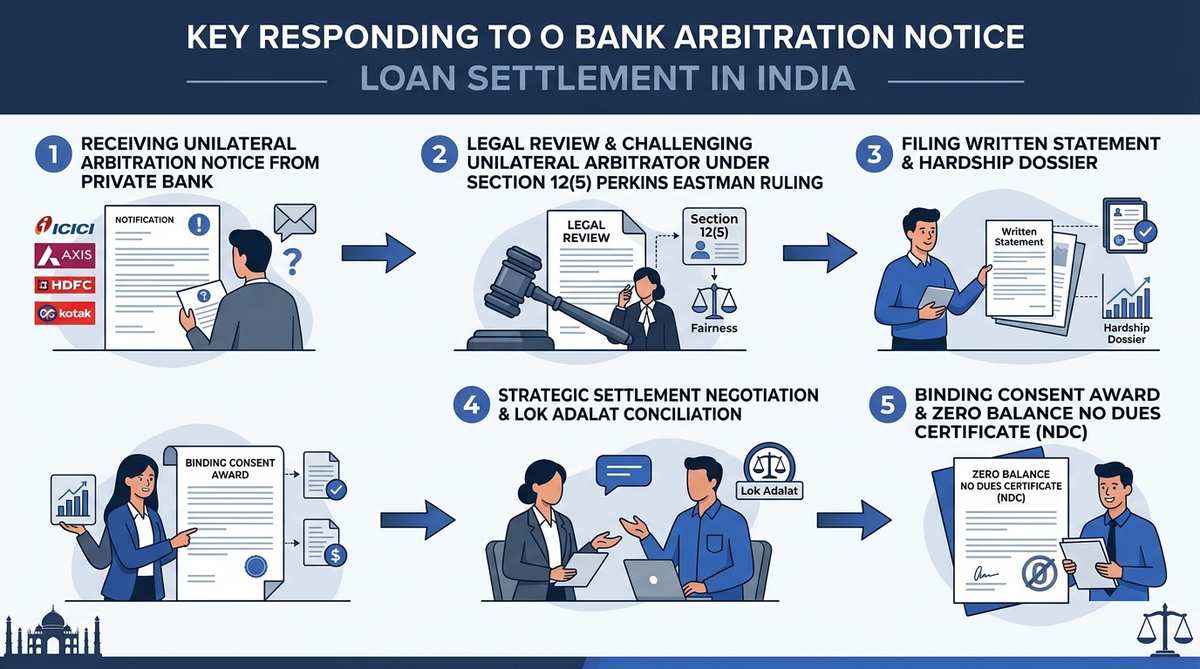
5. Bank Arbitration Notice Resolution & Settlement Visual Roadmap
The roadmap below details the 5-stage institutional process. It guides you from receiving an arbitration notice to advocate defense, filing jurisdictional challenges, negotiating compromise terms, and executing a binding Consent Award with a No Dues Certificate.
6. Challenging Unilateral Arbitration & Forcing Settlement
When managed strategically by seasoned banking litigation advocates, an arbitration notice transforms from a stressful legal threat into your most effective lever for negotiating an affordable One-Time Settlement (OTS). Rather than fleeing the cases or arguing helplessly with outsourced recovery tele-callers, our advocates apply a calibrated 4-phase legal defense:
Phase 1: Serving the Formal Statutory Objection
Within 15 days of receiving the Section 21 notice, your advocate serves a formal legal reply on both the bank and the arbitrator. The reply challenges the arbitrator's appointment under Section 12(5) read with the Seventh Schedule. Citing Perkins Eastman and TRF Ltd., it notifies the bank that any unilateral award will be challenged in High Court or Commercial Court.
Phase 2: Filing the Statement of Defense & Hardship Dossier
Before the arbitral tribunal, your counsel files a detailed Statement of Defense and Counterclaim under Section 23 of the Act. This document highlights uncredited repayments, disputes usurious penal compounding, and attaches an unassailable financial hardship dossier—including medical records, job termination letters, or business loss audits—proving bona fide inability to pay.
Phase 3: Bypassing Recovery Agents & Engaging Zonal Nodal Desks
Our legal team directly approaches the bank's Stressed Asset Resolution Group and Zonal Legal Counsel. Recognizing the risk that an expensive arbitral case may produce an invalid award, the bank's legal desk is strongly incentivized to bypass recovery agents and negotiate a direct compromise settlement.
Phase 4: Converting Claims into a Section 30 Consent Award or Lok Adalat Decree
Once settlement terms (typically 35% to 55% of principal) are agreed, both parties jointly petition the arbitrator for a Consent Award under Section 30. Alternatively, they can refer the matter to National Lok Adalat for full judicial protection.
This advocate-led approach ensures that the borrower never pays inflated late fees or collection agency commissions, securing complete debt extinguishment at the lowest lawful settlement figure.
7. Sanction Letter & Consent Award Forensics
Before disbursing any agreed settlement amount, a borrower must conduct rigorous forensic verification of the settlement instruments. Unscrupulous collection agents and fake recovery agencies frequently issue counterfeit "settlement confirmation letters" or verbal promises on WhatsApp to hit collection targets, leaving the borrower vulnerable to ongoing arbitration or future legal claims.
A legally watertight loan settlement originating from arbitration must satisfy five critical forensic checkpoints:
The One-Time Settlement (OTS) sanction letter must be issued on official bank letterhead containing registered office details, unique reference numbers, and the official seal of the issuing zonal office.
The letter must explicitly recite your exact 16-digit loan account number, full legal name, PAN, and the specific arbitration case reference number.
The document must declare in clear, unequivocal terms that payment of the compromised sum constitutes full and final settlement, with all balance principal, penal charges, and legal claims completely waived.
The terms of the OTS letter should be formally filed before the sole arbitrator to pass an official Consent Award under Section 30 of the Act, permanently ending the arbitration cases.
Never transfer settlement funds to an advocate's personal account, a recovery agency UPI ID, or any third-party payment gateway. Settlement funds must be deposited directly into your designated bank loan account via RTGS, NEFT, or an Account Payee Demand Draft drawn in favor of "[Bank Name] A/C [Your Loan Account Number]".
8. Loan Remittance, RBI ₹0 NDC Mandate & CIBIL Impact
Following the remittance of the final settlement tranche, the final milestone is obtaining unassailable debt discharge records. Under RBI Circular RBI/2023-24/60 on Responsible Lending Conduct, all regulated entities must deliver an official No Dues Certificate (NDC) or Loan Closure Letter. In addition, lenders must update credit information companies (CIBIL, Experian, Equifax, CRIF High Mark) within 30 calendar days.
If a lender delays delivering your NDC or updating credit bureau records beyond 30 days without lawful justification, it faces financial penalties. Under RBI directives, the lender must pay relief of ₹5,000 for each day of delay directly to the borrower.
Understanding CIBIL Bureau Reporting & Score recovery
Borrowers must understand the precise mechanism of credit bureau reporting following a compromise settlement:
- Account Status Remark: The bank will update the account status in CIBIL as "Settled" or "Post-Write-off Settled", reflecting a current outstanding balance of ₹0.
- Halting Default Compounding: Although the "Settled" remark indicates a partial waiver, it immediately halts ongoing 90+ DPD default accumulation and ends aggressive collection activities.
- 12-Month RBI Cooling Period: Regulated commercial banks observe a mandatory 12-month cooling period before sanctioning fresh unsecured credit products to settled borrowers.
- Systematic Credit Rebuilding: By opening a secured fixed-deposit credit card, maintaining credit use below 30%, and ensuring 100% on-time utility and credit card payments, borrowers reliably rebuild their CIBIL score back above 750 within 18 to 24 months.
9. Resolution Matrix: Arbitration vs Suit vs Lok Adalat vs OTS
Comparing the key dispute resolution mechanisms enables borrowers to evaluate the strategic advantages of converting an arbitration claim into an advocate-led compromise settlement:
| Resolution Channel | Legal Vulnerability / Ground | Average Haircut Potential | Resolution Timeline | Legal Finality & Risk |
|---|---|---|---|---|
| Unilateral Bank Arbitration | Void under Sec 12(5) & Perkins Eastman | 0% (Full Claim Demanded) | 6 – 12 Months | High risk of ex-parte decree if unrepresented |
| Advocate-Led Section 30 OTS | Challenged appointment forces compromise | 45% – 65% Principal Waiver | 30 – 60 Days | Absolute finality; binding Consent Award |
| National Lok Adalat | Consensual dispute conciliation | 40% – 60% Principal Waiver | Single Session | Non-appealable civil court decree equivalent |
| Order 37 CPC Summary Civil Suit | Strict 10-day appearance & Leave to Defend | 0% – 25% (Litigation route) | 3 – 5 Years | Protracted trial; high court & legal fees |
10. SettleLoans Legal Defense & Strategic Arbitration Advisory
Navigating an institutional arbitration claim from a major private bank requires seasoned legal advocates who specialize in banking litigation, the Arbitration Act, and RBI debt resolution frameworks. SettleLoans provides complete legal defense for borrowers nationwide. We draft formal Section 12(5) objection notices, appear before arbitral tribunals, and halt recovery harassment. Our advocates negotiate directly with bank zonal authorities to secure large haircuts backed by official No Dues Certificates.

Settle Loan is India's trusted debt relief and loan settlement platform. We help borrowers overcome financial distress by negotiating with banks and NBFCs to legally settle personal loans and credit card debts. With our transparent, performance-based approach, you can achieve debt freedom and regain your financial peace of mind.
COMPUTER
11. FAQs: Bank Arbitration Notice Reply & Defense
Direct, legally verified answers to essential questions regarding bank arbitration notices, unilateral arbitrator invalidation, and debt settlement in India.
What is a bank arbitration notice for an unsecured loan default?
A bank arbitration notice is a formal legal notice issued under Section 21 of the Arbitration and Conciliation Act, 1996, invoking the arbitration clause embedded in your original loan agreement. Private banks (such as ICICI, Axis, HDFC, and Kotak) use arbitration as an alternative dispute resolution mechanism to bypass crowded civil courts and rapidly obtain an enforceable monetary award against a defaulting borrower.
Is a unilateral arbitrator appointed by a bank legally valid in India?
No. The Supreme Court of India in landmark rulings—including TRF Ltd. v. Energo Engineering Projects (2017) and Perkins Eastman Architects DPC v. HSCC (India) Ltd. (2020)—held that a party interested in the dispute outcome cannot unilaterally appoint a sole arbitrator. Under Section 12(5) read with the Seventh Schedule of the Arbitration Act, unilateral arbitrator appointments are void ab initio unless the borrower expressly waives this protection in writing after the dispute has arisen.
What happens if I ignore a bank arbitration notice?
Ignoring an arbitration notice is dangerous. If you fail to respond or appear, the arbitrator will proceed ex-parte under Section 25 of the Act and pass an ex-parte Arbitral Award upholding the bank's entire claim including usurious penal interest. Once the 90-day challenge window under Section 34 lapses, the bank can file an execution petition under Section 36 in a Civil Court to attach your bank accounts, salary, or assets.
How do I reply to a bank arbitration notice effectively?
You must reply within 15 to 30 days through a qualified advocate. The reply should: (1) Object to unilateral arbitrator appointments under Section 12(5) and Perkins Eastman precedent; (2) Challenge territorial jurisdiction if the venue is inconvenient; (3) Dispute inflated interest and unverified penal charges; (4) Set out genuine financial hardship; and (5) Propose an amicable compromise settlement or Lok Adalat conciliation.
Can an arbitration case be converted into a loan settlement?
Yes. Arbitration cases provide an ideal institutional forum to force a One-Time Settlement (OTS). Once advocates challenge the arbitrator's legal mandate and file a strong Written Statement with hardship evidence, banks recognize the risk of awards being quashed in Section 34 challenges. The bank's legal desk frequently agrees to execute a compromise Consent Award under Section 30 with 45% to 65% principal haircuts.
Can a bank arbitrator issue an arrest warrant or send me to jail?
No. An arbitrator is a private adjudicator, not a criminal court judge or magistrate. An arbitrator has zero legal authority to issue bailable or non-bailable arrest warrants, direct police intervention, or order imprisonment. Arbitration deals strictly with civil monetary recovery.
What is a Consent Award under Section 30 of the Arbitration Act?
A Consent Award is an official arbitral award passed when both the bank and the borrower mutually agree upon settlement terms. It records the agreed discounted payment schedule, guarantees full extinguishment of remaining debt upon payment, and holds the same binding legal enforceability as a civil court decree while preventing future litigation.
What is the statutory timeline to challenge an illegal arbitral award?
Under Section 34(3) of the Arbitration and Conciliation Act, a borrower has strictly 90 days (3 months) from the date of receiving the signed arbitral award to file a setting-aside petition before the competent Commercial or Civil Court. A further 30-day grace period may be granted at the court's discretion upon showing sufficient cause, after which the award becomes final and executable.
How does settling an arbitration case impact my CIBIL credit score?
Upon fulfillment of the settlement terms, the bank reports the account to credit bureaus (CIBIL, Experian, Equifax, CRIF) as 'Settled' with an outstanding balance of ₹0. While this causes a temporary credit score dip of 75 to 150 points, it halts compounding default status and enables credit rebuilding above 750 within 18 to 24 months through disciplined secured credit management.
What is the penalty if a bank delays issuing my No Dues Certificate after settlement?
Under RBI Circular RBI/2023-24/60, banks are legally mandated to deliver a formal No Dues Certificate and update credit bureau records within 30 days of receiving the final settlement payment. Any unjustified delay beyond 30 days makes the bank liable to pay statutory relief of ₹5,000 per day of delay directly to the borrower.